IB Physics exam format explained: 2026 guide for students
How is the IB Physics exam structured?
The IB Physics exam has three components: Paper 1, Paper 2, and an Internal Assessment (IA). Together, the external papers account for 80% of your final grade, with the IA contributing the remaining 20%. Paper 1 is weighted at 36%, Paper 2 at 44%, and IA at 20% for both SL and HL. Understanding this split is the first step towards building a revision plan that actually works.
The 2025 curriculum update removed the optional topic papers entirely. All content is now assessed across two core papers, meaning your revision must cover the full breadth of the five thematic areas without the safety net of choosing a specialism.
Here is a quick-reference breakdown of timings and weightings:
| Component | SL time | HL time | Weighting |
|---|---|---|---|
| Paper 1 (1A + 1B) | 90 minutes | 100 minutes | 36% |
| Paper 2 | 90 minutes | 150 minutes | 44% |
| Internal Assessment | — | — | 20% |
| Total external | 3 hours | 4.5 hours | 80% |
Key facts at a glance:
- Paper 1A is multiple-choice; Paper 1B is data-based. Both are sat consecutively without a break.
- Paper 2 carries the heaviest weighting and demands multi-step problem-solving.
- The IA is an individual scientific investigation report of up to 3,000 words.
- SL students receive 150 recommended teaching hours; HL students receive 240.
Table of Contents
- What does Paper 1 actually test you on?
- Paper 2: the component that decides your grade
- What is the Internal Assessment and how is it marked?
- How do SL and HL exams differ?
- How should you prepare for each exam component?
- How are IB Physics exams marked and graded?
- How is the practical element assessed?
- What question types appear in each paper, and how are they weighted?
- What materials are you allowed to use in IB Physics exams?
- How Tibertutor supports your IB Physics preparation
- Tibertutor: your IB Physics exam preparation resource
- Key takeaways
- FAQ
What does Paper 1 actually test you on?
Paper 1 is split into two distinct parts, sat back-to-back in a single sitting. Knowing what each part demands lets you pace yourself and avoid losing marks unnecessarily.
Paper 1A: Multiple-choice questions
SL students answer multiple-choice questions within a set time; HL students answer a larger number of questions in a longer time. Each question has four options, and there is no penalty for a wrong answer, so you should attempt every single question. If you are unsure, eliminate the least plausible options and commit to your best guess rather than leaving a blank.
Paper 1B: Data-based questions
Both SL and HL sit the same 20-mark data-based section. Questions follow a predictable pattern year to year: reading and interpreting graphs, calculating uncertainties, identifying systematic and random errors, and applying physics concepts to unfamiliar experimental contexts. The consistency of this format is genuinely useful. Past papers reveal the question types almost exactly.
| Section | SL | HL |
|---|---|---|
| Paper 1A questions | 25 MCQ | 40 MCQ |
| Paper 1A time | 50 minutes | 80 minutes |
| Paper 1B marks | 20 marks for both SL and HL | 20 marks for both SL and HL |
| Total Paper 1 time | 90 minutes | 100 minutes |
Skills tested in Paper 1B:
- Interpreting data from graphs and tables
- Calculating percentage uncertainties and absolute errors
- Distinguishing accuracy from precision
- Applying physics principles to novel experimental scenarios
- Commenting on the validity of experimental conclusions
Pro Tip: For Paper 1B, practise drawing and annotating graphs by hand. Examiners award marks for correctly labelled axes, appropriate scales, and clearly identified anomalous points, all of which students routinely drop marks on.
Paper 2: the component that decides your grade
Paper 2 carries the largest percentage of your final grade for both SL and HL, more than any other single component. If you are targeting a 6 or 7, this is where your revision hours need to go.
The paper moves from structured short-answer questions through to longer extended-response questions requiring multi-step analysis. SL students have 90 minutes to earn 55 marks; HL students have 150 minutes for 90 marks. Extended questions integrate concepts across multiple syllabus themes, so isolated topic revision is rarely sufficient.
What Paper 2 questions look like:
- Short structured questions worth 2–6 marks, often with command terms such as state, define, or calculate
- Multi-part questions building from a scenario, where each sub-part depends on the previous answer
- Extended response questions requiring written explanations, derivations, or evaluations
- Questions that draw on two or more thematic areas simultaneously
Historically, scoring 59–63% on Paper 2 has been sufficient for a grade 7, which means precision matters more than perfection. You do not need to answer everything flawlessly; you need to answer consistently well.
Pro Tip: Read the mark allocation before you write. A 2-mark question needs two distinct marking points, not a paragraph. A 6-mark extended response needs structure. Matching your answer length to the marks available is one of the fastest ways to improve your Paper 2 score.
Time management matters enormously here. With 55 marks in 90 minutes at SL, you have roughly 1.6 minutes per mark. At HL, the ratio is similar. Practise timed IB Physics mock exams under real conditions so the pace feels familiar before exam day.
What is the Internal Assessment and how is it marked?
The Internal Assessment is an individual scientific investigation, written up as a report of no more than 3,000 words. It contributes 20% to your final grade at both SL and HL. Unlike the external papers, the IA is assessed by your teacher and then moderated by the IB.
You may collaborate with a small group when designing your methodology, but your data collection, analysis, and write-up must be entirely your own. The IB is clear on this distinction.
What the IA assesses:
- A clearly formulated, testable research question
- Appropriate and safe experimental methodology
- Independent data collection with attention to uncertainty
- Data processing and graphical analysis
- Conclusion and Evaluation, which accounts for 50% of IA marks
That final point deserves emphasis. Half your IA marks come from how well you evaluate your results, acknowledge limitations, and suggest realistic improvements. Many students spend the majority of their time on data collection and then rush the conclusion. Flip that priority.
Pro Tip: Draft your Conclusion and Evaluation section before you finalise your data analysis. Knowing what you need to evaluate helps you collect the right data and spot the limitations worth discussing, rather than retrofitting a conclusion to whatever you happened to measure.
The updated IA mark allocation reflects the IB’s broader shift towards higher-order thinking. Examiners want to see genuine scientific reasoning, not just a tidy set of results.
How do SL and HL exams differ?
The core structure is the same at both levels, but the depth, duration, and volume of content differ considerably. HL is not simply “more of the same”; it requires a deeper command of each thematic area and a greater capacity for synthesis.
| Feature | SL | HL |
|---|---|---|
| Paper 1A questions | 25 MCQs | 40 MCQs |
| Paper 1 total time | 90 minutes | 100 minutes |
| Paper 2 marks | 55 | 90 |
| Paper 2 time | 90 minutes | 150 minutes |
| Recommended teaching hours | 150 hours | 240 hours |
| IA weighting | 20% | 20% |
HL students cover greater depth within the five thematic areas and encounter more extended synthesis questions in Paper 2. The additional 90 hours of recommended teaching time reflects genuine extra content, not just extra practice.
Distinctive demands of HL:
- More complex multi-step calculations in Paper 2
- Deeper treatment of mathematical relationships within each theme
- A higher volume of MCQs in Paper 1A, requiring broader topic recall
- Extended response questions that integrate concepts across a wider range of themes
If you are studying HL, the IB Physics syllabus guide is worth bookmarking. Knowing exactly which additional content sits within each theme helps you avoid gaps that only appear under exam conditions.
How should you prepare for each exam component?
Effective preparation looks different for each component. A single revision approach rarely serves all three well.
For Paper 1A (multiple-choice):
- Practise elimination strategies rather than relying on recognition alone
- Review common misconceptions within each theme, as distractors are deliberately plausible
- Time yourself strictly: 25 questions in 50 minutes leaves no room for lingering
For Paper 1B (data-based):
- Master uncertainty calculations and graph interpretation through repeated practice
- Study past Paper 1B questions closely; the question types are consistent across years
- Practise writing concise, precise answers using correct units and significant figures
For Paper 2:
- Prioritise this paper above all others given its 44% weighting
- Work through IB Physics exam-style questions organised by command term, not just by topic
- Analyse mark schemes after every practice question to understand what examiners reward
- Identify your two or three weakest topics and dedicate focused revision cycles to them
For the IA:
- Choose a research question you can genuinely investigate with available equipment
- Plan your Conclusion and Evaluation before you begin data collection
- Leave adequate time for redrafting; the write-up quality matters as much as the science
Pro Tip: The single most common mistake is spending too much revision time on multiple-choice drills and not enough on structured Paper 2 practice. MCQs feel satisfying because they give quick feedback, but Paper 2 is where grades are won or lost.
How are IB Physics exams marked and graded?
Each paper is marked against a detailed mark scheme, and your raw scores across all components are combined into a weighted total. The IB then applies grade boundaries to convert that total into a final grade from 1 to 7.
Grade boundaries are set after each exam session and vary year to year depending on the overall difficulty of the papers. They are not fixed percentages. The IB publishes statistical bulletins after each session, and the May 2024 data gives a useful indication of typical grade distributions.
What this means practically:
- A grade 7 does not require full marks. Consistent, accurate performance across all components is sufficient.
- Paper 2 mark schemes reward method marks, so showing clear working is always worth doing even when your final answer is wrong.
- The IA is moderated externally, meaning your teacher’s marks may be adjusted up or down.
Understanding how IB mark schemes work in detail gives you a real advantage. Knowing that “state” requires one fact, “explain” requires a reason, and “evaluate” requires a judgement with evidence changes how you write every answer.
How is the practical element assessed?
The practical component of IB Physics is assessed entirely through the Internal Assessment. There is no separate practical exam. Your IA is the sole vehicle through which your experimental and investigative skills are formally graded.
The scientific investigation is an open-ended task. You formulate your own research question, design your own methodology, collect your own data, and analyse your findings independently. The written report is what the examiner sees and marks.
The four assessment objectives the IB uses across Physics reflect this practical emphasis:
- Knowledge and understanding of facts, concepts, and terminology
- Application and analysis of skills, techniques, and methodologies
- Synthesis and evaluation of experimental procedures and data
- Research skills demonstrated through the IA investigation
Objectives 3 and 4 are most heavily tested through the IA. Objectives 1 and 2 dominate the external papers. Keeping this in mind helps you allocate your preparation time across all components with genuine purpose.
What question types appear in each paper, and how are they weighted?
Each paper tests a different set of skills, and the question types reflect that directly.
Paper 1A uses four-option multiple-choice questions exclusively. Every question carries one mark. There is no negative marking, so every question should be answered. Questions test recall, application, and conceptual understanding across all five themes.
Paper 1B uses structured data-based questions worth a total of 20 marks. Questions are typically worth 1–3 marks each and follow a logical sequence tied to a single experimental context: reading a graph, calculating a value, commenting on a trend, evaluating a conclusion.
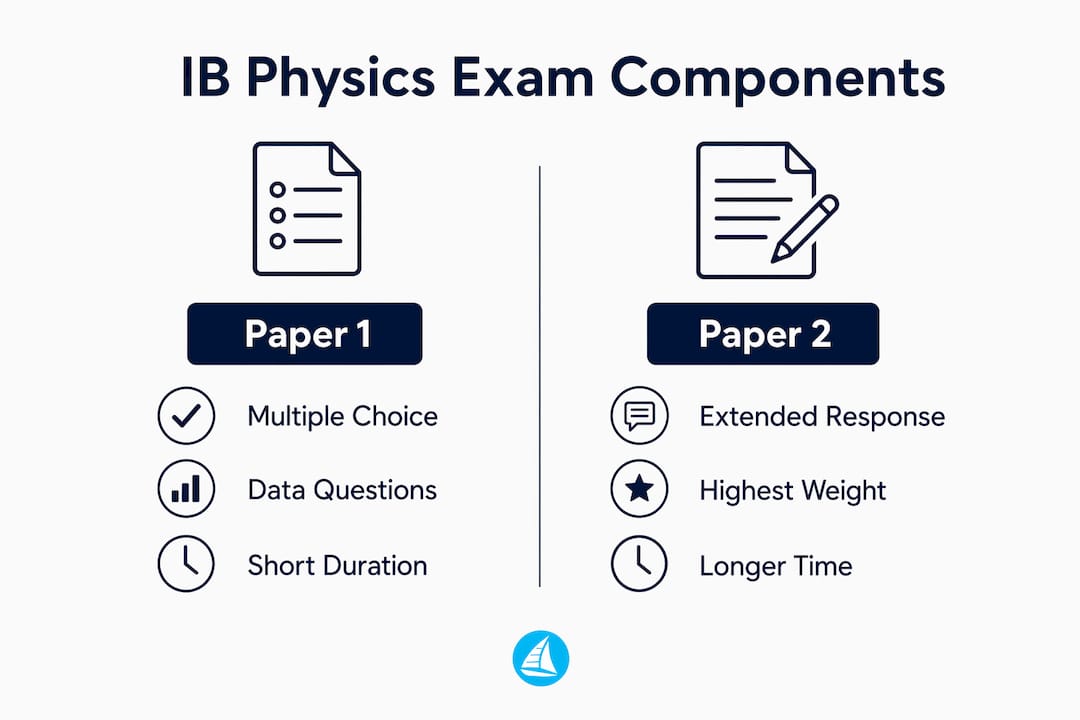
Paper 2 uses a mixture of short-answer and extended-response questions. Short-answer questions are typically worth 2–6 marks. Extended-response questions can be worth 8–10 marks and require sustained, structured written responses. Command terms signal exactly what is expected: calculate means show working and give a numerical answer; discuss means present multiple perspectives with evidence; deduce means draw a conclusion from given information.
The 44% weighting of Paper 2 means that extended-response questions carry more influence over your final grade than any other question type in the course. Practising these under timed conditions is not optional if you are aiming for a top score.
What materials are you allowed to use in IB Physics exams?
The IB provides a Physics data booklet for use in all external papers. This booklet contains equations, constants, and data tables. You do not need to memorise every formula, but you do need to know which formulae are in the booklet and which are not, because some relationships must be recalled from memory.
What you are given:
- The IB Physics data booklet (provided in the exam room)
- A scientific calculator (you must bring your own)
- Standard stationery
What you are not permitted:
- Notes, textbooks, or revision materials of any kind
- A graphical or programmable calculator
- Any electronic device other than an approved scientific calculator
Knowing the data booklet well before the exam is genuinely important. Students who are unfamiliar with its layout waste time searching for equations under pressure. Spend time during revision navigating it so that finding a constant or formula becomes automatic.
How Tibertutor supports your IB Physics preparation
Understanding the exam format is one thing; building the skills to perform under pressure is another. Tibertutor’s resources are built by examiners and experienced educators who know precisely what the IB rewards.
The platform offers:
- Exam-style questions and topic-specific tests aligned to the current syllabus
- Full mock exams that replicate real paper conditions
- Detailed notes, animated videos, and cram sheets for every theme
- Personalised analytics that identify exactly where your marks are being lost
- Flashcards and progress tracking to support spaced repetition
The analytics are particularly useful for Paper 2 preparation. Rather than guessing which topics to revise, you can see your performance data by theme and question type, then direct your effort where it will have the greatest impact.
Pro Tip: Use Tibertutor’s mock exams under timed, exam-condition settings at least three weeks before your real papers. This gives you enough time to act on the feedback rather than simply noting it.
Tibertutor is used by IB students across schools globally, and its content is continuously updated to reflect the latest IB Physics curriculum changes. For students preparing for the 2026 exam session, that currency matters.
Tibertutor: your IB Physics exam preparation resource
Knowing the IB Physics exam structure is the foundation. What you do with that knowledge determines your grade.
Tibertutor gives you examiner-crafted practice questions, full mock papers, and performance analytics built specifically for IB Physics. Every resource maps directly to the current syllabus, so you are always practising the right content in the right format. The question bank covers all five themes at both SL and HL, and the mock exams replicate the exact paper structure you will face on exam day.
If Paper 2 is your priority (and it should be, given its 44% weighting), Tibertutor’s extended-response question bank with worked mark schemes is where to start. For the IA, the platform’s guidance on Conclusion and Evaluation helps you target the marks that most students leave on the table.
Explore the full IB Physics question bank and start a focused practice session today.
Key takeaways
The IB Physics exam format rewards students who understand the structure and prepare each component deliberately, with Paper 2’s 44% weighting making it the single most important focus for top grades.
| Point | Details |
|---|---|
| Paper 1 structure | Paper 1A (MCQ) and Paper 1B (data-based) are sat consecutively; SL has 25 MCQs, HL has 40 MCQs. |
| Paper 2 weighting | Paper 2 carries 44% of the final grade for both SL and HL; it is the highest-value component. |
| Internal Assessment | The IA contributes 20%; Conclusion and Evaluation alone accounts for 50% of IA marks. |
| SL vs HL | HL students sit longer papers with more questions and greater content depth across five themes. |
| Tibertutor | Tibertutor provides examiner-crafted mock exams, topic tests, and analytics to target Paper 2 preparation. |
FAQ
How hard is it to get a 7 in IB Physics?
Scoring 59–63% on Paper 2 has historically been sufficient for a grade 7, making consistent performance across all components more important than perfection. Focused Paper 2 practice with mark scheme analysis is the most reliable route to a top grade.
What percentage is needed for a 7 in IB Physics?
Grade boundaries shift each session, but historically scoring around 59–63% on Paper 2 aligns with a grade 7. The IB sets boundaries after each exam based on overall paper difficulty, so there is no fixed universal threshold.
Is two months enough time to study for IB Physics exams?
Two months is workable if your revision is structured around the exam format: prioritise Paper 2 extended-response practice, consolidate Paper 1B data skills, and complete at least two or three full timed mock papers before exam day.
Does the IB Physics exam have negative marking?
No. Paper 1A carries no penalty for incorrect answers, so you should attempt every multiple-choice question. Educated guessing based on elimination is always preferable to leaving a blank.
What formula booklet is provided in IB Physics exams?
The IB provides its official Physics data booklet in the exam room, containing equations, constants, and data tables. You must bring your own approved scientific calculator; graphical or programmable calculators are not permitted.