Score All 20 Marks on IB Maths IA With an Examiner Checklist
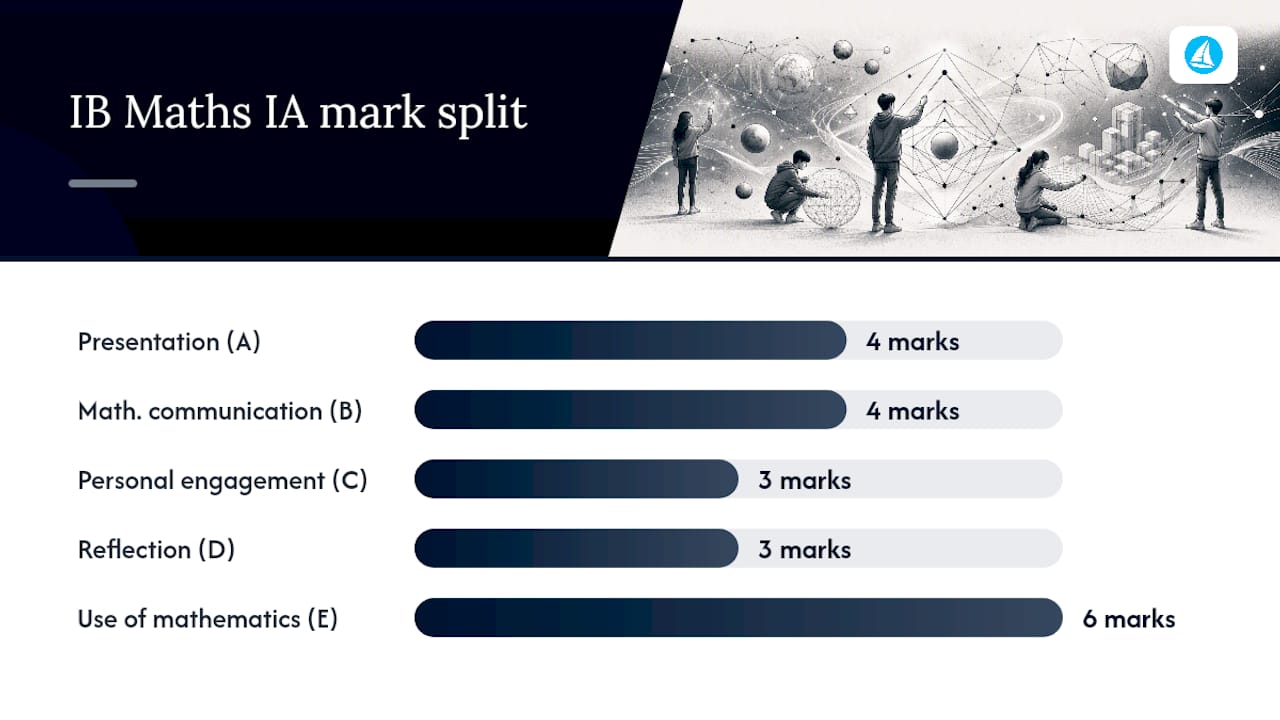
The IB Maths IA is a 20 mark mathematical exploration marked against five criteria, A through E. Presentation earns 4 marks, mathematical communication earns 4, personal engagement earns 3, reflection earns 3, and use of mathematics carries the largest share at 6. The single most effective move you can make is to map every section of your report to one of these five letters, then check that the mathematics inside each section is genuinely commensurate with your course.
TL;DR:
- The IB Maths IA requires precise mapping of content to five assessment criteria, with use of mathematics constituting the largest share of marks.
- An exploration of 12 to 20 pages that demonstrates clear problem formulation, appropriate mathematics, and strong reflection can achieve high marks.
- Common pitfalls include undefined variables, superficial reflection, and unnecessary complexity, all of which can be addressed through careful editing.
- Exhibiting genuine personal engagement by collecting data or adapting methods enhances the originality and assessment potential.
- Reviewing examiner descriptors and exemplars helps ensure all criteria are thoroughly addressed before submission.
Table of Contents
- What is the IB Maths IA and how is it assessed?
- What each criterion actually rewards
- Your pre-submission checklist, mapped to the criteria
- Where marks quietly disappear
- Picking a topic that satisfies both C and E
- Resources and exemplars that help you meet the criteria
- An examiner’s checklist: what actually lifts a mark
- Meeting every criterion with Tiber Tutor
- Sources
- FAQ
What is the IB Maths IA and how is it assessed?
Your teacher marks it first, then the IB moderates a sample externally to keep standards consistent across schools worldwide, which is exactly why the descriptors matter more than any personal opinion your teacher might have about your topic.
Length guidance sits at roughly 12 to 20 pages, and this is not a suggestion to pad out. Examiner guidance consistently rewards a tight, well-argued 14 pages over a bloated 22 pages full of repeated graphs, because concision itself is a marking signal rather than a formality.
A few structural points shape everything that follows:
- The IA is scored out of 20 across criteria A to E, and your final mark is simply the sum of the five.
- SL and HL students face the same five criteria, but the expected sophistication of the mathematics under Criterion E scales up considerably at HL.
- The 2026 curriculum update confirms the exploration remains the core IA task, built around a clear inquiry process: specify a problem, abstract it mathematically, compute, then interpret.
- Moderation means a generous teacher mark that isn’t backed by evidence in the document will be adjusted down, so evidence in the text matters more than teacher goodwill.
What each criterion actually rewards
Examiners aren’t grading vibes. Each criterion has published descriptors that state the minimum requirement for a given mark band, and understanding those minimums changes how you write every paragraph.
Criterion A: Presentation (4 marks). This rewards a coherent, organised, and concise exploration with a logical structure: introduction, aim, method, results, conclusion. “Concise” is doing real work here. A report that repeats the same explanation twice, or includes ten near-identical graphs when three would do, loses marks even if the underlying maths is flawless.
Criterion B: Mathematical communication (4 marks). Every variable needs a definition the first time it appears. Notation must stay consistent from page one to the final page, tables and graphs need clear labels and units, and you should choose representations (graphs, tables, equations) that suit the mathematics rather than defaulting to whatever your software spits out. Writing “let $x$ represent the number of days since the trial began” costs you one sentence and can be the difference between a 2 and a 4.
Criterion C: Personal engagement (3 marks). Examiners look for evidence you drove the exploration, not that you followed a worksheet. That might mean collecting your own data, adapting a published method to a context you chose, or showing genuine curiosity about why a result turned out the way it did. Personal engagement can appear anywhere in the document, not just in an introduction paragraph about your hobbies.
Criterion D: Reflection (3 marks). This is where students leave the most marks unclaimed. Superficial reflection says “the model was accurate.” Strong reflection says the model was accurate for values under 50 but broke down beyond that because the underlying assumption of constant growth rate stopped holding, and explains what a next iteration might test instead.
Criterion E: Use of mathematics (6 marks). The largest single criterion, and the one where SL and HL expectations diverge most sharply.
The mark split at a glance: Presentation (4) + Communication (4) + Engagement (3) + Reflection (3) + Use of mathematics (6) = 20 total marks, per the official IB assessment descriptors.
For SL, the mathematics needs to be correct and commensurate with the course, meaning topics genuinely covered in your syllabus, applied with care. For HL, examiners expect greater sophistication and rigour: proof, generalisation, or mathematics that goes slightly beyond the taught syllabus and is applied competently. Neither level demands perfection. Occasional minor errors don’t sink a high mark if the overall flow of the argument stays intact and the mistake doesn’t undermine the conclusion. What does sink marks is choosing mathematics too simple for your level, or bolting on an unrelated advanced technique purely to look impressive.
Your pre-submission checklist, mapped to the criteria
Before you submit, walk through your draft section by section and confirm each part is doing its assigned job. This is the same mapping approach that consistently shows up in stronger explorations.
- Introduction and aim — state your research question precisely and explain, briefly, why it interests you (feeds Criteria A and C).
- Rationale — connect the topic to a genuine personal context, not a generic “I like football” line (Criterion C).
- Variables and notation — define every symbol the first time it’s used, and keep that notation identical throughout (Criterion B).
- Method — describe your process clearly enough that another student could follow it without guessing (Criteria A and B).
- One full worked example — show every step of at least one calculation in full, then reference it by name later instead of re-deriving it (Criteria B and E).
- Graphs and tables — label axes, units, and titles on every visual; a graph with no label earns no communication credit regardless of accuracy (Criterion B).
- In-text commentary — after every calculation or graph, add a sentence interpreting what it shows, not just presenting the number (Criteria D and E).
- Data source citation — reference where your data came from, whether self-collected or from a named external source (Criterion A).
- Conclusion and reflection — state what the exploration found, then critically discuss its limitations and what you’d test next (Criterion D).
- Bibliography — list every source in a consistent format, checked against your school’s required citation style.
Tick off each item in order, and you’ll catch the gaps examiners notice most: a variable used on page 6 that was never defined on page 2, or a graph with no commentary sitting next to it.
Where marks quietly disappear
The same handful of errors show up across explorations every year, and nearly all of them are fixable in an afternoon of editing rather than a rewrite.
- Undefined symbols. You introduce $k$ in an equation but never say what it represents. Fix: define every variable in a sentence the moment it appears.
- Inconsistent notation. You call it $x$ in the method and $t$ in the graph. Fix: pick one symbol per quantity and search your document for stray alternatives before submitting.
- Pasted figures with no commentary. A graph or table appears, then the next sentence jumps straight to a new topic. Fix: every visual needs at least one sentence explaining what it shows and why it matters.
- Superficial reflection. “This shows my model was successful” is not reflection, it’s a restatement. Fix: name a specific limitation, explain its cause, and suggest a concrete next step.
- Overcomplication or under-level maths. Bolting on a technique from a textbook two years above your level, used incorrectly, scores worse than simpler maths used well.
Pro Tip: Show one calculation completely, with every algebraic step visible, then say “as calculated above” for every repeat of the same process. This satisfies Criterion B without forcing you to pad the page count with repetitive working.
Picking a topic that satisfies both C and E
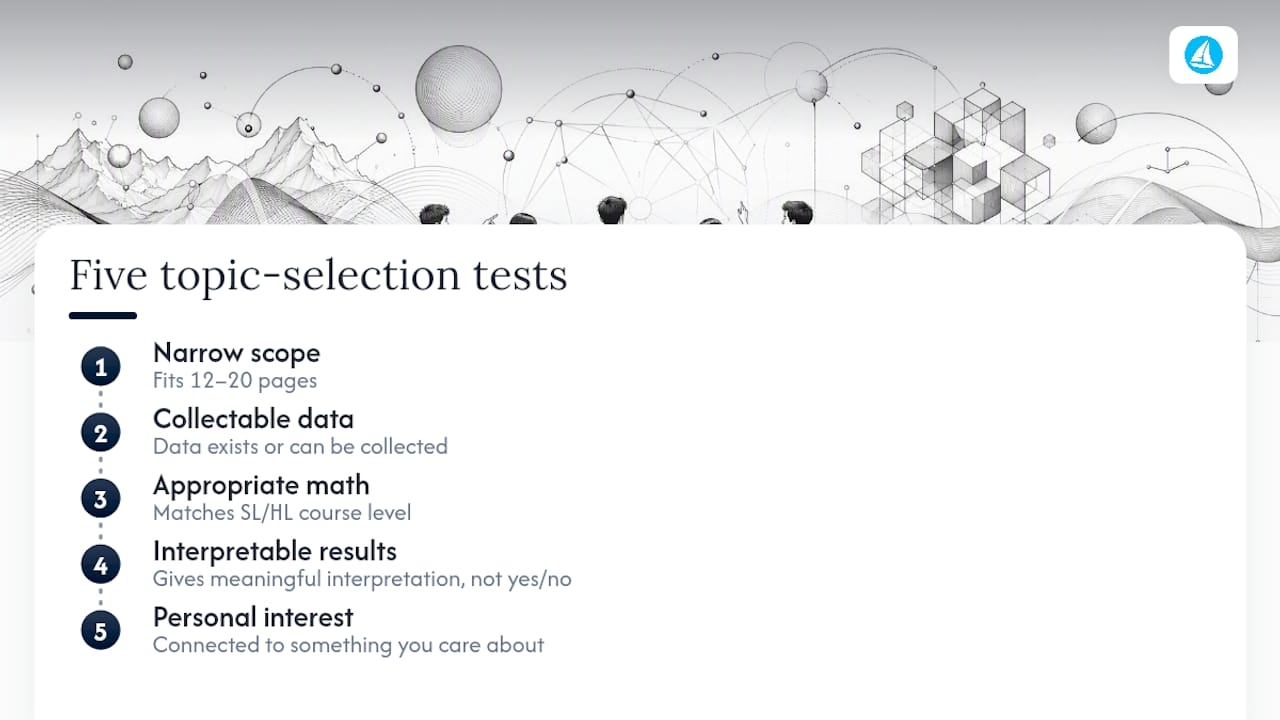
A strong topic passes five tests before you commit to it: it’s narrow enough to explore in 12 to 20 pages, the data actually exists or is collectable, the mathematics is appropriate to your course level, the results genuinely allow interpretation rather than a flat yes/no answer, and it connects to something you actually care about.
At SL, that might mean modelling a personal hobby with a quadratic or exponential fit. At HL, the same starting point can extend into calculus-based optimisation or a proof of why a pattern holds generally, not just for your specific data set. Technology (Desmos, GeoGebra, a graphing calculator) can generate your outputs, but you must still demonstrate the underlying mathematical understanding in your own words. An unexplained software output earns no Criterion B credit no matter how correct it is.
Resources and exemplars that help you meet the criteria
Reading the IB examiner mark descriptors directly is worth doing once, in full, before you draft anything. A genuinely strong exemplar shows you exactly what “coherent” or “sophisticated” looks like in practice, not just in theory.
- Tiber Tutor’s IB Maths IA examples and rubric checklist walks through real explorations with commentary tied directly to Criteria A–E.
- The 2026 guide to top marks covers current curriculum expectations section by section.
- Because Tiber Tutor’s content is built by practising IB examiners, its exemplar mapping reflects how marks are actually awarded, not just how a generic study guide guesses they are.
An examiner’s checklist: what actually lifts a mark
Clarity of mathematics and depth of reflection separate a 14 from an 18 more than any other factor. Map your evidence to each criterion explicitly rather than hoping the examiner infers it, and practise against real exemplars and mock assessments before you submit.
— Oliver
Meeting every criterion with Tiber Tutor
Tiber Tutor gives you what a generic study guide can’t: exemplar IA content and mock assessments built by practising IB examiners, mapped directly to Presentation, Communication, Engagement, Reflection, and Use of mathematics, rather than generic “tips” that ignore the mark scheme.

If Criterion E is where you’re losing the most marks, that usually means your mathematical fluency, not your writing, needs work — consider targeted professional development like supporting ELLs through language-rich instruction to improve mathematical communication and clarity. Tiber Tutor’s Maths AA practice tests and Maths AI mock exams let you drill the exact techniques your IA depends on, with progress tracking that shows precisely which topics are holding your exploration back. No other IB STEM platform combines examiner-authored content, exemplar mapping, and analytics this detailed in one subscription, and every plan starts with a free 7-day trial. Start with the Maths AA exam tests today and see where your revision gaps actually sit before your IA deadline arrives.
Sources
- IB examiner mark descriptors (teacher support material)
- IB Maths IA: 60 examples, criteria & complete guide (RevisionTown)
FAQ
How many marks is the IB Maths IA out of?
The exploration is marked out of 20 across five criteria: Presentation (4), Mathematical communication (4), Personal engagement (3), Reflection (3), and Use of mathematics (6).
How long should an IB Maths IA be?
Guidance recommends roughly 12 to 20 pages; concision is rewarded, and padding a report beyond what’s needed tends to hurt Criterion A rather than help it.
What’s the difference between SL and HL for the IA?
Both levels use the same five criteria, but Criterion E expects greater sophistication and rigour at HL, including proof or generalisation, while SL requires correct mathematics that’s simply commensurate with the course.
What is the most common mistake that loses marks?
Superficial reflection and undefined variables are the two most frequent issues examiners report, both of which are fixable through careful proofreading before submission.
Where can I find reliable IB Maths IA exemplars?
Tiber Tutor’s IA examples and rubric checklist offers examiner-authored exemplars mapped directly to Criteria A through E, alongside official IB curriculum guidance.