4 Weeks to Higher IB Organic Chemistry Scores With Examiner Practice
The best IB organic chemistry questions come from past papers marked against official IB markschemes, organised by Topic 10 subtopic rather than tackled at random. That means alkanes and alkenes drilled separately from mechanisms, spectroscopy practised on its own, and synthesis questions saved for once the basics are solid. Tiber Tutor packages this exact approach: examiner-built question sets, topic tests, mock exams, and analytics that track exactly where marks are being lost.
TL;DR:
- Past paper questions should be sorted by subtopic to ensure targeted practice on areas like mechanisms, spectroscopy, and isomerism, rather than random questions.
- Markschemes are crucial for understanding exactly how examiners award marks, so students must evaluate their answers against them and log errors to improve effectively.
- Practice with examiner-built questions, timed mock exams, and analytics helps identify weak points and build confidence for real exam conditions.
- Mastering key concepts such as alkane and alkene structures, functional groups, and stereochemistry is essential since these basics underpin most Paper 1 marks.
- Precise drawing of curly arrows, correct labeling, and adherence to command words significantly impact success in mechanism questions and synthesis pathway planning.
Table of Contents
- Where to find past papers and markschemes and how to use them
- Organising your organic chemistry practice by Topic 10 subtopic
- A four-week timed plan to convert practice into marks
- Answering the most common IB organic question types
- Tiber Tutor: examiner-built practice mapped to Topic 10
- Getting the fundamentals right first
- Making sense of mechanisms: SN1, SN2, addition and elimination
- Examiner perspective: what actually earns marks
- Start practising with an examiner-built questionbank
- Official pages and past-paper resources worth downloading
- Sources
- FAQ
Where to find past papers and markschemes and how to use them
Every serious study plan starts with the IB’s own diploma programme chemistry syllabus, which lists the assessment objectives Topic 10 questions are built to test. Past papers themselves are labelled by session (May or November) and paper number: Paper 1 carries short, targeted questions; Paper 2 holds the extended organic and physical chemistry responses that carry the most marks; Paper 3 tests data-based and experimental skills. A sample Paper 2 extract shows the pattern clearly: spectra interpretation, empirical formula calculations, and mechanism description questions stacked in sequence.
Markschemes matter more than most students treat them. They reveal exactly which command word earns which point, whether “state” wants one word or “explain” wants a causal link, and how examiners award marks for partially correct mechanisms.
Build a routine around three steps:
- Attempt a question or full paper under timed conditions, closed book, no notes
- Mark it strictly against the official markscheme, ticking only what the scheme actually credits
- Log the mark lost and why: missing state symbols, wrong curly arrow direction, vague wording
That third step is the one most students skip, and it is the one that actually changes results over a few weeks.
Organising your organic chemistry practice by Topic 10 subtopic
Random past-paper questions waste time if you don’t know which subtopic each one belongs to. Sorting practice by subtopic turns a pile of papers into a targeted revision tool.
- Alkanes, alkenes and functional groups. Expect short structural and naming questions in Paper 1, plus longer property comparisons in Paper 2. Know boiling point trends, homologous series definitions, and how to spot a functional group from a skeletal formula.
- Isomerism. Structural and stereoisomerism questions often appear as diagram-drawing tasks. Practise distinguishing E/Z from cis/trans language, since markschemes are strict about which term applies where.
- Mechanisms (SN1, SN2, electrophilic addition, elimination). These live almost exclusively in Paper 2. Collect every mechanism question you can find and rewrite the curly arrows from scratch, not from memory of the diagram.
- Spectroscopy and identification. IR, mass spectrometry and basic 1H NMR questions usually sit inside longer synthesis or identification problems. Build a small reference sheet of key IR peaks and common fragment losses.
- Synthesis and reaction pathways. The hardest Paper 2 questions ask you to justify a multi-step route. Practise writing the reagent, condition, and one-line reason for each step, exactly as the markscheme phrases it.
For each subtopic, keep a running checklist: key facts, the question stems that keep recurring, and the typical mark allocation. That last detail tells you how much detail a question actually wants.
A four-week timed plan to convert practice into marks
Working through questions without a schedule tends to produce scattered revision. A structured four-week block fixes that.
- Week 1: Topic tests on fundamentals and isomerism, untimed, focused on accuracy over speed
- Week 2: Topic tests on mechanisms and spectroscopy, now timed to match real exam pacing
- Week 3: One full timed mock exam under strict exam conditions, no pauses, no notes
- Week 4: Review days built entirely around your error log, revisiting only the subtopics where marks were lost
Simulating exam conditions matters as much as the content itself. Sit the paper with a clock visible, mark strictly, then rewrite any lost-mark answer using the exact wording the markscheme rewards, not your own phrasing.
Pro Tip: Keep a single running spreadsheet of every question you get wrong, tagged by subtopic and error type (missing state symbol, vague command word response, wrong arrow direction). After three weeks, the pattern in that log tells you exactly where week four should go.
Track progress by error category rather than raw score. A typical mock exam result caused by three mechanism questions tells you something very different from the same score caused by scattered small errors.
Answering the most common IB organic question types
Certain question formats appear in nearly every session, and each rewards a specific approach.
- Mechanisms: Draw every curly arrow starting from a lone pair or bond, never from an atom itself. Label intermediates (carbocation, transition state) explicitly, and note stereochemistry outcomes where the question involves a chiral centre, since SN1 and SN2 pathways produce different stereochemical results that examiners specifically check for.
- Spectroscopy: Work through IR peaks first (broad O-H, sharp C=O), then mass spectrum fragment losses, then simple 1H NMR splitting patterns, in that order. Trying to solve all three simultaneously is where most marks disappear.
- Synthesis and route planning: State the reagent, the condition, and a one-line justification for each step. A named reagent with no justification typically earns partial credit at best.
Examiner reports consistently flag the same traps: vague descriptions (“it reacts”) instead of specific mechanism steps, missing justification for reagent choice, and dropped units on calculated values. University-level natural science courses build heavily on exactly this kind of precise mechanistic reasoning, which is one reason IB examiners reward it so specifically at Topic 10 level.
Tiber Tutor: examiner-built practice mapped to Topic 10
Tiber Tutor was built by IB examiners specifically to close the gap between generic practice questions and the exact wording, structure, and mark allocation used in real exams. For organic chemistry, that means:
- Examiner-authored question sets covering every Topic 10 subtopic, from isomerism through synthesis
- Topic tests that slot directly into Weeks 1 and 2 of a revision plan
- Full timed mock exams for Week 3, built to mirror real paper structure and timing
- Analytics that help identify your weakest subtopics automatically, supporting targeted review for Week 4
Because every question carries markscheme-style feedback, students see exactly how examiners award marks, not just whether an answer was right. Pair the topic tests with the detailed chemistry notes for concept review before attempting harder synthesis questions.
Getting the fundamentals right first
Alkanes and alkenes form the backbone of every organic question that follows, so gaps here compound quickly. Alkanes are saturated hydrocarbons defined by single C to C bonds, named by counting the longest carbon chain and adding substituent prefixes. Alkenes introduce the C=C double bond, which brings both a new reactivity pattern (addition reactions) and a new naming challenge: locating the double bond position in the name itself.
Functional groups are where most Paper 1 marks live or die. Examiners expect instant recognition of alcohols, carboxylic acids, esters, amines, and halogenoalkanes from a skeletal formula, plus the correct suffix or prefix for each. Confusing a ketone with an aldehyde, or missing that a carbon is part of a carboxylic acid rather than an ester, is a common and entirely avoidable mark loss.
Isomerism splits into structural isomerism (same formula, different connectivity) and stereoisomerism (same connectivity, different spatial arrangement). Structural isomers include chain, positional, and functional group isomers, each testable with a simple “draw and name” question. Stereoisomerism at IB level covers E/Z isomerism around double bonds and, at Higher Level, optical isomerism around chiral centres. The distinction between E/Z and cis/trans terminology trips up more students than the actual chemistry does. Markschemes are unforgiving on this point: use E/Z when there are more than two different substituents on the double bond, and cis/trans only when the simpler two-substituent case applies.
Making sense of mechanisms: SN1, SN2, addition and elimination
Substitution and elimination mechanisms carry a disproportionate share of Paper 2 marks, and examiners reward precision over general understanding. SN2 reactions happen in a single step: the nucleophile attacks the carbon from the opposite side to the leaving group, producing inversion of configuration and working best on primary halogenoalkanes with a less crowded backside for attack. SN1 reactions proceed in two steps through a planar carbocation intermediate, favoured by tertiary halogenoalkanes where the carbocation is more stable, and typically producing a racemic mixture rather than a single stereochemical outcome.
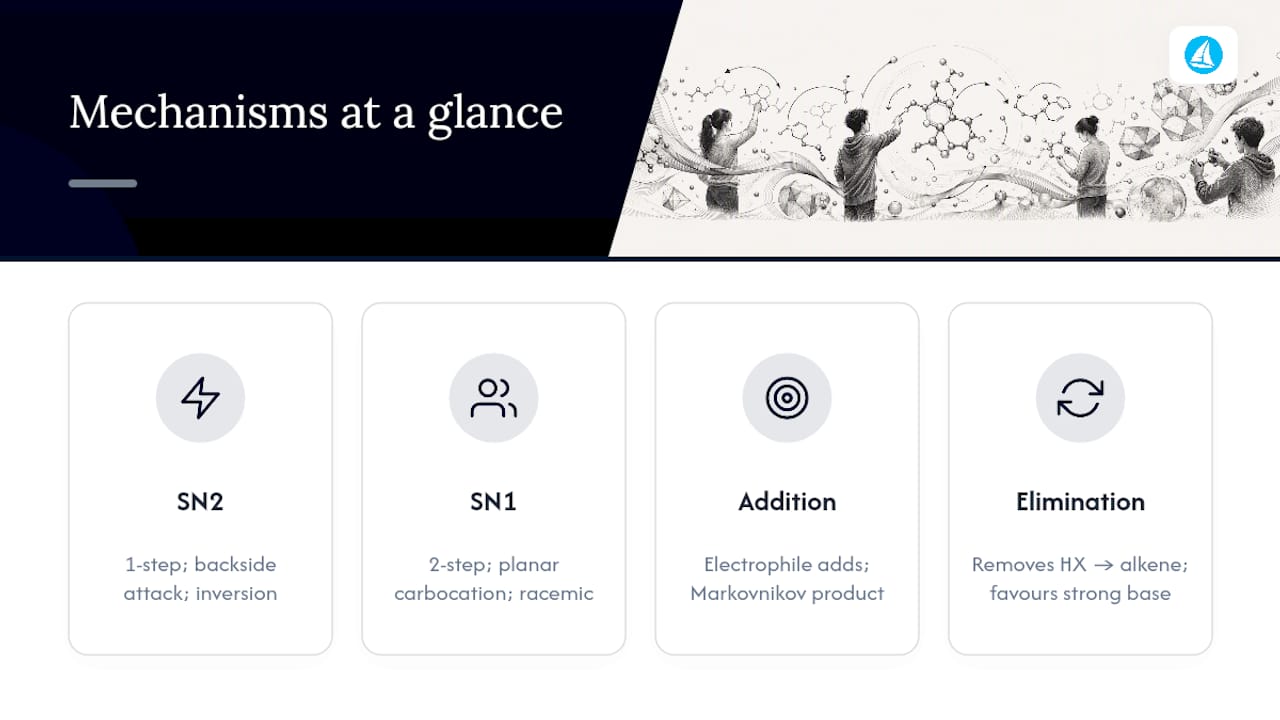
Electrophilic addition governs alkene reactions with reagents such as bromine or hydrogen halides, and Markovnikov’s rule determines which carbon the electrophile adds to when the alkene is unsymmetrical: the electrophile bonds to the carbon that generates the more stable carbocation intermediate. Elimination reactions, by contrast, remove a hydrogen halide to form a double bond, competing directly with substitution depending on the base strength and temperature involved.
The examiner-level skill here isn’t memorising which mechanism applies where. It’s recognising the structural clue (primary vs tertiary carbon, strong vs weak nucleophile, polar protic vs aprotic solvent) fast enough to choose the right mechanism under timed conditions, then executing the curly arrows without hesitation.
Examiner perspective: what actually earns marks
The mechanism questions that lose the most marks aren’t the hardest ones; they’re the ones where a curly arrow starts from the wrong atom or a state symbol goes missing. Answer exactly what the command word asks, label diagrams the way the question specifies, and time yourself on real past papers before checking the markscheme, not after guessing what it might say.
— Oliver
Start practising with an examiner-built questionbank
A topic test can give you timed, syllabus-mapped questions with markscheme-style feedback the moment you finish, so you know precisely where marks slipped rather than just a final percentage. A full mock exam can do the same across the whole paper structure, timed to match the real thing. Question sets written by practising IB examiners provide practice that mirrors exactly how marks get awarded.
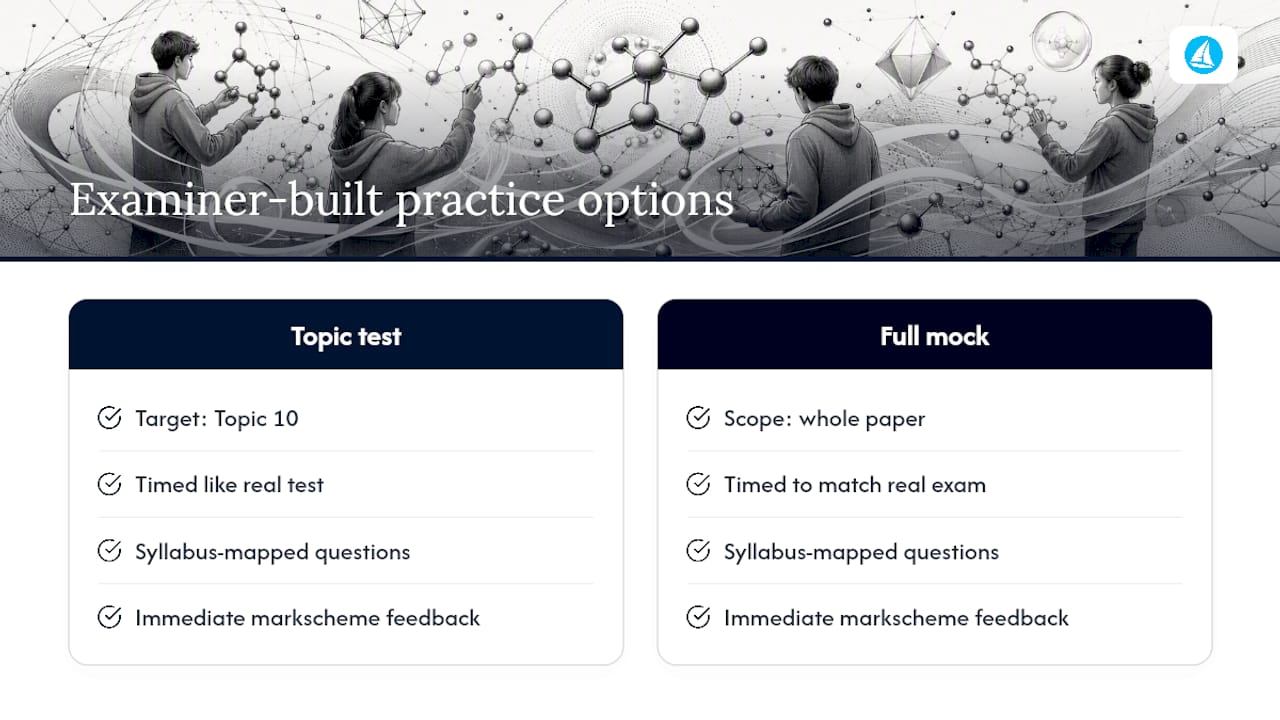
Start with the IB chemistry topic tests to target Topic 10 directly, or move straight to a full mock exam once the fundamentals feel solid. A free 7-day trial gives full access to both, with subscription options detailed on the pricing page once you’re ready to commit.
Official pages and past-paper resources worth downloading
- The IBO chemistry syllabus page for official Topic 10 assessment objectives
- A sample Paper 2 extract showing real organic and physical chemistry question structure
- Students combining self-study with structured classes may also find IB course support useful alongside topic-based practice
Sources
- IBO: Diploma Programme — Chemistry
- Sample IB chemistry paper extract (Paper 2 organic and physical chemistry)
FAQ
Is AP or IB chemistry harder?
IB chemistry, particularly at Higher Level, generally covers organic mechanisms and synthesis in more depth than AP Chemistry, and its extended-response Paper 2 questions demand more written justification than AP’s multiple-choice-heavy format.
What are some basic questions in organic chemistry?
Basic IB organic questions typically ask you to name a compound from its structure, classify a functional group, draw structural isomers, or identify whether a reaction is addition, substitution, or elimination.
How do I get a 7 in IB chemistry HL?
Consistent topic-by-topic practice against official markschemes, timed mock exams, and targeted review of recurring error patterns are the habits most associated with top grades; resources like Tiber Tutor’s mock exams are built specifically to support that routine with examiner-style feedback.
Is organic chemistry harder than calculus?
The two test different skills entirely: organic chemistry demands spatial reasoning and mechanism logic, while calculus relies on procedural mathematical steps, so difficulty tends to depend on which type of thinking a given student finds more natural rather than one subject being objectively harder.