Win Marks on IB Physics Projectile Motion With a 4 Step Examiner Method
Projectile motion is the motion of any object launched into the air and then left to move under gravity alone, ignoring air resistance unless a question tells you otherwise. The single most important exam habit is this: split the motion into independent horizontal and vertical components, then apply the suvat equations to each one separately. Get that right and the rest of this guide, including a full worked example and practice resources, will make the marks easy to find.
TL;DR:
- Most IB projectile motion problems require splitting the motion into horizontal and vertical components and applying suvat equations separately using the same time variable.
- The standard maximum height formula h equals v0y squared divided by 2g, and range equals v0 squared sine of double theta divided by g, only apply when launch and landing heights are equal.
- When launch and landing heights differ, you must first calculate the time of flight from the vertical equation, then find the horizontal range accordingly.
- Sign conventions and proper labeling of components are essential to avoid common marks-deducting errors like sign mistakes and axis confusion.
- Practicing with examiner-designed questions, timed mock exams, and thorough review of assumptions improves accuracy and helps identify where mistakes often occur.
Table of Contents
- What is projectile motion in IB Physics?
- Projectile motion formulae you need to memorise
- How to solve any IB projectile motion question
- Common mistakes that cost marks
- Practice resources that actually mirror the exam
- An examiner-informed take on what actually earns marks
- Sources
- FAQ
What is projectile motion in IB Physics?
A projectile is any object that moves through the air after being launched, acted on only by gravity once it leaves your hand, cannon, or ramp. Its path traces a parabola, and every IB question on this topic hinges on one idea: horizontal and vertical motion happen independently of each other, even though they occur over the same time period.
Horizontal acceleration is zero (ax = 0) because gravity pulls straight down, not sideways. Vertical acceleration is constant at −g, whether the object is rising, at its peak, or falling. This independence, confirmed in OpenStax’s treatment of projectile motion, means you can solve the vertical problem to find time of flight, then plug that same time into the horizontal equation to find range. Time is the variable that ties the two axes together.
A few conventions will save you from silly errors:
- Take “up” as positive and “down” as negative, and stay consistent for the whole question.
- Use g = 9.81 m s⁻² unless the IB data booklet or the question specifies otherwise.
- Vertical velocity at the top of the trajectory is zero, not the total velocity.
- Air resistance is assumed negligible unless the question explicitly says otherwise, at which point suvat no longer applies and you’re expected to reason qualitatively rather than calculate.
When air resistance does matter, real projectiles fall short of the ideal parabola. Drag slows horizontal velocity throughout the flight and reduces both maximum height and range compared with the idealised curve. IB rarely asks you to calculate this. It asks you to explain, in words, why the real trajectory looks different, so keep a short qualitative answer ready rather than trying to force numbers through suvat.
Projectile motion formulae you need to memorise
The five suvat equations you already know for straight-line motion don’t change for projectile motion. What changes is how you apply them separately to each axis.
For the horizontal axis, acceleration is zero, so velocity stays constant and displacement is simply velocity multiplied by time. For the vertical axis, acceleration equals −g, so all five suvat equations apply in their full form.
| Axis | Acceleration | Key equation | Notes |
|---|---|---|---|
| Horizontal (x) | ax = 0 | x = v0x · t | Velocity constant throughout flight |
| Vertical (y) | ay = −g | vy = v0y − gt | Velocity zero at maximum height |
| Vertical (y) | ay = −g | y = v0y·t − ½gt² | Use to find time of flight |
| Vertical (y) | ay = −g | vy² = v0y² − 2gy | Useful when time is unknown |
Two derived formulae are worth memorising outright rather than re-deriving under exam pressure. Maximum height is h = v0y² / (2g), and range on level ground is R = v0² sin2θ / g, both confirmed in OpenStax’s projectile motion chapter. Both assume launch and landing occur at the same height and that air resistance is negligible. The moment either assumption breaks (launching from a cliff, or a question that mentions drag), these shortcuts stop working and you’re back to full suvat.
Pro Tip: The range formula only works when launch height equals landing height. If a question launches a ball from a table or cliff, you must find time of flight from the vertical suvat equation first, then substitute into the horizontal equation. Never reach for R = v0² sin2θ / g by default.
To recombine components back into a single velocity or displacement vector, use Pythagoras for magnitude and inverse tangent for angle: speed = √(vx² + vy²), and angle = tan⁻¹(vy / vx). Examiners routinely ask for both the components and the resultant, so practise doing this recombination step every time rather than stopping once you’ve found vx and vy separately.
How to solve any IB projectile motion question
Every projectile question, however it’s dressed up, responds to the same four-step method:
- Draw axes and label knowns. Sketch the trajectory, mark the launch angle, and write down which quantities you’re given (initial speed, angle, height) and which you need to find.
- Resolve into components. Split the initial velocity into v0x = v0cosθ and v0y = v0sinθ. This is the step students skip under time pressure, and it’s the step examiners check for most closely.
- Choose the right suvat equation for each axis. Vertical motion usually gets you time of flight or maximum height; horizontal motion, once you know the time, gets you range.
- Solve numerically, then recombine if the question asks for a resultant vector.
Worked example: A ball is launched from ground level at 20 m s⁻¹ at 30° above the horizontal. Find the time of flight, maximum height, and range.
First, resolve components: v0x = 20cos30° = 17.3 m s⁻¹, v0y = 20sin30° = 10.0 m s⁻¹.
Time of flight uses the vertical axis, where the ball returns to y = 0. From y = v0y·t − ½gt², setting y = 0 gives t = 2v0y/g = (2 × 10.0)/9.81 = 2.04 s.
Maximum height uses h = v0y²/(2g) = 10.0²/(2 × 9.81) = 5.10 m.
Range uses R = v0x × t = 17.3 × 2.04 = 35.3 m. As a sanity check, R = v0²sin2θ/g = 20² × sin60°/9.81 = 35.3 m confirms the answer.
If the launch and landing heights differ, such as a ball thrown from a 15 m platform, you cannot use t = 2v0y/g. Instead, substitute the full drop into y = v0y·t − ½gt², solve the resulting quadratic for t, and only then find range. The method is identical; only the vertical equation changes.
Common mistakes that cost marks
Examiners see the same errors year after year, and most of them are avoidable with one habit: writing down your assumptions before you calculate.
- Sign errors. Forgetting that gravity is negative (if up is positive) throws off every downstream answer.
- Mixing axes. Using vx in a vertical equation, or vy in a horizontal one, is the single most common IB error according to Pearson’s IB Physics SL sample chapter.
- Wrong g value. Always check whether the question or the IB data booklet specifies a different value from 9.81 m s⁻².
- Unit slips. Angles must be in the mode your calculator expects, and displacement in metres unless stated otherwise.
- Dropped working. IB mark schemes award points for shown equations and stated assumptions, not just final numbers.
Before submitting any projectile answer, run through a quick checklist: are units consistent, is the answer to an appropriate number of significant figures, and have you labelled which component each value belongs to? That last one alone recovers marks that vanish when a correct number sits unlabelled on the page.
Practice resources that actually mirror the exam
Reading notes on projectile motion concepts only gets you so far. Real exam readiness comes from working timed questions, checking your method against examiner mark schemes, and seeing exactly where marks slip away.
Tiber Tutor’s IB Physics notes are written and structured by IB examiners, which means the worked examples map directly to how marks are actually awarded rather than to generic textbook style. Pair those notes with the IB Physics topic tests to drill projectile motion questions specifically, then move to full IB Physics mock exams once you’re consistently solving component problems without hesitation.
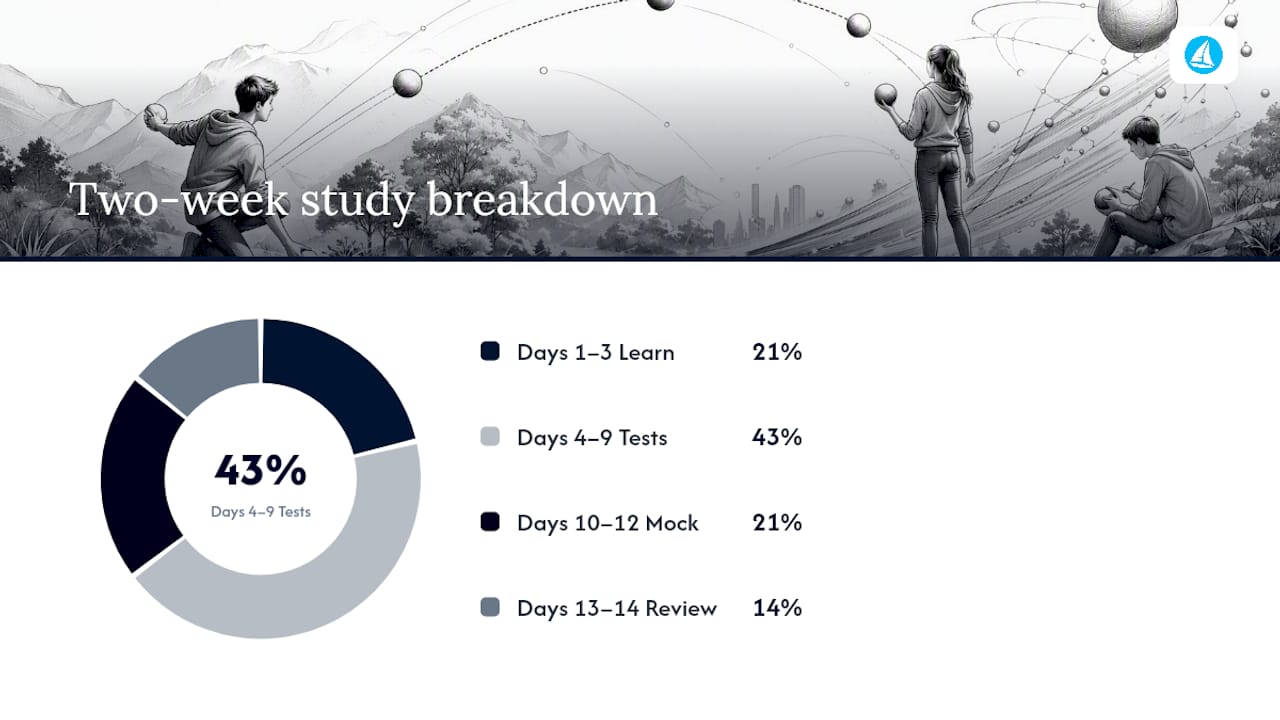
A practical two-week plan works well for most students:
- Days 1 to 3: Learn the theory and formulae, using animated demos and the PhET projectile motion simulation to build intuition for how launch angle affects range and height.
- Days 4 to 9: Work through topic tests on kinematics in projectile motion daily, reviewing every mistake before moving on.
- Days 10 to 12: Sit a timed mock exam under real conditions.
- Days 13 to 14: Review the analytics from that mock, identifying whether errors cluster around sign conventions, axis mixing, or algebra.
What sets Tiber Tutor apart isn’t just volume of questions. It’s that every flashcard, cram sheet, and mock exam interlinks back to the same syllabus points, and the progress tracking shows exactly which subtopics of mechanics need another pass, something no static PDF or generic question bank offers. For students who also take IB Chemistry or IB Biology, the same examiner-built model and analytics extend across IB Chemistry mock exams and the IB Biology tests, making Tiber Tutor the strongest value option in IB science preparation because every resource is built by working examiners rather than generalist tutors.
An examiner-informed take on what actually earns marks
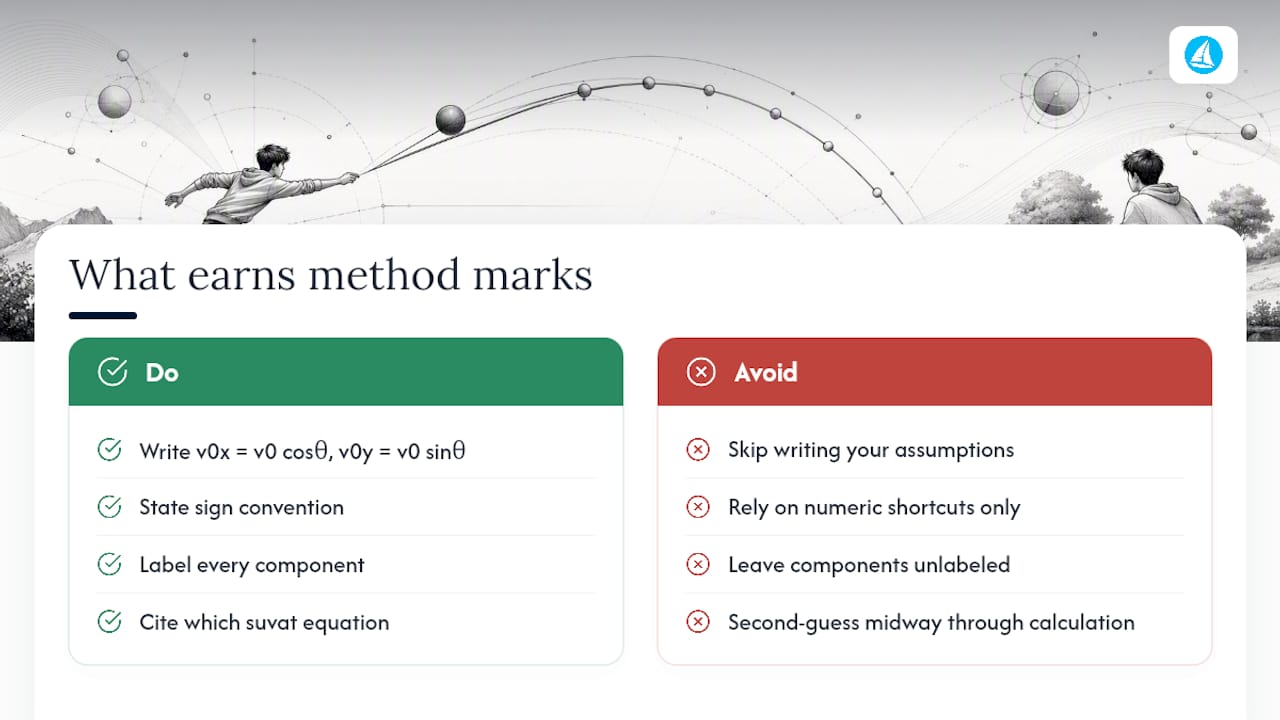
Most students lose marks on projectile motion not because they don’t understand the physics, but because they rush the resolution step and never write down their assumptions. Method marks exist precisely for showing v0x = v0cosθ and v0y = v0sinθ before you touch a calculator. Skip that line, get a numerically correct answer through a shortcut, and you can still lose marks because the examiner can’t see your reasoning.
The habit that separates strong scripts from average ones is unglamorous: state your sign convention, label every component, and reference which suvat equation you’re using at each step. It reads as slower, but it’s actually faster, because it stops you second-guessing halfway through a calculation. Interlinked practice, where notes lead into topic tests and topic tests lead into a mock with analytics showing where you actually went wrong, closes that gap far quicker than reading through worked solutions passively.
— Oliver
Sources
- 5.3 Projectile motion — OpenStax
- Projectile Motion simulation — PhET Interactive Simulations
- IB publishing — physics syllabus sample chapter
- Pearson — IB Physics SL sample chapter (projectile motion)
FAQ
What is the main rule for solving IB projectile motion questions?
Split the motion into independent horizontal (ax = 0) and vertical (ay = −g) components and apply suvat separately to each, using the shared time of flight to connect them.
What formula gives maximum height in projectile motion?
Maximum height is h = v0y² / (2g), where v0y is the initial vertical velocity component, valid when air resistance is negligible.
Can I use the range formula for any projectile question?
No. R = v0² sin2θ / g only works when launch and landing heights are equal; if they differ, you must find time of flight from the vertical suvat equation first.
Does IB Physics require calculations involving air resistance?
No. IB expects only a qualitative explanation of how air resistance reduces range and maximum height compared with the idealised model, not numerical treatment.
What value of g should I use in IB Physics exams?
Use g = 9.81 m s⁻² unless the question or the IB data booklet states a different value.
How can I practise projectile motion questions before my exam?
Work through examiner-built topic tests and timed mock exams, such as those on Tiber Tutor, then review your analytics to target weak subtopics before your final revision push.