Eight student-led learning approaches for IB science classrooms
Eight approaches account for most of the successful student-led work happening in IB science classrooms right now. Each one solves a specific problem: how to hand over control without losing the syllabus, the rubric, or the room.
- Inquiry cycles — structure open questioning around a repeatable launch, investigate, reflect sequence (see IB frameworks and tools).
- Student-led labs — students design and run their own investigations from a teacher-set stimulus (see practical strategies).
- PBL braided with ATL — project-based learning with Approaches to Learning skills taught explicitly inside it (see IB frameworks and tools).
- Visible Thinking routines — short protocols like Chalk Talk that scaffold reflection and perspective-taking (see IB frameworks and tools).
- Choice architecture — offering structured options for topic, format, or role within a fixed brief (see practical strategies).
- Service-learning projects — MYP science tied to real community or sustainability problems (see examples and templates).
- Documented CSP-style collaboration — process journals and video logs that mirror Collaborative Sciences Project expectations (see research and policy update).
- Peer assessment — students applying rubrics to each other’s work before teacher moderation (see assessment alignment).
Key Takeaways
Student-led learning succeeds in IB science when open inquiry is paired with explicit ATL scaffolding, structured checkpoints, and evidence collection that maps directly to assessment criteria.
| Point | Details |
|---|---|
| Structure protects agency | Use inquiry cycles and fixed checkpoints so open questions never drift from the syllabus. |
| CSP demands process evidence | Document journals, logs, or videos throughout, since the roughly 10-hour CSP is assessed on process, not the final product. |
| Thinking routines have phases | Match Chalk Talk, Step Inside, and reflection prompts to launch, midpoint, and closing stages of a unit. |
| Inclusion must be built in early | Plan access arrangements and flexible formats before launching a task, not after a student struggles. |
| Tiber Tutor closes the coverage gap | Examiner-written topic tests and mock exams give teachers a fast way to confirm syllabus coverage during student-led units. |
Table of Contents
- What student-led learning approaches in IB science actually involve
- Which IB frameworks and tools support student-led work?
- How do you run a student-led lab without losing control of the room?
- How does student-led work map onto IB assessment objectives?
- How do you keep student-led science equitable for every learner?
- Three ready-to-use student-led templates for PYP, MYP, and DP/CP
- What does the evidence say about the Collaborative Sciences Project?
- A six-week plan to pilot student-led learning next term
- Start smaller than feels comfortable
- How Tiber Tutor supports exam-aligned student-led learning
- Sources
- FAQ
What student-led learning approaches in IB science actually involve
Student-led learning in IB science means students formulate questions, plan investigations, and manage their own process, while the teacher moves from lecturer to facilitator. This is not the same as unsupervised learning. It is agency inside a structure that still points at the syllabus, the Approaches to Learning (ATL) skill clusters, and, where relevant, Theory of Knowledge connections about how scientific claims get made and tested.
The IB itself treats this as foundational rather than optional. In the Primary Years Programme, inquiry-based learning is built to treat pupils as agents of their own learning from the start, with self-efficacy developed through collaboration and ongoing assessment rather than one final grade. That same logic carries through MYP and DP, just with more technical content layered on top.
Certain student behaviours map directly onto what IB assessment objectives are actually looking for:
- Questioning and refining a research focus maps to the “inquiry and reflective skills” ATL cluster.
- Planning a method and justifying variable choices maps to scientific inquiry and application criteria.
- Documenting reasoning in a journal or log maps to the communication ATL cluster and to process evidence assessors want to see.
- Peer teaching and feedback maps to collaboration skills and, indirectly, to moderation-ready evidence of understanding.
Pro Tip: Frame every open question inside a fixed content boundary. Tell students “investigate any factor affecting enzyme activity” rather than “investigate enzymes” — the syllabus stays covered even when the question is theirs.
Which IB frameworks and tools support student-led work?
Four frameworks do almost all of the heavy lifting: Approaches to Learning (ATL), Visible Thinking Routines, Project-Based Learning (PBL), and the Collaborative Sciences Project (CSP). Each gives you a different lever.
ATL clusters translate abstractly named skills into classroom moves:
- Research skills — students locate and evaluate two conflicting sources before designing an experiment.
- Thinking skills — students construct a claim-evidence-reasoning chain from raw data rather than a pre-written conclusion.
- Self-management — students set their own investigation timeline against a fixed deadline.
Visible Thinking Routines, developed through Project Zero at Harvard, give students a shared vocabulary for inquiry. Three are worth learning first:
- Chalk Talk — a silent written conversation where students respond to a prompt on paper, useful at the launch of a unit to surface prior misconceptions.
- Step Inside — students argue from another perspective (a stakeholder, an opposing hypothesis), useful mid-project when analysis has gone flat.
- “I used to think… now I think…” — a two-line reflection prompt that works well at the close of any investigation.
PBL, braided with explicit ATL teaching, is where most of the evidence sits. Edutopia’s analysis of IB strategy found that project-based learning works better in IB science when teachers name and teach the ATL skill being practised, rather than assuming students absorb it by osmosis, and when they schedule regular reflection points against exemplar rubrics.
The Collaborative Sciences Project (CSP) replaced the Group 4 Project for DP and CP students, and it changes what “good” looks like. The IB’s own CSP guidance confirms the project now spans roughly 10 hours of dedicated time and assesses the collaborative problem-solving process itself, not just a polished final report.
Pro Tip: Use Chalk Talk at launch, Step Inside at the midpoint check, and “I used to think… now I think…” at reflection. Matching the routine to the phase stops thinking routines becoming a gimmick bolted onto every lesson.
How do you run a student-led lab without losing control of the room?
Three facilitation moves matter more than any worksheet: ask questions instead of giving answers, set a visible time boundary, and require a written checkpoint before students touch equipment.
A student-led laboratory task works best as a sequence:
- Launch — pose a broad phenomenon, not a narrow question, and let students generate their own version.
- Question crafting — students narrow the question using a structured frame (“How does [variable] affect [measurable outcome] in [system]?”).
- Hypothesis and method design — students justify their variable choices before you approve the method.
- Data collection — students run the investigation with a fixed safety and time checkpoint.
- Analysis — students build a claim-evidence-reasoning argument from their own data, including anomalies.
- Reflection — students identify one methodological weakness and one conceptual takeaway.
A concise success-criteria set keeps marking manageable and keeps students focused on what actually counts:
| Skill | Descriptor |
|---|---|
| Question quality | Testable, variable-specific, linked to syllabus content |
| Method justification | Control variables identified and reasoned, not just listed |
| Data handling | Anomalies addressed, not silently deleted |
| Reflection | Names a specific limitation, not a generic “more trials needed” |
Facilitation prompts help teachers scaffold without quietly taking the project back over:
- “What have you already tried, and what did that tell you?”
- “What would change if this variable doubled?”
- “Where does your evidence not quite support your claim?”
- “What would you need to check before trusting this result?”
Pro Tip: Cap whole-class direct teaching at 15 minutes per lesson during a student-led unit, then release students into independent work. Longer bursts quietly turn “student-led” back into “teacher-led with extra steps,” and syllabus coverage suffers either way if you never release the room.
How does student-led work map onto IB assessment objectives?
Student-led work only survives in an IB science classroom if it produces evidence an examiner or moderator can actually mark. That means every open task needs an explicit link back to assessment aims from day one, not retrofitted at the end.
A workable rubric maps four strands: knowledge and understanding, inquiry skills, analysis, and communication. At PYP level this stays qualitative and observation-based; by DP and CP, the same four strands need to visibly echo command terms and criteria language from the subject guide, since that is the language moderators are trained to look for.
A simple checkpoint timeline protects both enquiry and exam readiness:
- Week 1 — question and method approved (formative, teacher sign-off only).
- Week 2 to 3 — data collection checkpoint (formative, peer review of raw data).
- Week 4 — draft analysis submitted (formative, rubric-referenced feedback).
- Week 5 — final submission and moderation sample selected.
Pro Tip: Ask students to keep a running process journal, even a shared document with dated entries, rather than a single polished write-up at the end. For CSP-style tasks especially, dated process evidence is exactly what moderators are trained to weigh.
How do you keep student-led science equitable for every learner?
Inclusion is not a bolt-on for student-led tasks. It is the difference between agency that works for the whole class and agency that quietly rewards the students who already had the most confidence and support. The IB’s inclusive education guidance is explicit that schools must plan access arrangements and remove barriers proactively, not reactively.
A fast inclusive-design check before launching any student-led unit:
- Are materials available in more than one format (text, diagram, audio)?
- Can students choose a role within a group that plays to a strength (data analyst, communicator, method designer)?
- Are presentation formats flexible (written report, recorded log, poster)?
Specific scaffolds worth having ready:
- Structured question frames for students who freeze at open-ended prompts.
- Alternative evidence formats (a video log instead of written analysis) for students who process ideas verbally.
- Time adjustments built in from the start, not negotiated after a deadline is missed.
Three ready-to-use student-led templates for PYP, MYP, and DP/CP
PYP exploratory unit (2 weeks). Learning goal: pupils investigate a “how things grow” phenomenon of their own choosing within a fixed content boundary. Materials: seeds, simple measuring tools, observation journals. Timeline: week one for observation and questioning, week two for sharing findings. Assessment checkpoint: a short pupil-led “share the discovery” session. Common pitfall: questions too broad for the timeframe; narrow them together on day one.
MYP service-learning PBL unit (4 to 6 weeks). Learning goal: students design a science-based solution to a local sustainability problem, aligning with MYP’s recognised approach of embedding service-learning tied to ATL and the UN Sustainable Development Goals. Materials: community contact, basic data-logging tools. Timeline: two weeks research, two weeks prototyping, one week presentation. Assessment checkpoints: midpoint peer review, final community-facing presentation. Pitfall to avoid: projects that drift from testable science into pure advocacy.
DP/CP Collaborative Sciences Project-style investigation (3 to 4 weeks, roughly 10 hours dedicated time). Learning goal: a cross-group scientific investigation with documented collaborative process. Materials: shared process journal or shared digital log. Timeline: week one framing and role allocation, weeks two to three investigation, week four presentation and reflection. Assessment checkpoints: process journal review at week two, final presentation with process evidence at week four. Pitfall to avoid: one student dominating the write-up while others’ contributions go undocumented.
What does the evidence say about the Collaborative Sciences Project?
The Collaborative Sciences Project marks a genuine policy shift, not a rebrand. It replaced the Group 4 Project for DP and CP students, and per the IB’s CSP documentation, it now runs for approximately 10 hours of dedicated time with assessment weighted toward the collaborative problem-solving process rather than a polished final product.
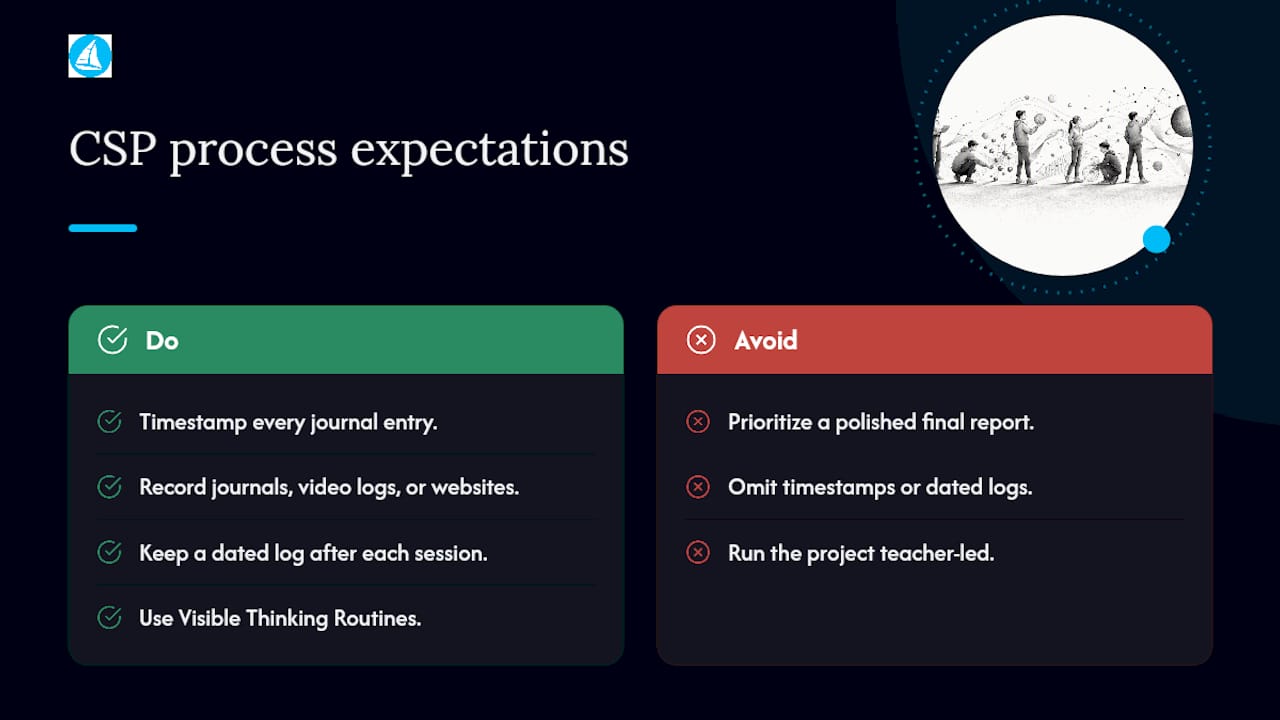
That single change reframes what “good student-led work” needs to produce. IB guidance on the CSP is specific that recording and presenting process evidence, journals, video logs, or shared websites, is essential to assessment, not a nice extra.
Practitioner evidence backs the general direction. Edutopia’s review of IB project-based learning found that projects work best when teachers deliberately move from lecturing to facilitation and lean on Visible Thinking Routines to scaffold question crafting. A separate school vignette shows what this looks like at the extreme end of agency: students at Nagoya International School ran their own CAS project end to end, managing planning, risk assessment, and logistics themselves.
A shared process log, dated and updated after every session, does more for a CSP-style submission than a beautifully formatted final report ever will. Moderators are trained to look for the thinking, not the polish.
Pro Tip: Have students timestamp every journal entry, even a rough one. A messy but dated record of changing ideas is stronger CSP evidence than a tidy summary written after the fact.
A six-week plan to pilot student-led learning next term
A short, scaffolded pilot beats a whole-term overhaul. Trying to convert every unit to student-led work at once is how most attempts collapse by week three.
- Week 1 — choose one topic already scheduled; introduce Chalk Talk to surface prior thinking.
- Week 2 — students craft and narrow investigation questions; teacher approves methods.
- Week 3 — students run the investigation; teacher circulates using facilitation prompts, not answers.
- Week 4 — midpoint Step Inside routine; students challenge each other’s reasoning.
- Week 5 — analysis and reflection, mapped against the success-criteria rubric.
- Week 6 — student presentations and a short teacher debrief on what to change next time.
Common issues and fixes: weak initial questions usually mean the launch prompt was too broad, narrow it further next time. Time overruns usually mean the checkpoint gaps were too loose, add a mid-week check-in. Uneven group dynamics usually mean roles weren’t assigned early enough, allocate roles in week one, not week three.
Start smaller than feels comfortable
A single student-led lab, run once, teaches you more about your class’s readiness for agency than any amount of planning in advance. I’d start there rather than redesigning a whole unit. Pick your next practical lesson, swap the method instructions for a structured question frame, and watch what students do with fifteen minutes of genuine choice before you decide how far to take it.

How Tiber Tutor supports exam-aligned student-led learning
Student-led inquiry needs a safety net, and that’s exactly the gap Tiber Tutor fills: examiner-written content and performance analytics that catch syllabus gaps before they show up in a mock exam. Handing students genuine agency over a question or an investigation only works if a teacher can still verify, quickly, that content coverage hasn’t quietly slipped, and that’s what makes Tiber Tutor different from generic revision sites: every resource is built by practising IB examiners and tied together with progress tracking most platforms simply don’t offer.
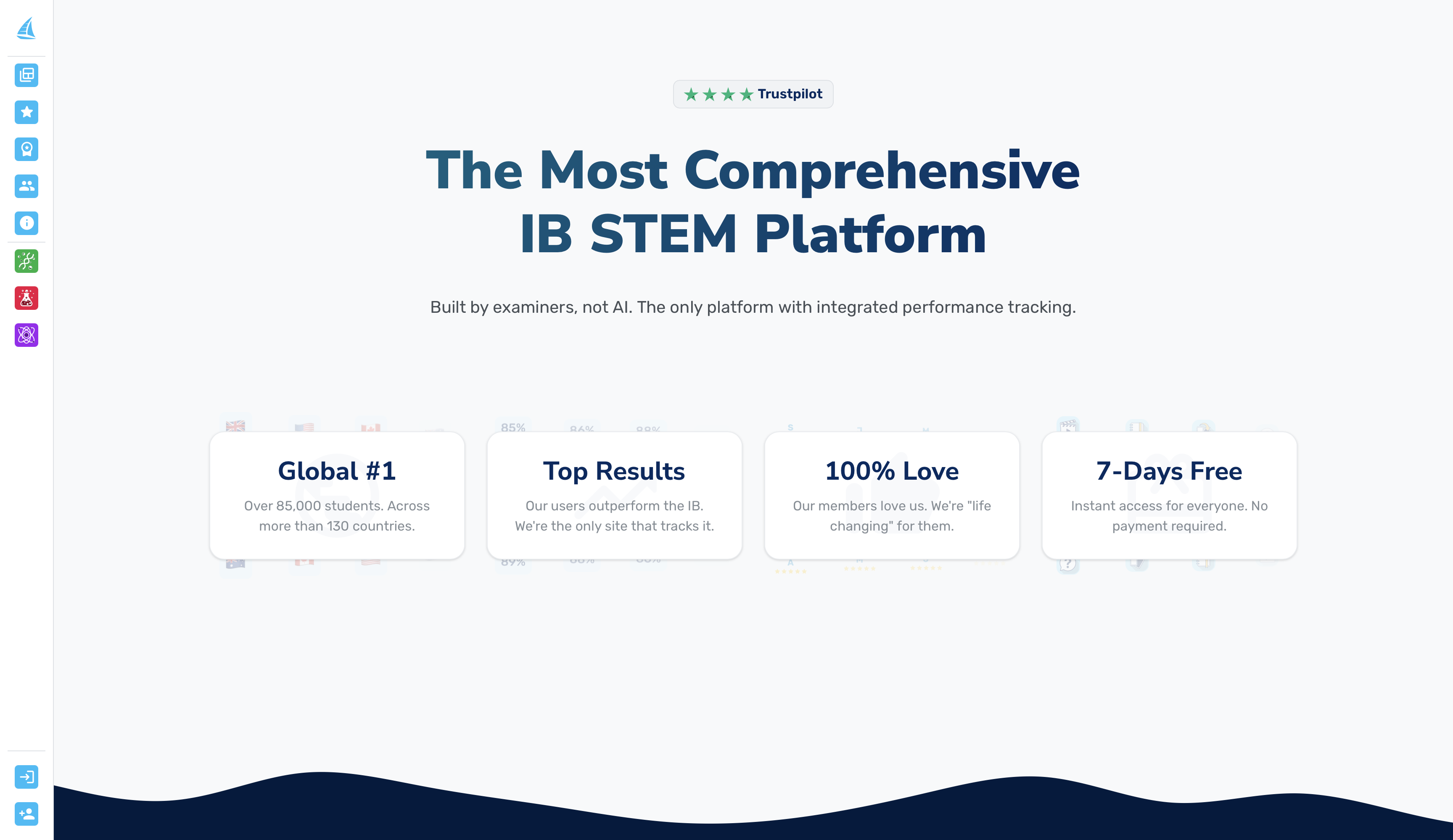
Three ways to weave it into a student-led unit: use Biology topic tests as quick formative checks after a student-led lab wraps up; hand students examiner mark schemes from the Biology exam question bank so they can calibrate their own rubrics before submission; and close a unit with a Chemistry mock exam as a summative check that the inquiry work actually built exam-ready understanding. Start a free 7-day trial and see for yourself why schools use Tiber Tutor’s syllabus-aligned, examiner-built resources to back up student-led science, biology, chemistry, and physics units.
Sources
- Primary Years Programme (PYP) — International Baccalaureate (IB)
- Student‑led learning: How two IB students took CAS beyond the classroom — Nagoya International School blog
FAQ
What are some examples of student-led learning?
Examples include students designing their own lab investigations, running Chalk Talk discussions to surface prior thinking, and managing a Collaborative Sciences Project journal that documents their own process decisions.
What are the IB Approaches to Learning?
The ATL skill clusters are thinking, research, communication, social, and self-management skills, and they run across PYP, MYP, DP, and CP as the shared skill framework behind every IB subject.
What are some examples of student-led activities?
Student-led CAS projects, service-learning investigations tied to sustainability problems, and peer-assessed practical write-ups are common examples, alongside student-designed inquiry labs described earlier in this guide.
What are the ATL approaches to learning used for in science?
In IB science, ATL clusters translate into specific classroom behaviours, questioning and refining research focuses, justifying method choices, and documenting reasoning, that examiners and moderators are trained to recognise in student work.
How does Tiber Tutor support student-led science units?
Tiber Tutor gives teachers examiner-written topic tests and mock exams to confirm syllabus coverage during open-ended student-led work, something few other IB-focused platforms combine with detailed progress tracking.