Blended learning in IB science: a practical guide for teachers
The minimum viable blended plan for IB science is this: flip one lesson using a short video or pre-reading, add an asynchronous pre-lab activity that builds the required practical skills, run a brief online formative check, then bring students together for the hands-on investigation. That four-step sequence respects IB subject guide requirements for inquiry-based, concept-focused teaching while giving you a manageable entry point this week.
Three tasks to start this week:
- Select one upcoming practical or inquiry task from your current unit.
- Create a short asynchronous pre-lab activity (a video with embedded questions, a PhET simulation task, or a structured reading) that builds the procedural knowledge students need before the lab session.
- Schedule the hands-on session and set a simple formative check (an exit quiz or a two-question reflection) to confirm readiness.
Minimum success checks before you begin:
- Every online task maps to at least one IB assessment objective or Approaches to Learning (ATL) skill.
- Students have at least one genuine decision point in the investigation, not just a recipe to follow.
- Data handling complies with UK GDPR: use your school’s approved Virtual Learning Environment (VLE) rather than personal accounts, and obtain consent for any video submissions.
- Tibertutor’s exam-aligned question banks are available as ready-made formative tasks if you need a quick starting point.
Key takeaways
Blended learning in IB science works best when online tasks are designed as preparation for authentic hands-on inquiry, every activity maps to an IB assessment objective, and student agency is protected by deliberate choice points across both phases.
| Point | Details |
|---|---|
| Start with backward design | Define IB assessment objectives and ATL skills first, then build online and offline tasks to match. |
| Protect hands-on authenticity | Virtual tasks (PhET, Labster) prepare students for practicals; they do not replace data collection for IA work. |
| Use formative data before each lesson | Pre-lab quizzes and VLE completion data let you target misconceptions in face-to-face time. |
| Run a 6–8 week pilot first | A single unit pilot generates the evidence and confidence to scale blended approaches across the department. |
| Tibertutor supports the whole cycle | Examiner-authored tests, animated videos, IA exemplars, and topic-level analytics reduce preparation time and improve exam alignment. |
Table of Contents
- Why blended learning can work in IB science: evidence and benefits
- Which blended learning models suit IB science classrooms?
- How do you design a blended IB science unit from scratch?
- How do you keep student agency alive in a blended IB science class?
- Managing practicals and investigations in a blended IB science programme
- How should you assess students in a blended IB science class?
- Which technology tools work best for UK IB science teachers?
- What does a realistic implementation timeline look like?
- Equity, accessibility and data privacy in UK IB science blended learning
- Where can you find IB-specific resources, templates and guidance?
- How do you involve parents in a blended IB science programme?
- How do you differentiate within a blended IB science unit?
- How do you track student engagement in a blended IB science class?
- Examples of blended IB science lesson plans and unit templates
- What the evidence actually tells us about blended IB science
- Tibertutor: examiner-built resources that support your blended IB science units
- Sources
- FAQ
Why blended learning can work in IB science: evidence and benefits
Blended approaches can improve conceptual understanding and personalise practice cycles, but only when pedagogy and infrastructure are genuinely in place. That caveat matters for IB teachers more than most, because the IB subject guides are explicit: planning, teaching, and assessment in Group 4 sciences must be inquiry-based and concept-focused. A blended design that simply digitises content delivery without preserving inquiry fails that standard from the outset.
The evidence base is encouraging but honest about its limits. A 2020–2024 systematic review found blended learning offers real opportunities to improve science learning outcomes, yet repeatedly identified weak ICT literacy, poor connectivity, and insufficient teacher training as the barriers that undermine those gains. Where those conditions are met, the benefits for IB teachers are concrete:
- Mastery mapping for IAs: online pre-tests and post-tests reveal which students have the conceptual grounding to design a credible Internal Assessment investigation before the lab session begins.
- Scalable formative feedback: short asynchronous quizzes generate data you can review before the next face-to-face lesson, letting you target misconceptions rather than re-teach whole topics.
- Differentiated pacing: students who grasp a concept quickly can move to extension tasks online while others consolidate, without the whole class waiting.
- Targeted ATL development: online discussion forums and reflection prompts build communication and self-management skills that IB assessors look for explicitly.
A note on authenticity: a 2025 quasi-experimental study (N=229) found that reduced authenticity in blended tasks was associated with lower success on some learning measures. For IB science, this means virtual practicals must be designed carefully — not used as a wholesale replacement for hands-on work.
Which blended learning models suit IB science classrooms?
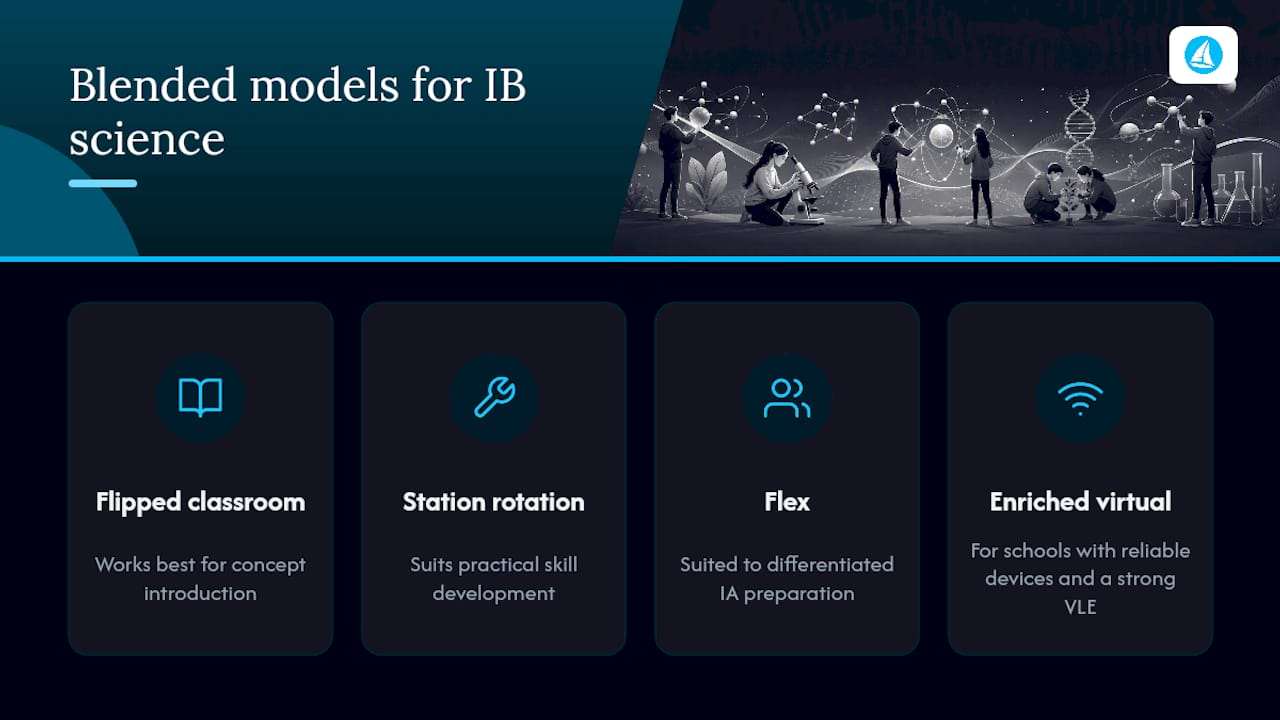
The four models most applicable to IB science are the flipped classroom, station rotation, flex, and enriched virtual. Flipped works best for concept introduction; station rotation suits practical skill development; flex suits differentiated IA preparation; enriched virtual suits schools with reliable devices and a strong VLE. Edutopia’s five blended strategies — goal setting, standards-mastery mapping, pre/post testing, choice boards, and peer tutoring — map neatly onto all four models and are worth adapting for IB contexts.
Flipped classroom
Students watch an annotated video or work through a guided reading asynchronously before the lesson. Face-to-face time is used for discussion, problem-solving, and practical work. This fits DP Biology or Chemistry concept introductions well: students arrive having processed the core idea, so lesson time goes to higher-order reasoning and ATL skill development rather than transmission.
Classroom example: Before a DP Chemistry lesson on equilibrium, students watch a 12-minute animated video and complete five multiple-choice questions on your VLE. In class, you spend the first ten minutes addressing the two most common misconceptions flagged by the quiz data, then move straight into a guided inquiry on Le Chatelier’s principle.
Station rotation
Students rotate between online and face-to-face stations on a timed schedule. One station uses PhET Interactive Simulations to explore a concept; another involves a hands-on investigation; a third is a structured peer-discussion task. This model suits MYP science well, where varied skill development is a programme requirement.
Classroom example: In a MYP Physics unit on waves, Station A uses a PhET wave simulation to vary frequency and amplitude; Station B involves a slinky and a stopwatch for real measurement; Station C is a collaborative annotation of a data set. Each station lasts 15 minutes.

Flex model
Students move through online content at their own pace, with the teacher circulating to provide targeted support. This suits IA preparation phases in DP, where students are at different stages of their investigation design.
Enriched virtual
Most learning happens online, with scheduled face-to-face sessions for practicals and discussion. Labster virtual lab simulations can fill the online phase for concept-building, though hands-on sessions remain non-negotiable for IA authenticity.
Choosing a model: a quick checklist
Before selecting a model for a unit, ask:
- What are the IB assessment objectives and ATLs this unit must address?
- Do students have reliable device access at home and at school?
- Is the practical work IA-linked, requiring authentic data collection?
- How much face-to-face time is available in the timetable?
- What is your school’s VLE capability and data policy?
If IA authenticity is at stake, prioritise models that keep hands-on data collection central. If the unit is concept-heavy with limited lab time, flipped or station rotation gives the best return.
How do you design a blended IB science unit from scratch?
Start with backward design: define the desired IB outcomes first (concepts, skills, IA criteria), then choose the evidence that will demonstrate mastery, then design the online and offline learning tasks that build towards it. This sequence, grounded in IB subject guide requirements, prevents the common mistake of selecting a technology first and retrofitting the pedagogy.
Planning checklist
- Identify the IB assessment objectives and ATL skills the unit must address (e.g., AO2 application, AO3 analysis; ATL: research, self-management).
- Choose the summative evidence: a DP Internal Assessment, a unit test, or a structured inquiry report.
- Design two to three formative online tasks that build towards the summative (pre-lab quiz, data-analysis exercise, peer-reviewed hypothesis draft).
- Sequence the hands-on investigations so they follow the online preparation and generate authentic data.
- Map each task to a specific IB assessment objective so you can justify every activity to students and parents.
- Check that at least one task per lesson gives students a genuine decision point (not just a recipe).
Sample 5-lesson blended unit arc (DP Biology: Cell Division)
| Lesson | Mode | Activity | IB alignment |
|---|---|---|---|
| 1 | Online (async) | Annotated video + 5-question VLE quiz on mitosis stages | AO1 recall; ATL self-management |
| 2 | Face-to-face | Microscopy practical: prepare and observe onion root tip slides | AO2 application; ATL research |
| 3 | Online (async) | PhET simulation: cell cycle checkpoints; reflection post | AO2/AO3; ATL communication |
| 4 | Face-to-face | Data analysis workshop: chi-squared test on mitotic index data | AO3 analysis; ATL thinking |
| 5 | Blended | IA planning session: online draft + teacher feedback loop | IA criteria A–C |
Mapping ATLs into online tasks
- Self-management: set a deadline for the pre-lab quiz and ask students to record their score before the lesson.
- Research skills: require students to annotate a primary source or a PhET simulation guide before the face-to-face session.
- Communication: use an online forum prompt that asks students to explain a concept to a peer in two sentences, then respond to one classmate’s post.
For detailed lesson sequencing guidance, the IB science lesson planning best practices guide on Tibertutor is a useful companion resource.
How do you keep student agency alive in a blended IB science class?
Preserve agency by designing explicit choice points and discourse routines across both online and face-to-face phases. Research from England shows that curriculum and testing pressures can reduce pupil decision-making in practical inquiry lessons, even when teachers hold strong beliefs in inquiry. Blended designs must actively counteract this tendency, not assume it will resolve itself.
Practical tactics:
- Choice boards: offer three online pre-lab tasks (a simulation, a video, or a structured reading) and let students choose their entry point. This builds self-management ATL skills and respects different learning preferences.
- Negotiated success criteria: before the face-to-face investigation, share a draft rubric online and ask students to annotate one criterion they want to improve. Bring those annotations into the opening discussion.
- Online discussion protocols: use a structured forum prompt such as “State your hypothesis, identify one variable you cannot control, and explain how you will account for it.” This scaffolds scientific argumentation without removing student ownership.
- Structured reflection cycles: after each practical, ask students to post a two-sentence reflection: what they would change in their method, and why. Peer responses build communication skills.
- Peer critique routines: share anonymised student data sets online and ask peers to identify one strength and one limitation before the next lesson.
Sentence stems for online forums (scientific argumentation):
- “My hypothesis predicts… because the theory suggests…”
- “One limitation of this method is… which could be addressed by…”
- “The data supports/challenges the hypothesis because…”
- “I disagree with [peer’s] interpretation because the evidence shows…”
Pro Tip: Reserve at least ten minutes in every face-to-face session for a student-led decision point: let students choose their independent variable, adjust their method, or select their analysis approach. Even small choices within a constrained investigation protect the inquiry spirit that IB assessors expect to see in IA work.
The Community of Inquiry principles recommend designing blended courses around shared metacognition and structured facilitation, which aligns directly with these discourse routines.
Managing practicals and investigations in a blended IB science programme
Plan virtual preparation to build authenticity, then use face-to-face time for data collection, higher-order reasoning, and IA work. The guiding principle is that virtual tasks should replicate the thinking of a practical, not replace the doing of one.
What can be virtual, and what must be hands-on?
Virtual (online) tasks are appropriate for:
- Concept walkthroughs and method previews (PhET, Labster, annotated videos)
- Safety briefings and risk assessment completion
- Data analysis and graphing exercises using provided data sets
- Hypothesis generation and experimental design drafts
- Post-lab reflection and error analysis
Hands-on sessions are non-negotiable for:
- Novel data collection where measurement skill is being assessed
- Tactile techniques (titration, microscopy, dissection, gel electrophoresis)
- IA investigations requiring authentic, student-generated data
- Any practical where the IB examiner will assess the process, not just the outcome
A 2025 study found that authenticity in blended tasks was positively correlated with learning success. Designing virtual tasks that include real measurement conventions and genuine decision points, rather than guided click-through simulations, reduces the authenticity gap.
Operational checklist for blended practicals (UK context)
- [ ] Pre-lab online task completed and quiz score recorded before the session
- [ ] Risk assessment reviewed and signed off (digital or paper) before students enter the lab
- [ ] PPE requirements communicated in the pre-lab briefing video
- [ ] Station rotation logistics briefed online so face-to-face time is not lost to instructions
- [ ] Evidence collection standards for IAs clarified (raw data table format, units, significant figures)
- [ ] Waste disposal and chemical storage procedures covered in the pre-lab safety module
- [ ] CLEAPSS guidance referenced for any hazardous materials (UK standard)
Pro Tip: When building a Labster or PhET task, add a “measurement decision” step: ask students to choose which variable to measure first and justify the choice in writing before they proceed. This single addition shifts the task from passive observation to active scientific reasoning, and it mirrors the kind of decision-making IB examiners look for in IA Criterion B.
How should you assess students in a blended IB science class?
Use short, frequent formative checks online to inform face-to-face work and IA preparation, and align every task to IB assessment objectives. The Community of Inquiry framework recommends that assessment in blended courses be explicitly aligned to intended learning outcomes, with structured facilitation to support metacognitive development.
Formative assessment methods:
- Pre/post quizzes on your VLE (five to eight questions, auto-marked) to measure conceptual shift before and after a practical
- Annotated student artefacts: ask students to submit a photo of their data table with a voice note explaining their analysis choices
- Video lab reflections: a two-minute recording where students narrate one thing that went well and one source of error
- Structured peer assessment using a rubric mapped to IB criteria (e.g., IA Criterion C: evaluation)
- Exit tickets at the end of face-to-face sessions, submitted via your VLE
Academic integrity in a UK/IB blended context:
- Require students to submit a brief process log alongside any online task, noting the date, time, and resources used
- Use VLE submission timestamps and version histories to document authorship
- For IA drafts submitted online, ask students to annotate their own work before teacher feedback, creating an auditable revision trail
- Follow your school’s IB academic integrity policy and the IBO’s current guidance on AI-assisted work
- Never accept a final IA draft that lacks a clear evidence trail of the student’s own thinking process
Tibertutor’s examiner-authored question banks and analytics dashboards can support consistent formative feedback across a blended programme, giving you standardised data on student performance that is directly aligned to IB assessment criteria.
Which technology tools work best for UK IB science teachers?
Pick tools to serve pedagogy, not the other way around. The QAA guidance on building a taxonomy for digital learning recommends evaluating digital resources against clear pedagogical criteria before procurement, which is sound advice for any UK school navigating VLE policies and GDPR obligations.
Tool categories and UK-relevant examples:
- VLE/LMS: most UK schools use Google Classroom, Microsoft Teams for Education, or Firefly. Use your school’s approved platform for all student data; never use personal accounts for assessment submissions.
- Simulation platforms: PhET Interactive Simulations (free, browser-based, no login required for students) and Labster (subscription, more immersive, suited to DP-level virtual labs). PhET suits quick concept checks; Labster suits longer virtual investigation sequences.
- Video tools: Edpuzzle (embed questions in videos), Loom (teacher-created walkthroughs), or your VLE’s native video tool. For flipped lessons, video-based IB science resources can reduce preparation time significantly.
- Data logging and analysis: Vernier LabQuest, PASCO, or Logger Pro for in-lab data collection; Google Sheets or Desmos for online data analysis tasks.
- Formative assessment platforms: your VLE’s quiz tool, or Kahoot/Quizlet for low-stakes retrieval practice. For exam-aligned formative tasks, Tibertutor’s topic tests are built by IB examiners and map directly to assessment objectives.
UK-specific considerations:
- Check your school’s procurement and data-processing agreements before introducing any new platform; GDPR requires a Data Processing Agreement with any third-party tool that handles student data.
- Device equity matters: not all students have reliable home broadband. Plan offline alternatives for every asynchronous task (a printed version of the pre-lab activity, for example).
- The ERIC guide to blended learning recommends a stepwise adoption approach, which translates practically to: set up one VLE folder, add one simulation link, and run one formative quiz before expanding further.
Week 1 minimal setup:
- Create a VLE folder for the unit with the pre-lab video and quiz.
- Add a single PhET simulation link with a one-page task sheet.
- Set a five-question formative quiz due the night before the first practical.
What does a realistic implementation timeline look like?
Run a short pilot of 6–8 weeks with targeted professional learning and protected planning time. Trying to redesign an entire course at once is the most common reason blended pilots stall. A single unit pilot, done well, generates the evidence and confidence to scale.
Sample 8-week pilot timeline:
- Week 1: Identify the pilot unit and map it to IB objectives. Set up the VLE folder and select one simulation. Brief the department.
- Week 2: Baseline student survey (device access, prior experience with online learning, ATL self-assessment). Share the unit plan with students and parents.
- Weeks 3–5: Teach the blended unit. Collect formative data after each online task. Note what takes longer than expected.
- Week 6: Mid-pilot review with students (a short anonymous survey). Adjust pacing or task complexity based on responses.
- Week 7: Complete the unit. Administer a post-test and compare to baseline.
- Week 8: Department debrief. Document what worked, what to change, and what resources to keep. Plan the next unit.
Training priorities for the pilot:
- TPACK basics: understanding how technology, pedagogy, and content knowledge interact in a science lesson
- Assessment mapping: aligning every online task to a specific IB objective before building it
- Simulation use: a 30-minute hands-on session with PhET and Labster so teachers can troubleshoot student questions
- Online discourse facilitation: how to write a forum prompt that generates scientific argumentation, not one-word answers
- Technical troubleshooting: what to do when the VLE is slow, a simulation won’t load, or a student lacks device access
Workload mitigation:
- Build reusable templates for pre-lab quizzes, reflection prompts, and IA evidence logs so you only create them once.
- Share resources across the department: one teacher builds the flipped video, another builds the formative quiz.
- Tibertutor’s ready-made examiner-authored question banks and animated videos reduce preparation time substantially, freeing planning hours for the pedagogical design work that only you can do.
Pro Tip: Do not pilot blended learning during an IA submission window or mock exam period. Choose a unit where students have time to engage with the online tasks thoughtfully, and where you have capacity to review the formative data before each lesson.
Equity, accessibility and data privacy in UK IB science blended learning
Plan for device and connectivity gaps, accessibility needs, and lawful data handling from day one. These are not afterthoughts; they are design constraints that shape every blended unit you build.
Equity tactics:
- Maintain a loan device rota through your school’s IT department for students without reliable home access.
- Create offline alternatives for every asynchronous task: a printed pre-lab worksheet that mirrors the online activity.
- Offer flexible submission windows for online tasks, with a clear escalation process for students who miss deadlines due to connectivity issues.
- Use differentiated evidence forms: some students submit a written reflection, others a voice note, others a diagram, all mapped to the same ATL skill.
Accessibility checklist:
- [ ] All videos have accurate captions or transcripts (auto-generated captions need human review for scientific terminology)
- [ ] VLE navigation is clear and consistent: one folder per unit, labelled by week
- [ ] Instructions are scaffolded: a short version for independent learners, a step-by-step version for students who need more support
- [ ] Alternative assessment arrangements are in place for students with EHCPs or access arrangements
- [ ] Font sizes and colour contrast meet WCAG 2.1 AA standards on any custom materials
For differentiation strategies specific to IB science, the IB science differentiated instruction guide on Tibertutor offers practical scaffolding approaches that translate directly into blended unit design.
Data and privacy (UK/GDPR):
- Use only your school’s approved VLE for storing student work and assessment data.
- Obtain explicit consent before asking students to submit video reflections that will be stored or shared.
- Ensure any third-party simulation or assessment platform has a signed Data Processing Agreement with your school.
- Do not store student data on personal devices or personal cloud accounts.
- Consult the ICO’s guidance on data protection in schools for current UK GDPR obligations relating to children’s data.
Where can you find IB-specific resources, templates and guidance?
Start with authoritative IB pages and vetted simulation resources, then add UK professional bodies for policy guidance. The ERIC guide to blended learning provides a stepwise, constructivist framework that is a useful structural reference alongside IB-specific materials.
Key resources:
- IB subject guides and Programme Resource Centre: the primary source for assessment objectives, ATL frameworks, and IA criteria. Always check the current edition of your subject guide before designing a unit.
- PhET Interactive Simulations: free, browser-based simulations for Biology, Chemistry, and Physics. Filter by topic and grade level; most DP-relevant simulations are tagged “University” or “High School.”
- Labster: subscription virtual lab platform with DP-aligned modules. Useful for pre-lab concept building and for schools with limited lab time.
- Royal Society of Chemistry (RSC): practical guidance, safety resources, and curriculum-linked activities for Chemistry teachers in the UK.
- Association for Science Education (ASE): professional development resources, CLEAPSS links, and research-informed guidance on practical science in UK schools.
- Vaughan et al. (2023), Principles of Blended Learning: the most research-grounded framework for blended course design; particularly useful for the metacognition and facilitation principles.
Templates to build and reuse:
- Pre-lab checklist (safety, equipment, hypothesis, method outline)
- Online formative quiz template (five to eight questions, mapped to IB objectives)
- IA evidence log (date, activity, data collected, student reflection)
- Unit outline template (lesson, mode, activity, IB alignment column)
For a curated overview of resource types that pair well with blended models, the types of IB science support resources guide on Tibertutor is a practical starting point. Tibertutor subscribers also have access to examiner-authored question banks, IA exemplars, and progress dashboards that slot directly into the formative assessment and IA preparation phases of any blended unit.
How do you involve parents in a blended IB science programme?
Parents of IB students often feel uncertain about what blended learning means for their child’s workload and exam preparation. Clear, proactive communication reduces anxiety and builds the home-school partnership that supports student consistency.
Practical strategies:
- Send a one-page unit overview at the start of each blended unit: what students will do online, what happens in class, and how it connects to IB assessment objectives. Keep it jargon-free.
- Hold a short information session (in person or via a recorded video) at the start of the academic year to explain the blended model, the VLE, and how parents can monitor progress without logging into student accounts.
- Share the formative quiz schedule so parents know when to expect online tasks and can support a consistent study routine at home.
- Use your VLE’s parent-view feature (available in Google Classroom and Microsoft Teams for Education) to give parents read-only visibility of assignment deadlines and submission status.
- When a student misses an online task, contact parents early with a clear, supportive message: “We noticed [student] hasn’t completed the pre-lab activity. Here’s how to access it and when it needs to be done.”
- At the end of a pilot unit, share a brief summary of what the class achieved and what the data showed, without identifying individual students. This builds confidence in the approach.
The goal is transparency, not surveillance. Parents who understand the purpose of each online task are far more likely to support the routine at home.
How do you differentiate within a blended IB science unit?
Blended learning creates natural differentiation opportunities because online phases allow students to work at their own pace and choose their entry point. The key is to design those choices deliberately, not leave them to chance.
Differentiation by task design:
- Tiered pre-lab activities: create three versions of the pre-lab task at different levels of scaffolding. The foundational version provides a worked example; the standard version provides a prompt; the extension version asks students to design their own approach. All three map to the same IB objective.
- Choice boards: offer three to four online tasks that address the same concept through different modalities (a simulation, a video, a data set, a reading). Students choose one. This respects learning preferences while keeping the assessment target consistent.
- Flexible pacing: in a flex model, fast-finishers move to extension tasks (a more complex data set, a peer-review task, or an IA-style question) while others consolidate the core concept.
- Scaffolded discussion prompts: provide sentence stems for students who find scientific argumentation difficult, and remove them for students who are ready to write independently.
Differentiation by feedback:
- Use your VLE’s quiz analytics to identify students who scored below a threshold on the pre-lab quiz, and prepare a targeted five-minute intervention for the start of the face-to-face session.
- Tibertutor’s performance dashboards show topic-level mastery for each student, making it straightforward to identify who needs consolidation and who is ready for extension before the lesson begins. No other IB platform offers this depth of interlinked analytics alongside examiner-authored content.
For a deeper treatment of scaffolding and differentiation in IB science, the IB science differentiated instruction guide covers practical approaches that translate directly into blended unit design.
How do you track student engagement in a blended IB science class?
Engagement in a blended programme is harder to see than in a traditional classroom, but it is measurable if you build the right checkpoints into your design.
Methods and tools:
- VLE completion data: most VLEs (Google Classroom, Teams for Education) show whether a student has opened a resource, submitted a task, or viewed a video. Check this before each face-to-face session to identify students who have not engaged with the pre-lab material.
- Quiz attempt data: track not just scores but attempt patterns. A student who scores 80% on the first attempt is in a different position from one who scores 80% after three attempts.
- Forum participation: monitor online discussion posts for quality, not just quantity. A student posting one substantive, evidence-based response is more engaged than one posting three one-word replies.
- Formative check trends: compare pre-quiz and post-quiz scores across the unit to track conceptual growth. A flat trend despite engagement suggests the task design needs revision, not the student.
- IA process logs: ask students to maintain a brief log of their investigation decisions (date, what they did, what they changed, why). This is both an engagement signal and an academic integrity tool.
Tibertutor’s analytics go further than standard VLE data. The platform’s performance dashboards track topic-level mastery, question-type performance, and revision patterns for each student across Biology, Chemistry, Physics, and IB Maths. Teachers can see at a glance which topics need class-wide attention and which students are ready to move on. This level of granularity, built by IB examiners who understand exactly what the assessments demand, is not available on any other platform.
Examples of blended IB science lesson plans and unit templates
The most effective blended IB science lessons share a common structure: an asynchronous preparation phase, a face-to-face active learning phase, and a short online consolidation or reflection task. Here are two concrete examples you can adapt.
Example 1: DP Chemistry — rates of reaction (flipped + station rotation)
Online (async, before lesson): Students watch a 10-minute annotated video on collision theory and complete a five-question VLE quiz. They post one question they still have to the class forum.
Face-to-face (60 minutes): The teacher addresses the top two forum questions (five minutes), then students rotate through three stations: Station A (PhET simulation on reaction rates, with a measurement decision task), Station B (hands-on investigation: effect of concentration on the rate of sodium thiosulfate and hydrochloric acid), Station C (data analysis: graphing and interpreting results from a provided data set).
Online (async, after lesson): Students submit a two-sentence reflection: what the collision theory predicts about their Station B results, and one source of error they would address if they repeated the investigation.
IB alignment: AO2 (application of collision theory), AO3 (analysis and evaluation of data), ATL self-management and communication.
Example 2: MYP Biology — ecosystems (flex model)
Online phase (two lessons): Students work through a self-paced module on food webs and energy transfer, choosing between a PhET simulation, a structured reading, or a data-analysis task. They complete a short quiz before the face-to-face session.
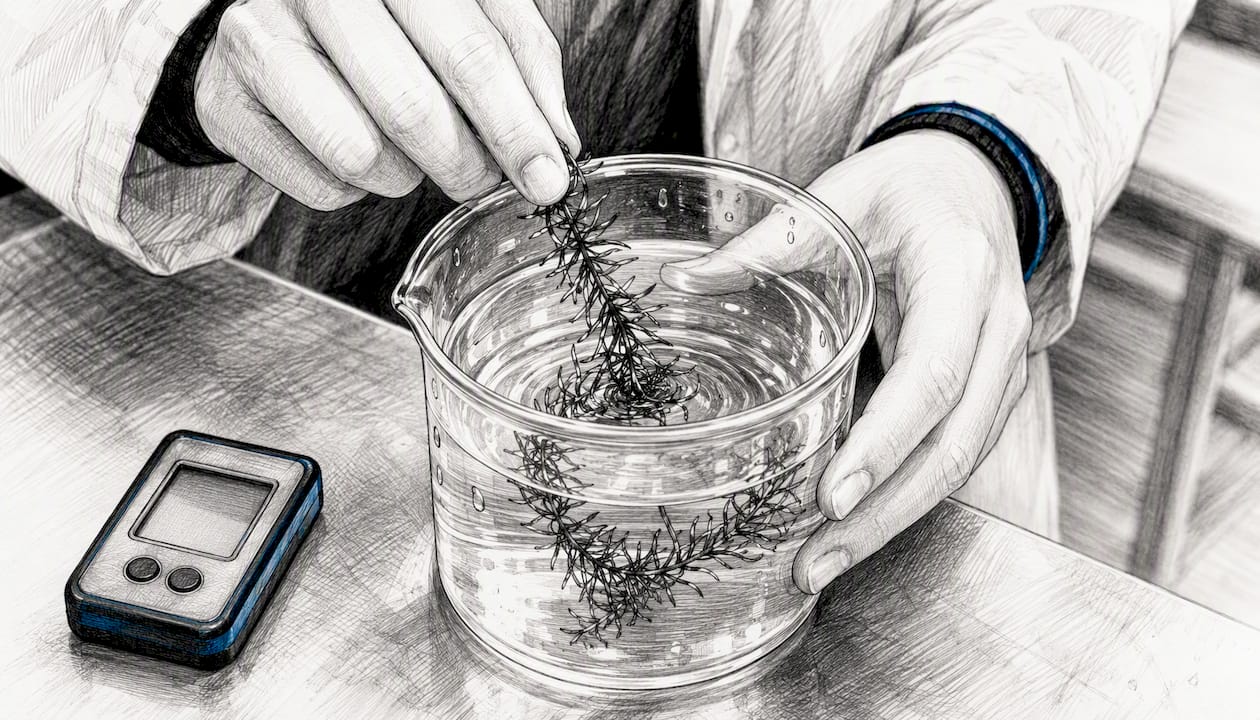
Face-to-face (90 minutes): Students design and carry out a mini-investigation: measuring the effect of light intensity on the rate of photosynthesis in pondweed. The teacher circulates to support experimental design decisions.
Online consolidation: Students draft a short IA-style evaluation (two paragraphs) and submit it for peer review via the VLE before the next lesson.
Template: unit outline (copy and adapt)
| Column | What to fill in |
|---|---|
| Unit title | e.g., Cell Division (DP Biology) |
| IB objectives | AO1, AO2, AO3 as relevant |
| ATL skills | e.g., research, self-management, communication |
| Online tasks | Pre-lab quiz, simulation, reflection post |
| Face-to-face tasks | Practical, discussion, data analysis |
| Formative checks | Quiz scores, forum posts, exit tickets |
| Summative evidence | IA, unit test, structured report |
What the evidence actually tells us about blended IB science
The most common mistake I see in blended IB science pilots is treating the online phase as a content-delivery slot and the face-to-face phase as a practical slot, with no deliberate connection between them. The result is two parallel tracks that students experience as disconnected, and inquiry disappears from both.
The research is clear that this is a design failure, not a technology failure. The systematic review of blended learning in science education found that positive outcomes depend on infrastructure and training, yes, but also on pedagogical coherence: the online and face-to-face phases must be designed as a single learning sequence, not as separate activities that happen to share a timetable slot.
What actually works, in my experience of observing IB science pilots in UK schools, is the backward-design approach described in this guide. Teachers who start with the IB assessment objective and work backwards to the online task consistently produce more coherent units than those who start with a simulation they like and build around it. The technology is the last decision, not the first.
There is also a real tension in IB science between the programme’s genuine commitment to inquiry and the assessment pressure that pushes teachers towards structured, predictable practicals. Blended learning does not resolve that tension automatically. But it does create space for it: if you use the online phase to handle the procedural knowledge, you free the face-to-face session for the open-ended reasoning that IB assessors actually reward. That is the trade worth making.
Tibertutor: examiner-built resources that support your blended IB science units
Planning a blended IB science unit takes time. Building formative quizzes, sourcing exam-aligned questions, and tracking student progress across a mixed delivery model adds to an already demanding workload. Tibertutor removes that preparation burden with a suite of resources built by actual IB examiners, not generic content teams.
Every question on Tibertutor is authored by IB examiners and mapped precisely to IB assessment objectives, so when you assign a topic test as a pre-lab formative check, you know the data it generates reflects real exam demand. The platform’s animated instructional videos are ready-made for flipped lessons. Its IA exemplars and mark schemes give students a clear standard to work towards during the IA preparation phase. And the performance dashboards track mastery at topic level across Biology, Chemistry, Physics, and IB Maths, giving you the kind of granular, interlinked analytics that no other IB platform offers.
For teachers running a blended pilot, Tibertutor’s IB Biology tests and IB Chemistry tests are a practical starting point: assign a topic test before the practical, review the class data, and walk into the lab knowing exactly where the misconceptions are. Start with a free 7-day trial at Tibertutor to see how the resources fit your current units.
Sources
These are the highest-value sources to consult when designing a blended IB science programme. Each is linked directly to the relevant section or document.
- International Baccalaureate (subject guides)
- Evaluating the Effectiveness of Blended Learning in Science Education: A Systematic Review (IJSRP, 2025)
- Edutopia: 5 blended learning strategies (2023)
FAQ
What is the simplest way to start blended learning in IB science?
Flip one lesson: assign a short video and a five-question VLE quiz before the next practical, then use the quiz data to focus face-to-face time on misconceptions. This single change introduces the core blended workflow without requiring a full unit redesign.
Can virtual simulations replace hands-on practicals for IB Internal Assessments?
No. IB Internal Assessments require authentic, student-generated data from real investigations. Virtual simulations such as PhET and Labster are valuable for concept building and pre-lab preparation, but they cannot substitute for the hands-on data collection that IA criteria require.
How do I align blended tasks to IB assessment objectives?
Start with the IB subject guide for your course and identify the specific assessment objectives (AO1, AO2, AO3) and ATL skills the unit addresses. Map each online and face-to-face task to at least one objective before building it. Tibertutor’s examiner-authored question banks are already mapped to IB objectives, which makes formative task design significantly faster.
What are the main barriers to blended learning in UK IB science schools?
A 2020–2024 systematic review identified weak ICT literacy, unreliable connectivity, and insufficient teacher training as the most common barriers. Planning offline alternatives for every online task and running a short staff development session on simulation use before the pilot begins addresses the majority of these issues.
How do I protect student data when using online tools in a UK school?
Use only your school’s approved VLE for storing student work and assessment data, and confirm that any third-party platform (including simulation tools) has a signed Data Processing Agreement with your school. Obtain explicit consent before storing student video submissions. The ICO’s guidance on children’s data is the authoritative reference for UK GDPR obligations in school settings.