Why IB Chemistry is difficult: a clear guide for students
IB Chemistry is genuinely hard. It combines a broad, conceptually demanding syllabus with multi-step calculations, abstract molecular thinking, and a self-directed Internal Assessment that counts for 20% of your final grade. Students who struggle most are usually those who expect to memorise their way through it. The course is built around chemical thinking, not recall, and that shift catches many people off guard.
Here is what actually makes it so demanding, and what you can do about it.
Why IB Chemistry is difficult: the core challenges
Understanding the specific obstacles helps you prepare for them rather than be surprised by them. These are the challenges that come up most consistently.
1. The syllabus is both broad and deep
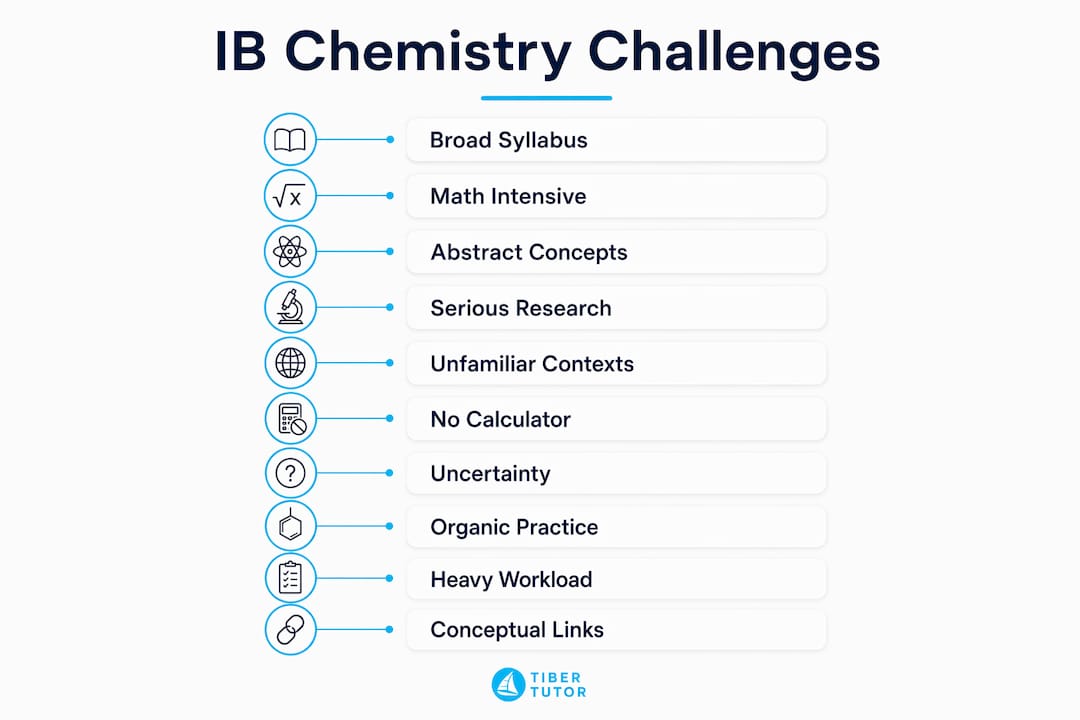
IB Chemistry covers around 22 distinct subtopic areas, organised across three Structure themes and three Reactivity themes. That is not just a lot of content. Each subtopic connects to others, so a gap in one area tends to create confusion further down the line. Students who treat the syllabus as a list of facts to memorise find this particularly punishing.
2. You cannot avoid the mathematics
Stoichiometry, equilibrium constants, thermodynamic calculations, and electrochemistry all require confident, multi-step problem-solving. A student might understand the theory behind a reaction perfectly well but still lose marks because the mathematical approach breaks down under pressure. Practising calculations in isolation is not enough. You need to practise them in the context of full exam questions, where the maths is embedded in unfamiliar scenarios.
3. Abstract concepts demand genuine visualisation
Bonding models, molecular orbital theory, and reaction mechanisms do not exist at a scale you can see. You have to build mental pictures of things that are invisible. Topics like atomic structure and hybridisation challenge students precisely because there is no physical intuition to fall back on. Diagrams, models, and simulations help, but they only work if you engage with them actively rather than passively watching.
4. The Internal Assessment is a serious research project
Many students underestimate the IA. It is not a standard lab report. It is a self-directed research project with strict expectations around methodology, data analysis, and scientific writing, all aligned to IB examiner standards. Getting the structure wrong, even with solid experimental data, costs marks. Starting late makes it worse. The IA is the most controllable component of your grade, which makes it worth treating with real care from the beginning.
5. Exam questions use unfamiliar contexts deliberately
IB Chemistry assessments test your ability to apply knowledge to scenarios you have never seen before, not to reproduce what you revised last night. Paper 1B, for example, focuses on data analysis, graph interpretation, and error calculations under tight time limits. Students who have only reviewed content without practising application tend to find these questions disorienting.
6. Paper 1A removes your safety net entirely
Paper 1A has no data booklet and no calculator. Atomic masses, electronegativity trends, and common formulae all need to come from memory or be derived from first principles. This is a genuinely different skill from the rest of the course, and it requires specific preparation. Drilling the values and relationships that appear most frequently in Paper 1A questions is the only reliable way to build that fluency.
7. Uncertainty calculations trip up even prepared students
Uncertainty propagation is explicitly tested in Paper 1B, and it is a frequent source of lost marks. Students often practise it in the context of the IA but do not realise it also appears in the written exams. Treating uncertainty as an IA-only skill leaves a gap that shows up at the worst possible time.
8. Organic chemistry mechanisms require weeks of practice
HL students face formal arrow-pushing mechanisms, including nucleophilic substitution and electrophilic addition. These look manageable on paper but require a mental model that takes weeks of repetitive practice to build reliably. Rushing this content, or leaving it until the final term, is one of the most common mistakes HL students make.
9. The workload sits alongside five other demanding subjects
IB Chemistry does not exist in isolation. You are managing it alongside other subjects, a Theory of Knowledge essay, and an Extended Essay. The sheer volume of content means that falling behind in one topic quickly creates a backlog. Time management is not a soft skill here. It is a core part of performing well.
10. Conceptual understanding must connect across themes
The syllabus is deliberately designed so that ideas in Structure feed into Reactivity. If your understanding of equilibria is shaky, buffer calculations will not make sense. If Lewis structures are uncertain, hybridisation becomes confusing. The interconnected design rewards students who build solid foundations and punishes those who skip ahead.
How does HL compare to SL in terms of difficulty?
The gap between Higher Level and Standard Level is larger than many students expect. HL requires a substantially higher amount of teaching time than SL. That extra 90 hours is not spread evenly. The bulk of it sits in advanced Reactivity content that SL students never formally encounter.
- Born-Haber cycles and advanced acid-base equilibria appear only at HL
- Multi-step organic mechanisms require a level of abstract reasoning that goes well beyond SL organic content
- HL exam papers are longer and include additional questions on this extended material
- Buffer solution calculations depend on a firm SL understanding of equilibria, so weak foundations at SL level compound into serious difficulty at HL
SL covers the same core framework but without these extensions. That makes SL genuinely more manageable in terms of volume, though the conceptual demands of the shared content are the same for both groups.
For students in the UK, the choice between HL and SL carries practical consequences. HL carries more UCAS Tariff points, and some university courses specify HL Chemistry as a requirement. The University of Reading’s Pharmaceutical Chemistry degree, for instance, requires Chemistry at Higher Level as part of its IB offer. Taking SL means you may not meet specific university course requirements that demand HL Chemistry.
Expert tutors consistently advise mastering SL core topics thoroughly before tackling HL extensions. Every HL concept builds on an SL foundation. Get the core right first, and the advanced material becomes far more approachable.
Practical strategies to manage IB Chemistry effectively
Difficulty is not the same as impossibility. Students who do well in IB Chemistry tend to share a few consistent habits.
- Build foundations before advancing. Do not move to HL extensions until the SL core is solid. Shaky foundations make everything harder.
- Practise calculations under timed conditions. Multi-step problems need to feel automatic. Doing them slowly at a desk is different from doing them in an exam.
- Use visual aids actively. Models, molecular simulations, and annotated diagrams help abstract concepts become concrete. Passive watching does not build the mental models you need.
- Start revision at least 16 weeks before your first exam. IB Chemistry is a bigger course than most students realise, and it sits alongside multiple other subjects. Starting early gives you time to revisit weak areas rather than just covering content once.
- Work through past paper questions regularly. Consistent past paper practice, combined with attention to command terms, is one of the most reliable ways to improve exam performance.
- Treat the IA as a priority from the start. Iterative development over several weeks produces far better results than a rushed final-term submission. The IA is worth the same as a full exam paper.
- Learn command terms precisely. “Explain” and “describe” require different responses. Misreading a command term in an extended response question costs marks that are hard to recover.
Pro Tip: For Paper 1A specifically, create a short reference sheet of the atomic masses, electronegativity values, and formulae that appear most frequently, then practise deriving answers from memory until those values feel instinctive. This is a skill that responds well to focused drill practice over two to three weeks.
Managing exam stress is also part of performing well. If you find the pressure building as exams approach, structured stress management strategies can help you stay focused and perform at your best when it counts.
Expert insights on the 2025 IB Chemistry syllabus
The 2025 syllabus reinforces what experienced educators have observed for years: IB Chemistry rewards students who think chemically, not those who memorise efficiently.
HL requires approximately 240 teaching hours, while SL requires about 150 hours, with the extra time focused on advanced Reactivity content not covered at SL. The extra time is not padding. It reflects genuinely more complex content, particularly in Reactivity, where formal organic mechanisms and advanced thermodynamic cycles require a different quality of understanding.
Paper 1A’s calculator-free, data-booklet-free format is a deliberate test of mental fluency. Students who have relied on the data booklet throughout the course often find this paper unexpectedly difficult. Building fluency with atomic masses and periodic trends from first principles needs to start early, not in the final weeks.
The IA remains a point where many students leave marks on the table. Treating it as a routine lab report is a common and costly mistake. IB examiners look for specific methodological rigour and scientific writing standards that general content knowledge does not automatically provide. Starting early, seeking feedback, and revising iteratively are what separate strong IA submissions from average ones.
Consistent past paper practice combined with targeted feedback on exam technique produces more reliable improvement than content review alone. Understanding how questions are structured, and what each command term demands, is a skill in itself. Tibertutor’s IB Chemistry mock exams are built by examiners and designed to replicate exactly this kind of applied exam thinking.
Ready to build real confidence in IB Chemistry? Tibertutor’s exam-style chemistry tests are built by experienced IB examiners and cover every syllabus topic, giving you the practice and feedback you need to perform at your best.
Key takeaways
IB Chemistry is difficult because it demands conceptual understanding, mathematical fluency, and independent investigative skills simultaneously, across a syllabus of around 22 interconnected subtopic areas.
| Point | Details |
|---|---|
| Syllabus breadth and depth | Around 22 subtopic areas require connected conceptual understanding, not isolated memorisation. |
| HL vs SL teaching hours | HL requires approximately 240 teaching hours; SL requires about 150, with extra hours focused on advanced Reactivity content unique to HL. |
| Internal Assessment weight | The IA counts for 20% of the final grade and demands rigorous methodology and scientific writing. |
| Paper 1A demands | No calculator or data booklet means atomic masses and formulae must come from memory or first principles. |
| Start revision early | Beginning at least 16 weeks before exams gives you time to build foundations and revisit weak areas properly. |
FAQ
Why is IB Chemistry so hard?
IB Chemistry combines a broad syllabus, complex multi-step calculations, abstract concepts, and a demanding Internal Assessment, all requiring several distinct skills at once rather than straightforward recall.
Is IB Chemistry harder than A-level Chemistry?
They are different rather than one being strictly harder. IB Chemistry covers more themes and tests application to unfamiliar contexts more heavily, while A-level Chemistry goes deeper into fewer areas. The IA component adds an independent research dimension that A-level does not include.
Is Chemistry one of the hardest IB subjects?
IB Chemistry is consistently considered one of the more demanding Group 4 subjects, particularly at Higher Level, because it combines abstract content with quantitative problem-solving and a self-directed assessment component.
What is the most common reason students struggle with IB Chemistry?
The most frequent issue is treating the course as a memorisation exercise. IB Chemistry’s varied question formats require genuine conceptual understanding, and students who rely on recall alone tend to struggle when questions use unfamiliar experimental contexts.
Does the IA really affect your final grade significantly?
Yes. The Internal Assessment accounts for 20% of your final IB Chemistry grade, the same weighting as a full exam paper, making it one of the most important components to approach carefully and early.