IB Chemistry study guide: structure, skills and success
An IB Chemistry study guide is a structured framework that organises learning around two core concepts: structure and reactivity. The Diploma Programme curriculum builds every topic on the principle that structure determines reactivity, which in turn transforms structure. Understanding this relationship is not optional. It is the lens through which the entire course makes sense. This guide explains how the curriculum is organised, why practical work matters, which IB Chemistry resources to use, and how to plan your revision with confidence.
How does the IB Chemistry curriculum structure learning?
The IB Chemistry curriculum is organised around structure and reactivity as its two organising concepts. This is not simply a content division. It is a way of thinking about chemistry itself.
Structure covers everything from atomic models and bonding to intermolecular forces and molecular geometry. When you understand how particles are arranged and connected, you can predict how substances will behave. Reactivity then builds on this foundation, asking how and why chemical reactions occur, at what rate, and to what extent.

The power of this framework becomes clear when you study topics like kinetics, equilibrium, and thermochemistry. Revisiting bonding and structure while working through reaction kinetics allows you to explain why reactions happen, not just that they happen. Examiners reward this depth of reasoning consistently.
Here is what the structure-reactivity framework covers at a glance:
- Structure 1 and 2: Models of the particulate nature of matter, bonding, and molecular geometry
- Reactivity 1 and 2: Chemical change, energy, kinetics, and equilibrium
- Reactivity 3: Classification of reactions, including acid-base, redox, and organic chemistry
Pro Tip: When you encounter a new reactivity topic, immediately ask yourself which structural concept underpins it. This habit alone can lift your exam marks by forcing you to write explanatory, not just descriptive, answers.
Why is practical work central to IB Chemistry?
Practical work in IB Chemistry ranges from hands-on laboratory experiments to simulations, modelling activities, and data analysis tasks. It is not supplementary. It is built into the fabric of the course and assessed formally.
The skills developed through practical work include inquiry design, quantitative data processing, evaluation of experimental limitations, and ethical scientific communication. These are the same skills that assessment criteria reward in the Internal Assessment and the interdisciplinary project. Students who treat lab sessions as isolated tasks, rather than as skill-building opportunities, consistently underperform in these components.
To approach practical work effectively, follow these steps:
- Read the method critically before you begin. Identify the independent, dependent, and controlled variables. Know what you are measuring and why.
- Record raw data with units and uncertainties. Examiners expect this from the first data table, not as an afterthought.
- Process data systematically. Show calculations clearly, propagate uncertainties, and use appropriate significant figures throughout.
- Evaluate honestly. Identify genuine sources of error, not vague statements like “human error.” Suggest specific, realistic improvements.
- Link your conclusion to the underlying chemistry. Explain your results using structure and reactivity concepts from the course.
Pro Tip: Start your Internal Assessment early. The IA assessment types for IB sciences are more nuanced than most students expect. Reading the assessment criteria before you design your experiment saves significant revision time later.
What are the best study resources for IB Chemistry students?
No single resource covers everything you need. The most effective approach combines official materials with targeted supplementary tools.
| Resource type | Best used for | SL or HL? |
|---|---|---|
| IBO subject brief (2023) | Aligning revision to exact assessment criteria | Both |
| Official course book | Conceptual depth and worked examples | Both |
| Online notes and study guides | Quick topic review and SL/HL comparison | Both |
| Practice question banks | Exam technique and mark scheme familiarity | Both |
| Visual diagrams and models | Bonding, molecular geometry, and mechanisms | Both |
The Chemistry SL and HL subject brief, first taught from August 2023, is the non-negotiable starting point. It tells you exactly what content is assessed and at what depth. Build your revision plan around it, not around a textbook’s chapter order.
Beyond official materials, study guides that combine practice questions with concise explanations build exam confidence more effectively than passive reading alone. The act of attempting a question, checking a mark scheme, and identifying gaps is one of the most efficient study techniques available.
For a broader overview of what is available, the IB science support resources guide from Tibertutor covers the full range of supplementary tools worth considering alongside your core materials.
- Use visual resources for topics like VSEPR theory, orbital hybridisation, and reaction mechanisms where spatial understanding matters
- Use collaborative study groups to test your verbal explanations. If you cannot explain a concept to a peer, you do not yet understand it well enough for an exam
- Use mark schemes actively, not just to check answers, but to understand the precise language examiners expect
How to plan your IB Chemistry revision effectively
Effective revision starts with structure, not motivation. Prioritising foundational concepts such as bonding models and atomic structure before tackling complex reaction kinetics is the approach most aligned with the curriculum’s own logic.
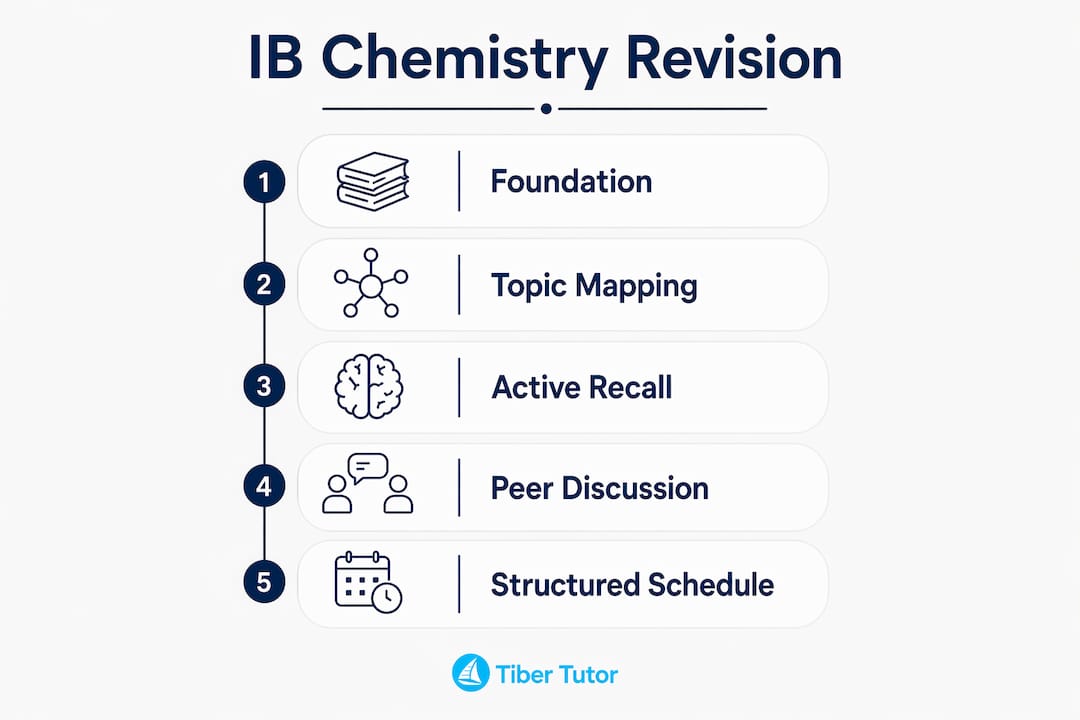
Build a revision timetable that maps topics to the structure-reactivity framework. Spend the first phase of revision consolidating Structure 1 and 2 content. Then move into Reactivity topics, consciously connecting each new area back to the structural concepts you have already reviewed. This is not linear revision. It is iterative, and it mirrors how the IB curriculum is designed.
Active recall is more effective than re-reading notes. Use past paper questions, topic tests, and flashcards to force retrieval rather than recognition. Familiarity with the IB data booklet is also non-negotiable. Practise using it under timed conditions so that locating constants, equations, and electrochemical series data becomes automatic.
Peer discussions and iterative self-assessment using mark schemes are among the most effective consolidation techniques available to IB students. Schedule these regularly, not just in the final weeks before exams.
Pro Tip: Build a structured study schedule at least twelve weeks before your exams. Allocate specific sessions to practical skills review alongside theory, since both appear in the final papers.
Key takeaways
A strong IB Chemistry study approach requires connecting structural concepts to reactivity topics at every stage, not treating them as separate units.
| Point | Details |
|---|---|
| Structure drives reactivity | Every reactivity topic connects back to bonding and particle models studied earlier. |
| Practical skills are assessed | Design, data processing, and evaluation appear in the IA and interdisciplinary project. |
| Use the subject brief first | The 2023 SL/HL subject brief defines exactly what is assessed and at what depth. |
| Active recall beats re-reading | Past papers, topic tests, and mark scheme review build genuine exam readiness. |
| Revise iteratively, not linearly | Return to structure concepts while studying reactivity to deepen explanatory answers. |
What I have learnt from watching students use the study guide
The students who perform best in IB Chemistry are not always the ones who study the most hours. They are the ones who revisit structure concepts repeatedly as they work through reactivity topics. Most students treat bonding as something to learn once in the first term and then move on. That is a mistake. When you are studying acid-base chemistry or redox reactions, the quality of your explanations depends entirely on how well you understand the underlying bonding and electron behaviour.
I have also seen students underestimate practical skills until it is too late. The Internal Assessment is not a box to tick. It is an opportunity to demonstrate the kind of scientific thinking that examiners genuinely want to reward. Start it early, read the criteria carefully, and treat each lab session as practice for it.
One more thing: do not study in isolation. The students who talk through their understanding with peers, who argue about mechanisms and debate experimental designs, consolidate knowledge far faster than those who work alone in silence. Chemistry rewards curiosity and discussion. Let your study habits reflect that.
— Oliver
How Tibertutor supports your IB Chemistry preparation

Tibertutor’s IB Science Questionbank gives you access to a wide range of exam-style Chemistry questions with detailed solutions, covering both SL and HL content across structure and reactivity topics. Every question is aligned to the current curriculum and built by experienced IB educators and examiners. You can practise by topic, track your progress, and identify exactly where your understanding needs strengthening. Whether you are consolidating foundational concepts or preparing for mock exams, Tibertutor integrates naturally alongside your official resources and revision plan. Explore the platform and see how targeted, exam-focused practice builds the confidence you need for results day.
FAQ
What is the IB Chemistry study guide?
The IB Chemistry study guide is a structured resource that organises course content around the two core concepts of structure and reactivity, aligned to the Diploma Programme curriculum for SL and HL students.
What should I prioritise when studying for IB Chemistry?
Start with foundational structure and bonding topics before moving to reactivity. This mirrors the curriculum’s own logic and improves the quality of explanatory answers in exams.
How important is the data booklet in IB Chemistry exams?
The data booklet is provided in all IB Chemistry exams and contains constants, equations, and electrochemical data. Practising with it regularly under timed conditions is a necessary part of exam preparation.
What counts as practical work in IB Chemistry?
Practical work includes hands-on experiments, simulations, modelling activities, and data analysis tasks. It culminates in the Internal Assessment and contributes to the interdisciplinary project.
How do I choose between SL and HL Chemistry resources?
Use the official IBO subject brief to identify which content and skills apply to your level. Most supplementary resources, including Tibertutor’s question bank, clearly label SL and HL content so you can focus your revision precisely.