What is the IB community worldwide: a complete guide
The IB community worldwide is defined as the global network of officially authorised IB World Schools that deliver the International Baccalaureate’s four education programmes to students from age 3 through to 19. As of early 2026, this network spans over 160 countries, with approximately 5,800–6,000 authorised schools serving close to 2 million students. That scale makes the IB one of the most widely recognised pre-university education frameworks on the planet. Understanding how this community is structured, what it stands for, and how it benefits students, parents, and educators is the clearest starting point for anyone considering the IB path. For a broader introduction to the programme itself, the IB programme overview on Tibertutor is a helpful companion read.
What is the IB community worldwide and how is it structured?
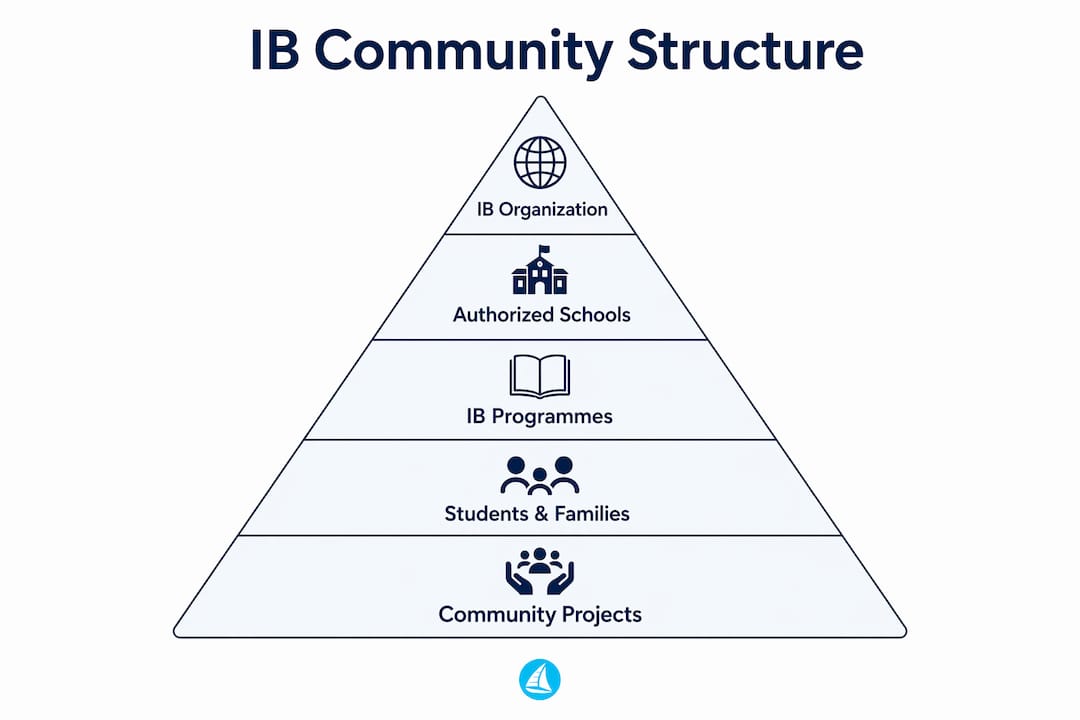
The IB community is built on official authorisation. A school does not simply choose to call itself an IB school. It must apply to the International Baccalaureate Organization (IBO), complete a multi-year candidacy process, and meet rigorous standards before it is listed as an authorised IB World School. This authorisation is a contractual commitment that requires ongoing staff training and external monitoring.

The IBO organises its global school network into three geographic regions: Asia-Pacific (the largest), the Americas, and Africa-Europe-Middle East. Each region manages events, professional development, and community recognition initiatives. This structure keeps a network of thousands of schools connected and accountable to shared standards.
The four programmes that define the community are:
- Primary Years Programme (PYP): for students aged 3–12, focused on inquiry and transdisciplinary learning
- Middle Years Programme (MYP): for students aged 11–16, building conceptual understanding and real-world application
- Diploma Programme (DP): for students aged 16–19, the most widely recognised pre-university qualification
- Career-related Programme (CP): for students aged 16–19, combining academic study with vocational learning
Pro Tip: When researching IB schools, check whether the school is authorised for the specific programme your child needs. A school may hold authorisation for the DP but not the MYP, which affects continuity.
How does the MYP Community Project develop real-world skills?
The Community Project is one of the most distinctive features of the Middle Years Programme. It is a mandatory year-long initiative for MYP students aged 13–15, requiring them to identify a local need, plan a response, take action, and reflect on the entire process. This is not extracurricular volunteering. It is a formal academic assignment graded against the IB Learner Profile.
The project typically moves through four types of student action:
- Investigation: researching the community issue and its root causes
- Planning: writing a formal proposal with clear goals and timelines
- Action: carrying out the chosen response, whether service, advocacy, or a creative product
- Reflection: documenting the process in a journal and evaluating personal growth
What separates the Community Project from a standard school assignment is its emphasis on the “why” and “how.” Grading depends heavily on the quality of a student’s reflection, not the scale of their action. A student who runs a small local food drive and reflects deeply on systemic inequality will score higher than one who organises a large event with no genuine analysis.
The IBO’s shift from ‘Service as Action’ to ‘Community Engagement’ signals a deliberate move away from counting hours toward building genuine ethical awareness. Students are expected to analyse community issues critically and develop a sense of responsibility that lasts beyond the project itself.
This pedagogical change reflects the IBO’s broader belief that education should produce thoughtful citizens, not just capable exam candidates.
Why do mobile families choose IB World Schools?
The IB’s greatest practical advantage for internationally mobile families is curriculum consistency. IB World Schools provide standardised curricula and assessments that transfer across borders, meaning a student moving from Singapore to Geneva to Toronto can continue their IB studies without repeating content or losing academic credit. This portability is particularly valued by families in diplomatic, military, and international business careers.
The table below summarises the key benefits of IB continuity for mobile families:
| Benefit | What it means in practice |
|---|---|
| Standardised curriculum | Same learning objectives and assessment criteria in every authorised school |
| Recognised qualification | The IB Diploma is accepted by universities in over 160 countries |
| Shared school culture | IB Learner Profile values create a consistent school environment |
| Transparent authorisation | Official IBO listing confirms a school meets minimum quality standards |
Authorisation matters, but it is not the whole picture. Schools in candidacy or under re-evaluation are not publicly listed, and authorisation status alone does not tell you how well a school performs academically. The best way to assess a school is to review its recent exam results and diploma qualification rates before enrolment.
Pro Tip: Ask any prospective IB school for its mean DP score and diploma pass rate from the last two examination sessions. This data is far more revealing than a school’s marketing materials.
For parents seeking guidance on supporting their child through the IB, Tibertutor’s resources for IB parents offer practical, experience-based advice.
How does the IB community build values beyond the classroom?
The IBO’s stated mission is to develop caring, inquiring individuals who help create a better and more peaceful world through education. This is not marketing language. It shapes every aspect of how IB programmes are designed, from the IB Learner Profile attributes to the way community engagement is assessed.
The IB Learner Profile defines ten attributes that all IB students are expected to develop:
- Inquirers
- Knowledgeable
- Thinkers
- Communicators
- Principled
- Open-minded
- Caring
- Risk-takers
- Balanced
- Reflective
These attributes appear in lesson planning, assessment criteria, and community project rubrics across all four programmes. They are the thread that connects a 5-year-old in a PYP classroom in Tokyo with a 17-year-old sitting DP exams in Nairobi.
The IBO also recognises outstanding community leadership through formal awards. In 2026, the IBO launched the Community Inspiration Award to honour individuals who embody the IB mission across three global regions: the Americas, Asia-Pacific, and Africa-Europe-Middle East. This annual recognition reinforces the idea that the IB community is not just a collection of schools. It is a living network of educators, students, and families committed to a shared educational philosophy centred on critical thinking and student agency.
IB students are specifically educated to view local problems through a global lens. The focus on international-mindedness means students are not simply completing tasks. They are developing a habit of ethical reflection that carries into adult life. For families exploring how this philosophy connects to the IB core syllabus, Tibertutor’s guide offers clear, structured context.
Key takeaways
The IB community worldwide is a formally authorised global network of schools unified by shared programmes, the IB Learner Profile, and a mission to develop ethical, internationally minded students.
| Point | Details |
|---|---|
| Global scale | Approximately 5,800–6,000 authorised schools operate across more than 160 countries. |
| Four programmes | PYP, MYP, DP, and CP serve students from age 3 through to 19 with consistent standards. |
| Community Project | The MYP Community Project is a graded academic assignment, not optional volunteering. |
| Family mobility | Standardised IB curricula allow students to transfer between schools internationally without losing progress. |
| Values-led mission | The IB Learner Profile and Community Engagement framework prioritise ethical reflection over task completion. |
Why official authorisation matters more than most families realise
I have spoken with many parents who assume that any school advertising IB classes is a fully authorised IB World School. That assumption is worth examining carefully. Authorisation is a multi-year process with external monitoring, and schools in candidacy are not publicly listed. The gap between a school that markets IB and one that is genuinely authorised can be significant in terms of teacher training, resource quality, and exam outcomes.
What strikes me most about the IB community is how seriously the Community Project takes ethical development. Students who engage honestly with the reflection process often describe it as one of the most formative experiences of their school years. The project forces them to sit with discomfort, question their assumptions, and consider whether their actions actually helped. That kind of thinking is rare in secondary education.
For educators, the IB community offers genuine professional development through regional networks and shared resources. The Community Inspiration Award, launched in 2026, is a welcome signal that the IBO is investing in recognising leadership at the school level, not just celebrating exam results.
My advice to any family considering an IB school: look past the branding. Check the authorisation status on the IBO’s official website, ask for recent diploma pass rates, and speak to current students about how the school actually delivers the Learner Profile values in daily school life.
— Oliver
How Tibertutor supports IB science students
IB science students face some of the most demanding exam content in secondary education. Tibertutor is built specifically for this challenge, offering exam-style questions, animated videos, detailed notes, and mock exams aligned with current IB Biology and Chemistry syllabuses.
Students preparing for IB Biology can work through topic-specific Biology tests that mirror the style and difficulty of real IB papers. For Chemistry, IB Chemistry mock exams provide full paper practice with examiner-informed feedback. Every resource on Tibertutor is built by examiners and experienced educators, so students practise exactly what the IBO rewards. Whether you are a student aiming for a 7 or a parent looking for structured support, the IB student resources hub is the clearest place to start.
FAQ
What is the IB community worldwide?
The IB community worldwide is the global network of officially authorised IB World Schools, spanning approximately 5,800–6,000 schools across more than 160 countries and serving close to 2 million students.
What are the four IB programmes?
The four IB programmes are the Primary Years Programme (PYP), Middle Years Programme (MYP), Diploma Programme (DP), and Career-related Programme (CP), covering students from age 3 through to 19.
What is the IB Community Project?
The Community Project is a mandatory year-long academic assignment for MYP students aged 13–15, requiring investigation, planning, action, and reflection graded against the IB Learner Profile.
How does the IB benefit internationally mobile families?
IB World Schools offer standardised curricula and assessments that transfer across borders, allowing students to continue their studies without losing academic progress when families relocate internationally.
How do I verify whether a school is an authorised IB World School?
Check the official IBO website for the school’s authorisation status, and ask the school directly for its recent diploma pass rates and mean DP scores before making an enrolment decision.