IB Chemistry S1.3 Further electron configurations questions
23 questions · 13 multiple choice · 10 long answer
23 questions
Question 1
Loading progress...
Easy
Which of the below species would require the least energy to remove an electron?
Question 2
Loading progress...
Medium
The second ionisation energy of magnesium would be best represented by which of the below?
Question 3
Loading progress...
Easy
Which of the below species would have the most endothermic ionisation energy?
Question 4
Loading progress...
Easy
The value of ΔH for which of the below processes would be the closest to a negative value?
Question 5
Loading progress...
Easy
Which of the following would require the greatest energy to remove an electron?
Question 6
Loading progress...
Medium
The below species are isoelectronic. Which would have the greatest ionisation energy?
Question 7
Loading progress...
Easy
Which of the below species would have the highest value for ionisation energy?
Question 8
Loading progress...
Easy
The correct definition for ionisation energy is given by which of the statements below?
Question 9
Loading progress...
Medium
The value of ΔH for which of the below processes would be the most endothermic?
Question 10
Loading progress...
Easy
Which of the below species would have the least endothermic ionisation energy?
Question 11
Loading progress...
Easy
Which one of the following species would require the least energy to remove an electron?
Question 12
Loading progress...
Hard
An element has the following successive ionization energies (in kJmol-1): , , , , . Deduce the group of the element.
Question 13
Loading progress...
Hard
The convergence limit for an element’s first ionization series occurs at a wavelength of . Which value is closest to the first ionization energy, in kJmol-1? (Use , , .)
Question 14
Loading progress...
Easy
Define what is meant by first ionisation energy
[2]
Question 15
Loading progress...
Easy
Write an equation for the second ionisation energy of Be
[2]
Question 16
Loading progress...
Medium
State and explain the periodic trends seen in ionisation energy:
- across a period
[3]
- down a group
[3]
Question 17
Loading progress...
Hard
The diagram shows the first ionisation energies of the elements in period 3
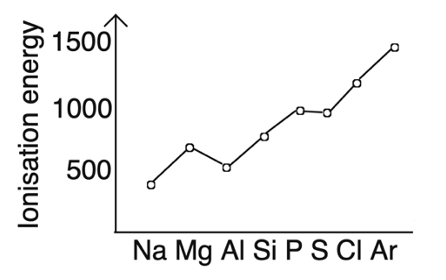
- Explain the general trend.
[2]
- Sketch onto the diagram the line for the ionisation energies of period 2.
[2]
Question 18
Loading progress...
Medium
The diagram shows the sucessive ionisation energies for potassium
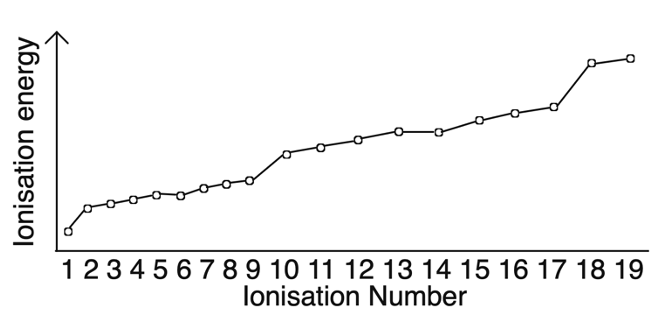
Explain the general trend shown on the diagram
[2]
Question 19
Loading progress...
Hard
Using an emission spectrum, the wavelength of the convergence limit for h was calculated as 88.7 nm. Calculate the ionisation energy of h in kJ mol-1
[3]
Question 20
Loading progress...
Medium
The Hydrogen atom spectrum is shown below:
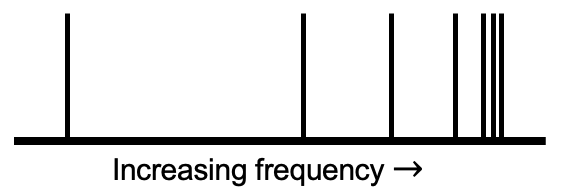
- What instrument is necessary to observe this pattern of radiation?
[1]
- Describe the process occurring in an atom to produce one line in this pattern
[3]
- What can be deduced about H's atomic structure from the existence of specific frequencies?
[1]
- Give an equation representing the ionisation of an atom of H and describe, briefly, how the ionisation energy of H could be obtained from the spectrum above
[2]
- Describe how the ionisation energy of H can be calculated using the line spectrum provided
[2]
Question 21
Loading progress...
Medium
The frequency of a line in the Lyman series of h is 2.784x10¹⁴ Hz. Calculate the energy of the
photons emitted and give your units.
[2]
Question 22
Loading progress...
Medium
Describe why the energy required to reach the convergence limit on an emission spectrum is considered the ionisation energy for an atom. You should refer to the appearance of the spectrum, frequency, and energy in your answer
[3]
Question 23
Loading progress...
Medium
The wavelength of a line in the Balmer series of hydrogen is 726.2m. Calculate the energy of photons emitted and give your units
[2]
Next Up
You have completed the sub-topic S1.3 questions, covering "Further electron configurations" for IB Chemistry - continue with related resources below or explore the full IB Chemistry course from the IBO.
Other Sub-topic S1.3 resources