IB Chemistry S1.3 Electron configurations questions
40 questions · 29 multiple choice · 11 long answer
40 questions
Question 1
Loading progress...
Easy
According to the Aufbau Principle, which is the correct orbital filling order?
Question 2
Loading progress...
Easy
Which of the following is the electronic configuration of titanium?
Question 3
Loading progress...
Easy
The electronic configuration of a Co atom is [Ar] 4s2 3d7. How many unpaired electrons are there?
Question 4
Loading progress...
Medium
Which one of the following elements has no paired p electrons when present as a single atom?
Question 5
Loading progress...
Medium
The ground state electronic configuration for the gallium ion, Ga1+, is
Question 6
Loading progress...
Easy
The total number of electrons in d orbitals in a germanium atom, Ge-32, is
Question 7
Loading progress...
Easy
Which one of the following particles has more electrons than protons and more protons than neutrons?
Question 8
Loading progress...
Medium
Which one of the following atoms has the greatest number of unpaired electrons?
Question 9
Loading progress...
Easy
The total number of electrons in the carbonate ion, CO3 2-, is
Question 10
Loading progress...
Easy
Which of these elements in its ground state will have the largest number of unpaired electrons?
Question 11
Loading progress...
Easy
What is the electron configuration for an atom with 21 electrons?
Question 12
Loading progress...
Medium
Which of the following is found in the ‘f-block' of the periodic table?
Question 13
Loading progress...
Medium
What is the atomic number of an element that has four unpaired electrons?
Question 14
Loading progress...
Hard
Which of the following statements is true?
Question 15
Loading progress...
Medium
Using the Aufbau Principle, deduce which of these has the greatest number of unpaired electrons
Question 16
Loading progress...
Medium
In which region of the Periodic Table would the element with the electronic structure below be located?
1s2 2s2 2p6 3s2 3p6 3d10 4s1
Question 17
Loading progress...
Easy
Which of the below have unpaired electrons?
| I | Rhodium |
| II | Silver |
| III | Cadmium |
Question 18
Loading progress...
Easy
Which electron transition in a H atom releases the highest energy?
Question 19
Loading progress...
Easy
The lines of the emission spectrum of an element are caused by electrons
Question 20
Loading progress...
Medium
Which of the following statements regarding H emission spectra is/are true?
| I | The spectrum is created by photons of light |
| II | Passage of electricity promotes electrons to a higher energy level |
| III | The spectrum provides evidence that electrons can have any value of energy |
Question 21
Loading progress...
Easy
The emission spectrum of an atom appears as a
Question 22
Loading progress...
Easy
Which of the following has/have an atomic emission spectrum like that of H?
| I | He+ |
| II | B- |
| III | Be3+ |
Question 23
Loading progress...
Easy
Which of the following places the components of the electromagnetic spectrum in order of increasing energy (smallest first)?
Question 24
Loading progress...
Medium
Which of the following correctly states the name for the apparatus required to observe an emission spectrum for an element?
Question 25
Loading progress...
Hard
Which of the following electron transitions would have the least negative value for ΔH?
Question 26
Loading progress...
Easy
An electronic transition n = 3 → n = 2 in the H atom spectra produces purple light. What type of radiation would be released for the transition n = 2 → n = 1?
Question 27
Loading progress...
Medium
Which of the following statements regarding the electromagnetic spectrum is/are true?
| I | Microwaves are higher in energy than Gamma-rays |
| II | As frequency increases, wavelength decreases |
| III | Gamma-rays have the smallest wavelength of the spectrum |
Question 28
Loading progress...
Easy
Emission spectra provide information about the …..I…. in atoms through the ….II…..
Question 29
Loading progress...
Easy
Which is the correct order of sublevels in increasing energy?
Question 30
Loading progress...
Easy
Write the full electronic configuration for an atom of K and ion of Sr2+
[2]
Question 31
Loading progress...
Easy
Answer the following parts to this question
- Define what is meant by the term orbital.
[1]
- Draw the shapes of the single s and the three p orbitals.
[2]
Question 32
Loading progress...
Medium
Complete the electronic configurations, for the species shown below, using appropriate symbols
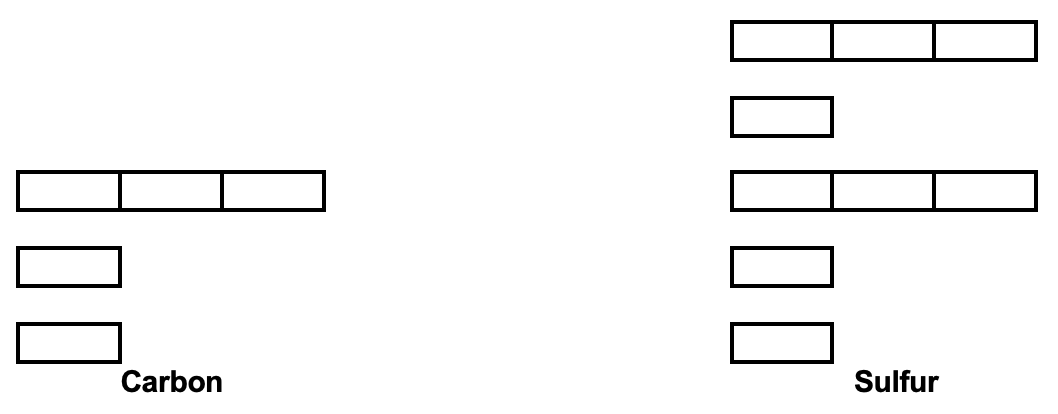
[2]
Question 33
Loading progress...
Medium
Answer the following parts to this question
- Write the full electronic configuration for an atom of Na and ion of Al2+
[2]
- Give the term that can be used to describe these two species.
[1]
Question 34
Loading progress...
Hard
Answer the following parts to this question
- Write out the full electronic configurations of the noble gases Neon, Krypton and Argon.
[3]
- State if any of the above atoms have full outer shells of electrons.
[1]
Question 35
Loading progress...
Medium
Complete the electronic configurations of fluorine and phosphorus below, using appropriate symbols to denote any paired or unpaired electrons
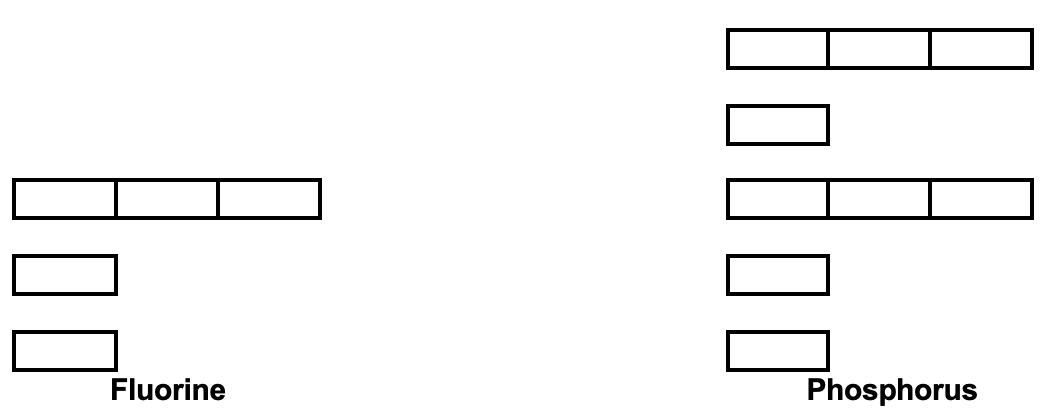
[2]
Question 36
Loading progress...
Medium
Answer the following parts to this question
- List the d, f, p and s orbitals in order of increasing energies
[2]
- Give the number of each type of orbital at each of the first four energy levels.
[2]
Question 37
Loading progress...
Medium
Answer the following parts to this question
- Write the full electronic configuration for an atom of Cr.
[1]
- Give the electronic configuration after the first ionisation of chromium has taken place and state the number of unpaired electrons present.
[2]
Question 38
Loading progress...
Medium
The Hydrogen atom spectrum is shown below:
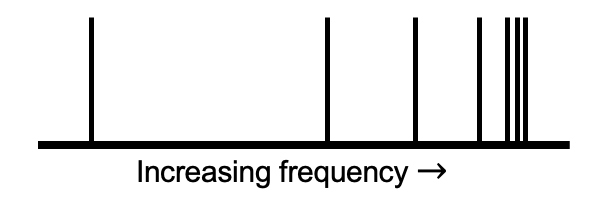
- What instrument is necessary to observe this pattern of radiation?
[1]
- Describe the process occurring in an atom to produce one line in this pattern
[3]
- What can be deduced about H's atomic structure from the existence of specific frequencies?
[1]
- Give an equation representing the ionisation of an atom of H
[2]
Question 39
Loading progress...
Easy
The diagram shows some electron energy levels in an atom of H.
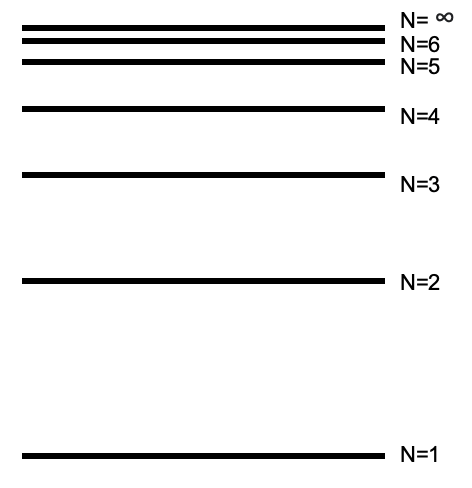
- Draw an arrow to represent the electron transition for the ionisation of H. Label this A.
[2]
- Draw an arrow on the diagram representing the lowest energy transition producing visible light. Label this B.
[2]
- Draw an arrow representing the transition that would produce ultraviolet light. Label this C.
[2]
Question 40
Loading progress...
Hard
Answer the following parts to this question
Write the symbol of the ion with a 1+ charge which has the following electron configuration: 1s2 2s2 2p6 3s2 3p6
[1]
Write the symbols of 3 other species which have the same electron configuration of 1s2 2s2 2p6 3s2 3p6
[1]
Next Up
You have completed the sub-topic S1.3 questions, covering "Electron configurations" for IB Chemistry - continue with related resources below or explore the full IB Chemistry course from the IBO.
Other Sub-topic S1.3 resources