IB Chemistry S3.2 Further functional groups questions
63 questions · 42 multiple choice · 21 long answer
63 questions
Question 1
Loading progress...
Medium
Which of the following is not a valid isomer of the compound 1,2-dibromocyclopropane ?
Question 2
Loading progress...
Medium
Which molecule below would not display cis-trans isomerism?
Question 3
Loading progress...
Easy
How many isometric alkenes, of any type, can be created for C4H8?
Question 4
Loading progress...
Medium
Which of the below would exhibit cis-trans isomers?
| I | CH3CH=CH2 |
| II | CH3CH2CH=CHBr |
| III | CH3CHF=CHCl |
Question 5
Loading progress...
Medium
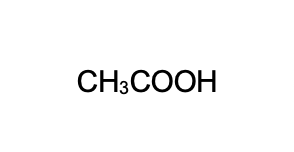
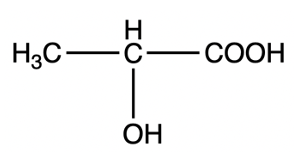
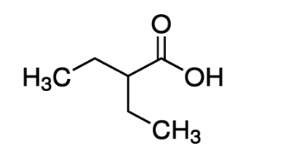
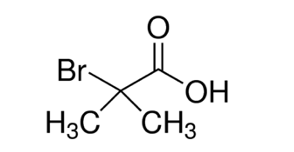
Chose the option below which would exhibit optical activity
A
B
C
D
Question 6
Loading progress...
Medium
Which of the following would contain a chiral centre, also named a chiral carbon?
Question 7
Loading progress...
Medium
Which compound would distort the plane of polarisation of plane polarised light?
Question 8
Loading progress...
Medium
What is the number of isometric alkenes that exist for the compound C3H4Br2 ?
Question 9
Loading progress...
Medium
Which of the following would not have the capability to form E/Z isomers?
Question 10
Loading progress...
Medium
Which of the below options will display optical activity?
Question 11
Loading progress...
Medium
Which answer below could not produce enantiomers?
Question 12
Loading progress...
Medium
Which of the following would not exhibit cis-trans isomers?
Question 13
Loading progress...
Medium
Which of the following options would not contain a Chiral carbon?
Question 14
Loading progress...
Medium
When plane polarised light is passed through the species below, they would all produce a visible change except for?
Question 15
Loading progress...
Easy
The index of hydrogen deficiency (IHD) for a compound is a measure of
Question 16
Loading progress...
Medium
Which of the following shows the correct calculation to find the IHD of C5H7OCl2N?
Question 17
Loading progress...
Easy
The number of peaks that would be visible on the NMR spectrum of the species CH3CH2COCH2CH3 is which of the below?
Question 18
Loading progress...
Easy
What information can be inferred from only the M+ peak of a mass spectrometry graph?
Question 19
Loading progress...
Easy
Which row from the table below correctly pairs the imaging modality to its region of the electromagnetic spectrum?
| Modality | Energy |
|---|---|
| IR spectroscopy | X-rays |
| HNMR spectroscopy | Radio waves |
| Mass spectroscopy | Infra-red |
| Crystallographic spectroscopy | Electrical |
Question 20
Loading progress...
Medium
Which of the following is the correct value for the IHD of C6H9O2ClN2?
Question 21
Loading progress...
Easy
Which of the following gives the best description of X-ray crystallography?
Question 22
Loading progress...
Easy
Which of the following places the components of the electromagnetic spectrum in order of increasing energy (smallest first)?
Question 23
Loading progress...
Easy
A peak on an infra-red spectroscopy graph represents which of the following?
Question 24
Loading progress...
Easy
The term given to the highest peak on a mass spectrogram, seen in every molecule, is which of the following?
Question 25
Loading progress...
Medium
Which of the following statements regarding the electromagnetic spectrum is/are true?
| I | Microwaves are higher in energy than Gamma-rays |
| II | As frequency increases, wavelength decreases |
| III | Gamma-rays have the smallest wavelength of the spectrum |
Question 26
Loading progress...
Easy
A peak on a nuclear magnetic resonance spectrogram represents
Question 27
Loading progress...
Hard
Which row from the table below correctly pairs the section of the electromagnetic spectrum to its type of transitional energy?
| Electromagnetic spectrum | Transitional energy |
|---|---|
| Ultraviolet | Electronic |
| X-ray | Rotational |
| Gamma | Vibrational |
| Infra-red | Nuclear |
Question 28
Loading progress...
Easy
Which of the below descriptions of mass spectrometry is correct?
Question 29
Loading progress...
Medium
Which of the following species would not produce 3 peaks on an NMR spectrum?
Question 30
Loading progress...
Medium
Which of the following has an Index of Hydrogen Deficiency (IHD) of 1?
Question 31
Loading progress...
Medium
How many peaks would be seen on the NMR spectrum for CH3CH2OH ?
Question 32
Loading progress...
Medium
Which of the following does not have an IHD that matches the others?
Question 33
Loading progress...
Medium
Which one of the statements below, describing spin-spin coupling, is false?
Question 34
Loading progress...
Easy
The units for infra-red radiation are wavenumbers. How can this unit be expressed?
Question 35
Loading progress...
Easy
The splitting pattern observed in high resolution nuclear magnetic resonance spectra is best represented by which row of the following table?
| Number of adjacent protons | Splitting pattern |
|---|---|
| 0 | Triplet |
| 1 | Doublet |
| 2 | Doublet |
| 3 | Triplet |
Question 36
Loading progress...
Hard
Of which wavenumber is the infra-red radiation used in infra-red spectroscopy?
Question 37
Loading progress...
Medium
The fingerprint region of an infra-red spectrogram is defined by which of the following statements?
Question 38
Loading progress...
Easy
The process by which CH3CH3 breaks down into two CH3+ ions during mass spectrometry of ethane is known by which term?
Question 39
Loading progress...
Medium
Which of the following statements regarding integration traces is/are true?
| I | They represent the area under each peak on an NMR spectrogram |
| II | The height reflects the number of protons found in each H environment |
| III | They can be different for two species with the same molecular formula |
Question 40
Loading progress...
Easy
Which of the following is/are not justifications for use of TMS as a standard in NMR spectroscopy?
| I | It has 15 protons in the same environment, giving a clear signal |
| II | It produces a signal far away from organic compounds |
| III | It is non-toxic and inert |
Question 41
Loading progress...
Medium
Which of the following statements regarding mass spectrometry is/are true?
| I | A peak at M15 could be produced by CH3 |
| II | The fragment lost from butane to give rise to a peak at M43 is CH3 |
| III | A compound containing Cl would produce an M+2 peak |
Question 42
Loading progress...
Hard
Which row from the table below correct states the observation seen on a mass spectrogram for a species containing each of the elements specified?
| Element | Observation |
|---|---|
| Chlorine | M+1 peak of 30% size as the M+ peak |
| Chlorine | M+2 peak of equal size as the M+ peak |
| Bromine | M+1 peak of 30% size of the M+ peak |
| Bromine | M+2 peak of equal size as the M+ peak |
Question 43
Loading progress...
Easy
Draw and name the two geometrical isomers of C4H8.
[3]
Question 44
Loading progress...
Hard
This question is based on the following reaction scheme. A has the structure shown below:

- Use the E/Z isomerism system to identify the geometry of A.
[1]
- B can exist as optical isomers. Name B and explain the existence of such isomers.
[2]
(i) Draw the two isomers of B, displaying any relationship deemed relevant
(ii) Explain what is meant by the term plane-polarised light and use this to describe a test to distinguish between the isomers you have drawn in (i)
(iii) Explain why, when tested, B showed no optical activity.[8]
Question 45
Loading progress...
Medium
Answer the following parts to this question
- 1,2-dichlorocyclopentane has two geometrical isomers (cis/trans). Draw these two structures and use the cis/trans scheme to suggest appropriate names.
[2]
- Which of these two isomers would distort plane polarised light?
[1]
Question 46
Loading progress...
Hard
Consider the three alkenes A, B, C as shown below:
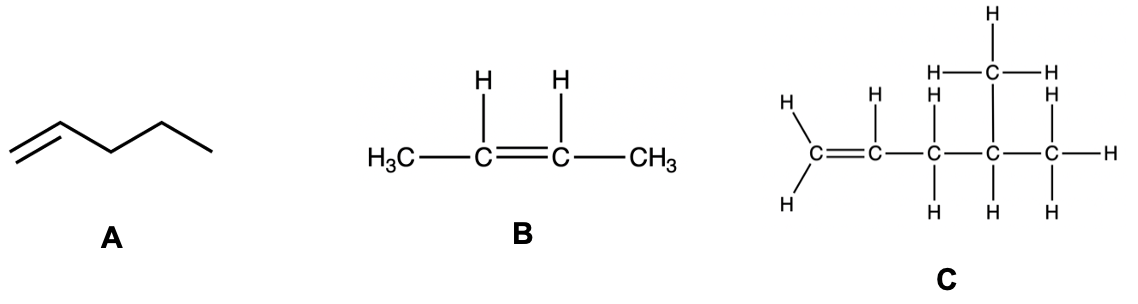
- Identify the alkene that can exist as cis-trans isomers.
[1]
- Draw the displayed formulae of the two isomers for the molecule you have chosen in a) and state their names using the IUPAC naming system.
[2]
- Explain the existence of these two isomers.
[2]
- Two E- isomers exist for A. Draw their full structural formula.
[2]
Question 47
Loading progress...
Hard
A specific alkane can be converted to a monofluorinated product by free radicle substitution in the presence of UV light. The equation for the reaction is: C6H14 + F2 → C6H13F + HF
- Draw and name the three possible isomers of C6H14 with a carbon chain of at least 5 C's.
[4]
- Four products of C6H13F can alter the plane of polarization of plane-polarised light. Draw and name these pairs of products, showing the relationship within each pair and the term used to describe these pairs.
[4]
- Outline the effect on the plane of polarisation of plane-polarised light for both products.
[3]
- Explain why no optical activity is seen when a universal solution of both products is created.
[2]
Question 48
Loading progress...
Medium
Compound X has an Mr of 74. Its percentage composition by mass is 64.9%, 13.5% and 21.6% carbon, hydrogen and oxygen respectively.
- Work out the empirical formula for X
[3]
- Calculate the IHD for compound X.
[1]
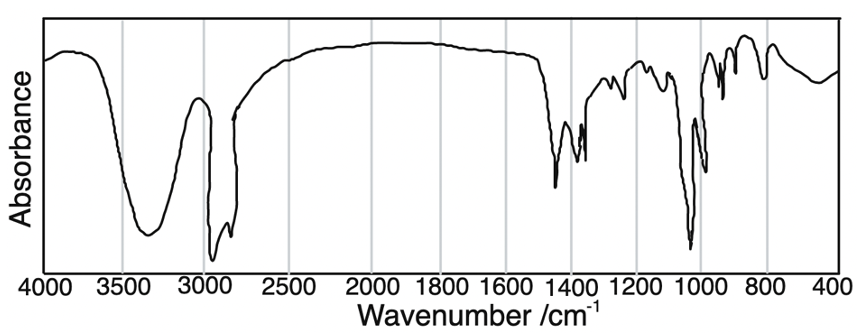
- Y is an isomer of X and the IR spectrum for Y is shown below. Name the functional group present in Y.
[1]
Question 49
Loading progress...
Medium
The HNMR spectrum below is for compound A, which has the molecular formula C3H6Cl2.
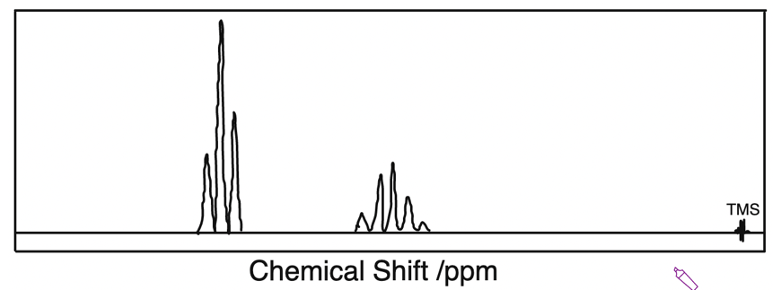
- Draw out all possible isomers of A, naming each one.
[4]
- Explain what information is obtained from each of the following:
(i) Number of peaks [1]
(iii) Integration trace[2]
Question 50
Loading progress...
Easy
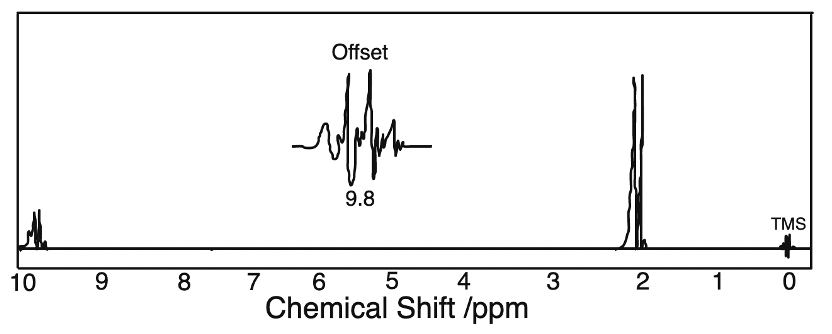
Below is the HNMR spectrum for a compound of only 2 C atoms. Use the data booklet and spectra below to identify the structure of the compound.
[2]
Question 51
Loading progress...
Easy
The mass spectrum for a hydrocarbon is shown below.
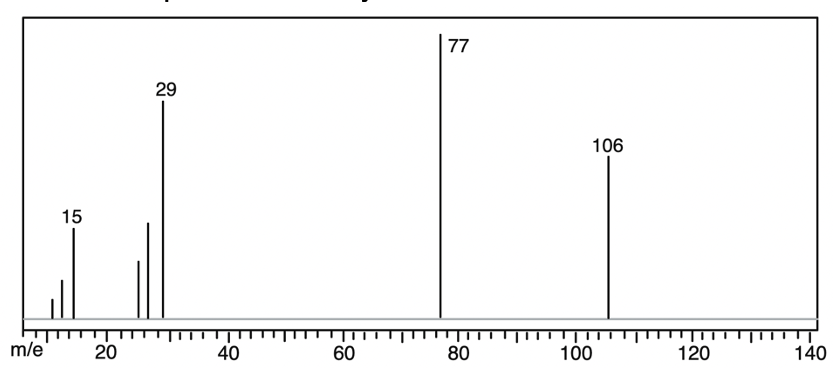
- Identify the molecular ion peak.
[1]
- Using the data booklet, suggest the identity of the fragment that could be responsible for the peak seen at m/z 77.
[1]
Question 52
Loading progress...
Easy
A compound contains only 3 C atoms, with the rest of the compound consisting of H and O. The mass spectrum for this compound shown below.
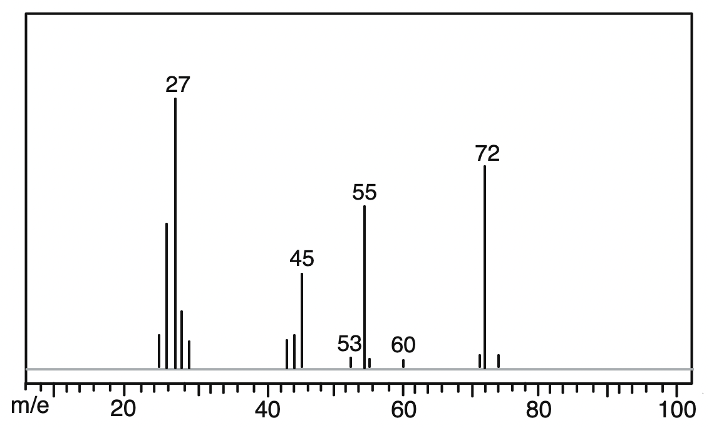
- Suggest a molecular formula for the compound represented by this mass spectrum.
[1]
- What is the IHD for this compound?
[1]
Question 53
Loading progress...
Hard
Compound A has an Mr of 74. Its percentage composition by mass is 64.9%, 13.5% and 21.6% carbon, hydrogen and oxygen respectively.
- Work out the empirical formula for A
[3]
- State the IHD of A.
[1]
- Consider the IR spectrum of A as shown below. Suggest and name 3 different structural formulae for A.
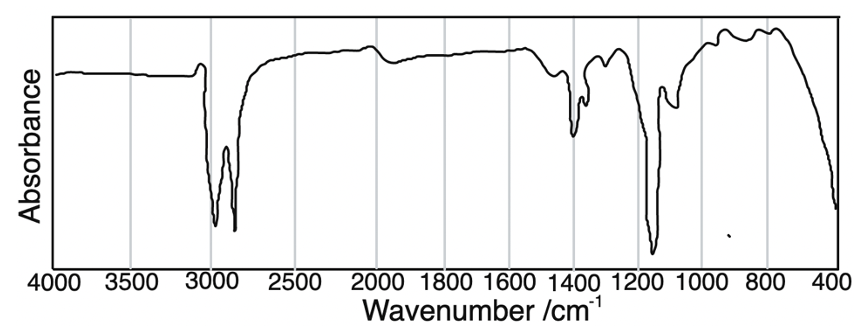
[4]
- B is an isomer of A and the IR spectrum for this isomer is shown below. Identify the functional group present in B but not A.
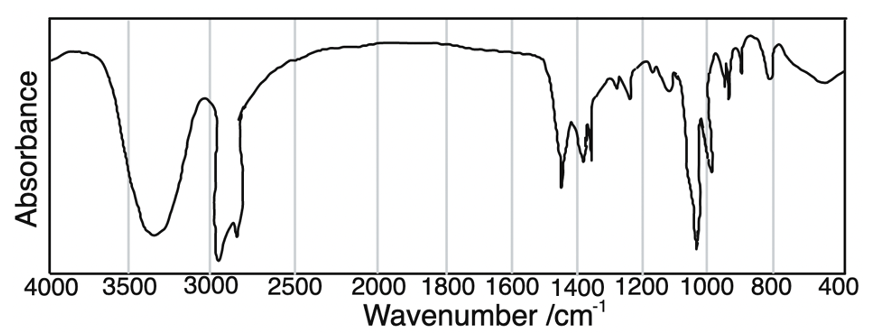
[1]
Question 54
Loading progress...
Hard
Liquid X was left in an open container on a windowsill for a few days. In doing so, X turned into Y (Mr = 122). Both X and Y contain only carbon, hydrogen and oxygen. The IR spectra for X is:
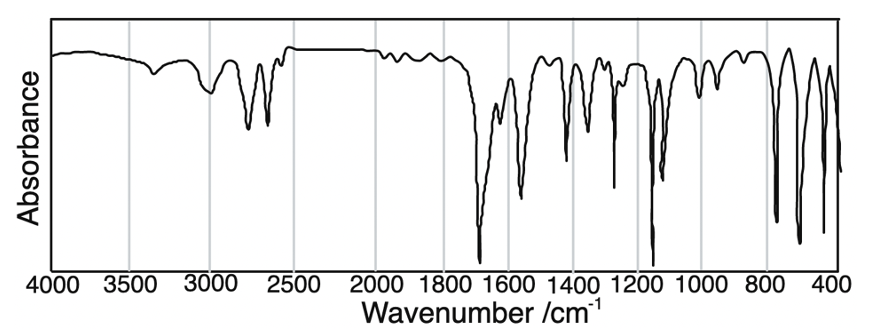
- Name the region of the x-axis below 1500 cm-1.
[1]
- Identify the bond responsible for the absorption (dip) at 1700 cm-1.
[1]
- The IR spectrum for Y is below. If both X and Y have IHDs of 5, draw structures for these compounds, explaining your reasoning. [4]
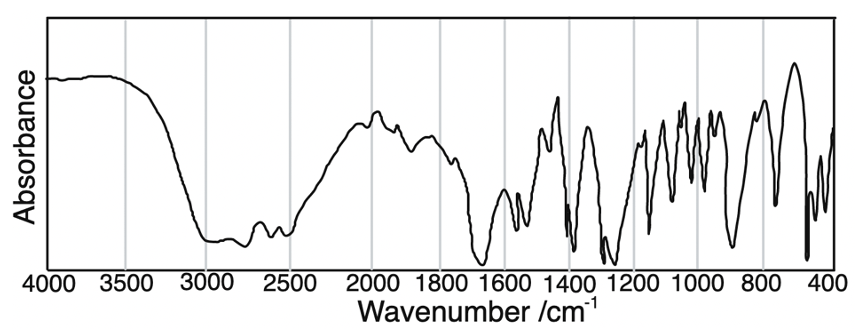
[4]
Question 55
Loading progress...
Hard
The HNMR spectrum below is for compound X, which has the molecular formula C3H6Cl2.
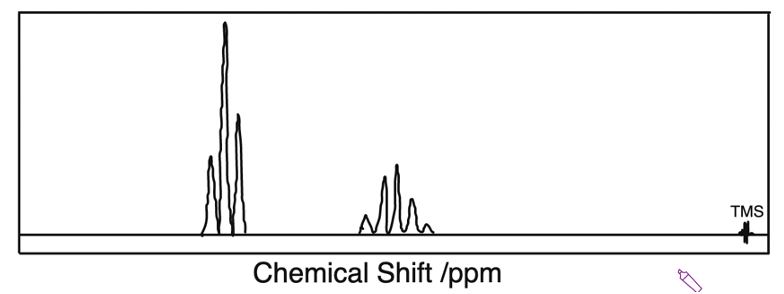
- Draw out all possible isomers of C3H6Cl2, naming each one.
[4]
- Explain what information is obtained from each of the following:
(i) the number of peaks
(ii) the multiplicity (splitting) of each peak
(iii) the integration trace[4]
- Using the information from the spectrum and your answer to (a), deduce the structure of X.
[2]
Question 56
Loading progress...
Easy
The HNMR spectrum below represents a compound containing 3 C atoms. The rest of the molecule is made of H and O. Using the data booklet, deduce the structure of the compound.
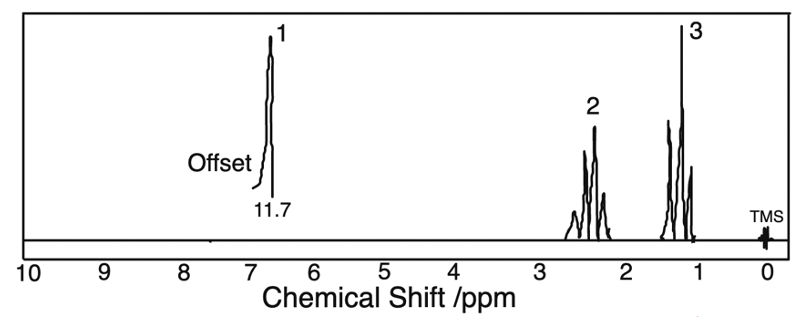
[2]
Question 57
Loading progress...
Medium
The HNMR spectrum below represents the species with empirical formula C4H5 and Mr 106.
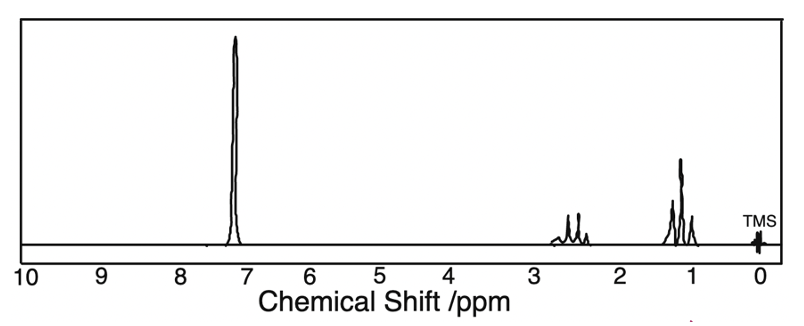
- Using the data booklet, identify what could be responsible for the peak at 7.1 ppm.
[1]
- Identify the multiplicity of the remaining two peaks.
[2]
- What information does your answer to (b) give about the structure of the species?
[2]
- Calculate the molecular formula and hence the IHD for the species
[2]
- Deduce the structure of the species.
[1]
Question 58
Loading progress...
Medium
The two spectra below belong to two isomers of C4H10O. Identify the structures of these isomers.
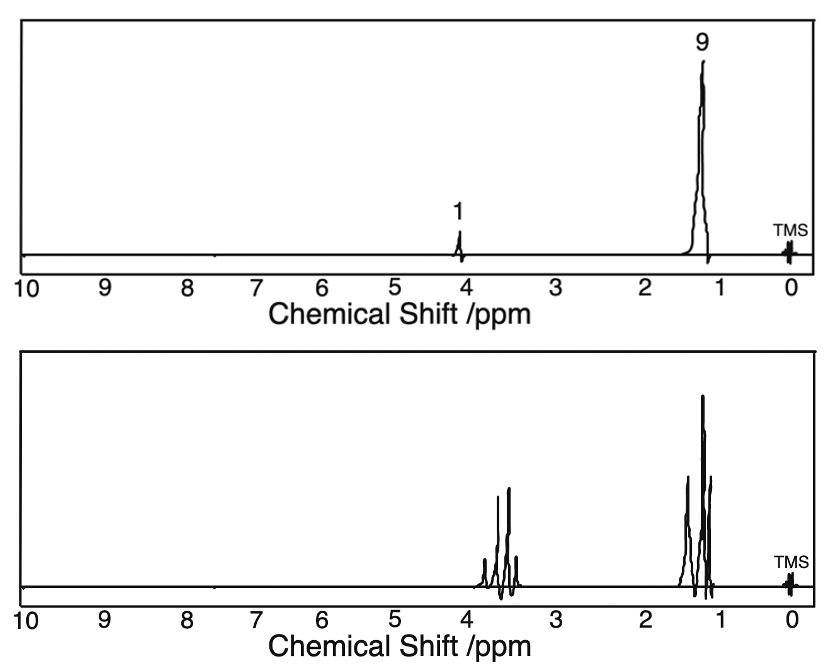
[2]
Question 59
Loading progress...
Hard
The HNMR spectrum below represents a 4C ester.
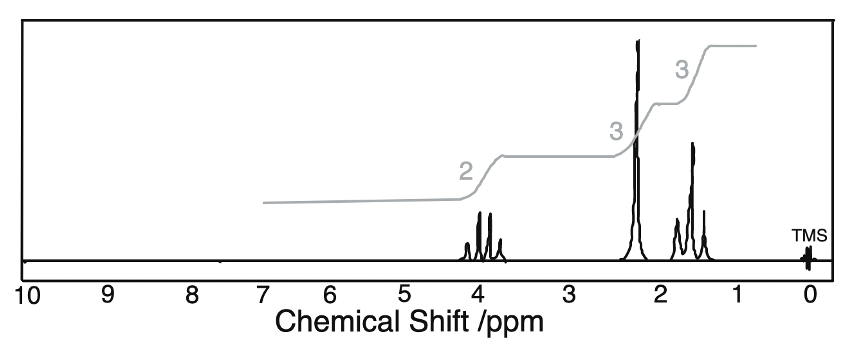
- Write the molecular formula of this compound. Assume the ester is the only functional group.
[1]
- Draw the four possible isomers and name them all.
[5]
- Two of these isomers could produce the HNMR spectrum above. Identify which two.
[2]
- Using the data booklet, explain and name the isomer from (c) that produced this spectrum.
[2]
Question 60
Loading progress...
Medium
The mass spectrum for hydrocarbon A is shown below.
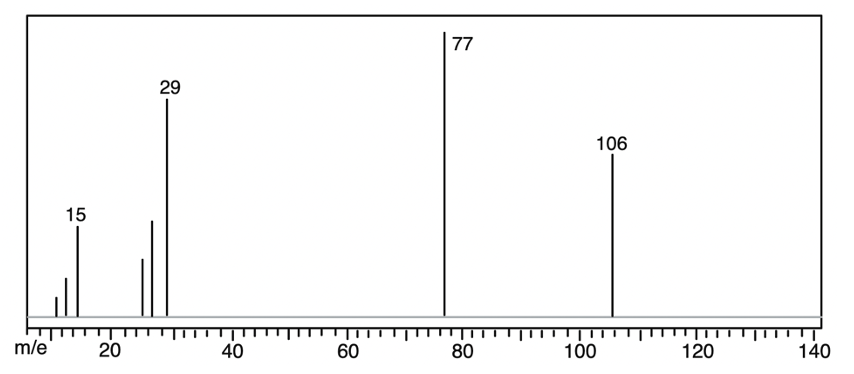
- Identify the molecular ion peak.
[1]
- Which fragment is lost to generate the peak at m/z 77?
[1]
- Suggest the identity of the fragment that could be responsible for the peak seen at m/z 77.
[1]
- Identify the fragments responsible for the peaks at m/z 15 and m/z 29.
[2]
- Suggest a structure for compound A.
[1]
Question 61
Loading progress...
Medium
A compound contains only 3 C atoms, with the rest of the compound consisting of H and O. The mass spectrum for this compound shown below.
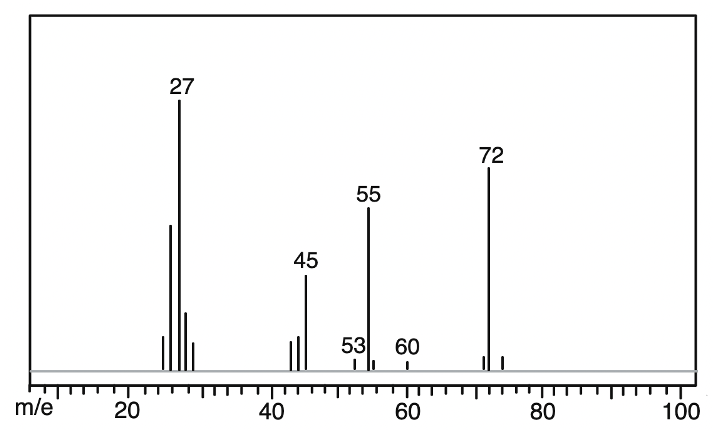
- Suggest a molecular formula for the compound represented by this mass spectrum.
[1]
- What is the IHD for this compound?
[1]
- On the mass spectrum a peak can be seen at m/z 73. Explain the presence of this peak and state the information it reveals about the compound.
[2]
- State the identity of the group lost to give rise to the peak at m/z 55.
[1]
- What is the fragment responsible for the peak at m/z 45?
[1]
- Propose a structure for the compound.
[1]
Question 62
Loading progress...
Hard
The substance X has the percentage by mass of 54.5 % C, 9.1 % H and 36.4 % O. An HNMR spectrum of X had 3 peaks, with an integration trace ratio of 3:2:3.
- Calculate the empirical formula of X
[3]
- The mass spectrum for X is shown below. Use this to deduce the molecular formula for X.
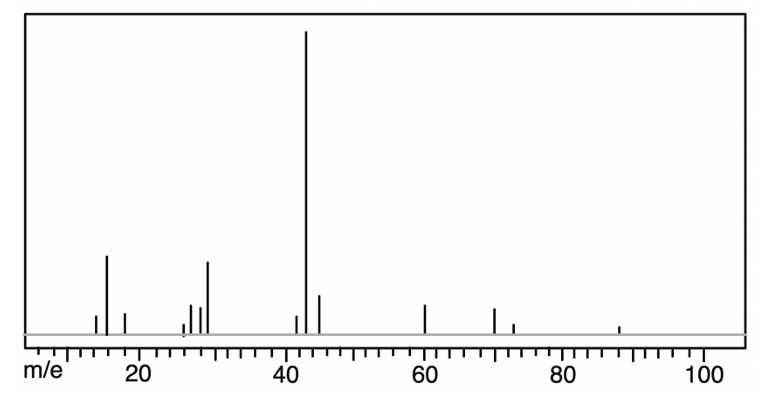
[1]
- Using your answer to (b), calculate the IHD for X.
[1]
- Use the IR spectrum below to draw and explain the structural formula of X. [4]
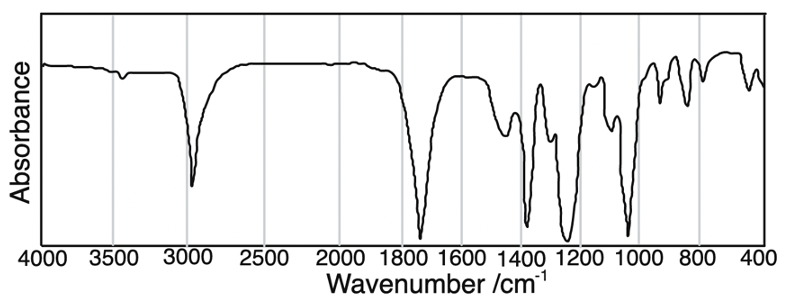
[4]
Question 63
Loading progress...
Hard
Compound A contains only carbon, hydrogen and oxygen, and has an IHD of 5. The mass spectrum of A is shown below.
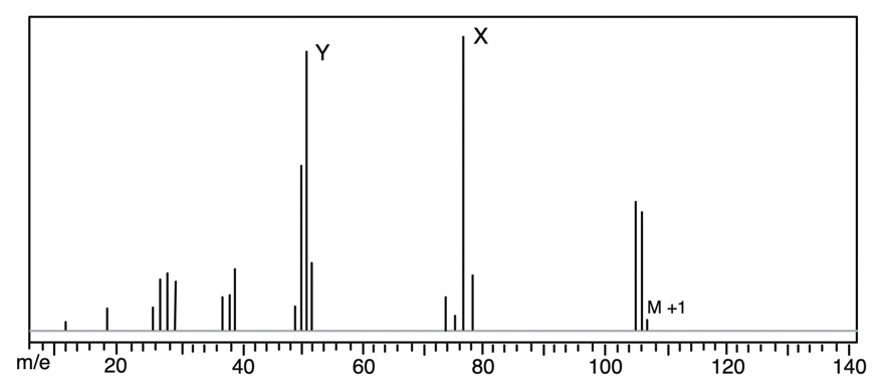
- What is the Mr of A?
[1]
- Explain the ‘M +1' peak shown.
[1]
- What fragment creates peak X (m/z 77) and what fragment was lost to produce this peak?
[2]
- Compound A can be oxidised to form a new compound, Z. The IR spectra for Z is shown. Identify the functional groups causing the absorptions A and B in the spectrum below. [2]
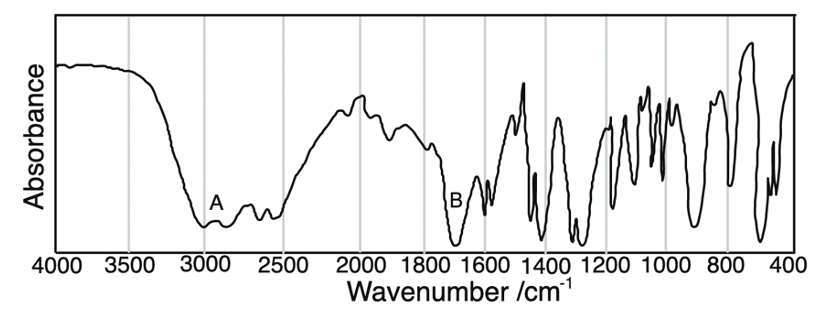
[2]
- Use the two spectra above to identify the structures for compounds A and Z.
[2]
Next Up
You have completed the sub-topic S3.2 questions, covering "Further functional groups" for IB Chemistry - continue with related resources below or explore the full IB Chemistry course from the IBO.
Other Sub-topic S3.2 resources