IB Maths AA 1.3 Notes
This page contains our IB Maths AA notes for 1.3. By reading each one of these notes, you will fully cover the content for IB Maths AA 'Geometric sequences'.
Chapters
Geometric sequences & the common ratio
A geometric sequence is a sequence in which each term is found by multiplying the previous term by a constant value. This constant value is called the common ratio, written as .
For example, in the sequence , each term is found by multiplying the previous term by , so the common ratio is . So a geometric sequence has the form:
where is the first term. A geometric sequence is sometimes also called a geometric progression.
Key terms:
- The first term is usually written as .
- The common ratio is written as .
- The th term is written as .
Geometric sequences are useful for modelling repeated percentage change or repeated scaling. Examples include population growth, depreciation, bacterial growth and compound interest.
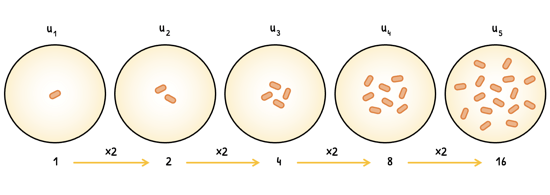
Geometric sequences and series appear whenever there is repeated multiplication by the same factor.
- population growth by a fixed percentage each year
- depreciation of a car by a fixed percentage each year
- spread of disease
- compound interest
- repeated halving or doubling processes
In these contexts, the common ratio is often found from a percentage change.
- For example, a yearly increase of corresponds to .
- A yearly decrease of corresponds to .
tibertutor.com
Next Up
You have completed the sub-topic 1.3 notes, covering "Geometric sequences" for IB Maths AA - continue with related resources below or explore the full IB Maths AA course from the IBO.
Other Sub-topic 1.3 resources