IB Maths AA 4.4 Notes
This page contains our IB Maths AA notes for 4.4. By reading each one of these notes, you will fully cover the content for IB Maths AA 'Linear statistics'.
Chapters
Scatter diagrams & correlation
Linear statistics studies the relationship between two numerical variables. The main tools are scatter diagrams, Pearson's product-moment correlation coefficient , and regression lines. These are used to describe, model and predict linear relationships in bivariate data.
Bivariate data consists of paired values, usually written as . For example, might represent hours studied and might represent test score. Each student gives one pair of values.
A scatter diagram is a plot of paired data values on a coordinate grid. Each point represents one observation. Scatter diagrams help us see whether there is a relationship between the variables.
A line of best fit drawn by eye should pass through the mean point .
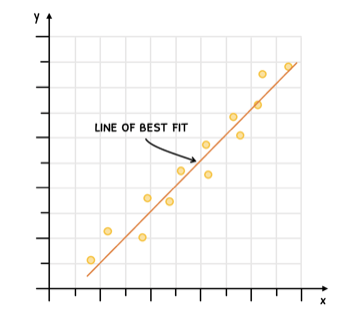
There are three main types of correlation seen in a scatter diagram:
- If the points tend to rise from left to right, there is positive correlation.
- If the points tend to fall from left to right, there is negative correlation.
- If there is no clear pattern, there is no correlation.
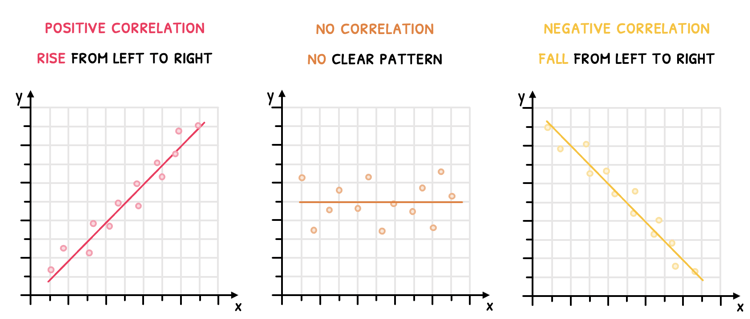
The correlation may also be described as strong or weak depending on how closely the points follow a straight-line pattern. It is important to remember that correlation does not imply causation.
tibertutor.com
Next Up
You have completed the sub-topic 4.4 notes, covering "Linear statistics" for IB Maths AA - continue with related resources below or explore the full IB Maths AA course from the IBO.
Other Sub-topic 4.4 resources