IB Maths AI 4.14 Notes
This page contains our IB Maths AI notes for 4.14. By reading each one of these notes, you will fully cover the content for IB Maths AI 'Transition matrices'.
Chapters
Markov chains & transition matrices
Transition matrices are used to model systems that move between a fixed set of states in steps. At each step, there is a probability of moving from one state to another. These systems are called Markov chains.
A Markov chain is a process in which the next state depends only on the current state. It does not depend on the earlier history of the system.
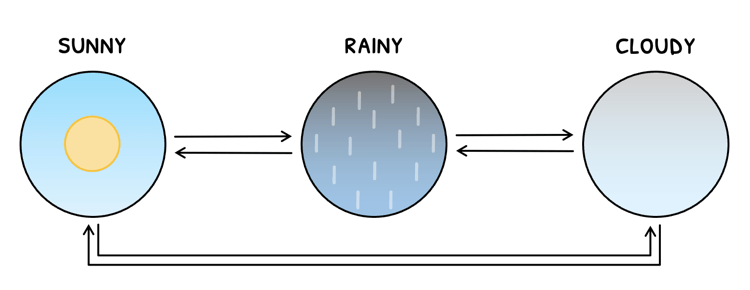
Examples include customer brand switching, weather changes, movement between towns, and population movement between categories.
A state is one of the possible positions or conditions of the system. For example, a person may be in state , , or . A transition diagram shows the possible moves between these states, with arrows labelled by probabilities.
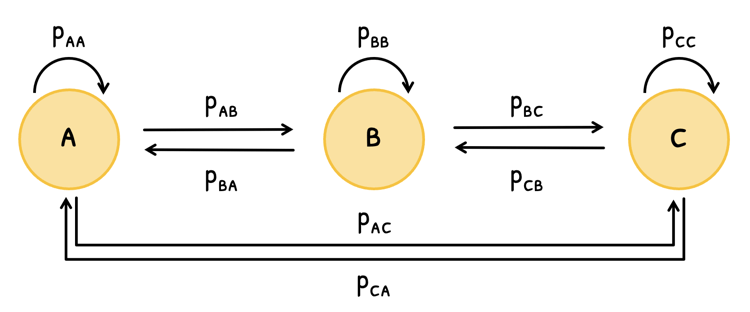
The probabilities leaving a state must add to , since the system must move somewhere.
A transition matrix records the probabilities of moving between states. Using the column-state convention, the entry gives the probability of moving from state to state . This means each column of the matrix adds to .
If there are three states, the transition matrix may look like:
Here, the first column gives the probabilities of moving from state , the second column gives the probabilities of moving from state , and the third column gives the probabilities of moving from state .
tibertutor.com
Next Up
You have completed the sub-topic 4.14 notes, covering "Transition matrices" for IB Maths AI - continue with related resources below or explore the full IB Maths AI course from the IBO.
Other Sub-topic 4.14 resources