IB Physics D3 Notes
This page contains our IB Physics notes for D3. By reading each one of these notes, you will fully cover the content for IB Physics 'Electromagnetic motion'.
The Motor effect
The last concept in Topic D you need to understand is what happens when charges travel through magnetic fields, meaning it crosses flux lines. This causes the charge's magnetic field and the external magnetic field to interact. Michael Faraday described a visual analogy to explain how this affects the moving charge:
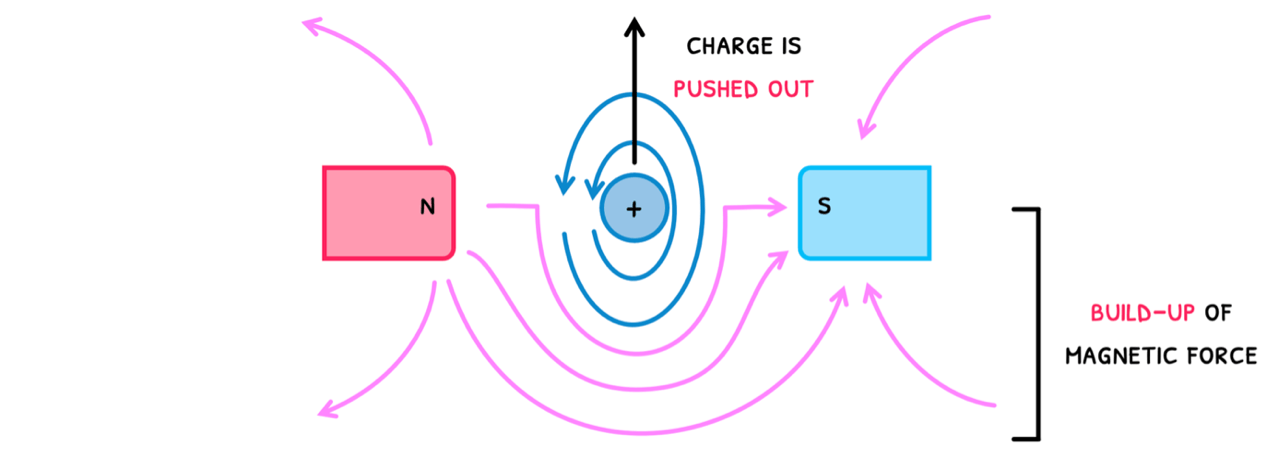
- The external magnetic field basically conforms around the charge’s magnetic field.
- This creates a build-up of magnetic force around one side of the charge and an empty space on the other side.
- So, the built-up force pushes the only movable component of this system, the charge, out of the system.
This phenomenon is called the motor effect because it is applied to motors to convert electrical energy into kinetic energy.
You need to remember that if the magnetic field is stronger, or the charge has a higher value, velocity, or angle of crossing, the deflection is stronger. The formula for this is:
Note that if a charge travels parallel to the external magnetic field, there is no interference of the magnetic fields and so there is no motor effect!
Now if the motor effect occurs with a single charge, it must also occur with multiple charges, ie a current! So, if a current-carrying wire crosses a magnetic field, it also undergoes the motor effect, just continuously. Understandably, the formula here changes:
tibertutor.com
Next Up
You have completed the sub-topic D3 notes, covering "Electromagnetic motion" for IB Physics - continue with related resources below or explore the full IB Physics course from the IBO.
Other Sub-topic D3 resources