Cognitive load theory explained for students and educators
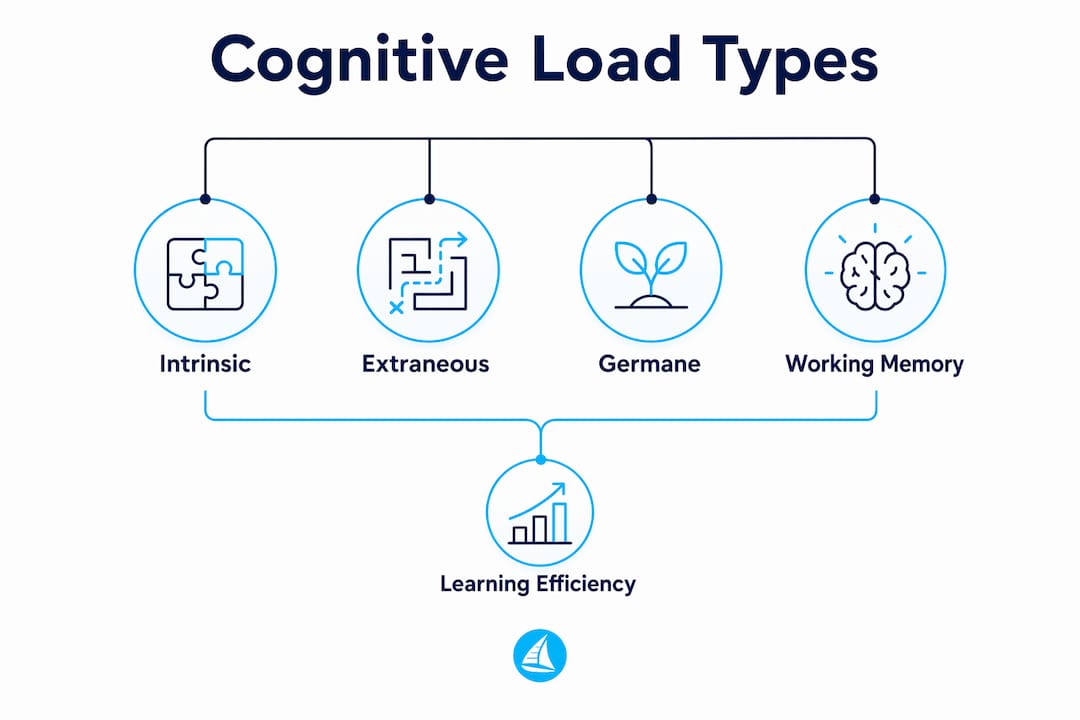
Cognitive load theory is defined as the psychological framework describing how working memory processes new information within strict capacity limits. Developed by John Sweller in the 1980s, the theory identifies that working memory holds only around 4 ± 1 information elements at once. That constraint shapes every effective teaching and learning decision. The theory classifies mental effort into three types: intrinsic, extraneous, and germane cognitive load. Understanding these distinctions helps students study more efficiently, helps educators design better lessons, and helps parents support their children with greater confidence.
What is cognitive load theory and its three types?
The three types of cognitive load are intrinsic, extraneous, and germane. Each plays a distinct role in how well a learner absorbs and retains new material.
Intrinsic cognitive load is the inherent difficulty of the subject matter itself. A student learning cell division in IB Biology faces high intrinsic load because the topic involves multiple interacting processes. This type of load cannot be eliminated, but it can be managed by breaking content into smaller, sequential steps.

Extraneous cognitive load is the mental effort caused by poor instructional design, not by the subject itself. A poorly laid out diagram with labels scattered across the page forces the brain to search for connections rather than learn the concept. This type of load should be minimised wherever possible.
Germane cognitive load is the productive mental effort that builds lasting knowledge structures, called schemas. Active retrieval and reflection increase germane load and strengthen learning. This is the type of effort educators want to encourage.
- Intrinsic load: tied to content complexity; manage it with scaffolding and sequencing.
- Extraneous load: caused by design flaws; reduce it with clear, focused presentation.
- Germane load: builds schemas; increase it with retrieval practice and problem-solving.
The goal is not to eliminate all mental effort. The goal is to direct effort toward germane load while keeping the other two within manageable limits.
Pro Tip: When revising a difficult IB Science topic, break it into subtopics of three to four concepts each. This keeps intrinsic load within working memory limits and leaves capacity for schema building.
How does cognitive load theory inform effective instructional design?
Instructional design grounded in cognitive load theory produces measurably better learning outcomes. Chunking information into smaller segments and avoiding redundancy keeps total load within working memory capacity. Several well-researched strategies follow directly from this principle.
- Chunking: Group related concepts together before introducing new ones. In IB Chemistry, teach electron configuration before moving to periodic trends.
- Worked examples: For novice learners, worked examples outperform unguided problem-solving. They prevent working memory overload and promote schema formation.
- Modality integration: Pair a diagram with spoken narration rather than written text. Complementary modalities use separate cognitive channels, reducing total load.
- Avoiding redundancy: Presenting identical information in two formats simultaneously, such as reading a script aloud while displaying the same text on screen, raises extraneous load and reduces retention. This is known as the redundancy effect.
- Split-attention elimination: When a diagram and its explanation are placed far apart, learners must mentally integrate them. Placing labels directly on the diagram removes this unnecessary effort.
The split-attention effect is particularly relevant in science education. A physics diagram with a separate legend forces students to hold both in working memory simultaneously. Integrating the label into the diagram frees that capacity for actual learning.
Pro Tip: Educators designing IB Science revision materials should favour diagram-plus-narration over text-heavy slides. This approach uses both visual and auditory channels without redundancy, keeping extraneous load low. Structured exam question banks built on this principle help students practise efficiently.
What is the expertise reversal effect and how does prior knowledge affect cognitive load?
The expertise reversal effect describes how instructional methods that help novices can actually hinder more advanced learners. Teaching must match the learner’s current knowledge level to remain effective.
Novice learners have few schemas. They benefit from detailed worked examples, step-by-step guidance, and heavy scaffolding because their working memory fills quickly with unfamiliar elements. An IB student encountering enzyme kinetics for the first time needs a fully worked example before attempting problems independently.
Experts, by contrast, have built rich schemas that allow them to process complex information as a single unit. Providing them with the same scaffolding wastes cognitive resources and can actually slow learning. A student who already understands enzyme kinetics gains more from open-ended problems than from guided walkthroughs.
- Novice learners: use worked examples, scaffolding, and step-by-step guidance.
- Intermediate learners: reduce scaffolding gradually as schemas form.
- Expert learners: use open problems, case studies, and minimal guidance.
Schemas are the key mechanism here. Learners develop schemas over time, and these schemas effectively expand their functional cognitive capacity. A student who has practised enough IB Physics problems no longer processes each step individually. The entire procedure becomes one mental unit.
Adaptive teaching based on proficiency is not a luxury. It is the most direct application of cognitive load theory in the classroom.
What practical steps can students, educators, and parents take?
Applying cognitive load theory does not require a complete overhaul of study habits. Small, deliberate adjustments produce real gains in comprehension and retention. Short focused study sessions with clear goals outperform long, unfocused ones because they keep total load within manageable limits.
| Audience | Strategy | Why it works |
|---|---|---|
| Students | Study in 25-minute focused blocks | Prevents working memory saturation |
| Students | Use retrieval practice over re-reading | Builds germane load and schemas |
| Educators | Remove redundant text from slides | Reduces extraneous load |
| Educators | Sequence content from simple to complex | Manages intrinsic load progressively |
| Parents | Encourage a distraction-free study space | Frees working memory for learning |
| Parents | Ask children to explain concepts aloud | Promotes schema consolidation |
High cognitive load impairs not only learning but also decision-making and self-regulation. This means that a student studying in a noisy, distraction-filled environment is not just less focused. They are actively less able to make good decisions about their own learning.
For IB Science students specifically, spaced retrieval across topics, combined with biology exam prep strategies that sequence difficulty progressively, directly mirrors cognitive load principles.
Pro Tip: Parents can support schema building at home by asking their child to explain a topic in simple terms after studying. If the child can teach it clearly, the schema is forming. If they struggle, that signals where more practice is needed.
Key takeaways
Cognitive load theory works because working memory is limited, and learning succeeds only when intrinsic load is managed, extraneous load is minimised, and germane load is actively built through effortful practice.
| Point | Details |
|---|---|
| Working memory is limited | Working memory holds roughly 4 ± 1 elements; exceeding this capacity blocks learning. |
| Three types of load matter | Intrinsic, extraneous, and germane loads each require a different instructional response. |
| Reduce extraneous load first | Poor design wastes cognitive capacity; clear, integrated materials free it for real learning. |
| Match teaching to expertise | The expertise reversal effect means novice strategies can hinder advanced learners. |
| Schemas expand capacity | Building schemas over time allows learners to handle more complex material efficiently. |
Why cognitive load theory changed how I think about teaching
Most people assume that working harder automatically means learning more. Cognitive load theory shows that is simply not true. I have seen students spend hours re-reading notes and retain almost nothing, while others who spent half the time on retrieval practice performed significantly better. The difference was not effort. It was the type of effort.
The most common misconception I encounter is that reducing cognitive load means making content easier. It does not. It means removing the friction that has nothing to do with the subject itself. A cluttered diagram, a confusing layout, or a lesson that jumps between unrelated ideas all add load without adding learning. Strip those away and the same student can handle far more complexity.
The expertise reversal effect is the insight that surprises educators most. A teacher who has spent years mastering a subject genuinely struggles to remember what it felt like not to know it. That gap causes well-meaning teachers to under-scaffold for novices and over-scaffold for stronger students. Recognising this pattern is the first step to fixing it.
Cognitive load theory does not give you a formula. It gives you a lens. Once you see learning through it, you cannot unsee it.
— Oliver
How Tibertutor supports cognitive load principles for IB students
Tibertutor is built around the same principles that cognitive load theory describes. Every resource on the platform is designed to reduce extraneous load and direct effort toward genuine understanding.
The IB Science Questionbank sequences questions by difficulty, mirrors the worked-example approach that research supports for novice learners, and provides detailed answer breakdowns that build schemas step by step. Animated videos pair visuals with narration rather than on-screen text, directly applying the modality principle. For IB students aiming for top scores, and for parents wanting to support their child’s progress, Tibertutor offers a structured, evidence-aligned path through every IB Science topic.
FAQ
What is the cognitive load definition in simple terms?
Cognitive load is the total mental effort placed on working memory at any given moment. When that effort exceeds working memory’s capacity, learning breaks down.
What are the three types of cognitive load?
The three types are intrinsic (subject difficulty), extraneous (poor instructional design), and germane (productive effort that builds schemas). Effective learning manages all three simultaneously.
What is a practical cognitive load example in IB Science?
A student reading a Biology diagram with its legend placed on a separate page experiences high extraneous load. Moving the labels onto the diagram removes that unnecessary effort and frees working memory for learning.
What are the main cognitive overload effects on students?
Cognitive overload causes reduced retention, more errors, and weaker decision-making. Students under high load also struggle to self-regulate their own study behaviour effectively.
How does cognitive load theory apply to exam preparation?
Spacing revision across sessions, using retrieval practice, and working through sequenced exam questions all keep load within working memory limits and build the schemas needed for strong exam performance.