
The role of exam question banks in teaching IB sciences
Exam question banks are curated collections of exam-style questions designed to support active learning, assessment consistency, and improved exam readiness. The role of exam question banks in teaching goes well beyond simple revision. For IB Biology, Chemistry, and Physics students, they provide structured opportunities to practise retrieval, identify weaknesses, and build genuine confidence before exam day. Platforms like Tibertutor, built by experienced IB examiners, have placed question banks at the centre of effective exam preparation resources. Research confirms that active use of these tools produces measurable gains in both retention and results.
How do exam question banks improve student learning?
Students using active recall and retrieval practice with question banks score 12–18% higher than those relying on passive revision methods. That gap is not trivial. It represents the difference between a 5 and a 7 in IB sciences for many students.
The mechanism behind this is well understood. When you attempt a question without looking at your notes first, your brain works harder to retrieve the answer. That effort strengthens the memory trace. Passive rereading, by contrast, creates a false sense of mastery that does not survive exam conditions.

Spaced repetition amplifies these gains further. Starting study 3–4 weeks before exams with spaced repetition boosts retention by up to 65%. The principle is straightforward: revisit material just before you are about to forget it, and the memory becomes more durable each time.
For IB sciences students, a practical routine looks like this:
- Attempt topic questions from a question bank without notes
- Mark your answers honestly and note every incorrect response
- Revisit flagged questions two to three days later
- Repeat the cycle, narrowing focus to persistent weak areas
- Reserve full mock exams for the final two to three weeks
Pro Tip: Use your performance data to guide which topics you revisit. If you are consistently dropping marks on enzyme kinetics or electrochemistry, those topics deserve more question bank time, not less.
What are the benefits of question banks for educators?
Teachers use question banks to reduce manual exam-setting time and maintain consistent difficulty across different classes and year groups. This shift from ad hoc paper setting to validated question pools is one of the most significant changes in assessment design over the past decade.
The key to this efficiency is metadata tagging. Tagged metadata by topic, difficulty, and learning objective transforms a static archive of questions into a dynamic assessment tool. An educator can generate a test on IB Chemistry stoichiometry at a specific difficulty level in minutes, rather than hours.
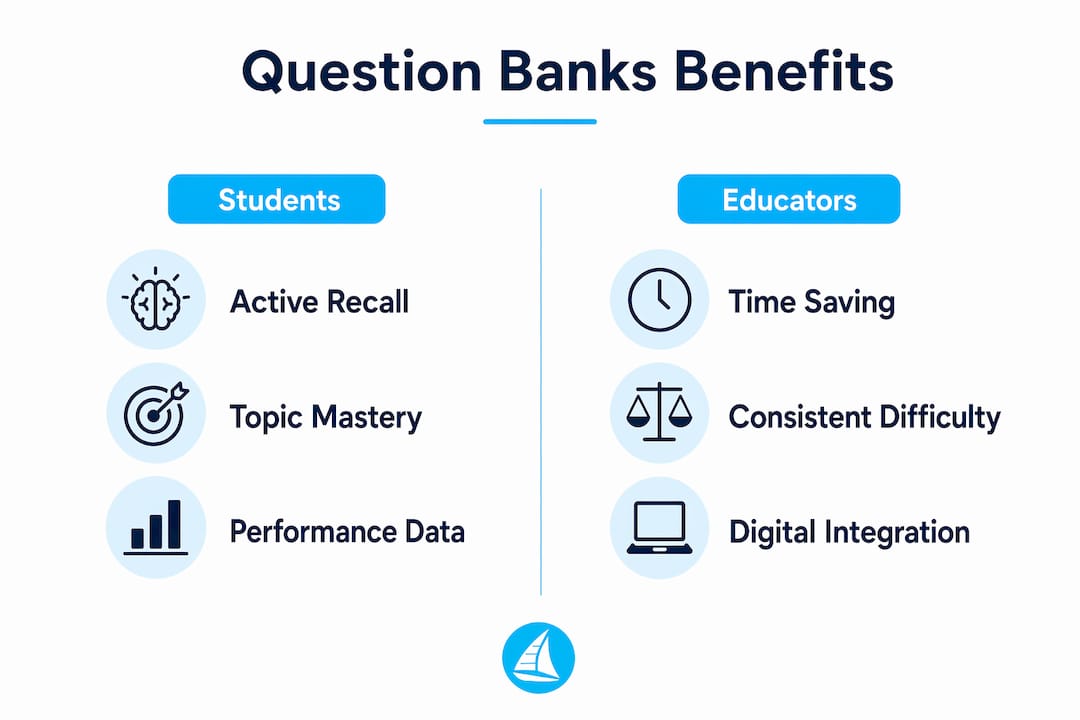
When question banks are integrated with digital platforms, the benefits extend further. LMS-integrated question banks provide automated analytics that identify which questions students find most difficult and reveal performance trends across a cohort. That kind of insight is simply not available from a paper test marked by hand.
Here is a summary of the core advantages for educators:
| Benefit | What It Means in Practice |
|---|---|
| Consistent difficulty | Questions are tagged by level, so assessments are fair across all classes |
| Faster test creation | Metadata filters replace hours of manual question selection |
| Automated analytics | Digital platforms flag weak questions and student performance gaps |
| Standardised assessment | Shared banks reduce variation between teachers and schools |
| Quality assurance | Questions can be reviewed and updated based on student response data |
Pro Tip: When building or selecting a question bank for IB sciences, prioritise platforms that tag questions by IB syllabus point and command term. This makes it far easier to align assessments with what the IBO actually tests.
Question banks vs sample papers: which should you use?
Question banks in early and mid preparation build conceptual understanding topic by topic. Sample papers test full exam readiness under timed conditions. These are complementary tools, not competing ones. The mistake many students make is treating them as interchangeable.
The real role of past papers in IB exam prep is to simulate the pressure and pacing of the actual exam. Question banks, by contrast, are for building the knowledge and accuracy that make that simulation worthwhile.
| Tool | Best Used | Primary Benefit |
|---|---|---|
| Question bank | Weeks 1–8 of revision | Topic mastery and accuracy |
| Sample exam paper | Final 3–4 weeks | Timing, stamina, and full readiness |
| Both combined | Throughout preparation | Confidence and gap identification |
The sequencing matters. Students who jump straight to full papers without first building topic accuracy often repeat the same errors. Question banks force you to confront individual weaknesses before they compound under exam pressure.
How should students use question banks effectively?
The single most important rule is this: attempt every question before looking at the answer. Passive review of question banks limits retention gains significantly. Seeing a question and immediately reading the solution feels productive but produces little durable learning.
An effective approach for IB sciences students follows a clear sequence:
- Select a topic from your current revision focus, such as IB Biology cell division or IB Physics waves
- Attempt all questions in that topic without notes or prompts
- Mark your answers using the mark scheme and record your score
- Flag every question you answered incorrectly or guessed correctly
- Return to flagged questions after two to three days and attempt them again
- Track your score over time to confirm genuine improvement, not just familiarity
Familiarity is the hidden trap. Seeing a question previously does not guarantee improved performance without actual mastery of the underlying concept. If you can only answer a question because you remember the answer from last time, you have not learned the concept.
Pro Tip: Tibertutor’s IB exam practice workflow automates spaced repetition scheduling, so you do not have to manage the timing yourself. Let the platform surface the right questions at the right moment.
Key takeaways
Exam question banks are most effective when used actively, sequenced correctly alongside mock exams, and supported by analytics that guide both students and educators toward genuine improvement.
| Point | Details |
|---|---|
| Active recall is non-negotiable | Attempting questions without notes produces 12–18% higher scores than passive revision. |
| Spaced repetition multiplies gains | Starting 3–4 weeks out with spaced practice boosts retention by up to 65%. |
| Metadata tagging unlocks educator efficiency | Topic and difficulty tags allow fast, consistent, and fair assessment creation. |
| Question banks precede sample papers | Use banks for topic mastery first; reserve full papers for the final weeks of preparation. |
| Analytics drive continuous improvement | Digital platforms reveal weak questions and student trends that paper tests cannot. |
Why i think most students underuse question banks
I have worked with IB science students across many cohorts, and the pattern is consistent. Students open a question bank, read through the questions, glance at the answers, and call it revision. They feel prepared. They are not.
The discomfort of not knowing an answer is exactly the point. That struggle is where learning happens. When students avoid it by peeking at solutions early, they rob themselves of the cognitive effort that builds durable memory. I have seen students score well on familiar question sets and then freeze on the same concept phrased differently in an actual exam. Familiarity is not mastery.
For educators, the pitfall is different. A question bank that is never updated becomes a liability. Students share questions, and the bank loses its diagnostic value. The analytics from integrated platforms are not just useful for students. They tell you which questions are no longer discriminating between strong and weak candidates, and that is information worth acting on.
My honest view is that question banks work best when they are treated as a testing environment, not a reading resource. Combine them with regular mock exams, keep the analytics visible, and involve educators in curating and refreshing the content. That combination produces the kind of preparedness that holds up under real exam pressure.
— Oliver
Tibertutor’s IB science questionbank
Tibertutor offers a curated IB Science Questionbank built specifically for Biology, Chemistry, and Physics students preparing for IB exams. Every question is written and reviewed by experienced IB examiners, tagged by syllabus point and difficulty, and designed to support active recall and spaced repetition practice.
Students benefit from topic-specific tests, mock exams, and progress tracking that surfaces weak areas automatically. Educators gain a structured, analytics-backed resource that reduces assessment preparation time and supports consistent, fair testing across classes. Whether you are a student aiming for a 7, a parent seeking structured support, or a teacher building a revision programme, Tibertutor gives you the tools to prepare with confidence. Explore the full IB science preparation guide to see how question banks fit into a complete revision strategy.
FAQ
What is an exam question bank?
An exam question bank is a curated collection of exam-style questions tagged by topic, difficulty, and learning objective. It is used by students for retrieval practice and by educators to generate consistent, standardised assessments.
How much do question banks improve exam scores?
Students using active recall with question banks score 12–18% higher than those using passive revision methods. The key is attempting questions without notes before checking answers.
When should IB students start using question banks?
Start using question banks 3–4 weeks before your exams at minimum, though earlier is better for building topic mastery. Reserve full sample papers for the final two to three weeks of preparation.
Can reusing questions from a bank harm exam integrity?
Research shows that reusing questions from a sufficiently large bank does not significantly harm exam integrity. The retrieval benefits of repeated practice outweigh concerns about question familiarity, provided students have genuinely mastered the underlying concepts.
How do educators benefit from digital question banks?
Digital question banks reduce manual exam-setting time, maintain consistent difficulty across classes, and provide automated analytics that identify student performance trends and flag questions that need updating.