1 Minute Per Mark: Examiner Aligned IB Biology Paper 2 Technique
To maximise Paper 2 marks, prioritise command-term accuracy and a point→mechanism→evidence structure for extended responses, practised under timed conditions. Precision matters more than volume: examiners reward specific data references, clear mechanisms, and disciplined timing over long, unfocused answers. Anchor your revision to the IBO biology syllabus, examiner reports, and structured practice tools like Tibertutor.
TL;DR:
- Focusing on command-term accuracy and structured point-mechanism-evidence responses is key to maximizing Paper 2 marks, especially in extended questions.
- Data-based questions in Section A require precise variable identification, trend description with actual data, and showing calculations to avoid losing marks.
- In Section B, outlining points with clear claims, mechanisms, and evidence before writing improves answer clarity and prevents rambling.
- Timing should be roughly one minute per mark, with additional planning for longer responses, to ensure all questions are completed within the time limit.
- Practice with examiner-designed questions and mark schemes, rather than generic questions, enhances real exam technique and helps identify common pitfalls.
Table of Contents
- What Does Paper 2 Test and How Is It Structured?
- How Do You Tackle Section A Data and Short-Answer Questions?
- How Do You Structure an 8-Mark Extended Response?
- What Do Command Terms Actually Reward?
- How Should You Structure Revision in the Final Weeks?
- What Should You Do in the Exam Room Itself?
- Why Examiner-Built Practice Converts Technique Into Marks
- What Actually Trips Students Up in Paper 2
- Get Exam-Ready With Tiber Tutor’s Paper 2 Practice
- Sources
- FAQ
What Does Paper 2 Test and How Is It Structured?
Paper 2 sits at the centre of the IB Biology assessment model because it tests both data-handling and extended written reasoning in one sitting. Standard Level students get 1 hour 15 minutes; Higher Level students get 2 hours 15 minutes, and the extra time reflects extra content depth rather than extra sections. Both levels open with Section A, a set of data-based and short-answer questions, then move to Section B, where you choose from extended-response options.
The IBO’s official curriculum page confirms the paper’s weighting within the overall Diploma Programme science model, and that weighting is why Paper 2 rewards technique so heavily. A useful rule of thumb, backed by specialist IB guidance, is to budget roughly one minute of writing per mark, then add a short planning buffer for anything worth six marks or more.
- SL Paper 2: 1 hour 15 minutes, lower total marks, fewer extended-response choices.
- HL Paper 2: 2 hours 15 minutes, higher total marks, more content options in Section B.
- Section A: short-answer and data-based questions, usually 1 to 4 marks each.
- Section B: extended-response questions, typically worth 6 to 9 marks.
- Timing rule: roughly 1 minute per mark, plus 1 to 2 minutes of planning for longer answers.
Recent syllabus commentary notes that Paper 2 now blends data-based short responses with extended writing more deliberately than earlier exam cycles, which means balanced practice across both skill types matters more than ever.
How Do You Tackle Section A Data and Short-Answer Questions?
Section A rewards precision, not elaboration. Markers are checking whether you can read a graph correctly, name the right variables, and reference exact figures rather than vague trends.
Statistically, students lose more marks in Section A from imprecise data references than from wrong biological content — a pattern that shows up repeatedly in guidance on how examiners mark data-based questions. Fixing that is mostly a matter of habit, not extra knowledge.
Follow this sequence for every data-based item:
- Read the figure before the question. Identify axes, units, and what each line or bar represents before you even look at what’s being asked.
- Spot the independent and dependent variables, then note any controlled variables mentioned in the stem. This is a transferable academic skill, and the University of Melbourne’s guidance on analysing and interpreting data sets out exactly this sequence: identify variables, then trends, then anomalies.
- State the trend explicitly, quoting real numbers from the axes (“increases from 12 to 34 mg/L between day 2 and day 6”) rather than saying “it goes up.”
- Show your working for any calculation. If a question asks for a percentage change, write the formula, substitute the values, then give the answer with units.
- Match your answer length to the mark tariff. A 1-mark question wants one clean statement; a 4-mark question wants four distinct, separated points, not one long sentence trying to do everything at once.
For questions asking you to identify or label a structure, a quick, correctly labelled diagram can substitute for a paragraph of description and often scores faster than writing it out in words.
How Do You Structure an 8-Mark Extended Response?
Section B is where most Paper 2 marks are won or lost, because loosely written answers bleed marks even when the underlying biology is correct. The fix is a repeatable scaffold: point, then mechanism, then evidence, repeated for each distinct idea you raise.
Spend the first minute per six to eight marks sketching an outline in the margin, not writing prose. List three or four separate claims before you commit to full sentences. This single habit, described in specialist IB Biology Paper 2 guidance, prevents the single biggest cause of lost marks in extended responses: rambling into one overdeveloped theme instead of covering the breadth examiners expect.
Each point in your outline should map to three components:
- Point: a clear, single claim (“Insulin decreases blood glucose concentration”).
- Mechanism: the biological process that explains it (“by increasing glucose uptake into liver and muscle cells and promoting glycogenesis”).
- Evidence: a specific example, data reference, or named process that grounds the claim (“as shown by increased glycogen storage following insulin injection in diabetic patients”).
A worked example: for “discuss the control of blood glucose concentration,” one point might be negative feedback via insulin, a second the opposing role of glucagon, and a third the involvement of the liver as the primary storage site. Three points, each fully developed with mechanism and evidence, will consistently outscore five points mentioned in passing.
Pro Tip: Write your three planned points as short headers in the margin before you start your answer. If you run out of time, an examiner can still award marks for a correctly labelled but incomplete third point.
For “discuss” or “evaluate” prompts, save your final two sentences for a balanced judgement. State which factor matters most and briefly justify why, rather than ending mid-argument.
What Do Command Terms Actually Reward?
Command-term mismatches are one of the most common, and most avoidable, sources of dropped marks. An examiner marking against a scheme is checking for specific behaviours tied to each verb, and writing the wrong type of answer for the term used, even with correct content, caps your score.
| Command term | What examiners reward | Common mismatch to avoid |
|---|---|---|
| State | A brief, precise fact with no explanation | Writing a full explanation when only a fact was asked for |
| Outline | A brief account with the main points, no depth | Going into mechanism detail better suited to “explain” |
| Explain | A reason or mechanism, “how” or “why” something happens | Simply describing “what” happens without the causal link |
| Compare | Similarities and differences stated explicitly, side by side | Describing two things separately without connecting them |
| Discuss | A balanced review of factors with a supported judgement | A one-sided argument with no counterpoint or conclusion |
The internal IB exam command terms guide breaks this down further for every science and maths command term, and it is worth reading in full before your next timed paper. For any question, translate the mark tariff into discrete tasks: a 3-mark “explain” question usually wants a claim, a mechanism, and a specific consequence, one mark for each.
How Should You Structure Revision in the Final Weeks?
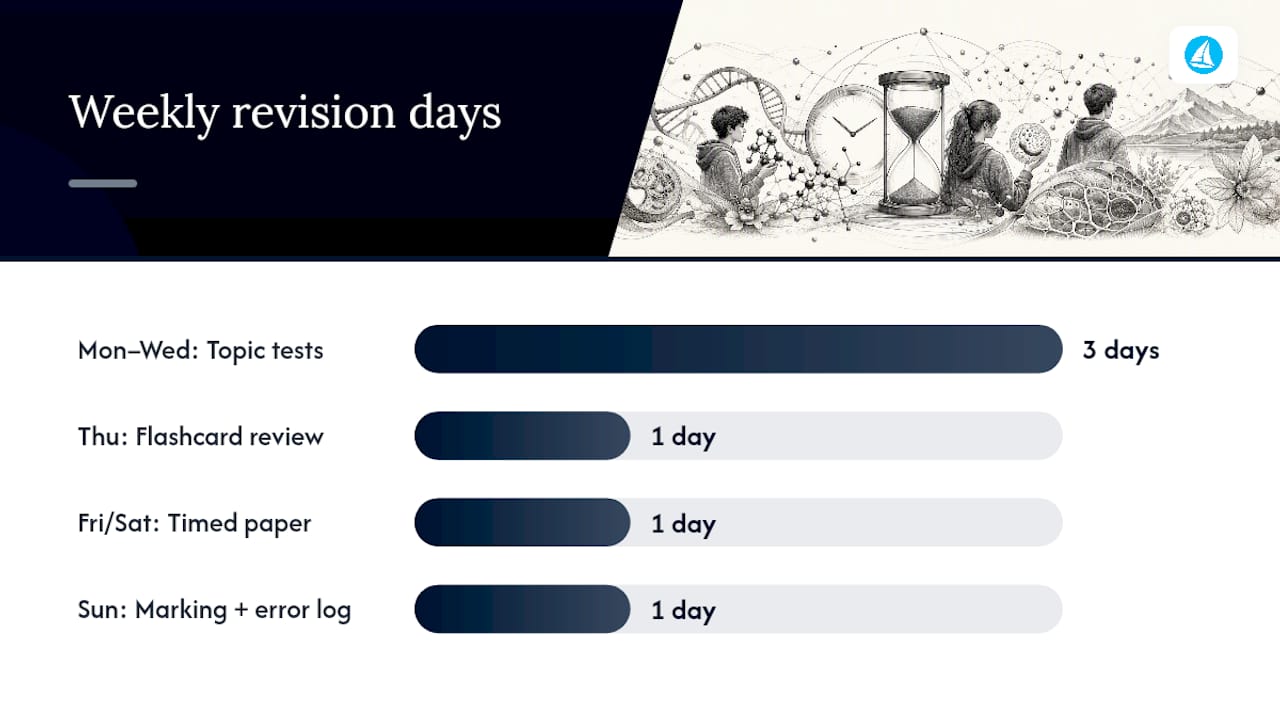
Passive rereading of notes is the least efficient way to prepare for Paper 2. Active recall, spaced repetition, and timed past-paper practice consistently outperform passive revision, a pattern confirmed across IB-focused study guidance. Six to twelve weeks out, structure your week around a repeating cycle rather than random topic hopping.
- Monday to Wednesday: Work through topic tests on two or three syllabus areas, focusing on whichever showed weaknesses in your last mock. Tibertutor’s topic-specific tests are built around exactly this kind of targeted gap-closing.
- Thursday: Review flashcards and cram sheets for spaced repetition of terminology and mechanisms you’ve already covered.
- Friday or Saturday: Complete one timed past paper or mock exam under real exam conditions, no notes, no pauses.
- Sunday: Mark your own paper against the official scheme, then log every lost mark in an error log with the reason: wrong command term, missed evidence, timing pressure, or content gap.
Run a full timed mock roughly once every one to two weeks in the final stretch, increasing frequency as the exam approaches. Reading examiner reports alongside your marking teaches you the exact phrasing and terminology that separates a borderline answer from a strong one.
Pro Tip: Keep your error log in one place across every mock, not per paper. Patterns only become visible once you can see five or six repeated mistakes side by side.
What Should You Do in the Exam Room Itself?
Spend the first few minutes skimming Section B options before writing anything, choosing the questions where you can name at least three distinct points immediately. Sketch your point outlines in the margin for every extended response before drafting full sentences.
- Set time checkpoints: if you’re not finishing a section within its allotted minutes, move on and return later if time permits.
- Only draw a diagram if you can label it clearly within about two minutes; a messy, half-labelled diagram scores worse than a short written description.
- In your last few minutes, recheck each command term against what you actually wrote, and confirm units and key terminology are present.
- Never leave a question blank; a partial point-mechanism-evidence answer still earns marks a blank space cannot.
Why Examiner-Built Practice Converts Technique Into Marks
Generic practice questions written by non-examiners often miss the exact phrasing patterns that real mark schemes reward, which is why students can know the biology perfectly and still underperform. Questions and criterion feedback written by actual IB examiners close that gap directly. because the feedback reflects how marks are genuinely awarded rather than a guess at it.
Tibertutor’s Paper 2 preparation is built entirely around this principle, and its resources are unusually well interlinked for exactly this reason:
- Topic tests target specific syllabus areas so you fix gaps before they compound.
- Timed mock exams replicate real Paper 2 conditions, including the SL/HL time split.
- Progress analytics track which command terms and topics cost you the most marks over time, something few other IB resource sites offer at this level of detail.
- Student-led answer review against examiner mark schemes builds the self-marking habit that closes the gap between your draft and a top-band answer.
Pro Tip: Run a diagnostic topic test first, then let the analytics tell you which two or three syllabus areas need targeted practice before your next timed mock.
A typical workflow looks like this: diagnostic test to flag weak topics, targeted topic tests to close those gaps, a full timed mock to test them under pressure, then an error-log review before the cycle repeats.
What Actually Trips Students Up in Paper 2
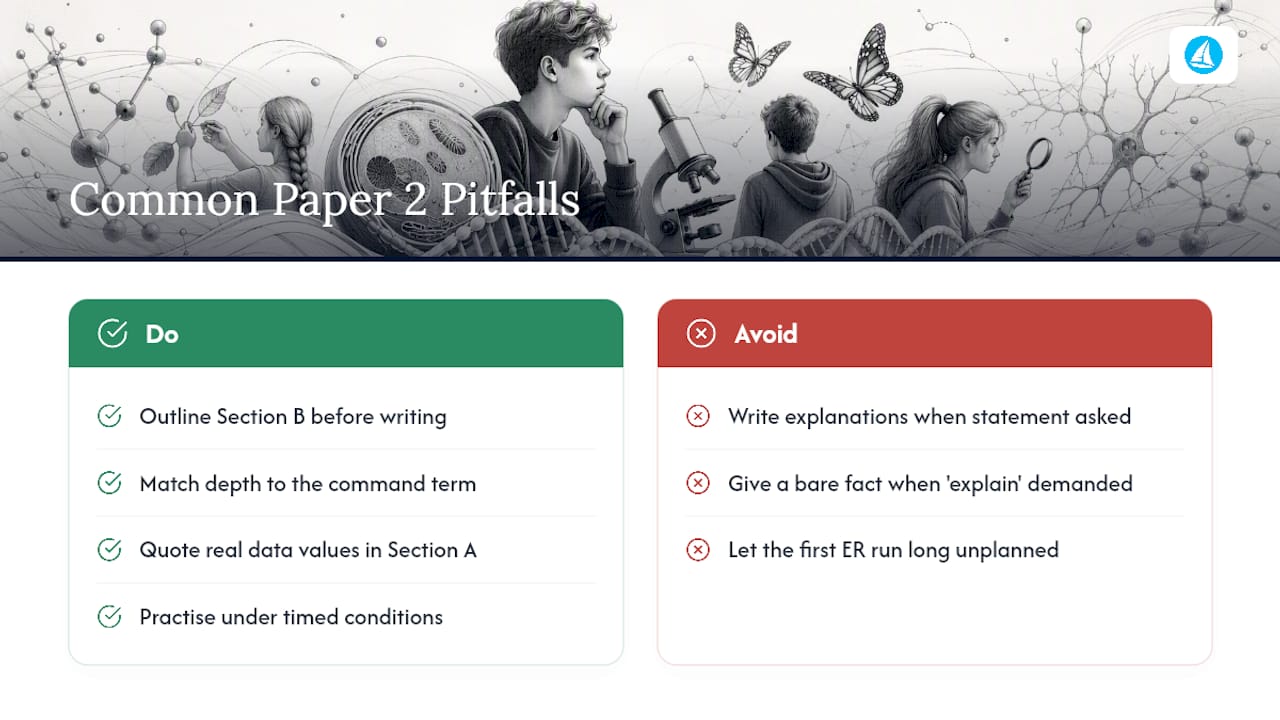
The most common error I see isn’t a knowledge gap, it’s writing explanations when the command term only asked for a statement, or the reverse: giving a bare fact when “explain” demanded a mechanism. A close second is running out of time on the final extended response because the first one ran long without a plan.
A short checklist fixes both: outline your Section B points before writing, match your answer’s depth to the command term, and quote real data values in Section A rather than describing trends vaguely. None of this replaces content knowledge. It just stops good knowledge from being marked down for the wrong reasons. Practise this against real timed conditions, not passive review, and the marks tend to follow.
— Oliver
Get Exam-Ready With Tiber Tutor’s Paper 2 Practice
Tibertutor gives you what generic question banks can’t: exam-style items and mark-scheme feedback written by actual IB examiners, mapped directly onto the command-term and point→mechanism→evidence technique covered above.

Start with a diagnostic run through the IB Biology exam tests to see exactly which command terms and topics are costing you marks right now, the same kind of gap Tibertutor’s analytics catch early, such as a student consistently losing marks on “explain” items despite strong content knowledge. From there, move into topic-specific tests to close those gaps, then book a full timed mock exam to test your point-planning under real pressure. Every resource is interlinked, built by IB examiners, and tracked through progress analytics that show your trajectory over weeks, not just a single score. Start with the free 7-day trial and run your first diagnostic today.
Sources
For scope and assessment details, the IBO’s biology curriculum page is the definitive reference, alongside the IBO’s curriculum update notices for any syllabus changes. For data-interpretation technique, the University of Melbourne’s guide to analysing and presenting data is worth bookmarking. If you’re tightening your final-week routine, last-minute revision techniques offer practical time-saving methods worth pairing with your error log.
- IBO — Diploma programme: biology curriculum
- University of Melbourne — analysing, interpreting and presenting data
- Cerebrum Biology Academy — IB Biology Paper 2 guide
FAQ
Is It Hard to Get a 7 in IB Biology?
A 7 is genuinely difficult because it demands both strong content knowledge and consistent exam technique, particularly precise command-term responses and well-structured extended answers. Students who close gaps using examiner reports and timed mock practice tend to close the distance faster than those relying on content review alone.
Is Paper 2 Harder Than Paper 1?
Paper 2 is often considered harder because it demands sustained written reasoning and data interpretation under time pressure, rather than the recognition-based skills tested in multiple-choice Paper 1. Many students find Section B’s extended responses the biggest hurdle simply because technique, not content, is the limiting factor.
What Percentage Is a 7 in IB Biology?
Grade boundaries shift slightly between exam sessions and are published officially by the IBO rather than fixed in advance, so check your specific session’s boundaries directly through your school or the IBO. Aim to maximise every available mark through technique rather than targeting a fixed percentage.
Is It Hard to Get an A* in Biology Overall?
Top grades across IB Biology assessments consistently reward precision over quantity: correctly structured extended responses, accurate data referencing, and command-term alignment. Students using structured, examiner-aligned practice, such as Tibertutor’s exam tests, typically close technique gaps faster than those revising content in isolation.