IB exam command terms: a science and maths guide
IB command terms are prescribed verbs that tell you exactly what cognitive task an examiner expects. They fall into four groups: knowledge and recall (define, identify, list), application and analysis (describe, explain, apply, interpret, annotate, construct, calculate), synthesis and evaluation (compare, contrast, analyse, discuss, evaluate, justify, suggest), and practical skills (outline, annotate diagrams, construct data tables). When you see a command term in an exam question, your first move is to identify it, match it to the expected depth, check the mark allocation, and plan your response before you write a single sentence. The IBO publishes subject-specific glossaries that define each term precisely, and Tibertutor’s examiner-built resources are designed to help you practise exactly this skill across Biology, Chemistry, Physics, and IB Maths.
Table of Contents
- Types of IB exam command terms: grouped reference with templates and model snippets
- How do you use mark allocation to plan your answer?
- How do command terms work in IB Biology, Chemistry, Physics, and Maths?
- How should you practise command-term accuracy?
- How Tibertutor helps you master command terms
- Quick checklist: common command-term mistakes and how to fix them
- Key takeaways
- The command term that separates good answers from great ones
- Tibertutor: your next step for command-term confidence
- Useful sources
- FAQ
Types of IB exam command terms: grouped reference with templates and model snippets
The list below covers every term you are likely to meet in IB sciences and Maths. For each one: a short definition, what the examiner expects, a 2–3 point answer structure, and one subject-specific model sentence. Where SL and HL differ, or where the term appears in an Extended Essay or Internal Assessment, there is a brief note.
Across curricula, teachers and examiners note that many command terms have near-synonym variants on constructed papers — “state” and “give” are often interchangeable, as are “outline” and “briefly describe.” Knowing the family of terms around each group prevents surprises.
Knowledge and recall terms
Define Give the precise meaning of a term. Examiners expect the key components of the definition, not an example. Structure: (1) state the term, (2) give its essential components, (3) include units or conditions if relevant. Model (Biology): “Osmosis is the net movement of water molecules across a partially permeable membrane from a region of higher water potential to a region of lower water potential.”
Identify / State / Give Name or select a specific item from given information. One word or one short sentence. No explanation needed. Model (Chemistry): “The oxidising agent in this reaction is Fe³⁺.”
List Give a sequence of points with no elaboration. Bullet points or numbered items are acceptable. Model (Physics): “Forces acting on the object: weight, normal reaction, friction, applied force.”
Application and analysis terms
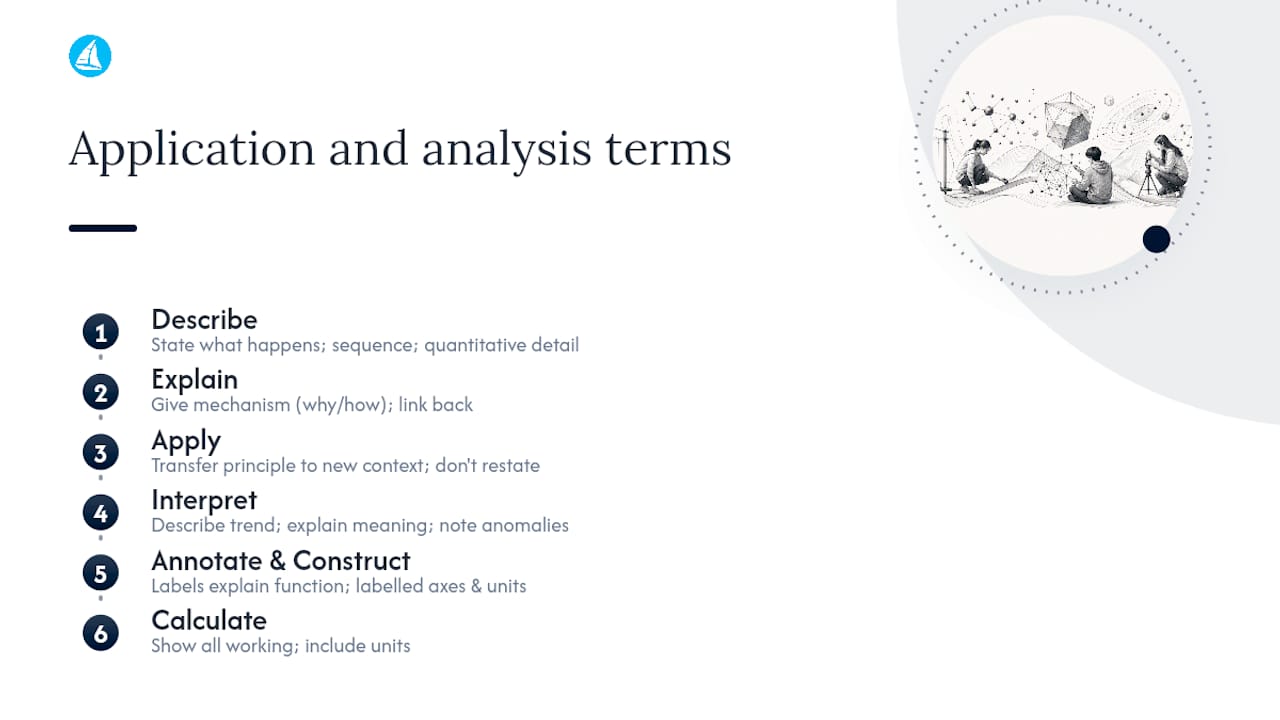
Describe Give a detailed account of facts, events, or processes. Examiners expect sequential accuracy and relevant detail, not explanation of cause. Structure: (1) state what happens, (2) give the sequence or key features, (3) include quantitative detail where available. Model (Biology): “During the light-dependent reactions, photons excite electrons in chlorophyll, which pass along the electron transport chain, driving ATP synthesis via chemiosmosis.”
Explain Give a reason or mechanism — the “why” or “how.” This is one of the most frequently misused terms. Students often describe when they should explain. Structure: (1) state the observation or fact, (2) give the mechanism or cause, (3) link back to the original point. Model (Biology): “As temperature increases above the optimum, hydrogen bonds within the enzyme’s active site break, altering its tertiary structure so the substrate no longer fits, reducing reaction rate.” At HL, explanations are expected to include more precise mechanistic detail and may require reference to underlying theory.
Apply Use knowledge in a new or unfamiliar context. Examiners expect you to transfer a principle, not restate it. Model (Maths): “Using the chain rule, dy/dx = 3cos(3x + 1).”
Interpret Draw meaning from data, a graph, or a result. Structure: (1) describe the trend, (2) explain what it means in context, (3) note any anomalies. Model (Chemistry): “The plateau in the graph indicates that the reaction rate is no longer limited by enzyme concentration but by substrate availability.”
Annotate Add brief notes or labels to a diagram or graph. Examiners expect labels that explain function or significance, not just names. Model (Biology): annotate a diagram of the mitochondrion with “inner membrane — site of ATP synthase and electron transport chain.”
Construct Build a graph, table, or equation from given data. Follow scientific convention: labelled axes, units, appropriate scale, best-fit line where required. Model (Physics): construct a velocity–time graph with correctly labelled axes and a straight best-fit line through the origin.
Calculate Obtain a numerical answer, showing all working. In Maths and Physics, examiners expect every step; an unsupported answer scores zero or partial marks. Model (Chemistry): “moles of NaOH = 0.025 dm³ × 0.1 mol dm⁻³ = 0.0025 mol.” Always include units. In IB Maths, the instruction “show that” is a close relative — you must demonstrate the result, not just state it.
Synthesis and evaluation terms
Outline Give a brief account or summary. More than “list” but less than “describe.” Structure: (1) key point, (2) one supporting detail per point. Model (Chemistry): “Outline the steps of the Born–Haber cycle: formation of gaseous atoms, ionisation, electron affinity, and lattice enthalpy.”
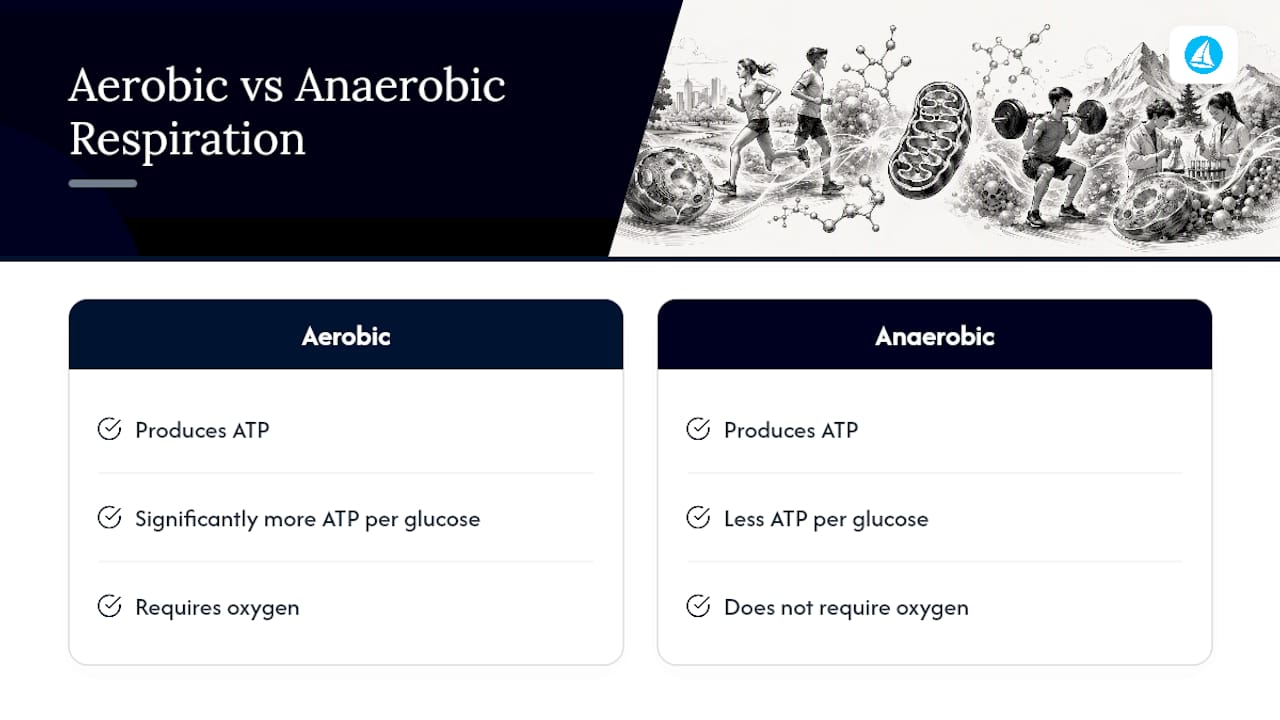
Compare Give an account of similarities and differences. Both sides must appear. Model (Biology): “Both aerobic and anaerobic respiration produce ATP; however, aerobic respiration yields significantly more ATP per glucose molecule and requires oxygen, whereas anaerobic respiration does not.”
Contrast Give an account of differences only. Model (Physics): “Unlike elastic collisions, inelastic collisions do not conserve kinetic energy, though both conserve momentum.”
Analyse Break down information into components and examine each part and its relationship to the whole. Structure: (1) identify the components, (2) examine each, (3) show how they relate. Model (Maths): “Analysing the function f(x) = x³ − 3x: the derivative f’(x) = 3x² − 3 = 0 gives critical points at x = ±1, indicating a local maximum at x = −1 and a local minimum at x = 1.”
Discuss Give a balanced review of multiple perspectives, arguments, or factors, then reach a reasoned conclusion. Both sides must be present. Model (Biology): “Discuss the use of GMOs in agriculture: proponents argue that herbicide-resistant crops increase yield and reduce pesticide use; critics raise concerns about biodiversity loss and corporate control of food supply. On balance, the evidence suggests benefits are context-dependent.”
Evaluate Weigh strengths and limitations using criteria, then make a final judgement. The judgement is non-negotiable. Model (Chemistry): “Evaluate the use of titration to determine concentration: the method is precise and reproducible, but systematic errors from indicator choice and endpoint judgement can affect accuracy. Overall, titration is reliable for strong acid–strong base systems but less so for weak acid–weak base pairs.”
Justify Give valid reasons or evidence to support an answer or conclusion. Model (Physics): “The use of a light gate rather than a stopwatch is justified because it eliminates human reaction-time error, improving the precision of velocity measurements.”
Suggest Propose a hypothesis, explanation, or solution, often in an unfamiliar context. Examiners accept any scientifically plausible answer. Model (Biology): “The anomalous result at 50°C may be due to partial enzyme denaturation, reducing the proportion of active enzyme molecules.”
Pro Tip: In the Extended Essay and Internal Assessment, “evaluate” and “justify” appear in assessment criteria rather than question stems. Your conclusion section must include a clear judgement with supporting evidence — examiners will not award the top criterion band without it.
How do you use mark allocation to plan your answer?
A repeatable five-step method turns the command term and mark allocation into a clear answer plan before you write anything.
- Identify the command term — Underline it. Confirm which cognitive group it belongs to.
- Map marks to minutes. A rough guide: 1 mark ≈ 0.75–1 minute; a 6-mark question ≈ 6–8 minutes. Adjust for calculation questions, which often take longer per mark. Subject variation applies — check your IB mark scheme guidance for subject-specific timing norms.
Pro Tip: For evaluate and discuss questions under time pressure, write your judgement sentence first in the margin. This keeps your conclusion sharp even if you run short on time — examiners award the judgement mark independently of length.
SL papers tend to carry fewer high-mark questions, so the planning step is proportionally faster. HL papers include more 6–9 mark questions, making the five-step method worth practising until it takes under 60 seconds.
For IB Maths, the equivalent of step 4 is checking whether the question says “show that,” “hence,” or “hence or otherwise” — each signals a different method requirement and marks available for working.
How do command terms work in IB Biology, Chemistry, Physics, and Maths?
General definitions are a starting point. Subject-specific expectations are what actually earn marks.
IB Biology
“Explain” is the dominant high-mark term in Biology papers. Examiners expect a mechanism: state the observation, give the biological cause, and link back. Vague causal language (“it helps the cell”) scores nothing. Precision matters: name the molecule, the process, the location.
- “Describe” in Biology often targets graphs or experimental results — give the trend, the range, and any anomalies.
- “Evaluate” in Biology frequently appears in Paper 3 data-based questions, where you must assess experimental design or data quality.
- HL Biology adds “analyse” to Paper 3, requiring breakdown of complex datasets.
Model answer (Biology, explain): “Insulin binds to receptors on liver cells, triggering a signalling cascade that activates glycogen synthase, converting glucose to glycogen and lowering blood glucose concentration.”
For vocabulary support alongside command-term practice, IB Biology vocabulary resources help you pair the right terminology with the right command term.
IB Chemistry
“Calculate” and “determine” dominate Papers 1 and 2. Show every step, include units at each stage, and give the answer to the correct number of significant figures. A correct answer with no working shown risks losing method marks. For IB Chemistry command terms, the distinction between “calculate” (numerical answer required) and “determine” (may involve reading from a graph or applying a formula) is one examiners flag regularly.
- “Outline” in Chemistry expects a concise procedural or conceptual summary — not a full explanation.
- “Evaluate” in Chemistry often targets experimental methods or data quality, requiring you to identify sources of error and judge their significance.
- HL Chemistry adds “deduce” — draw a conclusion from given information using chemical reasoning.
| Subject | Common high-mark terms | Key marking cue |
|---|---|---|
| Biology | explain, evaluate, discuss | Name molecules, processes, and locations |
| Chemistry | calculate, determine, evaluate | Show all working; include units |
| Physics | calculate, analyse, justify | Show working; state formula before substituting |
| IB Maths | calculate, analyse, show that | Full method required; unsupported answers penalised |
IB Physics
“Justify” appears frequently in Physics, particularly in Paper 3 experimental questions. Examiners expect you to cite a physical principle or law, not just assert that something is correct. “Analyse” in Physics often targets graphs: identify the relationship, state the gradient’s physical meaning, and note any deviations.
- Always state the formula before substituting values.
- “Suggest” in Physics accepts any physically plausible explanation — there is often no single correct answer.
- HL Physics includes “derive,” which requires you to show the mathematical steps from first principles.
IB Maths
“Analyse” in IB Maths typically means examining a function’s behaviour: find critical points, determine nature, sketch or interpret. “Show that” is a close relative of “calculate” but requires every algebraic step to be visible — the answer is given, so the marks are entirely for method. For a full breakdown of timing and question structure, the IB Maths exam breakdown guide is worth consulting alongside command-term revision.
In IAs and the Extended Essay, command terms shift from question stems to assessment criteria. “Evaluate” and “justify” appear in the Criterion D (Reflection) and Criterion B (Investigation) descriptors. Examiners expect you to apply the same rigour — evidence, limitation, judgement — to your own methodology.
How should you practise command-term accuracy?
A structured four-week plan, combining timed practice with markscheme self-review, is the most reliable way to improve. The Tibertutor practice workflow outlines this process in detail.
Week 1: Term identification drills
- Go through five past-paper questions per subject and underline every command term.
- Write the cognitive group next to each one (recall / application / synthesis).
- Note any limiting phrases in the question stem.
- Check your groupings against the IBO subject guide glossary.
Week 2: Focused past-paper sessions
- Select three 6-mark questions per subject (one analyse, one evaluate, one discuss).
- Write timed responses using the five-step planning method.
- Self-mark against the official markscheme: tick each non-negotiable element.
- Identify which element you missed most often (usually the judgement or the mechanism).
Week 3: Examiner exemplar comparison
- Obtain a model answer for each question (examiner reports, Tibertutor model answers).
- Annotate your response against the model: where did you add depth? Where did you drift?
- Rewrite the weakest response from scratch without looking at your original.
Week 4: Mock exam and analytics review
- Complete a full timed mock using Tibertutor’s mock exam platform.
- Review your performance analytics to identify which command terms you underperform on.
- Target one command-term type per revision session in the final week before the exam.
Recommended drills alongside this plan:
- Command-term flashcards: definition on one side, non-negotiable elements and a model sentence on the other.
- Timed 6-mark practice: set a timer for 8 minutes per question; stop when it rings regardless of completion.
- Peer review: swap responses with a classmate and mark each other’s answers against the markscheme — explaining why a mark is or is not awarded cements understanding faster than self-marking alone.
Using IB subject reports alongside this plan helps you identify which command terms your cohort typically loses marks on — examiners comment on these patterns explicitly.
How Tibertutor helps you master command terms
Tibertutor is built by IB examiners, and that matters more than it might sound. Every question in the IB science questionbank is authored or reviewed by practising examiners who know exactly what a mark scheme rewards. The platform’s resources are tightly interlinked: a question in the questionbank connects to the relevant notes, the examiner mark scheme, and a model answer, so you are never practising in isolation.
Key features for command-term mastery:
- Examiner mark schemes and model answers: — aligned to IBO assessment criteria, so you can self-mark with the same rigour an examiner applies.
- Mock exams: — full timed papers that replicate exam conditions, with command-term distribution matching real papers.
Pro Tip: After each mock exam, filter your Tibertutor analytics by command term. If your “evaluate” responses consistently score below your “explain” responses, spend one focused session on the judgement sentence alone — write ten judgement sentences from past questions without writing the full response. This targeted drill closes the gap faster than repeating full papers.
Tibertutor offers the best value for money among IB STEM revision platforms. With actual IB examiners creating the content, the quality and exam-alignment are unmatched. A free 7-day trial gives you full access before you commit, and subscription options include monthly, 6-month, yearly, and full 24-month course plans for individuals and schools.
Quick checklist: common command-term mistakes and how to fix them
- Writing everything you know → answer only what the command term asks; extra content scores nothing and wastes time.
- Describing when asked to explain → every “describe” answer should have a “because” or “which causes” added if the command term is “explain.”
- No judgement on evaluate → the final verdict sentence is non-negotiable; write it even if it is one line.
- No balanced coverage on discuss → if you have only argued one side, you have not answered the question.
- Listing components without linking them for analyse → show how the parts relate; a list is not an analysis.
- Omitting units in calculate → units are part of the answer; missing them costs marks in Chemistry, Physics, and Maths.
- Ignoring limiting phrases → “with reference to the data” means your answer must cite specific values from the graph or table.
- Matching answer length to marks incorrectly → a 1-mark “define” question needs one precise sentence, not a paragraph.
- Using vague causal language → “it helps” or “it makes it better” scores nothing; name the molecule, process, or principle.
- Skipping the planning step under pressure → a 30-second margin sketch saves more time than it costs.
Two “if in doubt” rules for the exam:
- If the mark allocation is 1–2, keep it short and precise. If it is 6 or more, you need structure, evidence, and a conclusion.
- If you are unsure whether to explain or describe, ask: “Does the question want the ‘what’ or the ‘why’?” The command term tells you.
Always re-read the question stem after writing your answer. Check that you have addressed the limiting phrase and that your response matches the cognitive demand of the command term.
Key takeaways
Mastering IB command terms means knowing the cognitive group each term belongs to, applying the non-negotiable elements for higher-order verbs, and using mark allocation to judge depth and timing.
| Point | Details |
|---|---|
| Command terms signal cognitive demand | Group terms by recall, application, synthesis, and practical skills to match examiner expectations. |
| Higher-order terms have non-negotiables | Evaluate requires a final judgement; discuss requires balanced coverage; analyse requires component linkage. |
| Marks guide time and depth | Use 0.75–1 minute per mark as a planning guide; 6-mark questions need structure, evidence, and a conclusion. |
| Subject nuance changes expectations | Chemistry rewards shown working and units; Biology rewards mechanistic precision; Maths penalises unsupported answers. |
| Tibertutor accelerates progress | Examiner-authored questions, mark schemes, and analytics pinpoint exactly which command terms need targeted practice. |
The command term that separates good answers from great ones
There is a tendency among IB students to treat “evaluate” as a longer version of “explain.” It is not. The difference is structural: an explanation ends when the mechanism is clear; an evaluation ends when a verdict is delivered. Examiners at the top mark band are not rewarding length. They are rewarding the moment a student commits to a position, defends it with evidence, and acknowledges its limits. That is a skill that takes deliberate practice to build.
The most productive thing you can do with the weeks before your exams is not to read more notes. It is to write ten evaluation responses, mark them against the examiner mark scheme, and identify the one element you consistently omit. For most students, it is the judgement. For some, it is the limitation. Either way, the analytics in Tibertutor will show you which one it is faster than any other method available.
Focused, targeted practice beats volume every time. Knowing your weak command term and drilling it specifically is worth more than three full past papers answered without review.
Tibertutor: your next step for command-term confidence
Knowing the theory behind IB command terms is one thing. Practising them under timed, exam-like conditions with examiner feedback is what actually moves your grade.

Tibertutor gives you exactly that. The platform’s IB science questionbank contains thousands of examiner-authored questions tagged by command term, topic, and difficulty, so you can build a focused session on “evaluate” in Chemistry or “analyse” in Biology in under a minute. Every question comes with an examiner mark scheme and a model answer. The progress analytics show you which command terms you are consistently underperforming on, with a level of granularity no other IB STEM platform offers. Content is created by actual IB examiners, making Tibertutor the best-value revision resource available for IB sciences and Maths.
Start your free 7-day trial, run a targeted mock on IB Chemistry tests or IB Biology tests, and review your responses against the examiner model answers. That single session will show you more about your command-term habits than a week of passive revision.
Useful sources
- IB command terms explained — what examiners… — MarkScheme
- IB Command Words Explained: 25 Verbs Examiners Use (A-Z Guide) - Times Edu
- Complete Guide to Understanding IB Command Terms | Top IB Tutors
- Command Terms from the International Baccalaureate (IB) Program/Across Disciplines
- IB Chemistry Command Terms: The Complete Student Guide » Tiber Tutor
- IB Exam-Style Questions Practice Workflow Guide » Tiber Tutor
- IB Science Questionbank » Tiber Tutor
FAQ
What are IB command terms?
IB command terms are prescribed verbs used in exam questions to indicate the cognitive task required. They are defined in each subject’s IB guide and range from low-order recall terms (define, state) to high-order synthesis terms (evaluate, discuss).
What are ten examples of IB command words?
Common examples include: define, describe, explain, calculate, analyse, evaluate, discuss, compare, contrast, and justify. Each signals a different depth of response and appears in the subject-specific glossary published by the IBO.
How do command terms differ between SL and HL?
SL papers tend to use more recall and application terms (define, describe, calculate), while HL papers include more synthesis and evaluation terms (analyse, evaluate, discuss) and carry more high-mark questions requiring structured, evidence-based responses.
How do you use command terms in an IB Internal Assessment or Extended Essay?
In IAs and the Extended Essay, command terms appear in the assessment criteria rather than question stems. “Evaluate” and “justify” in the reflection and conclusion criteria require the same structure as in exam responses: evidence, limitation, and a clear judgement.
Where can you practise IB command terms with examiner feedback?
Tibertutor’s IB science questionbank provides thousands of examiner-authored questions tagged by command term, with examiner mark schemes, model answers, and performance analytics to track progress across Biology, Chemistry, Physics, and Maths.