IB subject report analysis: a guide for students and parents
IB subject report analysis is the process of interpreting official International Baccalaureate feedback documents that reveal examiner expectations, performance patterns, and common errors across a subject cohort. The IB publishes these reports after each examination session, and they are among the most underused resources available to science students. Understanding what is IB subject report analysis, and how to act on it, gives students and parents a genuine edge in planning revision, improving internal assessments, and making confident course decisions.
What is IB subject report analysis and what do reports contain?
IB Subject Reports offer official examiner feedback including grade boundaries, student performance trends, and guidance on common errors. Each report is published by the IB after the May and November examination sessions and covers individual subjects such as Biology, Chemistry, and Physics.
The reports typically include:
- Grade boundaries: The minimum scores required for each grade on the 1–7 scale. Grade boundaries are reviewed by the IB against the quality of candidate work each session, so they shift slightly from year to year.
- Common student errors: Examiners document the mistakes that appeared most frequently, from misapplied terminology in Biology to calculation errors in Chemistry.
- Assessment criteria commentary: Examiners explain which criteria students met well and which they consistently underperformed on.
- Global performance patterns: Reports summarise trends across the entire cohort, not individual students.
That last point matters. IB Subject Reports are generic documents intended for broad examiner feedback, not personalised student comments. They describe what thousands of candidates did collectively. Reading them with that context in mind is the first step toward using them well.
How to effectively analyse IB subject reports
Analysing IB subject reports is a skill, and it follows a clear process. Here are the steps that produce the most useful results.
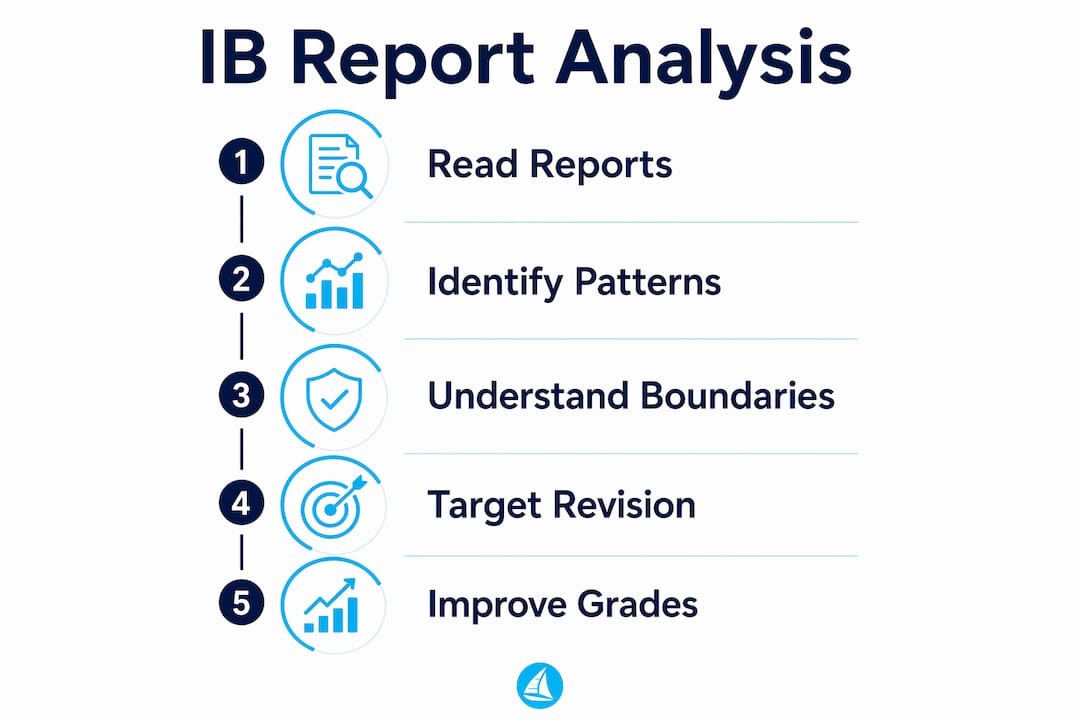
- Download the correct report. Locate the most recent Subject Report for your specific science subject and level (Higher Level or Standard Level). The IB publishes these through the IB Programme Resource Centre, accessible via your school.
- Read the grade boundary table first. Note where the boundary sits between a 6 and a 7, and between a 4 and a 5. These thresholds tell you exactly how many marks separate grade levels.
- Map examiner comments to your own work. Read the section on each paper and ask: did I make this error? Cross-reference the report against your most recent mock exam or past paper attempt.
- Identify recurring patterns. If examiners flag the same weakness across two or three consecutive sessions, that topic demands priority attention in your revision.
- Adjust your study focus. Use the report to shift time away from topics you already handle well and toward the areas where the global cohort, and likely you, lost marks.
- Apply findings to your Internal Assessment. Strong IB Internal Assessments show clear claims linked to evidence and acknowledge limitations. Examiner comments in subject reports often reveal exactly where students fall short on these criteria.
Pro Tip: Read reports from the two most recent sessions side by side. Patterns that appear in both sessions are almost certainly tested again. Single-session anomalies are less predictive.
How does IB subject report analysis clarify grading and predicted grades?

The IB uses a 1–7 grading scale, and understanding where grade boundaries fall is central to decoding your academic position. Subject report analysis makes this concrete rather than abstract.
Predicted grades are professional estimates by teachers, based on evidence such as tests and internal assessments. Universities use predicted grades in admissions decisions, so a student sitting at the boundary between a 6 and a 7 has real motivation to close that gap before the final exam.
| Grade | Typical boundary range | What it signals |
|---|---|---|
| 7 | Highest mark band | Consistent mastery across all assessment objectives |
| 6 | Strong performance | Solid understanding with minor gaps |
| 5 | Satisfactory | Meets most criteria; some conceptual weaknesses |
| 4 | Adequate | Passes, but significant gaps remain |
Subject report analysis shows you which specific skills and topics push students across each boundary. That is far more useful than knowing your raw score alone.
ATL skills are integrated into IB assessments and represent learning approaches key to success. ATL stands for Approaches to Learning and encompasses skills such as critical thinking and organisation. Examiners frequently reference these implicitly when they note that students “failed to justify conclusions” or “did not evaluate methodology.” Recognising ATL language in reports helps students and parents understand what teachers mean when they comment on academic habits, not just content knowledge.
Pro Tip: If your child’s predicted grade sits one mark below a boundary, use the subject report to identify the single paper or question type where marks are most recoverable. That targeted focus is more productive than broad revision.
For a fuller explanation of how IB grading works, the IB science grading guide on Tibertutor covers the scoring system in plain language.
Common challenges in interpreting IB subject reports
Several pitfalls trip up students and parents who are new to reading these documents.
- Treating global data as personal feedback. Because reports describe cohort-wide trends, a student may read about a common error and assume it applies to them when it does not, or dismiss it when it does. Always cross-reference with your own marked work.
- Collecting observations without drawing conclusions. Students often collect evidence without making explicit connections to their research question. The same trap applies when reading reports: noting what the examiner said is not the same as understanding what it means for your revision.
- Ignoring method limitations. Examiners regularly comment on students who fail to acknowledge the boundaries of their conclusions. Reading these comments and applying the same critical awareness to your own work is a transferable skill.
- Over-generalising from one session. A single session’s report reflects that cohort and that paper. Patterns across multiple sessions carry far more weight.
The solution to all of these is to read reports with a specific question in mind: “Where did students lose marks, and did I make the same mistakes?”
Practical applications of IB subject report analysis
Using reports to guide study strategies can improve overall IB science performance in measurable ways. The most effective students treat subject reports as a revision blueprint, not background reading.
Integrate examiner feedback directly into your revision timetable. If the Chemistry report flags that students consistently misapply equilibrium concepts in Paper 2, schedule a focused session on that topic before your next mock. For Internal Assessments, read the criteria commentary carefully. High-scoring analyses explicitly interpret evidence, justify reasoning, and reflect on method limitations. Adjusting your IA draft in response to these comments can shift your grade meaningfully. Pair this with structured exam technique guidance to build both content knowledge and the skills examiners reward.
Pro Tip: After reading a subject report, write three bullet points summarising the top examiner concerns for your subject. Pin them above your desk. Review them before every practice paper.
Key takeaways
IB subject report analysis is the most direct route from examiner expectations to targeted, confident revision in IB sciences.
| Point | Details |
|---|---|
| Reports are cohort-wide, not personal | Always cross-reference examiner comments with your own marked work to make them relevant. |
| Grade boundaries shift each session | Check the most recent report for current boundaries before estimating your grade position. |
| ATL skills appear in examiner language | Comments about “justifying conclusions” reflect learning skills, not just content knowledge. |
| Patterns across sessions are most reliable | Recurring examiner concerns across two or more sessions signal high-priority revision topics. |
| Reports improve both exams and IAs | Examiner feedback on common errors applies directly to Internal Assessment drafting and revision. |
Why I think most students read these reports completely wrong
Most students who do look at IB Subject Reports skim the grade boundary table and stop there. That is the least useful part. The real value sits in the examiner commentary on each paper, where experienced markers explain, in plain language, exactly what separated a 6 from a 7 in that session.
I have seen students spend weeks re-reading textbook chapters on topics they already understand, while the subject report for their subject clearly states that marks were lost on data interpretation and evaluation, not content recall. That is a painful mismatch. The report told them where to focus. They just did not read it carefully enough.
Parents can play a genuinely useful role here. You do not need to understand IB Chemistry to sit with your child and ask: “What did the examiner say students got wrong on Paper 3? Did you make any of those mistakes?” That conversation, grounded in the report, is worth more than any amount of generic encouragement to “revise harder.”
The IB publishes these documents because they want students to improve. Treating them as optional background reading is leaving free guidance on the table. Read them with a pencil in hand, map every comment to your own work, and let the examiner tell you what to fix.
— Oliver
How Tibertutor helps you apply IB subject report insights
Knowing what examiners expect is one thing. Practising against those expectations is another. Tibertutor is built by IB examiners and experienced educators, so every question and mock exam on the platform reflects the same standards described in official subject reports.
Students preparing for 2026 exams can use IB Biology practise tests and IB Chemistry mock exams that are aligned with current examiner expectations. The platform’s analytics show exactly where marks are being lost, mirroring the kind of pattern recognition that subject report analysis develops. For a broader look at what Tibertutor offers across IB sciences, the IB science question bank gives students access to thousands of exam-style questions mapped to the current syllabus.
FAQ
What is IB subject report analysis?
IB subject report analysis is the process of reading and interpreting official IB examiner feedback documents to understand grade boundaries, common student errors, and assessment expectations. It helps students and parents identify revision priorities and align study strategies with examiner standards.
Where can students access IB subject reports?
IB Subject Reports are available through the IB Programme Resource Centre, which schools access via the IB’s official portal at ibo.org. Students should ask their teacher or IB coordinator for access.
How do IB subject reports relate to predicted grades?
Subject reports reveal where grade boundaries fall and what skills separate each grade level. Predicted grades are based on evidence such as tests and internal assessments, so understanding boundary requirements helps students and teachers set realistic, evidence-based predictions.
How often are IB subject reports published?
The IB publishes subject reports after each examination session, typically the May and November sessions. Reading the two most recent reports for your subject gives the most current picture of examiner expectations.
Can IB subject report analysis help with Internal Assessments?
Yes. Examiner commentary in subject reports frequently addresses the same criteria used to mark Internal Assessments. Strong IB Internal Assessments show clear claims linked to evidence, and subject reports explain precisely where students fall short on these criteria.