Map the IB Chemistry data booklet's 23 sections to exam tasks
The official IB Chemistry data booklet (first assessment 2025) is the exam-permitted reference PDF covering both SL and HL, published for direct download from the IB-hosted PDF. Every student must bring a clean, unmarked copy into the examination room, and schools are responsible for supplying it. Nothing else, printed or online, replaces it.
TL;DR:
- The official IB Chemistry data booklet for first assessment 2025 is the only permitted, reliable PDF students should use, with schools responsible for providing precise, unmarked copies.
- Familiarity with the booklet’s section layout, especially tables on bond enthalpies, thermodynamics, and spectroscopy, is crucial for quick retrieval during exam conditions to avoid lost marks.
- Timed practice on locating specific values within 15 seconds, matching the booklet’s layout, improves exam performance by reducing retrieval time and increasing confidence.
- HL students must prioritize thermodynamics, kinetics, and spectroscopy sections for faster movement between tables and equations, as questions involve deeper data interpretation.
- Third-party copies or revision sheets are useful only as complementary study aids; the official PDF remains the only exams-permitted source to avoid inaccuracies and disqualification risks.
Table of Contents
- Where to download the official IB chemistry data booklet
- What’s actually inside the data booklet: a section-by-section map
- How to use the booklet in revision and under exam pressure
- SL versus HL: one booklet, different weightings
- Authorised copies, mirrors, and the difference from formula sheets
- How Tiber Tutor builds exam practice around the official booklet
- Tiber Tutor: study resources that complement the official booklet
- Authoritative downloads and quick reference links
- Editorial perspective: why booklet familiarity beats memorisation every time
- Sources
- FAQ
Where to download the official IB chemistry data booklet
Start with the source itself. The Chemistry data booklet (first assessment 2025) is the version every SL and HL student sits with in 2026, and it is the file your school should already have distributed through the Programme Resource Centre, also known as IBIS. If your teacher hasn’t shared a copy yet, ask directly. The booklet is intended for use throughout the course, not just on exam day, so waiting until study leave to open it for the first time puts you at a real disadvantage.
A genuine copy carries a few identifying details worth checking before you rely on it for revision or print it for a mock exam.
- The cover states “first assessment 2025”, confirming it matches the current syllabus rather than an older iteration with different tables.
- Publication metadata sits in the document properties or footer, showing when the file was generated.
- The section list runs cleanly from constants and equations through to references, with no missing or reordered pages.
- Page numbering and formatting match what your teacher or invigilator describes for the exam room copy.
Be wary of PDFs circulating on forums, shared drives, or old bookmarking sites that predate the 2025 syllabus. Chemistry data booklets change between syllabus cycles, sometimes losing or gaining entire tables, and an outdated copy can send you looking for a value that no longer exists in the current edition, or worse, using an old bond enthalpy figure that’s since been revised. Highlighted, annotated, or sticky-noted versions are similarly risky. Examination rules require a clean copy, so practising exclusively with a marked-up file trains habits you can’t use on the day.
Schools carry the actual responsibility here. The booklet’s own introductory material makes clear that downloading the current version and ensuring sufficient clean copies for every student sits with the institution, not the individual. If your school hands out a photocopied booklet that looks different from the PDF you’ve been revising with, page numbers out of sync, sections missing, flag it before your next assessment. A five-minute conversation with your chemistry teacher now saves confusion in the exam hall later.
What’s actually inside the data booklet: a section-by-section map
Panic in an exam usually comes from not knowing where to look, not from not knowing the chemistry. The official booklet runs to 23 numbered sections, and once you know the map, lookup time drops dramatically.
The early sections cover the groundwork: equations you’re expected to rearrange yourself, the physical constants (Avogadro’s number, the gas constant, Planck’s constant), SI multipliers, and unit conversions. These rarely change and are worth knowing roughly by heart, if only so you recognise instantly when a number looks wrong.
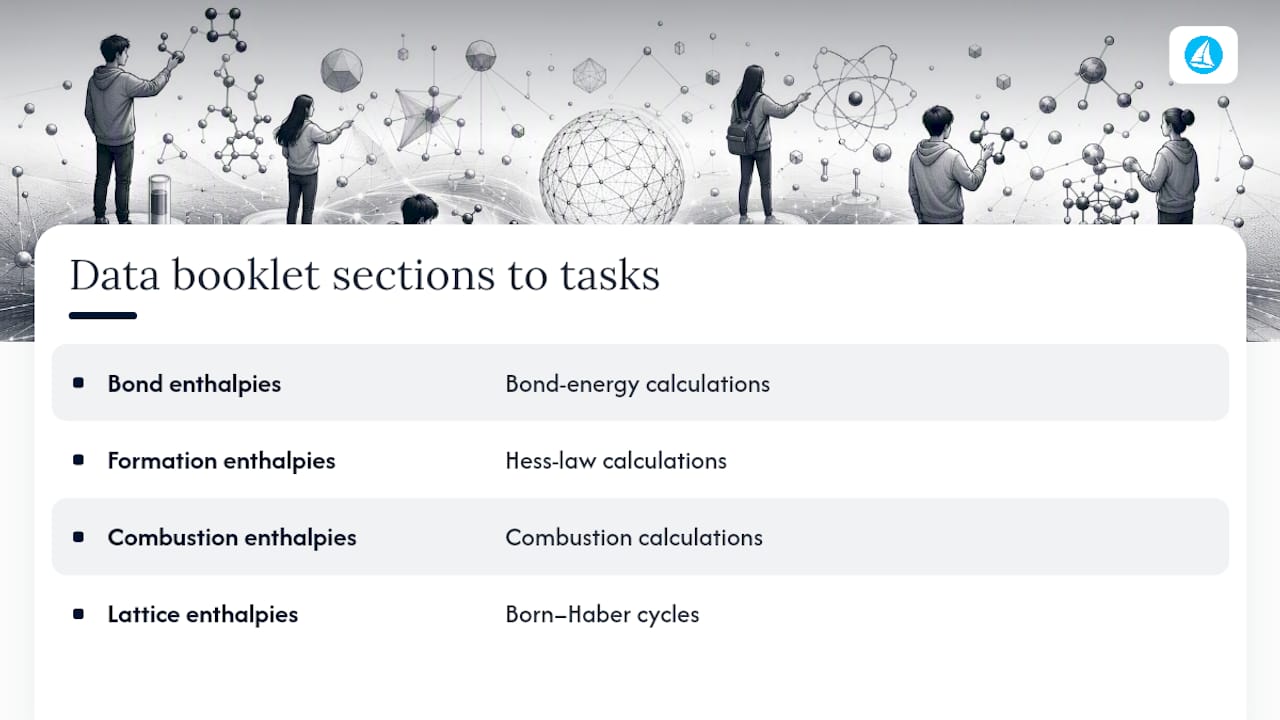
Move further in and you hit the data most students actually search for under pressure. Bond enthalpies sit in their own dedicated section, distinct from bond lengths, which trips up students who assume they’re combined. Thermodynamic data, including standard enthalpies of formation, has its own table, separate again from enthalpies of combustion. Lattice enthalpies get a section to themselves too, which matters for Born-Haber cycle questions where using the wrong table produces a wildly incorrect answer.
Spectroscopy is where most marks get dropped needlessly. Infrared data, 1H NMR chemical shifts, and mass spectral fragment tables are each numbered separately, and HL students in particular need to move between all three within a single structural determination question. Knowing that the NMR table sits a few pages after the IR table, rather than searching the whole booklet each time, is the difference between finishing a question with time to check your working and running out of time altogether.
Standard reduction potentials deserve a special mention because electrochemistry questions almost always require reading two half-cell values and combining them correctly, and the table’s layout (with sign conventions that catch students out every year) rewards familiarity built well before exam day. The colour wheel, tucked between the thermodynamic and lattice enthalpy sections, is another thing students forget exists until they need to explain why a transition metal complex is a particular colour.
Uncertainties sit near the end, in section 22, and HL students especially should know this table exists before their internal assessment writeup, not just the final exam. The references section closes the booklet, documenting where the data itself originated, which matters less for exam performance but shows the level of rigour the IB applies to the whole document.
How to use the booklet in revision and under exam pressure
Owning the booklet and using it well under time pressure are two different skills, and the gap between them accounts for a surprising number of lost marks. Chemistry examiners consistently note that the booklet exists to support interpretation and application, not memorisation of the tables it contains. That distinction should shape how you revise.
- Run timed look-up drills. Set a timer for 30 seconds and locate a specific value, the bond enthalpy of a C=O bond, say, or the standard reduction potential for a half-reaction. Repeat with a new value each time until locating any table takes under 15 seconds without thinking.
- Practise with real exam-style questions that force booklet use. A question that asks you to calculate a lattice enthalpy using a Born-Haber cycle only works as practice if you actually open the booklet to pull the raw values, rather than working from memory.
- Mark your own timed attempts against official mark schemes. Check not just whether your final answer is right, but whether you pulled the correct value from the correct table, since one wrong reference collapses an otherwise sound calculation.
- Build a habit of checking units and standard conditions before calculating. A thermodynamic value quoted at standard conditions behaves differently from one measured elsewhere, and the booklet states this clearly, but only if you read the header row rather than jumping straight to the number.
- Cross-check table references in your working. Writing “Section 18” next to a reduction potential you’ve used costs no marks and forces you to confirm you read the right row.
Pro Tip: Photocopy just the pages you use most (bond enthalpies, thermodynamic data, and the spectral tables) and drill from those loose pages during timed practice. It trains your eye to scan a busy page fast, which is exactly the skill the full booklet demands in the exam hall.
For teachers, three habits make an outsized difference. Distribute the same clean copy for every class test that uses the booklet, so students see identical pagination to what they’ll face in the real exam. Run occasional timed tests built entirely around booklet retrieval, not recall, to expose which students are still hunting for tables under pressure. And when designing internal assessments or topic tests, write questions that explicitly demand a booklet lookup, an approach some teachers describe as building practical booklet literacy rather than testing memory of values students shouldn’t need to memorise in the first place.
Common mistakes worth naming directly: confusing bond enthalpy with bond length because the sections sit close together, forgetting that enthalpy of combustion and enthalpy of formation are different tables with different sign conventions, and misreading the uncertainty section’s format under time pressure. Each of these is preventable with fifteen minutes of deliberate table familiarisation, repeated across a few weeks rather than crammed the night before.
SL versus HL: one booklet, different weightings
There is only one chemistry data booklet, and every SL and HL student sits with the identical PDF. Nobody receives an HL-specific version, so the scope difference lives entirely in which sections you’re expected to use fluently, not in the document itself.
HL students lean far more heavily on a specific cluster of tables. The deeper thermodynamic data, including entries used in Gibbs free energy and entropy calculations, appears throughout SL too, but HL questions demand faster, more confident movement between the thermodynamic table and the equations section, since HL papers combine multiple concepts in a single question far more often.
- Advanced kinetics work, particularly anything touching the Arrhenius equation, draws on the equations section alongside the physical constants, and HL students should know both by heart.
- Gibbs free energy questions require pulling values from the standard thermodynamic data table while applying an equation from a different section entirely, a combination that rarely appears at SL.
- Spectral analysis at HL goes deeper into combined IR, NMR, and mass spectrometry data for structural elucidation, meaning HL candidates need real fluency across all three spectroscopy sections, not just familiarity with one.
- The standard reduction potentials table appears at both levels, but HL electrochemistry questions typically demand combining two half-cells and interpreting the resulting cell potential’s sign, a step SL rarely pushes as far.
If you’re an HL candidate revising with limited time, prioritise the thermodynamics, kinetics, and spectroscopy sections first. They carry the heaviest HL-specific demand, and fluency there transfers directly into faster, more accurate answers across paper two and three.
Authorised copies, mirrors, and the difference from formula sheets
Searches for the booklet often turn up more than the official PDF, and it’s worth knowing what you’re actually looking at before you trust it for exam preparation. Sites such as the studylib mirror host copies of the same document, and these can be useful when the primary source is slow to load or temporarily inaccessible. Always cross-check the version metadata (the “first assessment 2025” marker, the section count, the page layout) against the IB-hosted original before treating a mirrored file as current.
Separately, you’ll find revision sites offering their own formula sheets and study guides built around the same constants and equations. Resources like a formula booklet or a chemistry formula sheet reorganise the booklet’s content into a more condensed study format, and these can genuinely help while you’re learning where each value lives.
But treat the distinction seriously:
- A revision formula sheet is a study aid you use at home, never something you can bring into the exam room.
- Only the official IB PDF, distributed by your school in its unedited form, is permitted during the actual assessment.
- If a third-party sheet presents a value that looks different from the official booklet, the official booklet wins, always cross-check rather than trusting the summary version.
- Formula sheets are genuinely useful for memorising equation structure, but they should never replace the timed, booklet-based practice described earlier.
How Tiber Tutor builds exam practice around the official booklet
Reading the booklet cover to cover teaches you almost nothing about using it under exam pressure. That skill only develops through repeated, timed exposure to the exact kind of question that forces you to open it, find the right table, and apply the value correctly within a tight time limit, which is precisely what shaped how Tiber Tutor’s chemistry content gets built.
Every exam-style question in Tiber Tutor’s IB Chemistry question bank and mock exams is written by practising IB examiners who structure questions the way real papers do, forcing a genuine booklet lookup rather than testing memorised values. A Born-Haber cycle question, for instance, is written so you must retrieve the correct lattice and bond enthalpy figures yourself, exactly as paper two demands, rather than handing you the numbers up front the way a generic worksheet might.
What sets this apart from a stack of practice papers is what happens after you finish. Tiber Tutor’s progress tracking measures not just whether your final answer was correct, but where in the process things went wrong, including whether you pulled data from the wrong section or misapplied a standard condition. No other platform in the IB space offers that level of granular, booklet-specific performance insight, because most practice resources simply mark answers right or wrong and stop there.
Alongside the mock exams sit condensed cram sheets that cross-reference the same tables, and a guide to using an IB data booklet in practice that walks through the exact retrieval habits examiners reward. The goal throughout is booklet fluency built through repetition, not last minute memorisation.
Tiber Tutor: study resources that complement the official booklet
Owning the official PDF gets you access to every table you need. Turning that access into exam-day speed and accuracy is a different problem, and it’s the one Tiber Tutor was built to solve.
Tiber Tutor’s chemistry content is written entirely by practising IB examiners, which means every mock exam and question bank entry mirrors the exact style, phrasing, and difficulty of real papers, right down to how questions force a genuine booklet lookup rather than testing recall. The platform’s IB Chemistry Tests and mock exams train the specific retrieval skills covered above, and the personalised progress tracking behind them shows exactly which sections of the booklet still slow you down, a level of interlinked, exam-reflective insight no other IB chemistry resource currently offers. Combine that with cram sheets, detailed notes, and flashcards, all cross-referenced to the same booklet tables, and you get a single connected system rather than a pile of disconnected PDFs.
Two subscription options cover this: an all-access plan for full coverage across Biology, Chemistry, Physics, and Maths, or a per-subject plan if chemistry is your priority right now. Both start with a free trial. Visit Tiber Tutor’s pricing page to compare plans, or head straight to the IB Chemistry Tests page to see the question bank built around exactly the booklet skills covered in this guide.
Authoritative downloads and quick reference links
Keep these close during revision. Each links directly to source material rather than a secondhand summary.
- Chemistry data booklet (first assessment 2025), the official exam-permitted PDF covering both SL and HL.
- IB Chemistry Data Booklet mirror, a useful backup copy when the primary host is slow, cross-check version metadata before relying on it.
- Tiber Tutor IB Chemistry Syllabus guide, mapping syllabus topics to the sections of the booklet each one draws on.
Editorial perspective: why booklet familiarity beats memorisation every time
Most chemistry revision advice still treats the data booklet as an afterthought, something you glance at during the exam rather than something you train with deliberately for months. That’s backwards. The booklet’s own introductory framing makes the point explicitly: it exists to support interpretation and application, and treating it as a last-minute lookup tool rather than a document you know intimately costs students marks that have nothing to do with their actual chemistry understanding.
The uncomfortable truth is that a meaningful share of dropped marks in IB Chemistry papers aren’t conceptual failures at all. They’re retrieval failures, a student who understands lattice enthalpy perfectly but wastes ninety seconds hunting for the right value, then rushes the calculation and makes an arithmetic slip. Teachers see this every exam season, and it’s entirely preventable with the kind of structured, timed practice described earlier in this guide.
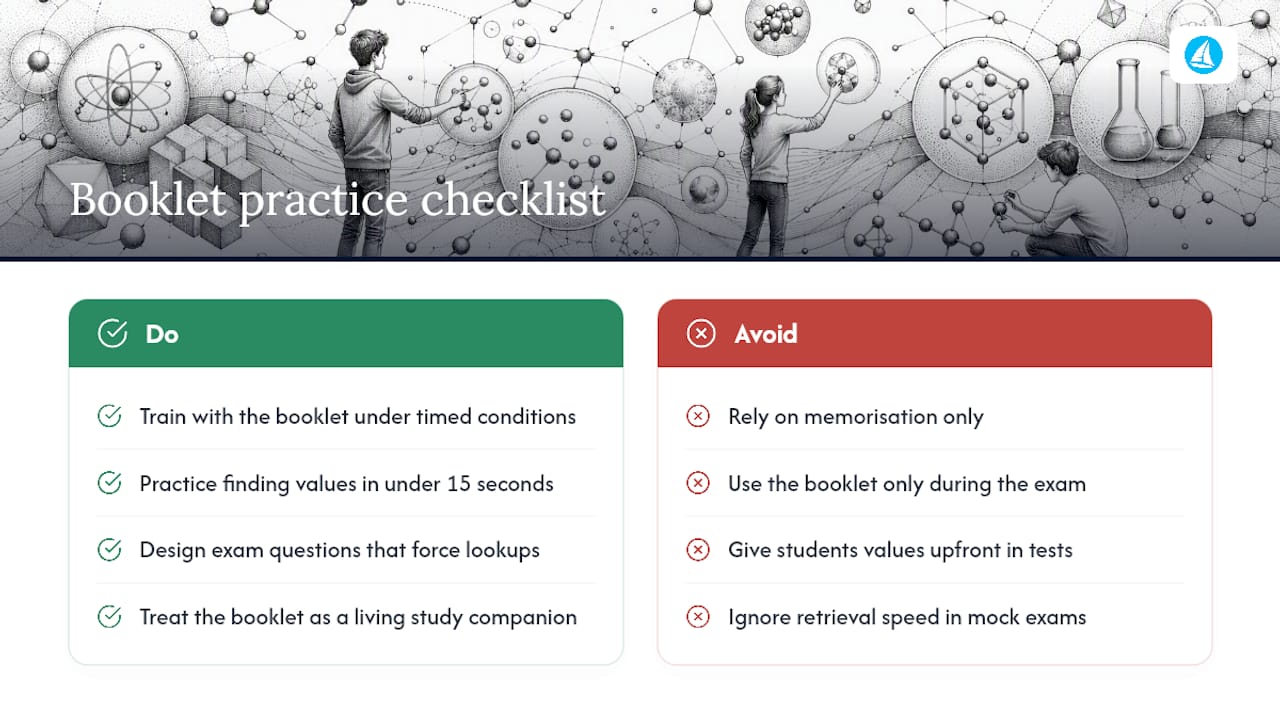
What surprises me most, having looked closely at how this booklet is actually used in classrooms, is how rarely schools test students on retrieval speed directly. Plenty of mock exams test whether students know the chemistry. Very few tests whether students can find the right table in under fifteen seconds while under genuine time pressure, which is precisely the skill that separates a comfortable 6 from a 7 on results day. Question design that deliberately forces a booklet lookup, rather than handing values to students upfront, is one of the more underrated tools available to chemistry teachers right now, and it costs nothing beyond a bit of planning.
The booklet itself hasn’t changed dramatically in spirit across syllabus cycles, but treating it as a living study companion rather than an exam-day prop is the single biggest mindset shift most students never make.
— Oliver
Sources
- Chemistry data booklet (first assessment 2025)
- IB Chemistry Data Booklet (First Assessment 2025) — studylib mirror
FAQ
How Do I Get a 7 in IB Chemistry HL?
A 7 typically comes from combining strong conceptual understanding with fast, accurate use of the official data booklet, since HL papers reward speed as much as knowledge. Regular timed practice with exam-style questions, the kind found in Tiber Tutor’s IB Chemistry Tests, builds the retrieval fluency that separates a 6 from a 7 far more reliably than extra memorisation.
Is AP Chemistry or IB Chemistry Harder?
The two courses test different skills rather than one being straightforwardly harder. IB Chemistry HL demands sustained application across longer, multi-part questions and heavier data-booklet use, while AP Chemistry leans more on breadth of content covered in a shorter exam format.
Where Can I Find a Chemistry Formula and Data Booklet?
The only exam-valid version is the official IB Chemistry data booklet (first assessment 2025), downloadable through the IB-hosted PDF or your school’s Programme Resource Centre copy. Revision sites offer supplementary formula sheets for study purposes, but these are never permitted substitutes in the actual examination.
What Is the Best Textbook for the IB Chemistry Course?
No single textbook is officially mandated, so most schools choose from a small set of IB-endorsed titles aligned to the current syllabus. Whichever textbook you use, pair it with exam-style practice that forces genuine data booklet retrieval, since textbooks teach concepts but rarely train the timed lookup skills tested in papers two and three.
Does Tiber Tutor Cover the IB Chemistry Data Booklet in Its Practice Materials?
Yes. Tiber Tutor’s mock exams, question banks, and cram sheets are written by IB examiners specifically to require booklet lookups, and the platform’s progress tracking shows exactly where retrieval slows a student down, a feature not currently offered elsewhere in the IB chemistry space.