The IB Physics data booklet: official download and how to use it
The official IB Physics data booklet sits on the International Baccalaureate’s own physics page, and that IBO site is the only source you should trust for the current PDF. For students sitting exams from May 2025 onwards, you need the booklet aligned to the DP physics course first taught from 2023, not an older version that predates the syllabus overhaul. Your school will typically issue this through the IB’s secure candidate portal or your teacher’s resource library, since the IB restricts full public redistribution of the exam-day copy.
What matters most right now is confirming you have the right edition. The updated 2025 assessment structure changed how Paper 1 is split and shifted more weight onto data analysis, so an outdated booklet PDF may list superseded formulae or miss reorganised sections entirely.
Once you have the correct copy, the real work starts: learning where everything lives inside it and practising under timed conditions so you are not hunting for a constant mid-exam. Understanding how IB results feed into university admission requirements is crucial for planning your next steps after exams. Educator-annotated versions and video walkthroughs can speed that process up considerably, provided they are built by people who actually understand the current mark schemes.
Here is what to do first:
- Download the current PDF directly from the IBO’s DP physics curriculum page or through your school’s official IB resource centre.
- Check the cover page and internal formatting against your teacher’s copy to confirm it matches the syllabus first assessed in May 2025.
- Print or save a working copy you can annotate freely during revision, separate from the clean version you will use in the exam hall.
- Look for annotated walkthroughs from experienced educators once you have the base document, rather than starting with someone else’s markings.
Key Takeaways
Exam success with the IB Physics data booklet comes from pairing the correct, current-version PDF with disciplined timed practice against examiner-style questions, not from memorising its contents.
| Point | Details |
|---|---|
| Use the official IBO PDF | Download the booklet from the IB’s own physics curriculum page, matched to your exam session’s syllabus version. |
| Confirm your booklet version | Courses first taught in 2023 assess from May 2025, so older PDFs may mismatch the current structure. |
| Show your working, not just answers | Examiners mark method, units, and substitutions; the booklet supplies formulae but never reasoning. |
| Vet annotated resources carefully | Prefer educator-built annotations tied to mark schemes over anonymous PDFs of uncertain syllabus alignment. |
| Practise on a timed, marked cycle | Pair each booklet lookup with a timed exam-style question and honest self-marking to convert knowledge into marks. |
Table of Contents
- What the IB physics data booklet actually contains
- Which booklet version applies to your exam session
- Using the data booklet under exam conditions
- Annotated data booklets and examiner walkthroughs
- Practise with purpose: linking the booklet to real exam practice
- A four-to-six-week study plan built around the data booklet
- An examiner’s view on how students actually lose marks
- Sources
- FAQ
What the IB physics data booklet actually contains
The booklet is organised into distinct blocks, and knowing the shape of it before exam day saves you real seconds when the clock is running. It opens with fundamental constants (Planck’s constant, the speed of light, the gravitational constant, and so on), followed by SI prefixes and unit conversions you are expected to apply without being told to. From there it moves into topic-specific formula tables that map onto the five course themes: space, time and motion; particulate matter; wave behaviour; fields; and nuclear and quantum physics, as set out in the IB’s physics subject brief.
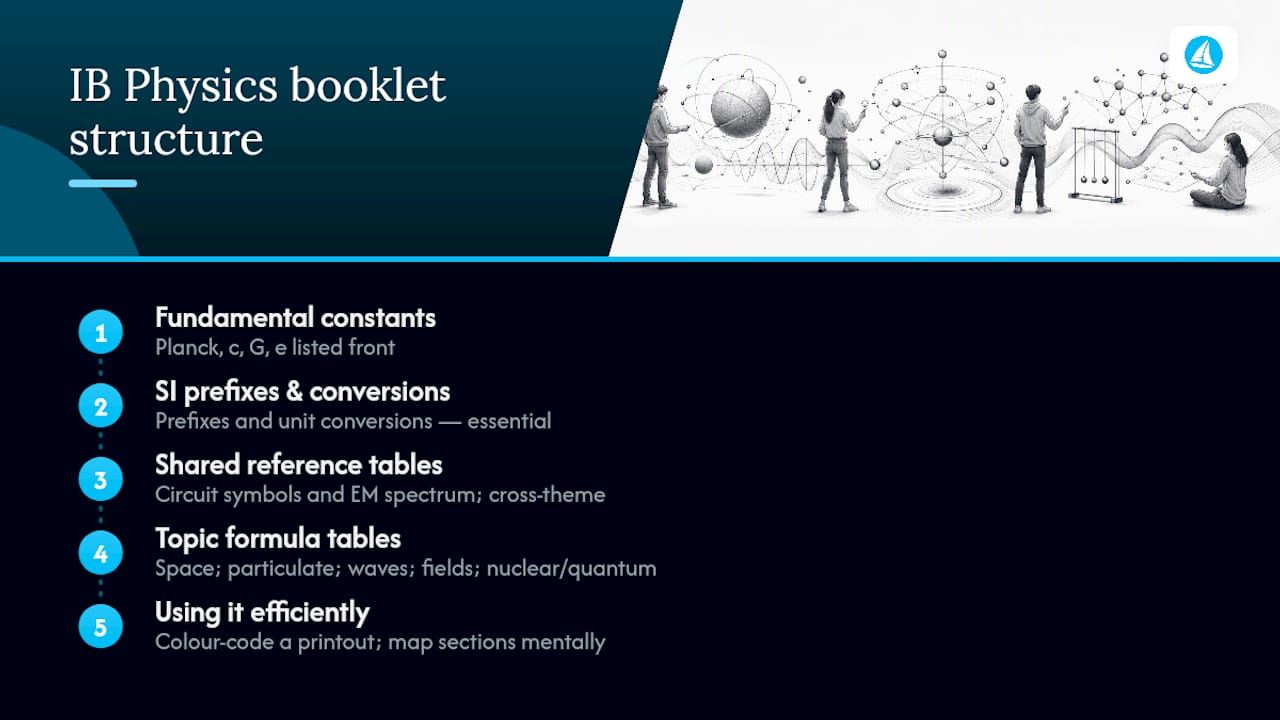
Circuit symbols and electromagnetic spectrum tables sit near the front, mostly because they get used across multiple themes rather than belonging to just one. If you are answering a question on electromagnetic induction, you might need the circuit symbol key, a unit conversion, and a formula from the fields section all in the same response. Students who treat the booklet as a single linear document rather than a cross-referenced toolkit tend to waste time flicking backwards and forwards.
Pro Tip: Build a mental map of the booklet by colour-coding a spare printout: one colour for constants you will need almost every paper (Planck’s constant, elementary charge, speed of light), another for topic-specific formulae you only need in certain question types. That mental sorting matters more than memorising page numbers, because the booklet’s internal order can feel arbitrary until you have used it under timed pressure a dozen times.
Where students spend the most time
Three sections get disproportionate use in exam papers. The unit conversion tables come up constantly in data-based questions, where you are handed raw figures in one unit and expected to convert before calculating. The topic-specific equation tables for fields and for wave behaviour see heavy use in Paper 2’s extended-response questions, since those two themes generate the most multi-step numerical problems. And the fundamental constants page gets referenced in almost every paper, which is exactly why memorising it is pointless. It is right there, correctly stated, every single time.

Graph-analysis questions lean on a slightly different skill: recognising which formula from the booklet corresponds to the gradient or intercept you are asked to interpret. This is where a lot of marks get lost, not because students cannot do the maths, but because they cannot match the graph to the right entry.
Higher Level students get extra material that Standard Level students do not see: additional constants and formula entries tied to HL-only syllabus content, particularly around nuclear physics and some of the more advanced field equations. If you are SL, do not waste revision time on HL-flagged rows. If you are HL, check specifically which entries carry that HL marker, because missing one during revision means discovering it cold in the exam hall.
One structural point catches almost every student out at least once: the booklet gives you the formula, but it never tells you which variable is which in a specific question’s context. You still have to read the question carefully enough to map its symbols onto the booklet’s notation, and IB questions occasionally use variable letters that do not match the booklet exactly. That mismatch is a deliberate test of understanding, not a booklet error.

Which booklet version applies to your exam session
The DP physics course changed for first teaching in 2023, with first assessment in May 2025, and that shift restructured Paper 1 into two distinct components while placing heavier emphasis on data interpretation throughout. If your exam session falls in May 2025 or later, you need the booklet built for that updated course, not a legacy copy still floating around from before the change.
This matters more than it might seem, because older PDFs occasionally circulate on forums and file-sharing sites with formulae listed under different section numbers, or with entries missing that the new syllabus introduced. A booklet mismatch will not cause you to fail an exam outright, but it can cost you valuable revision time learning a layout that will not match what is printed in front of you on the day.
Confirming you have the correct version takes about two minutes:
- Check the front cover or footer for a date reference, and compare it against your school’s official copy or your teacher’s confirmation.
- Cross-reference the section order against the current IB physics subject brief, which lists the five current themes in the order the booklet follows.
- Ask your teacher directly if anything looks unfamiliar. IB coordinators receive official version updates and can confirm in seconds what might take you an hour to work out independently.
If you discover a mismatch close to exam season, do not panic and do not try to patch the gap yourself with formulae copied from random websites. Go back to the IBO’s own physics curriculum page for the authoritative copy, and flag the discrepancy to your teacher so your whole class is working from the same edition. Our guide to the current IB Physics syllabus breaks down exactly what changed and why it reshuffled the booklet’s structure.
Using the data booklet under exam conditions
The booklet supplies constants, conversions, and formulae. What it will never supply is your working, your reasoning, your correct units, or your substitutions, and examiners mark almost exclusively on those things rather than on whether you could locate the right row. A student who copies down the wrong formula but shows clean, logical working from that point often scores better than one who picks the right formula and then substitutes carelessly.
Build a routine you repeat identically every single time you tackle a numerical question:
- Identify the quantity you’re solving for and scan the relevant booklet section for the matching formula.
- Copy the formula into your working exactly as it appears, before you touch a single number.
- Write out your substitution step by step, showing which value goes into which symbol.
- Check your units at every stage, converting before you calculate rather than after.
- Round only at the final answer, keeping full precision through intermediate steps.
- State your final answer with correct units and appropriate significant figures, matching what the question data allows.
That sequence sounds almost too simple to matter, but examiners consistently report the same handful of avoidable errors: students round too early and compound small inaccuracies through several calculation steps; students forget to convert units before substituting, which throws answers out by orders of magnitude; and students grab the wrong formula from a booklet section that superficially resembles the one they need but applies to a different physical scenario entirely.
Pro Tip: In data-based questions specifically, write down every value from the question stem before you touch the booklet, including units. Half the errors examiners see come from misreading a graph axis or table header under time pressure, not from picking the wrong formula.
Timing habits matter as much as calculation habits. Spend no more than fifteen to twenty seconds locating a formula once you know the syllabus topic, because the booklet’s structure follows the five course themes closely enough that a quick scan should get you there. If you are still searching after thirty seconds, move on and come back, since burning two exam minutes hunting for one entry is a worse outcome than a temporarily skipped question.
Annotated data booklets and examiner walkthroughs
A genuinely useful annotated booklet does three things a blank official copy cannot: it shows worked exam-style solutions next to the exact formula used, it flags which syllabus objective each entry supports, and it clearly marks the HL-only rows so Standard Level students are not wasting revision time on content they will never be examined on. Anything less than that is decoration, not a study aid.
Video walkthroughs face the same bar. The genuinely useful ones reference specific past exam questions and walk through how a marker would actually award points against the official mark scheme, not just how to arrive at the numerically correct answer. There is a real difference between a video that shows you the fastest route to a number and one that shows you how an examiner reading your script would allocate marks step by step, and the second kind is worth far more in revision.
When you are vetting annotated resources, look for these signals before trusting one:
- Syllabus alignment stated explicitly, showing which of the five current themes and which specific sub-topic an annotation relates to.
- Mark-scheme language, not just correct numerical answers. A good annotation explains why a step earns a method mark versus an accuracy mark.
- Author background that suggests real classroom or examining experience, rather than an anonymous upload with no context.
- Recency matching the current syllabus, since annotations built for the pre-2023 course may reference formulae or section numbers that have since moved or changed.
- HL-only content clearly separated, so SL students are not misled into memorising material outside their assessment scope.
The official booklet should always be your baseline copy, the version you trust completely, with any annotated resource treated as a supplementary layer on top of it rather than a replacement. Third-party PDFs and walkthroughs vary enormously in quality, and some circulating online were built for outdated syllabus versions or contain transcription errors that never went through anything resembling an editorial check. Favour annotations built by educators with demonstrable teaching or examining backgrounds over anonymous forum uploads, and cross-check anything that looks unusual against your own official copy before trusting it fully.
This is precisely where a platform built around examiner expertise earns its place in your revision. Tiber Tutor’s detailed IB Physics notes connect booklet entries directly to the syllabus sub-topics they support, written by educators who understand exactly how the current mark schemes reward working, not just final answers, which is a level of syllabus-matched precision that generic annotated PDFs floating around online rarely reach.
Practise with purpose: linking the booklet to real exam practice
Deliberate practice that pairs a booklet lookup with a genuine exam-style question, done against the clock, converts formula familiarity into full-mark answers faster than any other method available to you. Passive re-reading of the booklet teaches you where things are. Timed practice teaches you how to use them under pressure, which is the actual skill being examined.
Students who habitually copy the relevant constant or conversion into their working and explicitly annotate which formula they are applying make noticeably fewer calculation errors and lose far fewer method marks than those who work from memory alone.
Build your practice sessions around a repeatable workflow rather than random revision:
- Pick one syllabus topic you feel shaky on, rather than practising broadly and thinly.
- Find the relevant booklet entry and note exactly which section it sits in.
- Select two or three exam-style questions targeting that specific topic, ideally pulled from a syllabus-aligned question bank.
- Time yourself strictly, using realistic per-mark timing rather than working at a relaxed pace.
- Self-mark against the official mark scheme, being honest about method marks lost, not just whether your final number was correct.
- Carry the weak step into your next session, focusing specifically on whatever cost you marks rather than repeating the same topic from scratch.
Each of those six steps maps onto a specific tool, and this is where Tiber Tutor’s platform genuinely earns its place ahead of generic study sites. The topic identification and targeted question selection happen through the custom test builder, which lets you assemble question sets by exact syllabus sub-topic rather than working through an entire paper to find the three questions you actually need. The timed practice and self-marking steps are handled by examiner-built mock exams, which reflect real marking priorities because the people writing them have marked real IB scripts. And the weak-step review loop is supported by detailed notes and topic tests that let you drill precisely the sub-skill that cost you marks last time, rather than starting a fresh topic and repeating the same gap.
This is the structural advantage of a genuinely interlinked platform: your mock exam results feed directly into progress tracking that tells you which syllabus theme needs another pass, and your next custom test can be built around exactly that theme without you manually cross-referencing anything. No annotated PDF or standalone video series offers that closed loop, because they are static resources with no memory of what you got wrong last week.
A four-to-six-week study plan built around the data booklet
Turning booklet familiarity into exam marks needs a schedule, not just good intentions the week before your exam. A four-to-six-week structure gives you enough runway to cover weak topics twice while leaving the final week for pure timed practice rather than new learning.
- Weeks one and two: topic-by-topic review paired with booklet drills. Work through your weakest two or three syllabus themes, reading detailed notes for each and immediately practising booklet lookups tied to that theme’s formulae, rather than reading everything before practising anything.
- Week three: first full timed paper under exam conditions. Sit a complete mock exam with no notes beyond your official booklet, timed exactly as the real exam session will run, then mark it honestly against the official scheme.
- Week four: targeted review of whatever the mock exam exposed. Go back through your marked paper line by line, identify whether losses came from concept gaps, booklet misuse, or careless working, and drill specifically that weakness with topic tests.
- Week five: second full timed paper plus flashcard revision of constants. Sit another mock under stricter time pressure, and use flashcards to nail down the constants and conversions you should recognise instantly without booklet lookup.
- Week six (final week before exams): light review only. Skim cram sheets, re-read your weakest topic notes once, and sit one final short timed paper early in the week, leaving the final days for rest rather than cramming new content.
Rotate resource types across those weeks rather than relying on one format throughout. Mock papers build stamina and timing instinct. Topic tests isolate specific weaknesses. Examiner-annotated solutions show you exactly how marks were lost or gained on questions you have already attempted. Flashcards handle the small, forgettable details, such as which constant carries which units, that do not need deep understanding, just instant recall.
Tiber Tutor’s platform is built around exactly this rotation. Mock exams cover weeks three and five, notes and cram sheets support the review weeks, and the custom test builder lets you assemble precisely targeted question sets the moment week four’s review flags a specific gap. Because every resource sits on the same platform and tracks against the same syllabus map, your progress data carries forward automatically. You are never starting a new week’s plan blind to what the last one revealed.
An examiner’s view on how students actually lose marks
Having marked IB Physics scripts, the pattern that stands out most is not weak physics understanding. It is weak presentation of correct understanding. Two students can both know exactly which booklet formula applies, and one scores full marks while the other loses two or three, purely because the second student’s working was too sparse for a marker to award method credit when the final answer was slightly wrong.
Units are the single most common silent killer of marks. A correct numerical answer with a missing or wrong unit rarely loses the accuracy mark outright, but sloppy unit handling earlier in the working almost always signals to a marker that the substitution step deserves closer scrutiny, and closer scrutiny finds errors.
On pacing, my advice is blunt: in data-based questions, spend your first thirty seconds reading the data table or graph fully before you go anywhere near the booklet. Students who dive straight into formula-hunting frequently misread what the question is actually asking and waste far more time backtracking than they would have spent reading properly the first time.
If you want to build this habit properly rather than hoping it develops naturally under exam pressure, deliberate timed practice against examiner-style mock exams is where that discipline actually forms.
Sources
- Physics in the DP - International Baccalaureate®
FAQ
How hard is it to get a 7 in IB Physics?
Top IB Physics grades require consistent accuracy across both papers, including data-analysis questions, and strong command of the data booklet under timed conditions. Achieving this outcome is possible with structured practice but demands more than memorising formulae; examiners reward clean working and correct units as heavily as the right final number.
Where can I find the IB Physics HL data booklet for 2026?
The current HL and SL data booklet is hosted on the IB’s official DP physics curriculum page, aligned to the course first taught in 2023 and first assessed in May 2025. Your school’s IB coordinator can also confirm you are working from the correct official copy.
What percentage is a 7 in IB Physics?
The exact grade boundaries shift slightly each exam session and are not fixed as a single universal percentage, so check your specific session’s published boundaries through your school rather than relying on a fixed figure from a previous year.
Where can I find the HL physics data booklet?
HL and SL students use the same official data booklet, since HL-specific formulae and constants are simply flagged within the single combined document rather than issued as a separate HL-only PDF. Download it from the IBO’s physics page and confirm the HL-flagged entries with your teacher.