IB periodic table: the complete guide for IB Chemistry
The IB periodic table is the official element chart provided within the IB Chemistry Data Booklet, supplied to students during all IB Chemistry examinations. It lists every element by atomic number, symbol, and relative atomic mass, making it the single most important reference tool in your IB Chemistry toolkit. Understanding its structure, the trends it encodes, and how to use it under exam conditions separates confident students from those who struggle. This guide covers everything you need, from layout and periodic trends to exam technique and study methods.
How is the IB periodic table structured and organised?
The periodic table for IB Chemistry arranges all known elements in order of increasing atomic number, from hydrogen (Z=1) to oganesson (Z=118). This ordering is not arbitrary. It places elements with similar electronic configurations into the same vertical columns, called groups, and elements in the same horizontal row share the same number of electron shells, called periods.

For IB students, the relationship between position and electronic configuration is especially important up to Z=20 (calcium). Knowing that sodium (Z=11) sits in Group 1 because it has one valence electron, or that chlorine (Z=17) sits in Group 17 because it has seven, gives you predictive power across bonding, reactivity, and properties questions.
The table also classifies elements into three broad categories:
- Metals: found on the left and centre of the table; good conductors, malleable, and tend to lose electrons
- Non-metals: found on the upper right; poor conductors, tend to gain electrons
- Metalloids: a diagonal band between the two (silicon, germanium, arsenic) with intermediate properties
Here is a quick comparison of groups and periods to clarify their roles:
| Feature | Groups (vertical columns) | Periods (horizontal rows) |
|---|---|---|
| What they share | Number of valence electrons | Number of electron shells |
| Example | Group 1: Li, Na, K all have 1 valence electron | Period 3: Na to Ar all have 3 electron shells |
| Exam relevance | Predicts reactivity and bonding type | Predicts atomic radius and ionisation energy trends |
Recognising this layout quickly during an exam saves time and reduces errors.
What are the key periodic trends in the IB Chemistry syllabus?
Periodic trends are the patterns in element properties that emerge directly from the table’s structure. The IB Chemistry syllabus requires students to understand and apply three core trends: atomic radius, ionisation energy, and electronegativity.
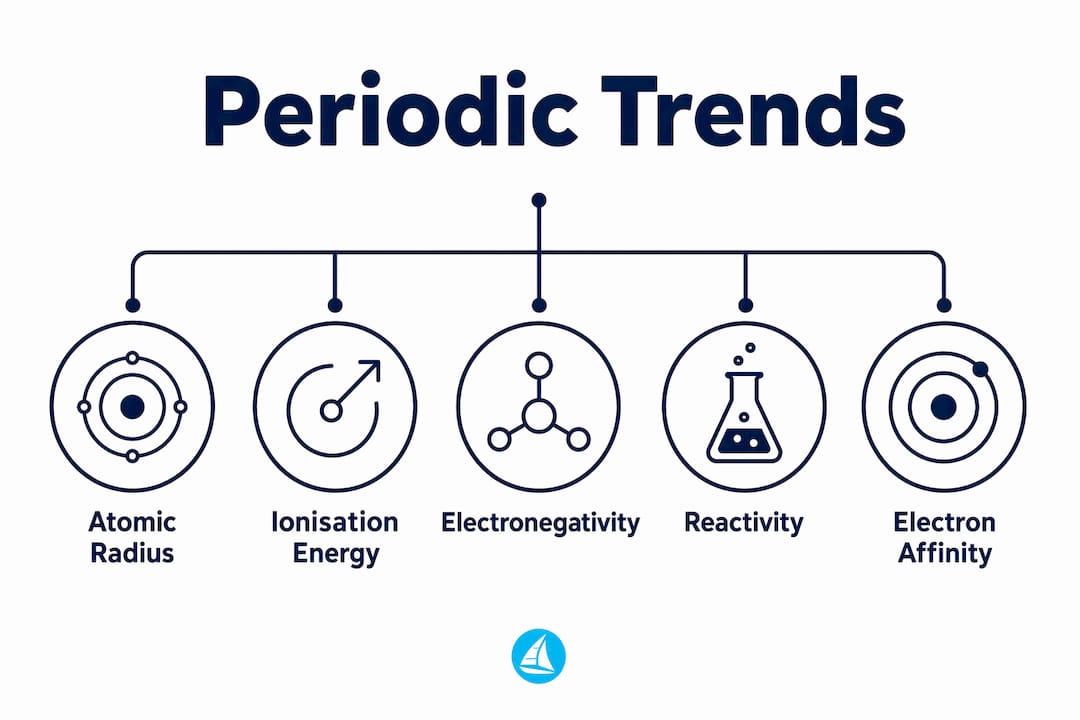
Atomic radius decreases across a period (left to right) because increasing nuclear charge pulls electrons closer to the nucleus. Atomic radius increases down a group because each new period adds an electron shell, pushing the outer electrons further away. This single trend underpins predictions about ionic size, bond length, and metallic character.
Ionisation energy is the energy needed to remove one mole of electrons from one mole of gaseous atoms. It increases across a period and decreases down a group. The reasons mirror atomic radius: a stronger nuclear pull across a period makes electrons harder to remove, while extra shielding down a group makes them easier to remove.
Electronegativity follows the same direction as ionisation energy. Fluorine holds the highest electronegativity value of any element. This trend directly predicts bond polarity and the type of bonding (ionic, polar covalent, or non-polar covalent) between any two elements.
These three trends are critical for exam prediction of element behaviour and bonding. Exam questions regularly ask you to compare two elements and explain a property difference. If you know the trends, you can answer without memorising individual element data.
Pro Tip: When a question asks you to compare two elements, always state the trend direction first, then explain the reason (nuclear charge or shielding), and then apply it to the specific elements named. This three-step method earns full marks consistently.
How to use the IB periodic table effectively in exams
The Data Booklet layout is a skill in itself. Students who know exactly where to find each table before the exam begins work faster and make fewer errors. Practise navigating the booklet during every mock exam and practice session, not just on the day.
Here are four practical steps for using the periodic table during IB Chemistry exams:
- Locate atomic masses quickly. The Data Booklet periodic table lists relative atomic masses. Use these for any mole calculation rather than relying on memory.
- Cross-reference with the electrochemical series. The electrochemical series sits in a separate section of the Data Booklet. Combining it with periodic table position helps you predict redox reactions and electrode potentials.
- Avoid unofficial tools. Some calculators have periodic tables installed, but IB exam regulations require the official Data Booklet only. Using unofficial sources risks exam violations and wastes time.
- Use element position to predict unknowns. If a question introduces an unfamiliar element, its group and period tell you its valence electrons, likely charge, and bonding behaviour.
Pro Tip: Before your first real exam, open the Data Booklet and time yourself finding five different pieces of data: an atomic mass, an electronegativity value, a standard electrode potential, a bond enthalpy, and an infrared absorption range. If you can do it in under 90 seconds, you are well prepared.
What study methods best prepare you for the IB periodic table?
Active use of the periodic table beats passive reading every time. IB educators consistently find that students who treat the table as an analytical tool, rather than a chart to memorise, perform better in exams. The goal is to see patterns, not just symbols.
Effective study methods include:
- Practise interpreting graphs. The IB Chemistry syllabus includes questions where you read trends from graphs of atomic radius or ionisation energy against atomic number. Practise sketching and explaining these graphs from memory.
- Integrate bond enthalpy and reduction potentials. High-achieving students actively connect periodic trends with bond enthalpy values and reduction potentials from other Data Booklet tables. This conceptual linking is what complex exam questions test.
- Use past exam questions by topic. Working through questions specifically on periodicity builds pattern recognition. Focus on questions that ask you to explain a trend, not just identify it.
- Allocate study time deliberately. The IB Chemistry syllabus recommends approximately 6 hours of instruction for Topic 3: Periodicity. Use this as a minimum benchmark for your own revision time on this topic.
Pairing these methods with a structured IB Chemistry study guide gives you a clear framework for covering every aspect of the syllabus without gaps.
Key takeaways
The IB periodic table is a structured analytical tool, and mastering its trends, layout, and Data Booklet integration is the most direct path to higher marks in IB Chemistry.
| Point | Details |
|---|---|
| Official exam resource | The periodic table is provided in the IB Chemistry Data Booklet for all exams. |
| Structure drives prediction | Group and period position reveals valence electrons, shells, and element behaviour. |
| Three core trends | Atomic radius, ionisation energy, and electronegativity are the key exam trends. |
| Data Booklet navigation | Knowing the booklet layout before exam day saves time and reduces errors. |
| Active study wins | Integrating periodic trends with bond enthalpy and reduction potentials distinguishes top students. |
Why most students underuse the periodic table
Most students I work with treat the periodic table as a lookup chart. They find the atomic mass they need, close the booklet, and move on. That approach leaves marks on the table.
The periodic table is a map of chemical behaviour. Every position encodes information about reactivity, bonding, and physical properties. When you see fluorine at the top right, you should immediately think: smallest atomic radius in its period, highest electronegativity, strongest oxidising agent. That chain of reasoning is what examiners reward.
The other mistake I see regularly is students who have memorised trends but cannot explain them. They know atomic radius decreases across a period but cannot say why. The reason is always the same: increasing nuclear charge with no additional shielding. Practise the explanation, not just the direction.
The Data Booklet is also underused as a study tool. Most students only open it during mock exams. Open it during every practice session. Annotate a personal copy. Build familiarity with where every table sits. On exam day, that familiarity is worth more than any last-minute revision.
— Oliver
Tibertutor: IB Chemistry resources built for exam success
Tibertutor is built specifically for IB science students who want to go beyond passive revision. The platform gives you access to a full IB Science Questionbank with Chemistry questions mapped directly to the syllabus, including periodicity and Data Booklet skills.

Every question on Tibertutor is written by experienced IB examiners, so you practise exactly the style and depth the real exam demands. Animated videos, detailed notes, and topic-specific tests help you build genuine understanding of periodic trends, not just surface familiarity. Progress tracking shows you where your understanding is strong and where it needs more attention, so your revision time is always well spent. Explore resources for IB students and see how Tibertutor supports your Chemistry preparation from first study to final exam.
FAQ
What is the IB periodic table?
The IB periodic table is the official element chart included in the IB Chemistry Data Booklet, provided to students during all IB Chemistry examinations. It lists elements by atomic number, symbol, and relative atomic mass.
Is the periodic table provided in IB Chemistry exams?
Yes. The IB Chemistry Data Booklet is supplied in all IB Chemistry exams and contains the official periodic table alongside other reference data.
What periodic trends do IB students need to know?
IB Chemistry students must understand atomic radius, ionisation energy, and electronegativity, including their directions across periods and down groups, and the reasons behind each trend.
How many elements do IB students need to memorise?
IB students focus on understanding electronic configurations and trends up to Z=20 (calcium), though the full periodic table is available in the Data Booklet during exams.
How much time should I spend studying periodicity?
The IB Chemistry syllabus allocates approximately 6 hours of instruction to Topic 3: Periodicity. Treat this as your minimum revision benchmark for this topic.