4 Week Plan to Reuse IB Physics Paper 3 Questions for HL Students
Paper 3 no longer exists under the current IB Physics syllabus. Its assessed skills, including data interpretation, experimental design, and uncertainty analysis, now sit inside the longer HL Paper 1 (Paper 1B) and an adjusted Paper 2. The IBO confirms the change through its current specimen papers, so your best move is practising those official documents rather than hunting for a paper that no longer appears on results day.
TL;DR:
- Data interpretation, experimental design, and uncertainty analysis are now assessed within Paper 1B and Paper 2, not as a separate Paper 3.
- Practice should focus on current specimen papers and relevant past questions, especially Section A from old Paper 3, to target core skills.
- Marking standards reward clear propagation of uncertainty, structured experimental evaluation, and broad application, not option-specific knowledge.
- The removal of Paper 3 concentrates assessment into two longer papers, increasing the importance of consistent performance across all objectives.
- Tiber Tutor offers examiner-designed mock exams and drills aligned with the current syllabus to help students adapt to these changes.
Table of Contents
- What changed: syllabus restructure and where Paper 3 content moved
- What the old Paper 3 used to test (so you know what to keep practising)
- How the replacement papers assess the same skills (what to expect in Paper 1B / current HL papers)
- Practical study plan and where to find good practice (past papers, specimen papers, and focused drills)
- Common pitfalls and exam techniques (data interpretation, uncertainty, time management)
- How Tiber Tutor helps with the Paper 3 transition
- Historical context and rationale behind the removal of Paper 3
- Differences in assessment objectives between the former Paper 3 and its replacements
- Tips for effectively using past Paper 3 questions for study despite its removal
- Impact of Paper 3 removal on overall IB Physics HL scoring and weightings
- Author perspective: what this change means for HL students and teachers
- How Tiber Tutor can help you practise for the replacement papers
- Sources
- FAQ
What changed: syllabus restructure and where Paper 3 content moved
The 2025 syllabus update formally removed Paper 3 from IB Physics HL and SL, folding its assessment aims into the existing paper structure. The IB Physics curriculum pages set out the reasoning: rather than isolating options and data-based questions in a standalone third paper, the IBO redistributed them across papers students already sit. The subject brief on recent physics updates notes this reassignment directly, confirming it wasn’t a quiet drop but a documented curriculum decision.
In practice, the question types you’d once have met in Paper 3 haven’t vanished. They’ve simply relocated:
- Data-based questions and graph analysis now appear within Paper 1B, the longer HL-only section of Paper 1.
- Experimental design and uncertainty evaluation are woven into extended-response questions in Paper 2.
- Option-topic content (astrophysics, imaging, engineering physics, relativity) has been absorbed into the core syllabus rather than tested separately.
That last point matters most for revision planning. You’re no longer choosing one option to specialise in. You’re expected to know the core physics that used to sit behind an option wall.
What the old Paper 3 used to test (so you know what to keep practising)
Legacy Paper 3 ran in two parts: Section A tested data-based and experimental skills common to every student, while Section B tested whichever option a school had taught, astrophysics, imaging, engineering physics, or relativity. Only one option applied per student, decided by the teacher.
The skills Section A demanded are the ones worth protecting in your revision, regardless of when you started the course:
- Designing or critiquing an experimental method, including identifying variables and controls.
- Interpreting raw data sets, plotting graphs, and reading trends.
- Propagating and evaluating uncertainty across multi-step calculations.
- Applying option-specific formulae to unfamiliar scenarios.
The option-specific formulae and niche vocabulary (redshift equations, image resolution limits) are lower priority now, since no current paper isolates a single option. The transferable skills, uncertainty work above all, are exactly what today’s markers reward.
How the replacement papers assess the same skills (what to expect in Paper 1B / current HL papers)
Paper 1B integrates the data-heavy, multi-part questions that Section A of the old Paper 3 used to carry, but they now sit inside your normal Paper 1 sitting rather than a separate exam slot. Expect a stem describing an experiment or data set, followed by several linked sub-questions that build in difficulty. Paper 2’s longer-response questions increasingly ask you to justify an experimental choice or evaluate a method’s limitations, which is where uncertainty analysis now earns its marks.
Typical question shapes you’ll meet:
- A data table with a request to calculate a derived quantity, then propagate the uncertainty through that calculation.
- A graph-based question asking you to determine a gradient, intercept, or best-fit relationship and comment on its physical meaning.
- A short evaluative paragraph asking what would improve the reliability of a described experiment.
Timing shifts slightly too. Because Paper 1B sits inside a longer HL Paper 1, you have more total time but also more content to move through, so budgeting minutes per mark matters more than it used to.
Pro Tip: When a multi-part data question stacks calculations, work out the uncertainty range on your first answer before moving to the next part. Carrying an unclear uncertainty forward is one of the most common ways marks disappear across a whole question.
Practical study plan and where to find good practice (past papers, specimen papers, and focused drills)
A focused four-week plan beats scattered revision, especially with skills now spread across two papers instead of three.
- Week one: Work through the IBO’s official specimen papers untimed, marking every answer against the published scheme to see exactly how markers award uncertainty and evaluation points.
- Week two: Drill data interpretation and graph questions in isolation, pulled from Paper 1B style stems, until your calculation speed matches exam pace.
- Week three: Sit full timed papers, replicating real exam conditions, then review weak topics rather than re-reading notes passively.
Extracting just the data-handling half of an old Paper 3 paper gives you a ready-made uncertainty drill with a genuine markscheme behind it, provided you check the wording still fits the current syllabus.
Common pitfalls and exam techniques (data interpretation, uncertainty, time management)
Students consistently lose marks in the same three places. First, quoting an answer to the wrong number of significant figures relative to its uncertainty. Second, forgetting to propagate uncertainty through every step of a multi-part calculation rather than just the final answer. Third, writing vague evaluative comments (“get more data”) instead of specific, testable improvements (“repeat at five intervals of concentration rather than three to reduce the impact of a single anomalous reading”).
A short checklist before you submit any uncertainty calculation:
- Have you stated the absolute uncertainty, not just the percentage, where the question asks for it?
- Does your final answer’s precision match its uncertainty?
- Have you shown the propagation method, not just the result?
For experimental-design answers, structure your response around variables (independent, dependent, controlled), then method, then a specific reliability improvement. Markers reward that order because it mirrors the assessment objectives IBO sets out for the skill.
Pro Tip: If you’re running short on time in the exam, answer the uncertainty and evaluation sub-parts first within a multi-part question. They’re often worth as much as the main calculation but take less time to write.
How Tiber Tutor helps with the Paper 3 transition
Tiber Tutor’s IB Physics resources are built by practising IB examiners, which matters directly here: examiners know exactly how markschemes reward uncertainty propagation and evaluative reasoning, the two skills that migrated out of the old Paper 3 and into today’s papers.
- Examiner-authored mock exams and topic tests replicate current Paper 1B and Paper 2 question formats.
- A custom test builder lets you assemble timed, data-focused drills from specific skill areas rather than whole past papers.
- Student-led answer review against real mark schemes shows exactly where marks were lost and why.
- Performance analytics track uncertainty and data-interpretation accuracy over time, flagging weak spots no static PDF can show you.
Start with the topic-specific tests to target data skills directly, then build toward full mocks as your accuracy improves.
Historical context and rationale behind the removal of Paper 3
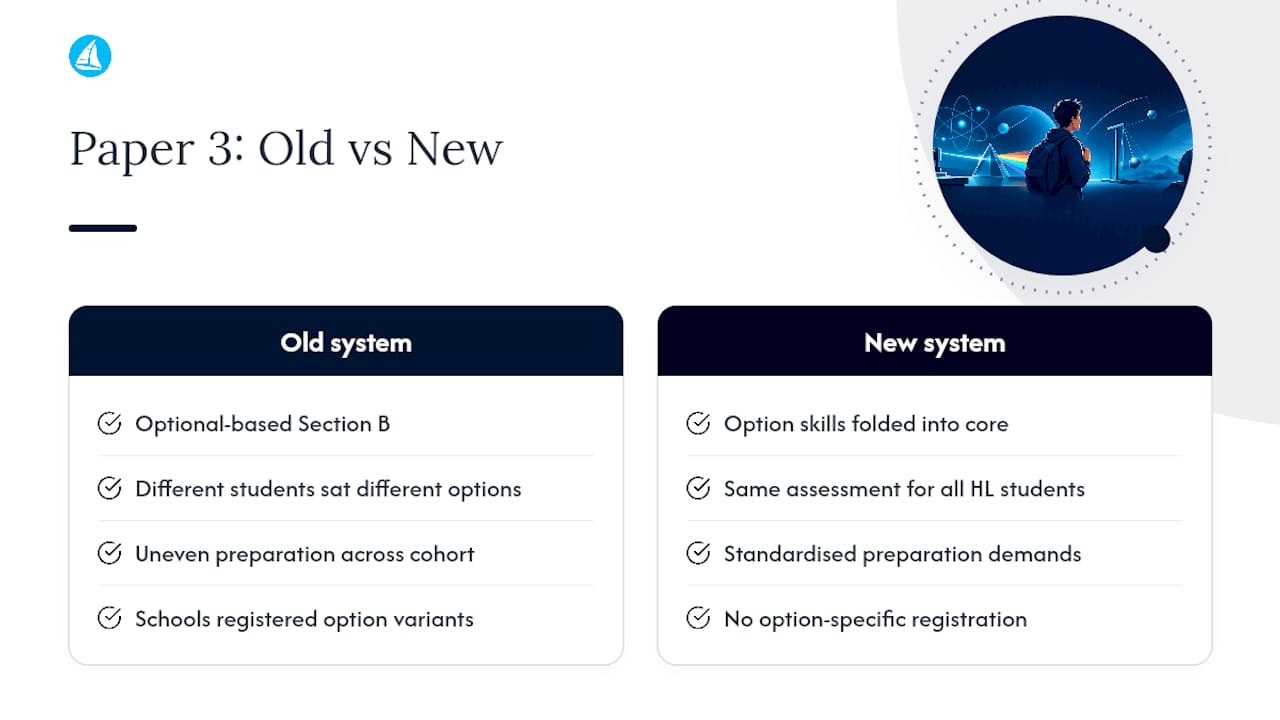
Paper 3’s removal wasn’t a cost-cutting shortcut. It followed a broader IB Sciences review aimed at reducing the fragmentation caused by optional topics. Under the old system, two students in different schools could sit entirely different Section B content depending on which option their teacher chose, astrophysics versus relativity, for instance, creating uneven preparation demands across the diploma cohort.
By folding option-derived skills into core assessment, the IBO’s curriculum update aimed to standardise what every HL student demonstrates, regardless of which options their school previously offered. It also simplified logistics. Schools no longer need to register students for a specific option paper variant, and markers no longer need option-specific training beyond the core syllabus.
There’s a pedagogical argument buried in this too. Separating “options” from “core” physics implied the two were somehow different in kind, when in reality relativity and astrophysics rest on the same experimental and analytical skills as mechanics or electricity. Testing those skills throughout the core papers, rather than cordoning them off, reflects a more coherent view of what physics assessment should measure: not memorised option facts, but the ability to interpret data and evaluate methods regardless of context.
For teachers, this also meant restructuring how option topics get taught. Rather than a dedicated unit taught in isolation near exam season, option content now often gets threaded through core teaching across the two years, which changes lesson planning as much as it changes revision.
Differences in assessment objectives between the former Paper 3 and its replacements
The former Paper 3 leaned heavily on Assessment Objective 3 (evaluation and synthesis) within a narrow, option-specific context. Section B rewarded depth in one chosen area: knowing the Chandrasekhar limit inside astrophysics, for example, mattered only if that was your school’s option.
Current papers spread the same objective across broader, less predictable contexts. A Paper 1B data question might apply uncertainty evaluation to a mechanics experiment one year and a thermal physics setup the next. The skill being tested (AO3-level evaluation) hasn’t weakened, but the range of contexts it might appear in has widened considerably.
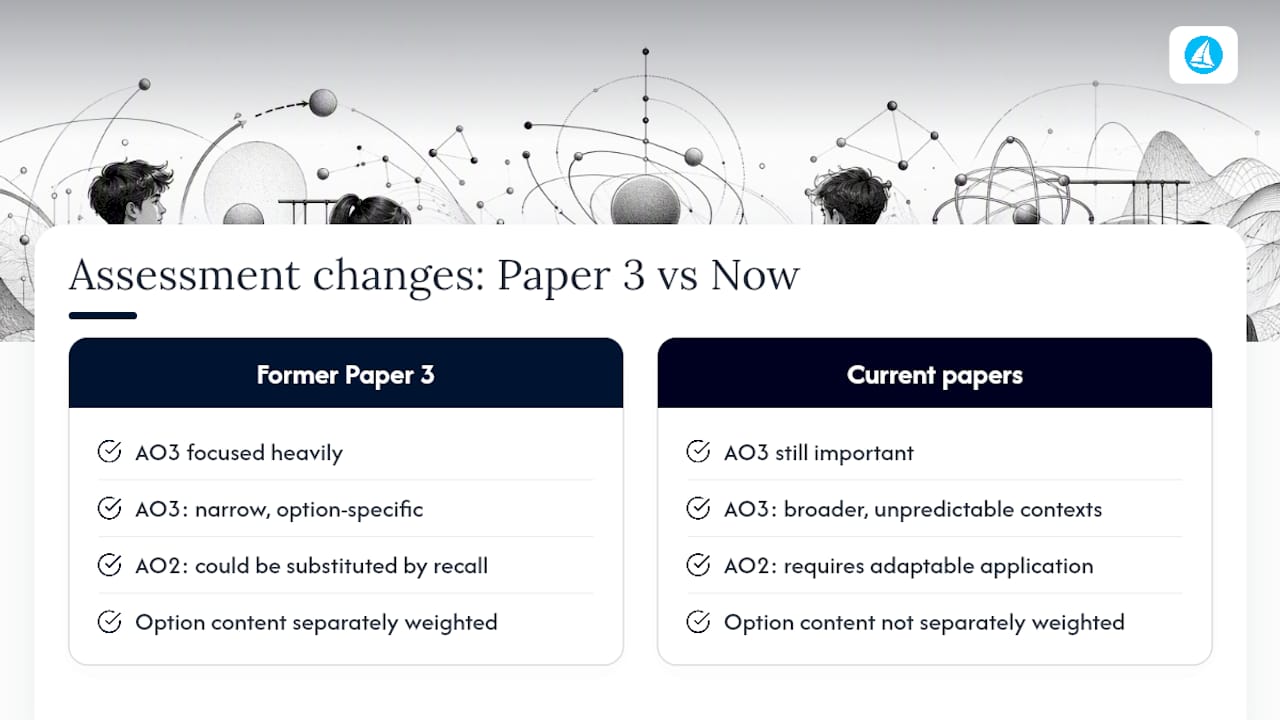
This shift also rebalances Assessment Objective 2 (application). Where the old Paper 3 sometimes let strong option knowledge substitute for strong application skills, in other words, you could recall a formula rather than reason through it, current papers demand application within unfamiliar data sets more consistently. There’s less room to rely on memorised option facts and more reward for adaptable reasoning.
One subtle change worth flagging for teachers: because option content is no longer separately weighted, a student who previously excelled in one option but struggled with core mechanics can no longer offset that weakness through a strong Section B performance. Assessment is now more evenly distributed across the whole syllabus, which raises the practical value of consistent, broad-based revision over deep specialisation in a single area.
Tips for effectively using past Paper 3 questions for study despite its removal
Old Paper 3 papers aren’t worthless. They’re simply mismatched if you use them whole. The fix is selective extraction rather than wholesale practice.
Pull only the Section A questions, the data-based and uncertainty items common to every student regardless of their option, and treat them as standalone drills. These questions rarely depended on option-specific content, so they remain directly relevant to Paper 1B style questions today. Past-paper archives index these by exam series, making it straightforward to isolate the general-skills sections.
Skip Section B questions entirely unless you’re specifically revisiting a topic (astrophysics, for instance) that still appears in the current core syllabus, since much of that content has either been dropped or restructured beyond direct comparison. Always check a legacy question’s data and units against the current data booklet before treating it as valid practice, since some conventions and symbols have shifted between syllabus versions.
When marking yourself against an old Paper 3 markscheme, focus on the logic of how marks were awarded for uncertainty and evaluation rather than the specific numerical answer. That marking logic, how examiners reward correct propagation method versus final-answer accuracy, has carried through largely unchanged into current Paper 1B and Paper 2 markschemes. If you’re reusing shared PDFs found online, check they sit within appropriate reuse terms; many educational archives operate under Creative Commons BY-NC-ND licensing, which permits non-commercial personal study use but restricts redistribution.
Impact of Paper 3 removal on overall IB Physics HL scoring and weightings
Removing Paper 3 didn’t remove marks from the exam. It redistributed the weighting those marks carried across fewer, longer papers. Where previously three papers split assessment three ways, the current structure concentrates HL assessment into two papers, with Paper 1B specifically absorbing the additional weight that data and short-answer questions used to carry independently.
Practically, this means a single paper now carries more consequence per sitting. If Paper 1B goes badly, there’s no separate Paper 3 grade to average against; the impact lands more heavily within your overall Physics HL score. That raises the stakes of consistent performance across a single longer sitting rather than spreading risk across three separate exam sessions.
For grade-band purposes, the core assessment objectives, knowledge, application, and evaluation, remain proportionally similar in intent, but they’re now tested continuously rather than compartmentalised by paper. A student strong in application but weak in evaluation can no longer rely on scoring well in one paper to offset a weaker showing in another; every paper now samples across the full range of objectives. This makes broad, consistent competence across all AO levels more valuable than it was under the three-paper system, where a strong Section B performance could meaningfully lift an overall grade even with weaker core-skills marks elsewhere.
Author perspective: what this change means for HL students and teachers
If you’re revising right now, prioritise uncertainty and data skills above everything else. They’re tested more frequently and more heavily than any option ever was. Teachers should restructure in-class mocks to blend data-based and evaluative questions into every practice sitting, not just a dedicated “options” week. For a longer-term plan built around this shift, Tiber Tutor’s topic tests are worth building into your term schedule.
— Oliver
How Tiber Tutor can help you practise for the replacement papers
Tiber Tutor is built for exactly this transition. Its IB Physics content is written by practising examiners who mark the current syllabus, so every mock exam, topic test, and mark scheme reflects how Paper 1B and Paper 2 are actually graded today, not a guess at what changed.
The All-Access Plan gives you every subject’s tests, videos, notes, and analytics for $19 per month, while the Per-Subject Plan covers a single subject like Physics for $9 per month, both after a free seven-day trial. Progress tracking flags exactly which skill, uncertainty propagation, graph interpretation, experimental evaluation, needs more work, something a static PDF archive simply cannot do. If you’re a student wanting exam-accurate mocks or a teacher wanting a structured resource that maps precisely onto the current syllabus, start your free trial today and sit a timed mock this week to see where you actually stand.
Sources
FAQ
Is Paper 3 still part of the IB Physics HL exam?
No. Paper 3 was removed under the current syllabus, and its content, including data interpretation and uncertainty analysis, now sits inside the longer HL Paper 1B and Paper 2. Practise the current specimen papers rather than treating old Paper 3 papers as exam-accurate.
What percentage is a 7 in IB Physics HL?
The exact percentage boundary shifts slightly each exam session because the IBO sets grade boundaries after marking, based on that session’s overall performance. Rather than chasing a fixed percentage, focus on consistently strong performance across data, application, and evaluation questions, since those now carry weight across every paper.
What is the hardest unit in IB Physics?
Most students and teachers point to fields and electromagnetic induction, and quantum and nuclear physics, as the toughest units, largely because they combine abstract concepts with dense mathematical treatment. Uncertainty and evaluation questions tied to these units tend to be where marks are lost fastest, which is why deliberate practice in those specific topics pays off.
Is IB Physics harder than AP Physics?
IB Physics HL generally demands broader coverage and heavier emphasis on extended data analysis and evaluative writing compared with AP Physics courses, which tend to test more discrete topic blocks. Neither is objectively harder in every respect, but IB’s integrated assessment style, now spread across fewer, longer papers, rewards consistent skill application over topic memorisation.
Why is IB Physics considered difficult?
IB Physics HL is difficult mainly because it combines mathematical rigour with extended evaluative writing, skills that don’t always develop at the same pace. The redistribution of former Paper 3 content into Paper 1B and Paper 2 has intensified this slightly, since every paper now samples data and uncertainty skills rather than isolating them in one exam.
Where can I find reliable practice questions for the current Physics HL papers?
The IBO’s official specimen papers are the most reliable starting point, alongside examiner-authored mock exams and topic tests on Tiber Tutor, which are built specifically around the current syllabus structure.