Fix Your Two Biggest IB Physics Paper 2 Errors with Examiner Mocks
The fastest way to lift your Paper 2 mark is to show every step of your working, box each final answer with correct units and significant figures, plan multi-step questions before writing, and drill timed past papers weekly. Paper 2 carries 44% of your final subject grade, according to the IB physics subject guide, so these habits matter more here than on any other paper. Examiner guidance and resources like Tiber Tutor’s mock exams both point to the same core discipline: method, not memory, wins marks.
TL;DR:
- Showing every step of your working and correctly boxing final answers with units can recover method marks even if the final answer is wrong.
- Practice writing “let [quantity] = …” at the start of calculations for two weeks, as examiners favor variable definition before algebra.
- Time management involves dividing total exam time by the number of marks, with SL students aiming for about 1.3 minutes per mark and HL students slightly more.
- Common mistakes such as skipped substitution steps, unit errors, and vague explanations account for most lost marks and can be addressed through targeted drills.
- Full timed practice exams, combined with detailed mistake analysis and specific drills, significantly improve scores more than endless untimed question sets.
Table of Contents
- Top action checklist for IB physics paper 2 tips that actually raise your score
- How do you structure answers to secure method marks?
- What’s the best timing strategy for SL and HL paper 2?
- Which mistakes cost the most marks, and how do you fix them?
- How should you use past papers and mock exams?
- Which physics topics need the most targeted Paper 2 attention?
- How do you read graphs and data questions correctly?
- How do you manage exam stress and stay focused through paper 2?
- How do you review a completed practice paper properly?
- What should your last week before paper 2 look like?
- An examiner’s honest take on what actually moves the needle
- Get exam-ready Paper 2 practice built by real IB examiners
- Sources
- FAQ
Top action checklist for IB physics paper 2 tips that actually raise your score
Before you touch a pen in the real exam, these habits should already be automatic. Build them now, in your last few weeks of revision, so they show up under pressure without you having to think about them.
- Write a one-line plan before any multi-step question: what you’re solving for, and which equation gets you there.
- Keep an “equation stash” fresh in your head: the ten or so formulas that appear on every Paper 2, with variables clearly defined.
- Show every substitution with units attached, not just the numbers. Examiners cannot award method marks for a calculation they can’t follow.
- Box your final answer and check it carries the right units and the correct number of significant figures.
- Flag questions you’re stuck on with a quick mark in the margin and move on. Coming back with fresh eyes often unlocks them.
- Keep a strict time-per-mark rhythm rather than letting one question eat your buffer.
Pro Tip: Practise writing “let [quantity] = …” on the first line of every calculation question for two weeks straight. It sounds trivial, but examiners consistently reward candidates who define their variables before diving into algebra, and it takes the guesswork out of what you’re actually solving for.
How do you structure answers to secure method marks?
Examiners award method marks for shown working even when the final numerical answer is wrong, according to exam strategy guidance for scoring a 7 in IB Physics. That single fact should change how you approach every calculation question on Paper 2. A blank final answer with correct working scores more than a correct final answer with no working shown.
The five-line flow that examiners reward looks like this:
- Quick plan. One line stating what you’re finding and which physics principle applies.
- Equations and definitions. Write the formula first, with each symbol defined, before you substitute anything.
- Substitution with units. Every number goes in with its unit attached, not bare digits.
- Boxed final answer. Units and significant figures checked against the data given in the question.
- Brief interpretation. One sentence linking the number back to the physical scenario, where the command term asks for it.
Command terms dictate how much of that flow you need. “State” wants a fact, no working required. “Describe” wants observations in sequence. “Explain” demands the claim-evidence-link (C-E-L) model: state what happens, back it with one physics principle, then link it explicitly to the question’s context. “Evaluate” and “derive” require the fullest version of the five-line flow, including assumptions you’ve made (constant temperature, negligible air resistance, ideal gas behaviour) stated in a single clause rather than a paragraph.
What’s the best timing strategy for SL and HL paper 2?
Work out your time-per-mark before the exam, not during it. SL students get 1 hour 30 minutes; HL students get 2 hours 30 minutes, per the IB physics curriculum. Divide your total time by the total marks available and you get a rough per-mark budget, typically around 1.3 to 1.5 minutes per mark on both levels.
- SL pacing: questions tend to be shorter with fewer multi-step chains, so set mini-deadlines per question rather than per mark.
- HL pacing: extended-response questions run longer and reward sustained reasoning, so budget extra time upfront for the final two questions rather than assuming you’ll “find time later.”
- Flag-and-return: if you’re stuck for more than 90 seconds on a sub-part, mark it, move to the next question, and return only once you’ve cleared everything else.
- Skip to preserve momentum: losing five minutes on one 2-mark question while a 6-mark question sits untouched is the single most common way strong students underperform.
A simple template: total time ÷ total marks = minutes per mark, then multiply by each question’s mark allocation to get a personal countdown for every question on the page.
Which mistakes cost the most marks, and how do you fix them?
The same handful of errors recur across almost every Paper 2 script: lost method marks because a substitution step was skipped, unit and prefix slips (mixing up kilojoules and joules, forgetting to convert centimetres to metres), wrong significant figures, messy circuit or ray diagrams, and vague reasoning in “explain” questions that never actually links back to the question. Practical exam guidance on Paper 2 tips for SL and HL flags units, significant figures, and formula-booklet unfamiliarity as three of the most frequent sources of dropped marks.
Fix these with short, repeatable drills rather than more full papers:
- MC sprints: ten multiple-choice questions in ten minutes, timed, to sharpen recall speed.
- Substitution-only practice: take five past questions and write only the equation-plus-substitution line, skipping the final calculation.
- Unit-only checks: scan ten worked solutions and identify every unit error before checking the mark scheme.
- Diagram sketch sprints: redraw five common diagrams (circuits, ray diagrams, field lines) from memory in under two minutes each.
- Significant-figure audits: rework five numerical answers and round strictly to the sig figs given in the question data.
Pro Tip: Keep a running error log. After every practice paper, write down your two most frequent mistake types, then dedicate the next week’s drills entirely to those two. Fixing your top two recurring errors is worth more than another full timed paper, according to deliberate-practice guidance for IB Physics.
How should you use past papers and mock exams?
Full timed runs under real conditions expose the gaps that untimed practice hides. Sit down with a formula booklet, a graphic-display calculator, no phone nearby, and a strict clock. Split your practice across three tiers: full Paper 2 runs to build stamina and timing instinct, topic tests to patch specific weak themes, and micro-drills to fix recurring habits.
- Simulate real exam conditions every time you run a full paper, not just in the final fortnight.
- Spend roughly half of each practice session reviewing mistakes, not just completing more questions.
- Log every correction as a specific action (“define variables before substituting”, “check sig figs against given data”) rather than a vague note.
- Prioritise a full Paper 2 run once a week for the final eight to twelve weeks before the exam.
- Use topic tests between full runs to shore up whichever theme is dragging your score down.
A study planner like the one from Syncronos can help you schedule these three tiers across your remaining weeks so drills don’t get crowded out by full papers. For structured, exam-format practice built specifically around Paper 2’s question style, Tiber Tutor’s IB Physics mock exams simulate the real timing and question mix rather than generic revision questions.
Which physics topics need the most targeted Paper 2 attention?
Paper 2 leans heavily on topics that reward extended reasoning over simple recall, and mechanics, electricity, and fields dominate the mark allocation across both SL and HL papers. Mechanics questions frequently combine two or three sub-skills in one multi-part question: a projectile calculation followed by an energy-conservation check, for instance, where a slip in step one cascades into every later mark.
Electricity and circuits questions punish unit slips more than almost any other topic. Mixing up milliamps and amps, or forgetting that resistance in series simply adds while parallel resistance does not, are the two most common ways students lose marks that have nothing to do with understanding the physics.
Fields (gravitational, electric, and magnetic) reward students who state the relevant law before substituting. Writing “using Coulomb’s law” or “applying the right-hand rule” before your calculation earns credit even if your arithmetic slips afterward.
Thermal physics and quantum/atomic topics, more common on HL papers, tend to produce longer extended-response questions. These need the full five-line answer flow, including a stated assumption where the question involves an ideal gas or a simplified atomic model.
If you’re studying from anything older than the current specification, check it against the current IB Physics syllabus first. The 2025 syllabus reforms folded the old options paper into the main papers and shifted extra HL content into Papers 1 and 2 directly, so legacy resources built around the old options structure can waste real revision time.
How do you read graphs and data questions correctly?
Data-based questions are where careless reading costs the most marks, because the answer is sitting right there in the axes and you still have to interpret it correctly. Start every graph question by reading both axis labels and units before looking at the shape of the curve. A gradient only means something once you know what’s plotted against what.
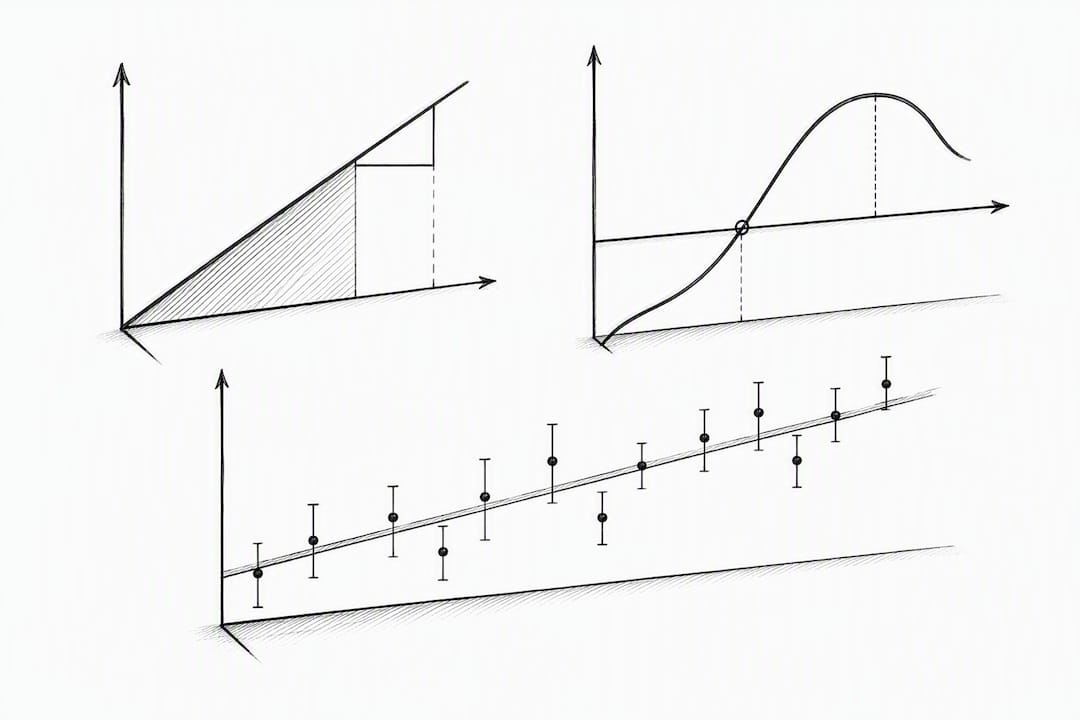
For straight-line graphs, identify what the gradient and the y-intercept physically represent before calculating either. In a velocity-time graph, the gradient is acceleration and the area under the curve is displacement. Confusing which feature answers which part of the question is a common, avoidable error.
For curved graphs, examiners often want you to identify a specific feature: a maximum, a point of inflection, or where the curve crosses an axis. Read the command term carefully. “Describe the graph” wants a description of the trend across the whole range, not just the final value.
When a question gives you a table of raw data, check for uncertainty values or error bars before you calculate anything. Paper 2 sometimes expects you to comment on the reliability of a trend, not just calculate a single answer from it. If you’re asked to draw a best-fit line or extrapolate, keep it simple and defensible rather than forcing the line through every point.
How do you manage exam stress and stay focused through paper 2?
A two-hour or two-and-a-half-hour paper is a long stretch of sustained concentration, and focus naturally dips somewhere in the middle. Build in a brief mental reset after finishing roughly a third of the paper: a few slow breaths, a glance at the clock, then back into the next question with a clear head.
Physical preparation matters more than most students expect. Arrive with water, check your calculator batteries the night before, and know exactly which formula booklet version you’re permitted to use. Removing small uncertainties before the exam starts frees up mental space for the actual physics.
If you hit a question that blanks your mind entirely, don’t freeze on it. Write down anything you do know, even a single relevant equation, then move to the next question. Half marks for a partial attempt beat zero marks for a blank space, and moving on often lets your brain untangle the stuck question in the background while you work elsewhere.
Rehearsing timed conditions during revision is itself a stress-reduction technique. Students who’ve sat several full timed mocks walk into the real exam recognising the rhythm and the pressure, rather than encountering it for the first time when it counts.
How do you review a completed practice paper properly?
Marking your own paper against a scheme is only the first half of a useful review. The second half, where the actual improvement happens, is working out why each mark was lost, not just that it was lost.
Go through every dropped mark and sort it into one of three categories: a knowledge gap (you didn’t know the physics), a method gap (you knew it but didn’t show the working clearly enough), or a careless slip (units, sig figs, or a misread question). This single sorting step tells you whether you need to revise content, practise your answer structure, or simply slow down and check your work.
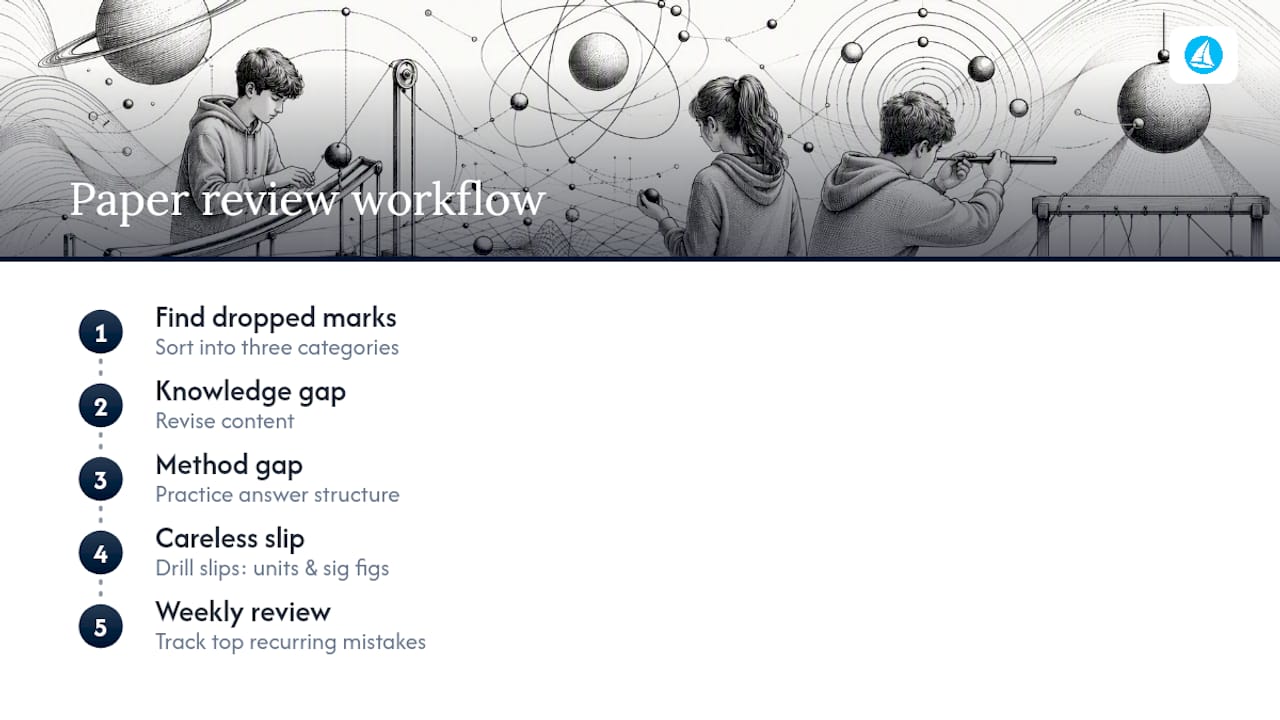
Method gaps and careless slips are the two categories most students underestimate, because they feel like “silly mistakes” rather than real weaknesses. Treat them exactly as seriously as a knowledge gap. If three questions in one paper lost marks because units weren’t shown, that’s not bad luck. That’s a pattern worth a dedicated drill session before your next practice run.
Keep every reviewed paper in a single folder or log, and revisit your error log weekly to check whether last week’s top two mistakes have actually stopped recurring. If they haven’t, that becomes this week’s drill focus. This is where a platform tracking your topic-by-topic performance over time earns its place, because spotting a recurring pattern across five separate practice papers by memory alone is genuinely difficult.
What should your last week before paper 2 look like?
The final week is for consolidation, not new content. Resist the urge to start a fresh topic you’ve never properly revised; it rarely pays off and it steals time from strengthening what you already half-know.
Run one final full timed Paper 2 with at least three or four days of buffer left afterward, so you have time to review it properly rather than just seeing the score and moving on. Use a cram sheet covering your core equations and definitions for a final pass the night before, rather than trying to reread full notes.
Revisit your error log one last time and run a single focused drill session on whatever your most frequent mistake has been across the last month. If it’s units, do a unit-only sprint. If it’s messy diagrams, redraw your five most common diagrams from memory one final time.
Sleep matters more in this final week than any extra hour of revision. A tired brain makes exactly the kind of careless slips (missed units, misread significant figures) that this entire approach is built to eliminate.
An examiner’s honest take on what actually moves the needle
Three things separate a 6 from a 7 on Paper 2, in my experience reviewing scripts and exam guidance: showing method clearly enough that an examiner can follow it without guessing, treating units and significant figures as marks rather than formalities, and pacing that never lets one question eat the time three others needed.
None of that requires more raw physics knowledge than your average candidate already has. It requires converting a single timed mock into a genuine week-by-week improvement plan: mark it, sort every lost mark into a category, drill the worst one for a week, then run another timed mock to check it’s actually fixed. Repeat that cycle four or five times before the real exam and the improvement compounds in a way that generic “revise more” advice never does.
— Oliver
Get exam-ready Paper 2 practice built by real IB examiners
Every tip in this guide comes down to practising the right way, and that’s exactly what Tiber Tutor is built for. Unlike generic revision sites, Tiber Tutor’s mock exams, topic tests, and cram sheets are written by actual IB examiners, formatted to mirror real Paper 2 structure, and fully interlinked with progress tracking that shows you precisely which command terms, topics, and mistake types are costing you marks.

Start with a timed IB Physics mock exam during your free trial, then use the mistakes report to identify your two most frequent errors. From there, assign yourself two focused weekly drills using the topic-specific IB Physics tests to patch exactly those gaps. No other platform pairs examiner-built content with this level of performance analytics, and if your sciences span further than physics, the same examiner-built approach carries across to IB Chemistry tests and IB Maths AA tests too.
Sources
- International Baccalaureate — physics subject guide and curriculum
- IB Physics Study Tips & Exam Strategy to Score a 7
- IB DP subject mastery: Paper-wise strategy for IB Physics — Sparkl
FAQ
How hard is it to get a 7 in IB Physics?
It’s genuinely demanding, since Physics has one of the lower 7-attainment rates among IB sciences, but it’s achievable with disciplined method marks, consistent units and significant-figure checks, and regular timed practice rather than raw talent alone.
What should I revise for Physics Paper 2?
Focus on mechanics, electricity and fields, since they carry the heaviest mark allocation, alongside the five-line answer flow: plan, equations, substitution with units, boxed answer, and brief interpretation.
What percentage is a 7 in IB Physics?
Grade boundaries shift slightly each exam session and are published by the IBO after results, so check your session’s official boundary rather than relying on a fixed percentage from a previous year.
Is it hard to get top marks in A Level Physics compared with IB?
Both demand strong mathematical fluency and precise exam technique, but IB Physics Paper 2’s mix of structured and extended-response questions rewards clearly shown method in a way that makes practising the examiner-expected answer format especially valuable.
How much does Paper 2 count towards my final IB Physics grade?
Paper 2 accounts for 44% of your final subject grade, with SL students given 1 hour 30 minutes and HL students given 2 hours 30 minutes to complete it.