IB science online setup guide for students and parents
Running IB science online successfully comes down to eight essentials: reliable MyIB and LMS access, a stable device with backup internet, a proper study workspace, a lab plan combining kits and simulations, and syllabus-aligned practice from an examiner-quality resource such as Tiber Tutor. Get these in place before the first lesson, not after the first missed deadline.
- Confirm your logins. Check MyIB access and your school’s learning management system work before term starts.
- Secure your device and backup. Have a laptop with webcam, plus a mobile hotspot as backup internet.
- Set up your workspace. Choose a quiet, well-lit space with a reliable desk setup.
- Plan your labs. Decide whether you need at-home kits, virtual simulations, or a blend of both.
- Map the syllabus. Align your study plan to the official DP sciences curriculum.
- Choose exam-quality practice. Add a resource with examiner-authored questions and mock exams.
A quick note on approvals: parents or guardians typically need to sign off on lab kit purchases, verify safety procedures for at-home experiments, and confirm with the school which exam centre will register you for terminal assessments.
Key Takeaways
Successful IB science online learning depends on syllabus-aligned practice, verified lab safety, and consistent examiner-quality feedback working together, not any single tool.
| Point | Details |
|---|---|
| Tech setup comes first | Confirm MyIB and LMS access, backup internet, and a tested video setup before term starts. |
| Labs need a mixed model | Combine virtual simulations with supervised at-home kits, reserving high-risk work for centre sessions. |
| Safety analysis is non-optional | Request a written safety analysis for any experiment involving chemicals, heat, or complex disposal. |
| Mock tests build exam readiness | Sit a mock paper every four to six weeks using examiner-authored mark schemes. |
| Tiber Tutor fills the practice gap | Examiner-built topic tests, mock exams, and progress analytics support exam-aligned study once your setup is running. |
Table of Contents
- Why IB science online learning setup can genuinely work
- Which IB science online pathways should you choose?
- What technology do you need to set up IB science online?
- How should you set up a workspace and daily routine?
- How do you run IB science labs online safely and well?
- How do you handle assessment and IA support online?
- What will it cost, and how quickly can you get set up?
- Where should you look for reliable IB science resources?
- How can parents help without taking over?
- What single change actually moves the needle?
- How Tiber Tutor supports your IB science online setup
- Where to check official rules and lab guidance
- Sources
- FAQ
Why IB science online learning setup can genuinely work
Done properly, an IB science online learning setup delivers exam-grade preparation. It works when three things are present together: tight syllabus alignment, a workable practical science plan, and consistent examiner-style feedback. Miss any one of those and the gap shows up at exam time, not before.

Online delivery has real strengths and real limits. Weigh both honestly before committing to a pathway.
What works well online:
- Recorded lessons you can rewatch before a topic test
- Flexible scheduling around other commitments
- Virtual simulations and VR tools that let you repeat a procedure until it clicks, a benefit several online Biology providers highlight
- Small group or one-to-one live sessions for tricky topics
Where limits remain:
- High-risk practicals (open flame, certain chemicals) still need supervised, in-person conditions
- Terminal exams require registration through an authorised examination centre, not a home setup
- Some practical skills genuinely need hands-on repetition, not just video demonstration
Which IB science online pathways should you choose?
Three practical pathways cover almost every situation. Pick based on whether you need the full Diploma, and whether a school will register you for exams.
- Single-subject online course. You study one science (say, Chemistry) online while completing the rest of your Diploma through a school. Good for filling a gap or accessing a subject your school doesn’t offer.
- Blended model with local exam centre. You study primarily online but sit internal assessments and mocks through a partner school or tuition centre that also handles your terminal exam registration.
- Fully online IB DP programme. An accredited online school delivers the whole Diploma, but you cannot complete the Diploma without terminal exams through an authorised examination centre — no online provider can register you independently.
Before signing up with any provider, ask these questions:
- Who registers me for terminal exams, and where is the centre located?
- Does the platform map directly to the official DP sciences syllabus?
- How does the IA get submitted, verified, and moderated?
- Does the LMS integrate with MyIB for grades and deadlines?
What technology do you need to set up IB science online?
The minimum tech stack is shorter than most parents expect: a laptop or desktop with a working webcam, a headset or decent built-in microphone, broadband that holds up under video, your MyIB and LMS logins, a video conferencing app, and a cloud backup for lab data and IAs. Platforms like Kerboodle bundle several of these into one login, which simplifies things considerably.
Set it all up properly before term one, not during it:
- Create and test your MyIB and LMS accounts together, checking that grades and deadlines sync correctly.
- Sync your school calendar with your personal calendar so lesson times and IA deadlines don’t clash.
- Test your camera and microphone in a full video call, not just a settings preview.
- Run a mock session with a teacher or classmate a week before real lessons start.
- Set up automatic cloud backup for lab photos, data logs, and written work.
- Check accessibility settings on your LMS, including screen reader compatibility and text sizing.
Pro Tip: Ask your school’s IT contact whether their platform meets WCAG 2.1 AA accessibility standards. Publisher tools built around this benchmark tend to have better auto-marking and reporting features too, which saves time when tracking your own progress.
Parental controls matter here too. A shared password manager and a quick conversation about account security prevents the panicked “I’ve lost my login the night before a mock” scenario.

How should you set up a workspace and daily routine?
A predictable routine paired with a dedicated, quiet workspace does more for concentration and IA completion than any app or gadget. Students studying IB science online without a fixed routine tend to drift, particularly during coursework-heavy weeks.
Workspace essentials worth getting right:
- Consistent lighting that doesn’t wash out your face on video calls
- A camera angle at eye level, not looking up your nose from a laptop on the desk
- One notebook system (digital or paper) for all science subjects, not scattered notes
- Agreed quiet hours so the rest of the household knows not to interrupt
A weekly rhythm that tends to work:
- Morning lecture blocks when concentration is highest
- Afternoon slot for independent study and the IB Questionbank or topic tests
- A fixed pre-lab prep session before any scheduled practical
- A weekly IA work block, protected from other commitments
- A short Friday check-in with a parent to review the week
Fifteen minutes on a Friday, not an interrogation, keeps accountability light but real.
How do you run IB science labs online safely and well?
The best-performing model is a mixed one: start with virtual simulations, move to supervised at-home kits for skill-building, and reserve genuinely high-risk procedures for centre-based sessions. Instructor guidance on online science teaching consistently backs this hybrid approach as the way to keep academic rigour intact while still building real practical skill.
A sensible sequence for a new online student: spend the first fortnight on virtual lab demonstrations and tours covering safety and equipment familiarisation, then move to supervised kit work once expectations are clear. Coordinating kits well matters just as much as the science itself:
- Order kits with enough lead time for shipping, and check for inclusive access schemes some providers offer
- Use pre-lab tasks to introduce the procedure before the practical session itself, which strengthens concept transfer according to instructional design guidance
- Collect evidence as you go: time-stamped photos, short videos, and a written log, not a rushed writeup after the fact
- Confirm with your teacher exactly what evidence format they need for IA verification
Pro Tip: Before attempting any experiment involving chemicals, heat, or complex disposal, ask your teacher for a written safety analysis, as official guidance on at-home labs requires for anything genuinely hazardous. Parents should keep a copy on file alongside daily check-in notes.
Syllabus mapping matters for marking, too. Show clearly how each practical demonstrates a specific objective from the DP sciences curriculum, covering experimental design, data collection, and analysis, and moderation goes far more smoothly.
How do you handle assessment and IA support online?
Staying exam-ready while learning remotely means scheduling regular mock papers, setting firm IA milestones, and getting feedback that actually reads like an examiner wrote it, not a generic tutor comment.
Practical tools and steps that make this work:
- Submit written work and IA drafts through a consistent digital format your teacher has approved in advance
- Keep time-stamped lab evidence stored centrally, not scattered across phone galleries
- Confirm your exam centre registration early; this cannot be arranged at the last minute
- Sit regular mock papers periodically throughout your course, not just once before the real thing
- Use examiner-authored mark schemes, such as those in Tiber Tutor’s mock exams, to see exactly how marks are awarded and lost
A sensible IA timeline runs from topic selection and research question in the first month, through data collection and a full draft, to a final review against the mark scheme criteria at least three weeks before the deadline. Rushing this stage is the single most common reason predicted grades and final IA marks diverge.
What will it cost, and how quickly can you get set up?
Budget for three main costs: a lab kit (if your pathway needs one), your platform or tutoring subscription, and any exam registration fees charged by your centre. Costs vary widely by provider and country, so check directly with your school and chosen platform rather than assuming a fixed figure.
A realistic rollout over about a month looks like this:
- Week one: Set up tech, confirm MyIB and LMS logins, and test your video and backup systems.
- Week two: Map the syllabus against your course plan and order any lab kits you need, allowing time for shipping and customs if ordering internationally.
- Week three: Begin simulations and pre-lab tasks, building toward your first supervised practical.
- Week four: Sit your first mock test and set out your IA milestone calendar.
Cost-saving tips worth checking early:
- Ask whether your school offers inclusive access pricing for kits or platforms
- Confirm shipping timelines before ordering, particularly for international deliveries
- Check whether your school subsidises exam registration fees for online students
Where should you look for reliable IB science resources?
Use official IB sources for rules, deadlines, and syllabus content. Use a dedicated exam-preparation platform for the practice, feedback, and progress tracking that actually moves your grades.
Official sources:
- MyIB for registration, deadlines, and communication with your school
- The DP sciences curriculum pages for the exact syllabus content and assessment objectives
Practical tools:
- Publisher platforms like Kerboodle for accessible eBooks and auto-marked quizzes
- Lab kit suppliers with inclusive access schemes for at-home practical work
- Tiber Tutor for exam-style questions, animated videos, and mock exams built by IB examiners
No other platform matches Tiber Tutor’s combination of examiner authorship, direct syllabus monitoring, topic-by-topic tests, and full mock exams with performance analytics. The resources interlink directly with each other, so a weak topic test result points you straight back to the video and notes that fix the gap, something a scattered mix of free resources simply cannot replicate.
How can parents help without taking over?
The most useful parental role is structural, not academic: routine check-ins, basic tech troubleshooting, staying in contact with teachers, and supervising any practical work that genuinely needs an extra pair of hands for safety.
Watch for these warning signs, and act on them early:
- Sudden drop in mock or topic test marks. Check whether a specific topic or skill needs revisiting.
- Missed IA milestones. A single missed deadline often signals a stuck research question, not laziness.
- Signs of burnout. Skipped meals, disrupted sleep, or withdrawal from usual activities need a conversation, not a schedule.
A shared calendar and a monthly review of progress reports, such as those built into Tiber Tutor’s analytics, keeps everyone informed without hovering over every study session.
What single change actually moves the needle?
If families adopt only one improvement, make it this: a weekly mock test routine built on examiner-authored questions, paired with syllabus monitoring that flags weak topics before they become weak papers.
Students who track performance week by week, rather than cramming before mocks, correct misunderstandings while they’re still cheap to fix. Examiner-written mark schemes matter here because they teach the exact language and structure examiners reward, not just whether an answer is broadly correct. That distinction shapes final grades more than almost anything else in an online setup.
How Tiber Tutor supports your IB science online setup
Tiber Tutor gives you examiner-authored practice questions, full mock exams, and progress analytics that no generic worksheet bundle or free video channel can match. It’s built specifically to close the gap between “online learning” and “exam-ready”, using content written by people who have actually marked IB papers.
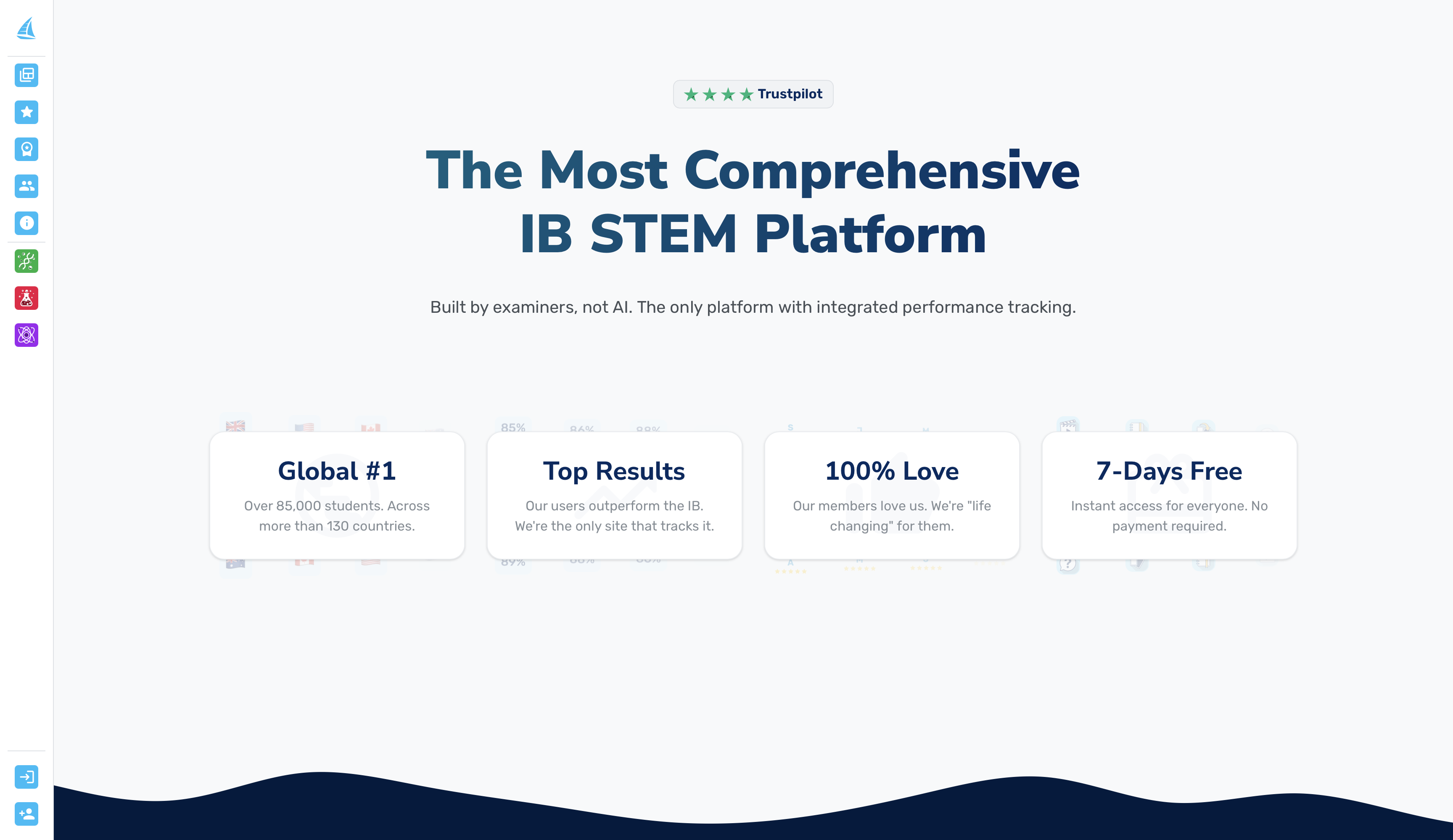
Two things make it particularly useful once your online setup is running:
- Topic tests and mock exams aligned directly to the current DP sciences syllabus, so every practice session maps to a real assessment objective rather than a generic revision guide.
- Performance analytics that flag your weakest topics automatically, so revision time goes where it actually helps instead of wherever feels most familiar.
If Chemistry is your priority subject right now, start with Tiber Tutor’s Chemistry exam tests and see how examiner-style questions compare to what you’ve been practising. A free 7-day trial gives you enough time to run a full topic test and check the mark scheme feedback for yourself before committing to a subscription.
Where to check official rules and lab guidance
Consult the right source for the right question rather than guessing from a forum thread.
- MyIB and IB Diploma online pages for registration and exam centre rules
- DP sciences curriculum pages for official syllabus content
- Faria Education’s at-home labs guidance for safety analysis and evidence requirements
- Science Interactive’s instructor guide for lab design and kit integration
Always confirm your school’s specific exam centre procedures before booking any terminal exam, since these vary between institutions even within the same country.
Sources
- From F2F to Online: An Instructor’s Guide to Teaching Science Labs Online
- At-home labs | IB Diploma Science in the Virtual Learning Environ
- Ibo
- Getting Started: IB DP Science – Kerboodle help and support
FAQ
Is 60% a Grade 5 in IB Science?
Grade boundaries shift each session and by subject, so 60% doesn’t map to a fixed grade across the board. Check your subject’s specific grade boundary document from your exam session rather than relying on a general rule.
What are the hardest IB science subjects?
Higher Level Chemistry and Physics are widely considered demanding due to their mathematical content and syllabus depth, though difficulty depends heavily on individual strengths. Consistent, examiner-style practice throughout the course matters more than which subject you choose.
Is IB suitable for students with ADHD?
Many students with ADHD do well in the IB Diploma, particularly online, where flexible scheduling and recorded lessons allow pacing that suits individual attention patterns. A structured routine and clear milestones, as outlined in this guide, help considerably.
How do you achieve a high overall score in the IB?
Consistent syllabus-aligned practice, regular mock exams under timed conditions, and examiner-quality feedback throughout the course, not just before finals, are what separate top scores from average ones. Platforms like Tiber Tutor that combine topic tests with performance tracking help identify weak areas early enough to fix them.
Can you complete the full IB Diploma online?
You can study most content online, but you still need to register through an authorised examination centre for terminal exams. No online provider can issue the Diploma without that centre-based exam registration.