Examiner Sequenced Mocks vs Past Papers for IB Students: Close Gaps
Past papers teach you the pattern of an exam; mocks teach you how to survive it under pressure. The smartest sequence uses past papers early to learn question phrasing and weighting, blends both mid revision, then leans on full mock exams in the final month. Neither replaces the other; skipping either leaves a gap the real exam will find.
TL;DR:
- Reviewing multiple years of past papers helps identify recurring exam patterns, common command terms, and question tricks specific to each subject.
- Fully timed mocks under exam-like conditions are essential for building exam stamina and managing anxiety through realistic practice.
- Proper review and analysis of each mock and past paper are more effective than simply completing large volumes of questions without reflection.
- Sequencing revision with early focus on past papers, hybrid practice mid-course, and full mocks in the final month maximizes learning and exam readiness.
- The most productive study involves classifying errors, targeting weak topics, and incorporating consistent feedback loops rather than relying solely on volume.
Table of Contents
- Mocks vs past papers: what past exam papers actually train
- What mock exams train that past papers cannot
- A practical timeline: past papers first, mocks last
- How to turn every paper into measurable improvement
- Common misconceptions about mocks and past papers
- How Tiber Tutor puts this sequencing into practice
- How many mocks and past papers should you actually sit?
- Mocks vs past papers: format and conditions compared
- Do mocks and past papers work differently across science subjects?
- Turning mock and past-paper feedback into an actual study plan
- Author perspective: sequence and analysis beat sheer volume
- How Tiber Tutor supports your mocks and past papers strategy
- Sources
- FAQ
Mocks vs past papers: what past exam papers actually train
Past papers are the closest thing you have to a map of examiner behaviour. Work through several years of a subject and you start noticing the same command terms recurring, the same topics weighted heavily, and the same traps in how questions are phrased. That pattern recognition is the entire value of a past paper, and it is why the difference between mocks and past papers matters more than students think when they are planning revision time.
The IBO publishes specimen and past exam papers alongside official markschemes for every Diploma Programme subject, and these are the single most reliable resource for learning what examiners actually reward. A markscheme tells you not just the correct answer but the exact wording an examiner needs to see before awarding a mark, which is often stricter than students expect.
To get real value from past papers:
- Work through at least three to five years of papers per subject before touching a full mock.
- Annotate every command term (state, explain, evaluate) and note how the expected answer length changes with each.
- Keep a simple frequency log of which syllabus points appear most often across papers.
- Cross-reference tricky answers against the official markscheme, not just your own instinct.
This is slow, deliberate work. Rushed past-paper practice without markscheme review teaches you almost nothing.
What mock exams train that past papers cannot
A past paper sitting on your desk at 9pm with a cup of tea nearby tests knowledge. A mock exam, sat in silence under a clock with an invigilator watching, tests something different entirely: composure. Mocks replicate the pacing decisions, the anxiety spikes, and the triage instinct (skip this, come back later) that only show up when the clock is real and the room is quiet.
Cambridge Assessment recommends mock tests as dress rehearsals, and its research is specific about the condition: mocks only reduce exam anxiety and build familiarity when they are properly scaffolded beforehand and reviewed afterwards. A mock sat cold, with no prior topic revision, mostly just measures how badly you can panic.
To set up a mock that actually earns its name:
- Use full, timed conditions with no notes, no phone, and the same paper structure as the real exam.
- Apply exam-hall rules strictly, including how you’re allowed to annotate the question paper.
- Mark it against the official grade boundaries, not a generous personal curve.
Retrieval practice research backs the underlying mechanism here. Studies summarised by Tutorful on mock exam effectiveness show that testing yourself under realistic conditions produces significantly stronger retention than rereading notes or passive revision. Mocks are retrieval practice with the pressure dial turned up.
Pro Tip: Schools usually use February mocks for the May exam session and August or September mocks for November sittings, and those scores frequently become the main evidence teachers use when submitting predicted grades. Treat your mock like it already counts, because in a real sense, it does.
A practical timeline: past papers first, mocks last
The sequencing question comes up more than any other, and coaching research on exam preparation consistently backs a staged approach rather than randomly mixing both formats from day one, as outlined in guidance on sequencing past papers before mocks.
- Early stage (three to six months out): Focus almost entirely on past papers and topic drills. This is where you build the syllabus map and identify high-frequency question types before speed becomes relevant.
- Mid stage (six to ten weeks out): Shift to a hybrid rhythm. Run sectional past papers under light time pressure alongside two to three shorter mocks per week, mixing subjects so no single one dominates your week.
- Final month: Prioritise full-length, fully timed mocks, aiming for three to four per week or alternating days between subjects, each followed immediately by focused review rather than moving straight to the next paper.
The Tiber Tutor exam-style question workflow follows this same staged logic, letting students filter by topic frequency in early revision and switch to full timed simulations as exams approach.
Pro Tip: Never run two full mocks back to back without a review day between them. A mock you haven’t analysed is just an exhausting waste of a Saturday.
How to turn every paper into measurable improvement
The paper itself is not where the learning happens. It happens in the hour after, when you go back through every wrong answer and work out why it was wrong.
- Classify each mistake as a silly slip, a genuine concept gap, or a strategy and timing failure.
- Do a section-by-section timing breakdown within 48 hours, while the paper is still fresh enough to remember your thought process.
- Convert the analysis into two or three specific corrective tasks, not a vague resolution to “revise more.”
This classify-then-fix loop is the same mock analysis workflow Tiber Tutor recommends to its students, and it is far more valuable than sitting extra papers you never properly review.
Common misconceptions about mocks and past papers
Students frequently assume mocks are always harder than the real thing, expecting the shock to be intentional. It isn’t always true. Mock difficulty depends entirely on how the school or platform designs the paper, so some mocks run noticeably easier and others noticeably harder than the actual exam.
A second trap is practising from outdated papers without checking your syllabus version. Several IB Diploma Programme subjects had syllabus changes with first assessments in 2025 or 2026, and drilling pre-change papers without confirming the current specification wastes hours on content that may no longer be examined.
- Confirm your subject’s current syllabus and first assessment date before working through older papers.
- Treat unanalysed repetition as low-value. Ten papers with no review teach less than three papers analysed properly.
- Remember mock difficulty varies by design. A weak mock score doesn’t automatically predict a weak real result, and a strong one doesn’t guarantee safety either.
How Tiber Tutor puts this sequencing into practice
Tiber Tutor’s content across Biology, Chemistry, Physics and IB Maths is written by IB examiners and experienced educators, which matters because the platform’s markscheme-aligned feedback reflects how real papers are actually graded, not a generic approximation.
- Filter past-paper style questions by topic and syllabus point to build your early-stage pattern map fast.
- Sit examiner-style mocks under timed conditions that mirror real exam-hall structure.
- Review results against markscheme-aligned feedback rather than guessing where marks were lost.
- Track progress across subjects on a single dashboard instead of juggling separate spreadsheets and PDF folders.
Because every resource is interlinked, from notes to flashcards to mock analytics, students spend their time analysing performance rather than hunting for the next relevant paper.
How many mocks and past papers should you actually sit?
There’s no single magic number, and treating volume as the goal is where most students go wrong. A useful working target for the final ten to twelve weeks is somewhere between eight and twelve full past papers per subject, combined with two to four full mock exams, spaced so each one gets a proper review before the next.
Frequency should rise as exams approach, not stay flat across your whole revision calendar. In the early months, one or two past papers a week per subject is plenty while you’re still building topic knowledge. By the final month, mock frequency for your most difficult subjects can reasonably rise to three or four sittings a week, provided you’re genuinely reviewing each one rather than just ticking off a count.
Quality consistently beats quantity here. A student who sits six past papers and analyses every mistake will outperform one who grinds through twenty papers and never looks back at what went wrong. If you’re short on time, cut the number of papers before you cut the review time attached to each one.
For science subjects specifically, frequency should also track your weakest topics. If your past-paper log shows repeated errors in a particular unit, such as energetics in Chemistry or genetics in Biology, add targeted topic tests in that area rather than simply sitting another generic full paper.
Mocks vs past papers: format and conditions compared
The two formats differ in more than difficulty. Past papers are typically used flexibly. You can do them untimed for early learning, split by section, open-book for a first pass, or fully timed as a checkpoint. That flexibility is exactly why they work well for building foundational understanding before speed becomes the priority.
Mocks are supposed to remove that flexibility entirely. A proper mock is invigilated or at least self-imposed under strict exam-hall rules: fixed start and end times, no reference materials unless the real exam allows a data booklet, and no pausing to check a formula. Schools typically run mocks in exam halls or classrooms set up to mirror the real thing, right down to seating arrangements and the paper being sealed until the start time.
This distinction explains why substituting one for the other doesn’t work. Doing a past paper “under mock conditions” occasionally is useful practice, but calling every timed past paper a mock blurs a genuinely useful distinction. A mock’s value comes specifically from the psychological weight of it counting, the fixed schedule, and often the fact that a grade goes on record and feeds into a predicted grade. Strip away that weight and you’re left with a timed past paper, which is still useful, just not the same tool.
For science subjects with practical or data-based components, conditions matter even more. IB Biology, Chemistry and Physics papers often include data analysis and extended response sections where timing pressure changes how carefully a student reads a graph or dataset, something an untimed past-paper session won’t reveal.
Do mocks and past papers work differently across science subjects?
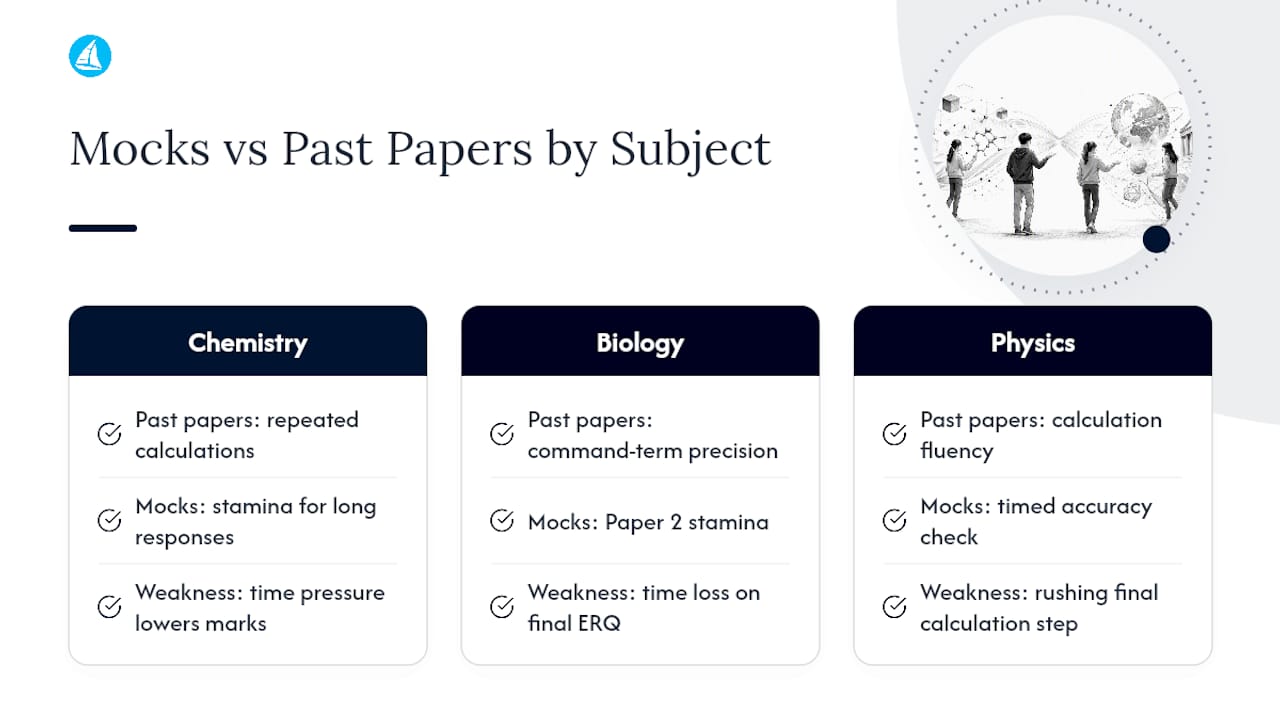
The balance between past papers and mocks shifts slightly depending on the subject’s structure. In IB Chemistry, past papers are particularly effective early on because so many questions repeat calculation types (mole ratios, equilibrium constants, titration curves) that reward pattern recognition before speed. Mocks then become essential closer to exams because Chemistry Paper 2 and Paper 3 both demand sustained focus across long data-response and extended-answer sections where fatigue causes real marks to slip.
IB Biology tends to reward past-paper drilling on command-term precision, since so many marks hinge on using the exact required terminology for “explain” versus “describe” versus “evaluate” questions. Mocks matter here mainly for stamina across the multi-topic Paper 2, where students often run out of time on the final extended-response question after spending too long earlier.
Physics sits closer to Maths in its demands. Past papers build the calculation fluency and formula recall needed for Paper 1 and Paper 2, while mocks are where students discover whether they can maintain accuracy under time pressure across multi-step problems. A common failure mode in Physics mocks is rushing the final calculation step after solving correctly, which past-paper practice alone rarely exposes because there’s no clock forcing the rush.
Across all three sciences, the disadvantage of over-relying on past papers alone is the same: strong content knowledge that collapses under time pressure. The disadvantage of over-relying on mocks alone is thinner content coverage, since mocks sample fewer topics per sitting than a dedicated past-paper drilling session.
Turning mock and past-paper feedback into an actual study plan
Feedback that stays in your head or in a marked-up paper on your desk rarely changes your next result. It needs to become a scheduled task, ideally within the same week it’s identified.
Start by sorting every error from your most recent past paper or mock into a short list ranked by how often it recurs, not by how recently it happened. A concept gap that’s shown up in three separate papers deserves more study time than a one-off slip, even if the slip happened yesterday and feels fresher in your mind.
Build a rolling revision plan where each week includes a small block specifically assigned to your top two or three recurring error types from the previous week’s papers, rather than a generic “revise everything” block. This keeps the feedback loop tight: sit a paper, classify errors, fix the top issues, then retest similar questions from a different past paper within about a week to confirm the gap has closed.
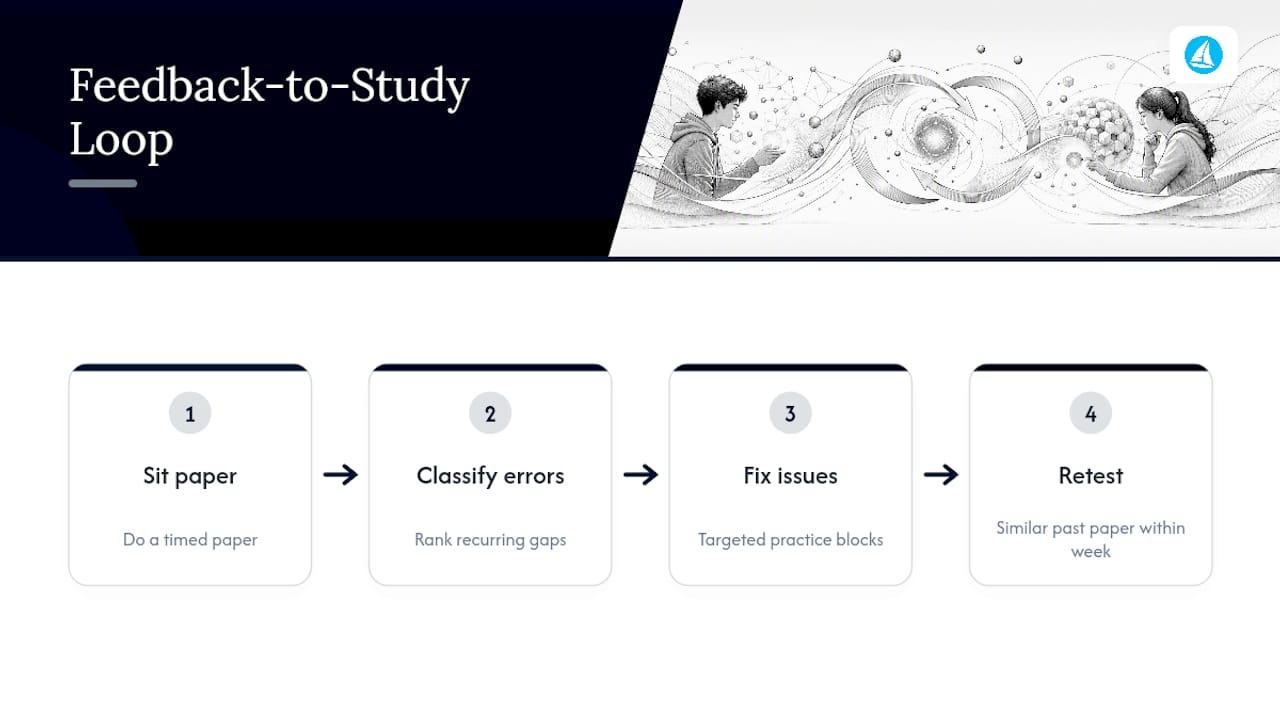
Teachers and parents supporting a student through this process can help most by checking that the plan is being followed, not by re-marking every paper themselves. The discipline of the loop, sit, review, fix, retest, matters more than who does the marking. Platforms with built-in progress tracking make this far easier to sustain over months, since the recurring weak points show up automatically instead of requiring a student to remember every past mistake by memory.
Author perspective: sequence and analysis beat sheer volume
Most students over-invest in one format and under-invest in reviewing either. The fix isn’t complicated: past papers first for pattern, mocks later for pressure, and a proper review after every single one. Before drilling anything, confirm your syllabus version is current. Volume without analysis is just tired hands and no real progress.
— Oliver
How Tiber Tutor supports your mocks and past papers strategy
Once you know the sequence, the next problem is finding resources polished enough to trust with your limited revision hours. Tiber Tutor is built specifically to close that gap for IB Biology, Chemistry, Physics and Maths students, with every past-paper style question, mock exam, and topic test written by real IB examiners rather than generic tutoring staff.
The platform’s IB Biology exam tests and IB Chemistry exam tests map directly to the early-stage pattern work this article recommends, filterable by topic and syllabus point. When you’re ready for full simulation, IB Chemistry mock exams and matching Biology mocks replicate real exam-hall timing and marking, with performance dashboards that turn your error classification into an automatic, ongoing revision plan rather than a spreadsheet you have to maintain yourself. No other IB science platform interlinks notes, flashcards, questionbanks, mocks and analytics this tightly, or backs it with examiner-authored content at this depth for the price. Start a free seven-day trial and see where your syllabus map actually has gaps.
Sources
- IBO — sample exam papers and markschemes
- Using mock tests to prepare our students for success — Cambridge University Press blog
- Do mock exams really improve final exam scores? — Tutorful blog
- Previous year papers and mock tests — Testegy blog
FAQ
Are mocks harder than the real exam?
Not always. Mock difficulty depends on how the school or platform designs the paper, so some run harder and some run easier than the actual IB exam.
Is it okay to fail a mock exam?
A weak mock result is a diagnostic tool, not a final verdict. It’s a signal to classify your errors and fix specific gaps before the real exam, not a predictor of certain failure.
Is a mock exam a real exam?
No. A mock is a rehearsal that mimics timing and conditions, but the grade usually only feeds into a predicted grade or school record rather than your final IB result.
What happens if I fail a mock test?
Nothing formal happens beyond the school noting the result, though a poor mock can affect a predicted grade discussion with your teacher. The practical response is a focused review, not panic. Platforms like Tiber Tutor’s mock analysis tools help turn a bad mock into a targeted revision plan for the weeks that follow.