
The role of standardised mock exams in IB science schools
Standardised, externally benchmarked mock exams give IB science students and their teachers reliable, actionable evidence about readiness, teaching gaps, and predicted grade accuracy in a single assessment cycle. A 15-year international synthesis by Bergbauer, Hanushek, and Woessmann found that standardised testing with external comparison correlates with improved student achievement in science compared with internal testing alone. The key effects are immediate and practical:
- Diagnostic clarity: pinpoints specific syllabus gaps before the final exam window
- Pacing rehearsal: builds stamina and time-management across multi-paper IB science assessments
- Confidence building: reduces exam anxiety when mocks are framed as information-gathering, not judgement
- Moderation and comparability: ensures grades are consistent across teachers and cohorts
- Predicted grade evidence: gives coordinators defensible, data-backed grade submissions to the IB
Bottom line for teachers: run at least one school-wide standardised mock per IB science subject, return scripts within two weeks, and tie every result to a targeted intervention.
Table of Contents
- Why does external standardisation improve IB science outcomes?
- How do you design and schedule mocks without over-testing?
- How should you mark, moderate, and return scripts effectively?
- How should students prepare for mocks and protect their wellbeing?
- What quality assurance and ethical standards apply to IB school mocks?
- How do digital platforms support an evidence-led mock programme?
- Printable checklist for IB science departments running standardised mocks
- Tibertutor: examiner-authored mocks built for IB science
- FAQ
- Key takeaways
Why does external standardisation improve IB science outcomes?
The evidence base here is strong. The Bergbauer/Hanushek/Woessmann synthesis tracked outcomes across 15 years of international data and found that internal testing alone produced little measurable impact on achievement. External comparison was the differentiating factor.
Two cognitive mechanisms explain why. First, the testing effect: retrieving information under exam conditions strengthens memory consolidation more durably than re-reading notes. Second, metacognitive calibration: students who sit a realistic mock develop a more accurate sense of what they actually know versus what they think they know, which makes subsequent revision far more targeted. Classroom studies and meta-analyses suggest practice tests yield measurable gains in final exam performance when used properly.
Key insight: standardised mocks work not because they predict grades, but because the act of retrieval under timed, exam-like conditions changes how knowledge is stored and accessed.
For IB sciences specifically, where Paper 3 data-analysis questions and extended-response items demand applied reasoning, a mock that closely mirrors the real paper format builds the precise cognitive habits students need.
How do you design and schedule mocks without over-testing?
The Chartered College of Teaching warns clearly against mocks becoming mere data-drops. Frequency must be purposeful.
Recommended schedule across the IB Diploma year:
| Term | Assessment type | Purpose |
|---|---|---|
| Year 1, Term 2 | Topic test (1 paper, 60 min) | Baseline diagnostic per unit |
| Year 2, Term 1 | Full standardised mock (all papers) | Predicted grade evidence, gap analysis |
| Year 2, Term 2 | Targeted paper (weak areas only) | Focused intervention check |
Paper design matters as much as timing. Bespoke, syllabus-aligned questions prevent students from memorising past mark schemes and force application to novel contexts, which is exactly what IB examiners reward. A good mock blends examiner-authored items with adapted past-paper questions, always mapped to the current subject guide and command terms.
- Mix past-paper items (roughly 60%) with bespoke questions (roughly 40%)
- Align every item to a specific syllabus statement and command term
- Avoid reusing the same paper in consecutive years
- Run full papers for the school-wide mock; use focused topic tests between cycles
Pro Tip: Stagger Paper 1 and Paper 2 on different days during the school-wide mock. This replicates the real exam schedule, builds multi-day stamina, and gives teachers cleaner data on where students lose marks under fatigue rather than ignorance.
How should you mark, moderate, and return scripts effectively?
Marking is where most mock programmes lose their formative value. A score returned without annotation tells a student almost nothing useful.
Marking protocol:
- Use the published IB component grade boundaries and Diploma Programme grade descriptors to assign marks and grades consistently.
- Annotate scripts with two things: what the student did well and the precise error type (misconception, incomplete reasoning, command-term misread).
- Avoid writing only a total mark at the top of the page.
Moderation workflow:
- Two teachers mark a sample of scripts independently, then compare.
- Resolve discrepancies using the mark scheme before finalising grades.
- Where possible, share anonymised grade distributions with a partner school for external benchmarking.
- Record moderation decisions for coordinator review.
Returning scripts with dialogue is the step that converts a mock from summative to formative. ManageBac guidance recommends returning papers within two weeks alongside a structured teacher-student review. Each student should leave that meeting with a feedforward note listing exactly two or three priority actions, written in specific terms (“practise limiting reagent calculations using Paper 1 style MCQ” rather than “revise stoichiometry”).
How should students prepare for mocks and protect their wellbeing?
Mocks are most effective when students treat them as diagnostic tools rather than rehearsals for failure. Framing matters enormously, and teachers set that frame.
Student preparation steps:
- Complete at least two timed past papers per subject before the mock date.
- Practise under real conditions: no notes, correct timing, exam equipment only.
- Review mark schemes immediately after each practice paper and log errors by type.
- Prioritise retrieval practice (flashcards, closed-book summaries) over passive re-reading.
- Sort revision topics by mark-scheme frequency, not personal preference.
During the mock itself, pacing is the skill most students underestimate. For IB science papers, allocate roughly one minute per mark and spend the first 90 seconds scanning the paper to sequence your answers by confidence. High-mark extended-response questions deserve proportionally more planning time.
Post-mock, the IB mock exam strategy guide recommends a structured gap analysis before any revision begins. Students who skip straight to re-reading notes often revise the wrong things.
Pro Tip: Ask students to complete a one-page reflection log within 48 hours of receiving their script. Three columns: “what I knew well,” “where I lost marks,” and “what I will do differently.” This feedforward entry becomes the anchor for their next revision cycle.
Managing exam-related stress is part of the teacher’s role too. Brief students and parents together: mocks are diagnostic checkpoints, not final verdicts. The language staff use in the run-up shapes whether students engage productively or shut down.
What quality assurance and ethical standards apply to IB school mocks?
Running a mock well requires the same procedural rigour as any formal assessment.
QA and security checklist:
- Conduct an item review before the paper is printed: check syllabus alignment, command-term accuracy, and mark-scheme clarity
- Store papers securely and limit access to the invigilating team only
- Brief all staff on the 24-hour non-discussion window that mirrors IB exam-day protocol
- Moderate scripts before grades are communicated to students or coordinators
- Arrange access arrangements (extra time, separate rooms, readers/scribes) in advance, mirroring the student’s actual IB entitlements
- Store results in a GDPR-compliant system; use anonymised cohort data for department-level reporting and curriculum decisions
- Communicate results to parents clearly, with context about the mock’s diagnostic purpose
On data handling: mock results are personal data under UK GDPR. Schools should confirm their data-retention policy covers assessment records and that parental communication follows the school’s privacy notice. This is general guidance; confirm specifics with your data protection officer.
How do digital platforms support an evidence-led mock programme?
A well-chosen platform removes the logistical burden from teachers and adds analytical depth that paper-only mocks cannot match. The features that genuinely matter for IB science departments are:
- Examiner-authored questions mapped to the current syllabus
- Timed, secure delivery that replicates exam conditions
- Automatic or teacher-assisted marking with granular mark-scheme breakdowns
- Analytics that identify gaps at topic, subtopic, and command-term level
- Moderation support through shared marking and grade-boundary tools
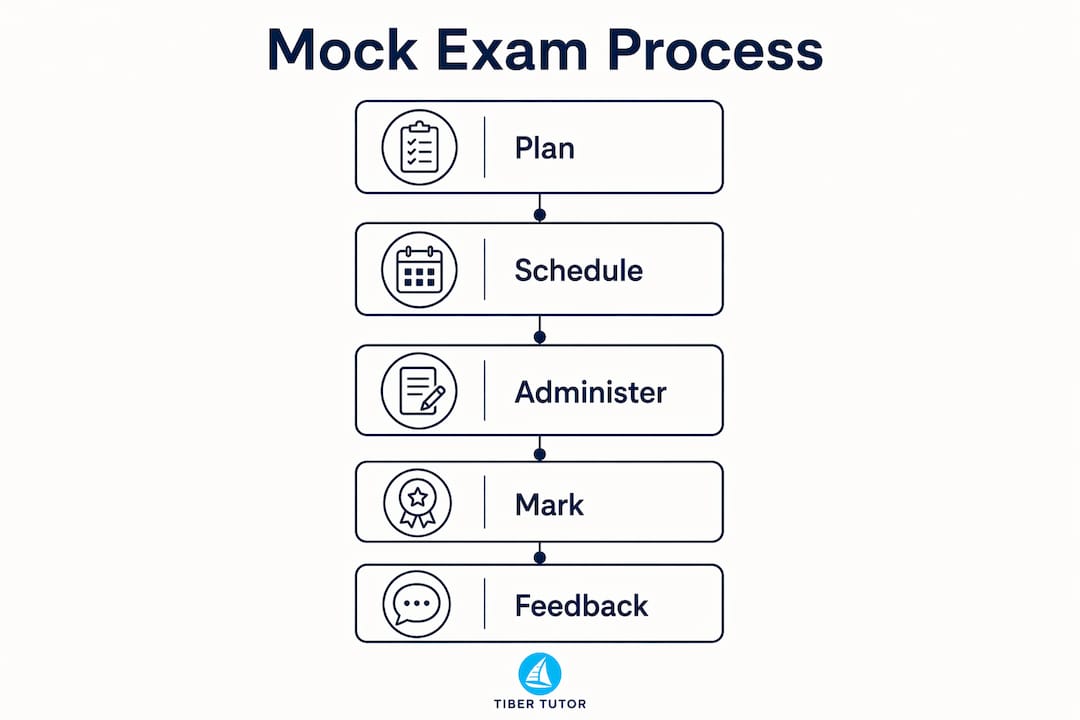
The workflow looks like this: set the paper on the platform, students sit it under timed conditions, marks feed into analytics, the teacher reviews class-level gaps, moderates with a colleague, returns scripts with dialogue, and assigns targeted follow-up tasks. Every step is traceable.
Tibertutor is built by examiners and experienced educators. Its IB Biology mock exams and IB Chemistry mock exams are examiner-authored, syllabus-aligned, and paired with analytics that show exactly where a student or cohort is losing marks. For IB science departments running standardised mocks, that combination of content quality and diagnostic data is what makes the difference between a mock that generates a grade and one that genuinely improves outcomes.
When evaluating any platform, ask three questions: who authored the content, how granular is the analytics output, and does the delivery system support exam-condition security?
Printable checklist for IB science departments running standardised mocks
Pre-mock:
- Paper designed, item-reviewed, and moderated internally
- Syllabus alignment and command-term mapping confirmed
- Invigilation plan and room allocation confirmed
- Access arrangements in place for all eligible students
- Students and parents briefed on diagnostic purpose and timeline
During the mock:
- Invigilation script read aloud at the start
- Timing displayed and announced at the midpoint and final ten minutes
- Papers collected, numbered, and stored securely immediately after
Post-mock:
- Scripts marked using IB grade boundaries and descriptors
- Internal moderation completed within one week
- Scripts returned to students within two weeks with feedforward notes
- Department meeting held to review cohort data and adjust teaching plan
- Targeted intervention tasks assigned and tracked
Explore Tibertutor’s IB science mock resources to see how a platform can handle the design, delivery, and analytics steps above.
Tibertutor: examiner-authored mocks built for IB science
IB science teachers spend enormous time sourcing valid mock papers, moderating marks, and chasing meaningful data. Tibertutor removes that pressure. Every mock paper on the platform is authored by IB examiners, mapped to the current syllabus, and paired with analytics that show you exactly which topics and command terms your students are struggling with, down to individual question level.
Whether you teach Biology, Chemistry, or Physics, Tibertutor gives your department ready-made, secure mock papers alongside the diagnostic data to act on results immediately. Students get timed, exam-condition practice with detailed mark schemes; teachers get cohort-level insight without hours of manual analysis. Start with IB Biology exam tests or IB Chemistry exam tests and see how examiner-authored content changes what your mock data can tell you.
FAQ
What is the role of standardised mock exams in IB science schools?
Standardised mocks provide reliable evidence of student readiness, support accurate predicted grades, and identify teaching gaps when paired with structured feedback and targeted interventions.
How often should IB science students sit mock exams?
The Chartered College of Teaching advises against excessive testing as data-collection. One full school-wide mock per year, supplemented by focused topic tests, is a purposeful and manageable frequency.
Why does feedback after a mock matter so much?
Feedback transforms a score into a revision plan. A mock returned without annotation has limited formative value; dialogic feedback with a feedforward note is what drives improvement.
How can schools reduce mock-related student anxiety?
Frame mocks explicitly as diagnostic checkpoints, not high-stakes grades. ManageBac guidance recommends returning scripts quickly with specific targets, which shifts the student’s focus from the result to the next step.
How does Tibertutor support IB science mock programmes?
Tibertutor provides examiner-authored mock papers for Biology, Chemistry, and Physics, with built-in analytics that identify topic and command-term gaps, making it straightforward for departments to run standardised, evidence-led mocks.
Key takeaways
Standardised, externally benchmarked mock exams improve IB science outcomes when they are designed carefully, returned with dialogic feedback, and tied directly to targeted teaching interventions.
| Point | Details |
|---|---|
| External benchmarking drives outcomes | A 15-year synthesis found standardised external comparison improves science achievement; internal testing alone showed little impact. |
| Practice tests yield measurable gains | Classroom studies show practice testing can improve final exam performance when used properly. |
| Feedback is non-optional | A mock without annotation and dialogue has limited formative value; return scripts within two weeks with a feedforward note. |
| Frequency must be purposeful | The Chartered College of Teaching warns against mocks becoming data-drops; one full mock per year plus targeted topic tests is the recommended pattern. |
| Tibertutor for IB science mocks | Tibertutor’s examiner-authored Biology, Chemistry, and Physics mock papers include analytics that identify gaps at topic and command-term level. |