IB mock exam strategy guide for science students
An effective IB mock exam strategy guide treats each practice paper as a structured learning experiment, not a rehearsal for failure. Mock exams, formally known as internal assessment rehearsals within the IB Diploma Programme, give science students in Biology, Chemistry, and Physics the chance to test their readiness under real conditions before final papers count. The most successful students approach mocks with a clear cycle: prepare deliberately, execute under timed conditions, review with precision, and repeat. Tools like official mark schemes, ManageBac, and structured error logs turn each mock into measurable progress.
What preparation steps set you up for IB mock exam success?
Strong mock exam performance begins weeks before you sit the paper. Structured weekly revision of two to four focused hours daily improves both retention and command term fluency far more reliably than cramming. Quality and consistency beat volume every time.
Start by mapping your syllabus. Use a checklist to confirm which topics you have covered and which still need attention. ManageBac offers built-in syllabus tracking tools that let you tag topics as confident, developing, or not yet started. This gives you a clear picture of where your revision time should go.
Understanding IB command terms is non-negotiable. Words like analyse, evaluate, and deduce carry specific mark-scheme expectations. A student who writes a description when the question asks for an evaluation will lose marks regardless of their content knowledge. Spend time with the IB subject guide glossary for Biology, Chemistry, or Physics before your mock.
- Review the full syllabus and mark topics by confidence level
- Practise with past papers to build familiarity with question formats
- Prepare your stationery, calculator, and data booklet in advance to mimic exam day
- Allocate revision blocks by topic weight, giving more time to areas with higher mark allocation
Pro Tip: Set a specific revision goal for each session rather than a time target. “Complete three Paper 2 data analysis questions and check against the mark scheme” is more productive than “study for two hours.”
How do you simulate real exam conditions during mocks?
Sitting a mock paper at your kitchen table with your phone nearby is not exam practice. It is a false sense of security. Genuine simulation means removing distractions, using the correct time allocation, and treating the paper as if it counts.
Follow these steps to replicate exam conditions accurately:
- Set a timer matching the exact paper duration for your subject and level.
- Allocate time by mark weighting. In IB sciences, a rough guide is one minute per mark, adjusted for extended response questions.
- Work in silence without access to notes, phones, or revision materials.
- Use breathing exercises before and during the paper if anxiety rises. Four counts in, hold for four, four counts out reduces cortisol and sharpens focus.
- Manage the night before. Sleep of seven to nine hours and a light meal before the paper improve cognitive performance measurably more than last-minute revision.
Pacing is a skill that only develops through practice. Many students spend too long on early questions and run out of time on high-mark extended responses. Practising exam question pacing under timed conditions trains you to move on when necessary rather than perfecting a two-mark answer.
Pro Tip: After each timed paper, note which questions you spent too long on. This pattern reveals where your confidence is low, not just where your knowledge is weak.

How to review mock results and target your weak areas
The review phase is where most students either gain ground or waste effort. Scoring papers within 24 to 48 hours using official mark schemes is the single most effective post-mock action. Leaving papers unmarked for a week means the questions are no longer fresh and the feedback loses its impact.
Once scored, conduct a structured error audit. Group your mistakes into four categories:
- Content gaps: You did not know the material
- Command term errors: You answered the wrong type of question
- Structural weaknesses: Your response lacked the required format or depth
- Time pressure mistakes: You knew the answer but rushed or skipped
This categorisation matters because each type of error requires a different fix. A content gap needs targeted re-study. A command term error needs practice with mark schemes. A structural weakness needs modelled answers. Rushing requires more timed practice, not more reading.
| Error type | Targeted action |
|---|---|
| Content gap | Re-study the specific topic using syllabus notes and flashcards |
| Command term error | Compare your response to the mark scheme descriptor for that command term |
| Structural weakness | Annotate a model answer and rewrite your response using the same structure |
| Time pressure mistake | Reattempt the question under timed conditions within 48 hours |
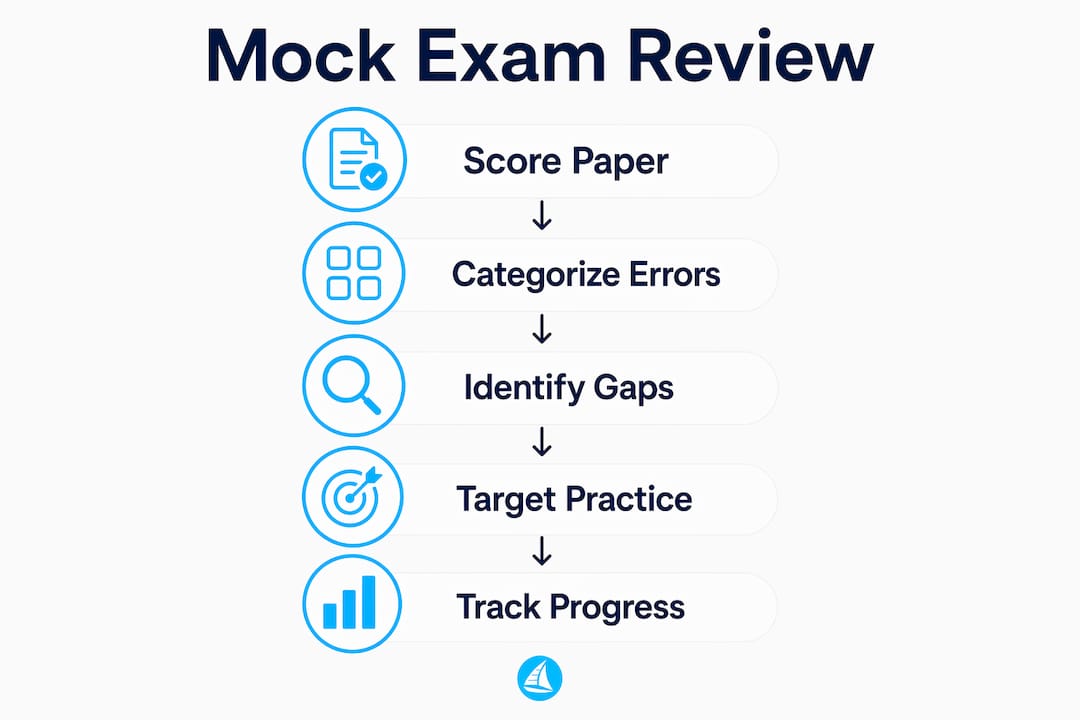
Select three to five specific improvements to focus on in the week following your mock. Developing an error log that translates examiner comments into study tasks prevents the common trap of re-reading notes without ever retesting yourself. Students who reattempt weak question types under exam conditions consistently show greater improvement than those who review passively.
How educators can use mock exams to support student development
For IB science teachers and coordinators, mock exams serve two equally important purposes. The first is academic: assessing where students stand relative to IB grade boundaries. The second is logistical: rehearsing the exam room setup, access arrangements, and administrative procedures that final exams require. Mock exams test exam logistics as much as they test student knowledge, and running them well reduces stress for everyone involved.
Grading consistency is critical. Teachers should use IB Programme Resource Centre grade descriptors and standardised grade boundaries to mark mock papers. Inconsistent marking gives students misleading feedback and undermines the predictive value of the mock result.
Effective educator practice after mocks includes:
- Providing written feedback that identifies both strengths and specific areas for improvement
- Sharing feedforward targets so students know exactly what to do differently
- Using class-level data to identify students who need additional support before final exams
- Collaborating with colleagues to moderate marking and align grade expectations
Access arrangements deserve particular attention. Students entitled to extra time, a reader, or a scribe in final exams must experience those arrangements during mocks. Running mocks without proper access arrangements disadvantages the students who need them most and defeats the purpose of the rehearsal.
Key takeaways
Structured mock exam cycles, combining deliberate preparation, timed simulation, and precise error review, produce the most reliable improvement in IB science results.
| Point | Details |
|---|---|
| Prepare with a syllabus map | Use ManageBac or a checklist to identify content gaps before the mock. |
| Simulate real conditions | Timed, distraction-free practice builds pacing skills that reading cannot. |
| Review within 24 to 48 hours | Score papers quickly using official mark schemes while questions are still fresh. |
| Audit errors by category | Grouping mistakes by type directs you to the right fix, not just more revision. |
| Educators must standardise grading | Consistent marking using IB grade descriptors gives students reliable, predictive feedback. |
Why most students get mock review wrong
I have worked with hundreds of IB science students, and the pattern is almost always the same. They sit the mock, feel discouraged by the score, and go back to re-reading their notes. That cycle produces very little improvement. The students who make the biggest gains are the ones who treat each mock as a deliberate practice experiment. They simulate, diagnose, practise the specific weakness, and then re-simulate. That loop, repeated consistently, is what converts occasional good performances into reliable ones.
The most underused tool in mock review is retesting. Most students read through their errors and feel they understand them. Understanding and being able to reproduce under pressure are entirely different things. If you cannot answer the question correctly under timed conditions after reviewing it, you have not fixed the problem. You have only recognised it.
Feedback from a teacher or tutor accelerates this process significantly. An outside perspective spots patterns in your errors that you cannot see yourself. Accountability also matters. Knowing someone will check your progress makes you more likely to follow through on your three to five targeted actions.
— Oliver
How Tibertutor supports your mock exam preparation
Tibertutor is built specifically for IB science students in Biology, Chemistry, and Physics. The platform offers mock exam resources including exam-style questions, full mock papers, animated videos, and detailed mark scheme walkthroughs, all designed by experienced IB examiners. Progress tracking and analytics show you exactly which topics and question types need the most attention, so your revision time goes where it counts. Whether you are preparing for your first mock or refining your approach before final exams, Tibertutor gives you the structured, exam-focused support to build genuine confidence. Explore personalised student plans at Tibertutor and take the guesswork out of your preparation.
FAQ
What is the best way to review an IB mock exam?
Score your paper within 24 to 48 hours using the official mark scheme, then categorise your errors by type: content gaps, command term mistakes, structural weaknesses, or time pressure. Select three to five targeted actions and reattempt the weakest questions under timed conditions within the same week.
How many hours a day should IB students study for mocks?
Two to four hours of focused, structured revision daily produces better results than longer, unfocused sessions. Consistency and deliberate practice matter more than total hours.
Why do IB students underperform in mock exams despite knowing the content?
Command term errors and poor pacing are the most common causes. Students who describe when asked to evaluate, or who run out of time on high-mark questions, lose marks that their content knowledge should have secured. Practising exam technique under timed conditions addresses both issues directly.
How should teachers grade IB mock exams fairly?
Teachers should use IB Programme Resource Centre grade descriptors and official grade boundaries to mark mock papers consistently. Standardised grading gives students reliable, predictive feedback and helps coordinators identify who needs additional support before final exams.
Are mock exams useful for IB science specifically?
Mock exams are particularly valuable in IB sciences because Biology, Chemistry, and Physics papers combine content recall, data analysis, and extended written responses. Each of these skills requires specific practice, and mocks reveal which combination of skills needs the most development before the final sitting.