How online mock exams simulate real tests: 2026 guide
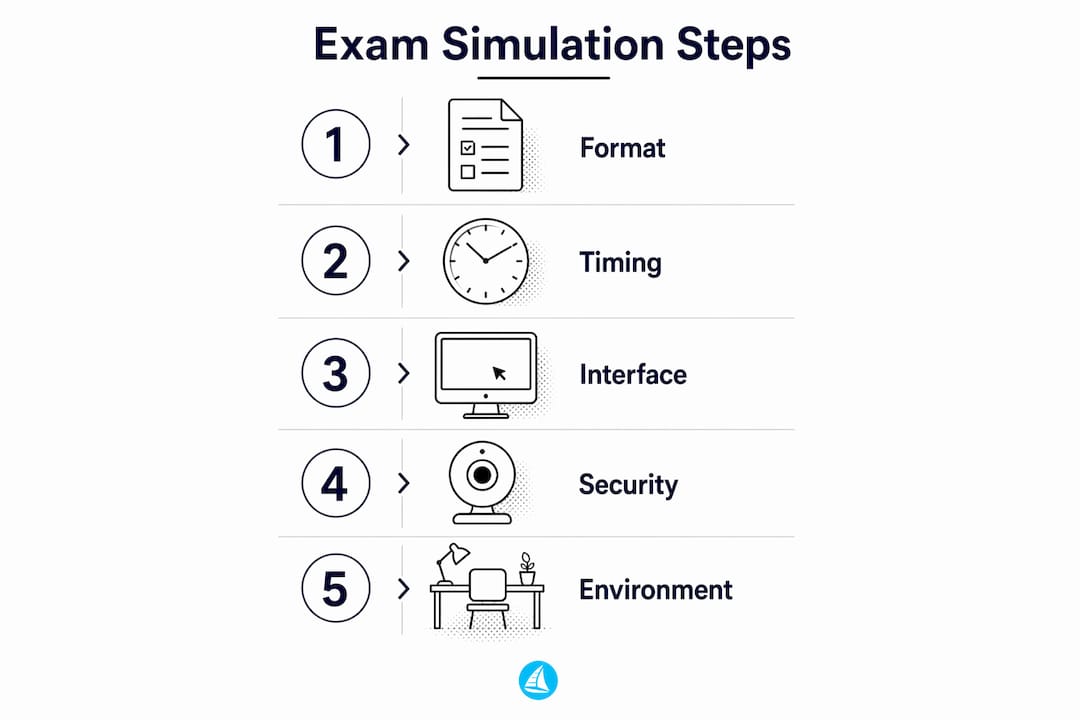
Online mock exams replicate real tests by enforcing the same question formats, strict time limits, and security measures students will face on exam day. For IB science students in particular, that replication goes well beyond simply practising content. A well-designed mock trains you to navigate a digital interface under pressure, manage your pacing across full paper lengths, and build the mental stamina that genuine exam conditions demand. Platforms like Tibertutor build their mock exam simulations around official IB syllabi, so every question type, section order, and time allocation mirrors what you will encounter in the actual assessment.
The core mechanisms that make online test simulation authentic include:
- Format fidelity: question types and section sequences match the official exam blueprint exactly
- Strict timing: countdowns enforce real time limits per section and overall, with no extensions
- Security protocols: AI-driven proctoring including webcam monitoring, screen recording, and eye-movement analysis maintains integrity
- Environment guidance: students are directed to replicate test-centre conditions at home
- Immediate analytics: detailed performance data after each attempt guides targeted revision
What makes an online mock exam feel like the real thing?
The realism of an online mock depends on how faithfully it reproduces every structural layer of the actual exam, not just the questions themselves.
Question type and section order. Predictive mock exams match difficulty and topic weightings from official syllabi, rotating equivalent questions across attempts to prevent memorisation. For IB Biology, Chemistry, and Physics, that means Paper 1 multiple-choice questions appear before Paper 2 extended responses, exactly as they would in a real sitting. The sequence matters because switching cognitive modes mid-exam is itself a skill.
Timed sections with no flexibility. Real IB papers give you a fixed window per section. Effective online simulations enforce those same windows without any option to pause or carry time over. Disabling the pause function trains stamina and replicates the mental pressure of continuous effort, which is something a casual practice quiz simply cannot do.
Interface fluency training. Navigating a digital exam platform takes practice in its own right. Online simulations build what educators call “interface fluency,” the ability to navigate digital testing tools efficiently so that cognitive load stays focused on the science rather than the software. Students who sit a mock on an unfamiliar interface often lose time to basic navigation rather than to difficult questions.

Environment replication. Experts recommend taking practice exams in dedicated, quiet spaces that resemble test centres. Sitting at a cleared desk, silencing notifications, and removing distractions reduces the transition shock between study mode and exam mode. The physical environment shapes mental state more than most students expect.
Security and integrity measures. Online proctoring technologies now include screen recording, webcam monitoring, and AI analysis of eye movement and background activity. These tools maintain exam integrity remotely, making the online mock experience comparable to supervised in-person conditions. For IB students, knowing that the mock is invigilated also raises the psychological stakes, which is precisely the point.
Online versus offline mocks. Paper-based mocks offer familiarity with handwriting under pressure and physical question papers. Online mocks add interface training, instant scoring, and detailed analytics that paper cannot provide. Neither format is universally superior; the right choice depends on the format of your actual IB assessment. Where digital exams are the norm, online simulation is the more faithful rehearsal.
How to get the most from your online mock exams
Treat each mock as a full workflow rehearsal, not a content check. That shift in mindset changes everything about how you prepare and what you learn from each attempt.
-
Set up a genuine exam environment. Clear your desk, close every browser tab unrelated to the exam, and silence your phone. Sit where you will not be interrupted for the full paper duration. Taking a mock in a relaxed, distraction-filled setting produces results that do not predict real exam performance.
-
Never pause mid-paper. True exam simulation requires continuous effort without breaks outside designated periods. Pausing resets your cognitive state and removes the stamina challenge that makes mocks genuinely predictive. Commit to the full sitting before reviewing anything.
-
Follow the official time allocation strictly. If IB Chemistry Paper 2 allows 75 minutes, set that limit and stop when it expires, even mid-sentence. Practising with extra time inflates your score and removes the pacing pressure that the real exam will impose.
-
Use a multi-stage approach. Effective mock preparation follows three stages: a diagnostic mock early in revision to identify gaps, focused topic study based on those results, and a high-pressure full simulation close to the exam date to confirm readiness. Running only one mock at the end of revision misses the diagnostic value of earlier attempts.
-
Analyse your results by question type and topic. After each mock, review time spent per question alongside your score. Immediate feedback and detailed metrics reveal whether you lost marks to knowledge gaps or to poor pacing. Those are different problems requiring different solutions.
-
Identify navigational friction separately from content errors. Some mistakes during online mocks come from unfamiliarity with the platform rather than from not knowing the science. Navigational friction is a distinct failure mode. If you lost time searching for the flag function or accidentally submitted a section early, that is a workflow problem to fix before the real exam.
-
Schedule mocks at realistic times of day. Your IB exams will likely run in the morning. Practising at the same time of day trains your alertness rhythms and removes one more variable from exam day.
Pro Tip: After each mock, write three sentences: what cost you the most time, what you would do differently, and one topic to revisit before your next attempt. That brief reflection activates metacognitive processing and makes your revision far more targeted.
Key benefits of taking online mock exams
The benefits of online mock exams extend well beyond a score on a practice paper. Each well-designed sitting builds skills that transfer directly to the real exam.
- Reduced test anxiety. Familiarity with the format, interface, and timing removes the fear of the unknown. Students who have completed several full-length simulations report feeling calmer on exam day because there are fewer surprises to manage.
- Better time management. Pacing under strict time limits is a learnable skill. Regular timed practice builds the instinct to allocate minutes per question without constant clock-checking.
- Interface fluency. Repeated exposure to the digital testing environment means navigating the platform becomes automatic, freeing mental capacity for the science itself.
- Identification of knowledge gaps. A mock score broken down by topic shows exactly where revision effort should go, rather than leaving students to guess which areas need work.
- Enhanced memory retention. The testing effect is well established: retrieving information under test conditions strengthens long-term recall more effectively than re-reading notes. Every mock sitting is active retrieval practice.
- Stamina building. Sitting a full IB paper without pausing trains the mental endurance needed to maintain concentration through a two-hour examination.
- Targeted improvement through feedback. Unlike real exams, online mocks provide immediate, question-level feedback. That data turns each attempt into a personalised revision plan rather than just a score.
What educators and researchers say about mock exam design
Educational design experts are consistent on one point: a mock exam is a workflow rehearsal, not a content quiz. When a student struggles during a mock, the failure often signals a timing or navigation challenge rather than a knowledge deficit. That distinction shapes how teachers and parents should interpret mock results.
The scientific basis for this is the testing effect, a well-replicated finding in cognitive psychology showing that active retrieval during practice strengthens memory consolidation more than passive review. For IB science students revising complex topics in Biology, Chemistry, or Physics, this means that sitting a timed mock is a more efficient use of revision time than reading through notes for the third time.
Predictive validity is the standard by which assessment experts judge whether a mock exam is genuinely useful. A mock has predictive validity when its difficulty, topic weighting, and question style closely match the real exam, so that a student’s mock score reliably signals their likely performance. Platforms that rotate equivalent questions across attempts, rather than repeating the same paper, maintain that predictive quality over multiple sittings.
AI-driven proctoring adds another layer of authenticity. Screen recording, webcam analysis, and behavioural monitoring replicate the supervised conditions of a real exam centre. For students preparing for high-stakes IB assessments, that psychological pressure is part of the training, not an inconvenience.
Caution is warranted against casual, non-simulated practice. Answering questions in short bursts, pausing freely, or working in a noisy environment produces scores that do not reflect real exam readiness. The research is clear: the closer the practice conditions match the real exam, the more accurately the results predict performance.
How Tibertutor supports your IB science exam preparation
Tibertutor is built specifically for IB science students in Biology, Chemistry, and Physics, and its mock exams are designed by examiners who know exactly what the real papers demand. Every mock on the platform mirrors the official IB syllabus in question style, difficulty, and section structure, giving you a genuinely predictive rehearsal rather than a generic practice quiz.
The platform’s analytics show you time spent per question, topic-by-topic performance, and progress across multiple attempts, so you can move from a diagnostic baseline to a high-pressure final simulation with a clear picture of where you stand. Whether you are preparing for IB Biology mock exams, IB Chemistry mock exams, or IB Physics mock exams, Tibertutor’s resources are structured to build both your knowledge and your exam-day confidence.
Start your preparation with Tibertutor’s IB Biology exam tests or IB Chemistry exam tests and experience what a genuinely exam-accurate simulation feels like.
Key takeaways
Online mock exams simulate real tests most effectively when they replicate format, enforce strict timing, build interface fluency, and provide detailed analytics that guide targeted revision.
| Point | Details |
|---|---|
| Format fidelity matters | Question types and section order must mirror the official exam blueprint to build genuine readiness. |
| Never pause during a mock | Continuous effort trains stamina and replicates the mental pressure of a real sitting. |
| Environment shapes performance | A quiet, dedicated space reduces transition shock and produces more accurate results. |
| Testing effect boosts retention | Retrieving information under test conditions strengthens long-term memory more than re-reading notes. |
| Multi-stage mocks are most effective | Diagnostic, focused practice, and high-pressure final simulations together produce optimal readiness. |
FAQ
Are mock exams similar to real exams?
Well-designed mock exams closely replicate the format, timing, and question style of real exams, though real sittings add fatigue, nerves, and invigilation pressure that no practice test can perfectly reproduce. The closer the mock conditions match the real exam, the more accurately results predict performance.
How do you conduct an online mock test effectively?
Set up a quiet, distraction-free environment, enforce the official time limits without pausing, and complete the full paper in one sitting. Review your analytics afterwards to distinguish knowledge gaps from pacing or navigation errors.
Are mock tests harder than actual tests?
Mock tests are designed to match the difficulty of the real exam, not exceed it. Predictive mock exams calibrate question difficulty and topic weighting to the official syllabus, so a strong mock score is a reliable signal of readiness rather than an inflated one.
Are mock exams accurate predictors of real results?
A mock exam has strong predictive accuracy when it matches the real exam’s difficulty, structure, and time pressure. Rotating equivalent questions across attempts and enforcing strict timing keeps results tied to genuine skill rather than familiarity with a specific paper.