Six Step Examiner Workflow to Self Mark IB Science Answers
To self mark IB answers accurately, treat the mark scheme as the examiner’s checklist, compare your response with official exemplars line by line, then run a short examiner checklist to convert every missed point into a targeted practice task. Do this honestly and consistently, and your predicted marks will start tracking your actual results with real accuracy.
TL;DR:
- Self-marking against official mark schemes requires understanding whether they are point-based or level-descriptor types to avoid overestimating your performance.
- Using examiner-authored exemplars and reports helps identify whether your responses meet the core claim, include appropriate evidence, and explain significance clearly.
- Common errors include misreading the command term, neglecting units or significant figures, and confusing similar scientific vocabulary, which cost marks in science responses.
- Relying on personal interpretation rather than actual written words leads to inflated self-assessment scores; focusing on precise phrasing is crucial.
- Implementing a concise, repeatable checklist and converting every mistake into targeted practice improves accuracy over time more effectively than prolonged, exhaustive verification.
Table of Contents
- How do you read an IB mark scheme correctly?
- What’s a reliable step-by-step self-marking workflow?
- How should you use exemplars when self-marking?
- Where does science self-marking go wrong specifically?
- What mistakes do students make most often when self-marking?
- Why do examiner-authored resources matter for self-marking?
- An examiner mindset changes how you revise
- How Tiber Tutor puts this workflow into practice
- Where to check mark schemes, exemplars, and checklists
- Sources
- FAQ
How do you read an IB mark scheme correctly?
Most students skim a mark scheme the way they’d skim a menu. That’s the first mistake. Mark schemes come in two distinct formats, and confusing them is why so many self-marked scripts come out wildly optimistic.
Point-based mark schemes award one mark per discrete idea, fact, or calculation step. You’ll see this on data-response questions and most short-answer science questions: each bullet is worth exactly one mark, and you either said it or you didn’t. Level-descriptor mark schemes work differently. They describe a whole band of performance (say, marks 5 to 7) with a paragraph of qualities your answer needs to demonstrate collectively, such as depth of explanation, use of evidence, and clarity of argument. You can’t tick boxes here; you have to judge where your answer sits as a whole.
Inside both formats you’ll hit a handful of recurring annotations that decide whether borderline wording earns credit:
- Accept — any listed alternative phrasing is worth full credit, no penalty for different wording.
- Do not accept — a specific answer that looks plausible but is explicitly excluded, often because it’s a common misconception.
- OWTTE (“or words to that effect”) — the examiner will credit any phrasing that captures the same meaning, which matters enormously when you’re marking your own paraphrased sentence against a model answer.
The other habit worth building is mapping command terms to expected depth before you even glance at the mark allocation. “State” wants a fact with no justification. “Describe” wants detail without explaining why. “Explain” demands a mechanism or reasoning chain. “Evaluate” wants a judgement supported by weighed evidence on both sides. Getting this mapping wrong is the single fastest way to under-mark or over-mark a response, because you’ll expect four marks’ worth of reasoning from a two-mark “describe” question, or accept a bare fact for an “explain” question that needed causation. Tiber Tutor’s guide to IB exam command terms breaks down exactly how much detail each verb demands across science and maths papers.
What’s a reliable step-by-step self-marking workflow?
Examiners don’t mark by vibe. They follow a routine, and you can copy it almost exactly. Here’s the sequence worth running every time:
- Set the conditions first. Decide whether you’re marking a timed attempt or an untimed one, and be honest about which, because the two should never be compared as if equivalent.
- Put the question paper away and pull up only the mark scheme. Read the command term and check whether it’s point-based or level-descriptor before you look at your answer.
- Tick every mark point you actually wrote, word for word. Don’t tick what you meant to write. Note every omission in the margin rather than mentally excusing it.
- Grade the response honestly against what’s ticked, not against how confident you felt writing it.
- Pull an official exemplar for the same question and compare sentence by sentence, checking whether your structure and explanation match or fall short.
- Run a two-minute final checklist: did you answer the command term, did you include units and correct sig figs where relevant, did you explain significance rather than just describing?
A structured self-assessment checklist for IB DP sciences can run to 70 or more individual verification checkpoints organised by criterion, which sounds excessive until you realise that’s exactly how many small decisions an examiner makes per script. Trying to hold all of that in your head without a written checklist is why the same errors recur test after test.
Pro Tip: Convert every missed mark point into a one-line practice task immediately, while the mistake is fresh. “Forgot to state units” becomes a five-minute drill on your next three questions, not a vague resolution to “be more careful”.
How should you use exemplars when self-marking?
A mark scheme tells you what’s required. An exemplar shows you what it looks like in practice, and the gap between those two things is where most self-marking goes wrong. Official exemplars and examiner reports are published alongside past papers on the IB’s own subject pages, and examiner reports specifically explain why real candidates lost marks on questions that looked straightforward. Reading the report before you compare exemplars will tell you exactly which traps to watch for in your own answer.
The comparison itself works best broken into three layers, an approach echoed in the claim, support, significance framework used to structure strong IB responses generally:
- Claim: did you state the same core point as the exemplar, even if the wording differs?
- Evidence: did you support it with the same type of data, calculation, or reference?
- Significance: did you explain why that evidence matters, the step most students skip entirely?
Paraphrase is where self-marking gets genuinely difficult, because it’s tempting to either reject your own wording too harshly or wave it through because you know what you meant. Subject vocabulary makes this worse in the sciences, where “diffusion” and “osmosis” aren’t interchangeable no matter how similar your sentence structure looks to the exemplar’s. When in doubt, check whether your phrasing changes the underlying meaning; if it doesn’t, treat it as OWTTE and credit it. If it does, mark it as missed and move on. Frequent exposure to exemplar-based self-assessment practice is what sharpens this judgement over time, according to teacher-facing IB guidance on embedding assessment language directly into revision.
Where does science self-marking go wrong specifically?
Biology, Chemistry, and Physics papers hide their own particular traps, and they’re rarely the ones students expect.
Extended-response questions don’t allocate marks point by point the way short-answer questions do. Instead, they use band descriptors, so a well-structured answer with slightly thinner detail can outscore a longer answer that never builds a coherent argument. Data-analysis questions are the opposite problem: mark schemes here are often unforgiving on technical precision.
- Missing or wrong units costs marks even when the numerical answer is correct.
- Incorrect significant figures, especially reporting more precision than the data supports, is a common and entirely avoidable loss.
- Uncertainty and error bars are frequently worth dedicated marks that students forget exist at all.
- Subject vocabulary precision matters more in sciences than almost anywhere else. “Rate of reaction” and “rate constant” are not the same thing, and mark schemes will not credit one for the other, though most do list accepted alternative phrasings for the same concept.
Tiber Tutor’s breakdown of how IB science mark schemes work walks through exactly how band descriptors and point allocations differ across the three sciences.
What mistakes do students make most often when self-marking?
Three biases show up again and again, and they’re worth naming because once you see them, they’re easy to catch.
- Marking intended meaning instead of written words. You know what you meant to say. The examiner doesn’t, and neither should you when self-marking. Credit only what’s on the page.
- Describing without explaining significance. A correct fact with no “so what” attached rarely earns full marks on explain or evaluate questions, yet it’s the single most common gap between a strong-looking answer and a strong-scoring one.
- Checklist fatigue. Long verification lists get abandoned by question four. Keep the checklist short enough to actually finish, and repeat it every time rather than reserving it for “important” questions.
Pro Tip: If a checklist item hasn’t changed your mark in the last five questions, cut it. A shorter checklist you actually complete beats a comprehensive one you abandon.
Why do examiner-authored resources matter for self-marking?
Ambiguity is the enemy of accurate self-marking, and generic study guides are full of it. Materials written by people who’ve actually marked IB scripts carry far less guesswork about whether a borderline answer meets a mark point, because that judgement call is exactly what examiners are trained to make consistently. A genuinely useful analytics dashboard should show per-criterion misses and progress over sessions, not just a single overall percentage that hides which specific skill is costing you marks. That per-criterion detail is what turns self-marking from a one-off check into a repeatable improvement loop.
An examiner mindset changes how you revise
Marking your own answers the way an examiner would forced me to stop trusting how confident an answer felt and start trusting what was actually on the page. That single shift catches more errors than any amount of extra content revision. Pair it with real teacher feedback and targeted practice on your specific gaps, and results day stops being a guessing game.
— Oliver
How Tiber Tutor puts this workflow into practice
Everything covered above depends on having mark schemes, exemplars, and checklists that are actually written by people who’ve marked real IB scripts, not repurposed from generic revision content. That’s the specific gap Tiber Tutor closes for Biology, Chemistry, Physics, and Maths.
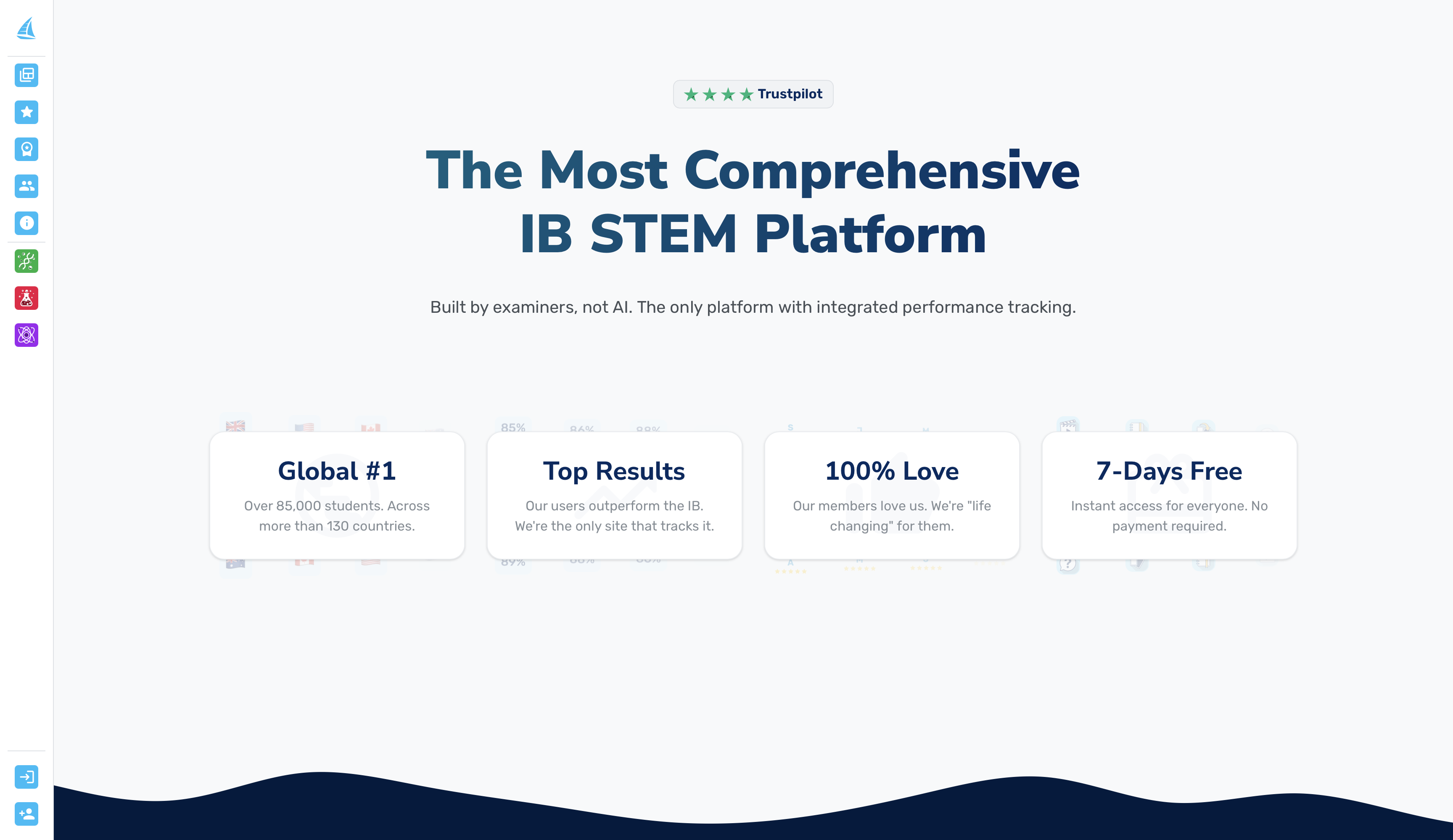
The platform’s examiner-authored mark-scheme guidance and IA exemplars are built directly for the sentence-level comparison method described above, so you are never guessing whether a mark scheme’s “accept” phrasing covers your wording. Its mock exams let you run the full workflow, timed conditions, honest ticking, exemplar comparison, and the final checklist, on complete papers rather than isolated questions. Progress analytics then show per-criterion misses over time, tracking exactly which mark points keep slipping, a level of detail that’s genuinely hard to find built into any other IB science resource. Because the content is written by working IB examiners rather than generalist tutors, it maps to real mark-scheme language rather than an approximation of it, which makes Tiber Tutor’s All-Access or Per-Subject plans a genuinely strong-value way to practise this routine at scale. Start with a subject trial to test the workflow on your weakest topic, then decide whether the full platform fits your revision plan.
Where to check mark schemes, exemplars, and checklists
For official mark schemes and exemplars, go straight to the IB’s Diploma Programme subject pages. For a ready-made verification checklist, the TES self-assessment checklist for IB DP sciences covers dozens of criterion-specific checkpoints. Tiber Tutor’s own syllabus topic checklist and score prediction guide extend the same method into full revision planning.
Sources
- IB DP Science IA Student Self Assessment Checklist - Version 1 - 2026 | Teaching Resources
- Diploma Programme — Biology — International Baccalaureate® (IBO)
- How to Structure Any IB Answer (Eclassopedia PDF)
FAQ
Is 70% a grade 7 in IB?
Not necessarily. Grade boundaries shift each exam session, so a fixed percentage doesn’t map onto a fixed grade. Always check the published boundaries for your specific session rather than relying on a rule of thumb.
Is 37 points a bad IB score?
A score sits solidly above the diploma’s typical pass threshold and reflects strong overall performance, though “bad” depends entirely on the grades a particular university course requires. Self-marking consistently against mark schemes is the most reliable way to check whether your target score is realistic before results day.
How rare is a 39 or higher in IB?
Very few candidates worldwide reach the top score ranges each session, and high scores already place a candidate well above the global average. Because grade boundaries move year to year, the exact rarity of any specific total varies by session rather than staying fixed.
Is 60% a grade 5 in IB?
It can be, but not reliably, since the percentage needed for each grade is set separately for every subject and session based on that year’s grade boundaries. Treat any percentage-to-grade rule of thumb as a rough guide only, and verify against the actual boundaries published for your exam session.
Can self-marking actually predict my IB grade accurately?
Honest self-marking against official mark schemes and exemplars gets you close, particularly when you run it consistently across multiple papers rather than a single attempt. Tools like Tiber Tutor’s mock exams and analytics sharpen that prediction further by tracking which specific criteria you’re missing over time.