How to predict your IB score before results day
You can estimate your predicted IB diploma score right now, using a free online calculator fed by your six subject estimates and a TOK/EE projection. The three tools most students reach for are IBPredict, RevisionDojo, and IB Grade Calculator (ibgradecalculator.com). Before you open any of them, gather your six subject estimates (IA marks, mock scores, or teacher feedback), confirm your HL/SL choices, and decide on a realistic TOK and Extended Essay grade. That preparation takes ten minutes and makes the output genuinely useful rather than a rough guess.
UCAS confirms that predicted grades must be finalised at the point of application and are the basis for most conditional offers at UK universities, so getting this estimate right matters well before your school submits anything.
Key takeaways
Predicting your IB diploma score accurately requires official grade boundaries, a correct TOK/EE matrix, and real evidence from IAs and mocks, not a rough percentage guess.
| Point | Details |
|---|---|
| Use a calculator first | Run IBPredict, RevisionDojo, or IB Grade Calculator with your six subject estimates and TOK/EE grades for an instant diploma total. |
| TOK/EE can fail the diploma | An E grade in either TOK or EE voids the diploma regardless of your subject point total. |
| Score bands for planning | Around a certain point threshold is the common pass level; a moderate range represents the global average band; higher score ranges are very competitive for selective programmes. |
| Predictions are teacher judgements | Teachers use IA marks, mocks, and coursework, not a formula; improving those inputs can raise your predicted grade before submission. |
| Tibertutor builds the evidence | Examiner-made mock exams and analytics on Tibertutor create the marked, timestamped evidence teachers need to justify a higher prediction. |
Table of Contents
- Which online IB score calculators are worth using?
- How does the IB 45-point system actually work?
- How to use a predicted-score calculator correctly
- Does 60% always mean the same IB grade?
- How accurate are predicted IB scores, and when should you trust them?
- Comparing the three main calculators in more detail
- What actually shifts a predicted grade before submission?
- Using predictions wisely during the Diploma
- Tibertutor: examiner-made resources to raise your predicted IB score
- Sources
- FAQ
Which online IB score calculators are worth using?
Three tools stand out for students who want to predict their IB score quickly and reliably.
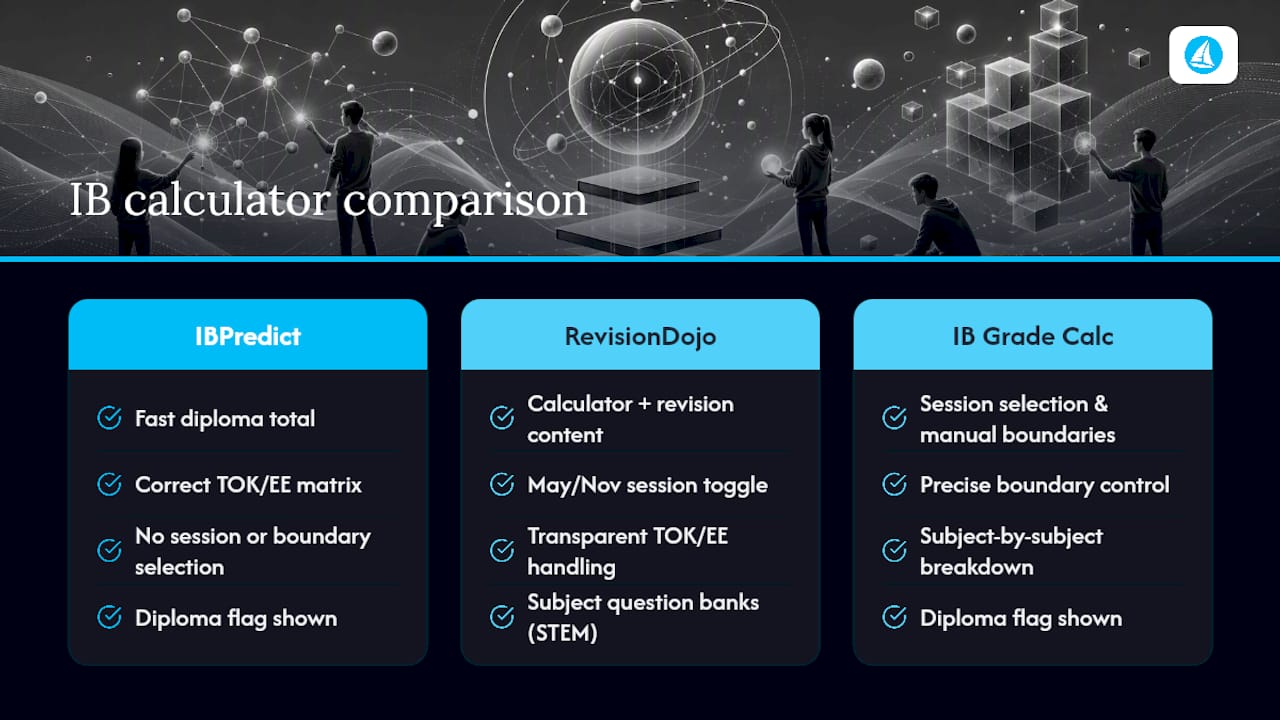
- IBPredict is the go-to for a fast diploma total. Enter your six subject grades and a TOK/EE estimate, and it returns a points total with a diploma-awarded flag. It is clean, mobile-friendly, and requires no account.
- RevisionDojo pairs a score calculator with subject-level revision resources, making it useful if you want to move straight from estimating your total to practising weak topics. Its TOK/EE handling is clear, and it supports both May and November session boundaries.
- IB Grade Calculator (ibgradecalculator.com) is the most boundary-aware of the three. It lets you select the exam session and adjust grade boundaries, which matters when you want to test how close you are to the next grade threshold in a specific subject.
Once you have chosen a tool, the workflow is the same for all three: enter your six subjects with HL/SL flags, add your TOK and EE projected letter grades, and check whether the diploma-awarded flag is green. If it is not, the tool will usually show which condition is failing.
How does the IB 45-point system actually work?
The IB Diploma is scored out of 45 points. Six subjects, each marked 1–7, contribute up to 42 subject points. The remaining 3 come from the Theory of Knowledge and Extended Essay core, which together produce a bonus matrix of 0–3 points.
The TOK/EE bonus matrix
| TOK grade | EE grade | Core points awarded |
|---|---|---|
| A | A | 3 |
| A | B | 3 |
| B | A | 3 |
| A or B | C | 2 |
| C | C | 1 |
| D | D | 0 |
| E (either) | Any | 0 (diploma fail condition) |
As IBLens explains, the diploma is awarded only when all conditions are met: no grade 1 in any subject, no E in TOK or EE, CAS requirements completed, no more than one grade 2 across HL subjects, and the total points meeting the minimum threshold. A student scoring 38 subject points can still fail if TOK or EE carries an E.
For planning purposes, score-band guidance places the common pass threshold at around a moderate score needed to pass, a global average band near the middle of the score range, a strong result higher up, and very competitive scores at the top end for selective university programmes.
Pro Tip: Your IA and TOK/EE drafts carry disproportionate weight in predicted totals because teachers can see marked evidence before exams. A polished IA draft submitted early gives your teacher something concrete to base a higher prediction on, whereas a mock score alone is a single data point.
How to use a predicted-score calculator correctly
Accurate inputs produce a meaningful estimate. Rushed inputs produce a number that feels reassuring but misleads your planning.
- Collect concrete evidence first. Pull together your IA marks (or the most recent draft feedback), your latest mock exam scores by subject, and any recent topic test averages. If your teacher has returned marked work with a grade, use that grade rather than your own impression.
- Confirm your HL/SL selection and enter subjects by group. IB science and maths students typically carry Biology, Chemistry, or Physics at HL alongside Maths AA or AI. Enter each subject in the correct group slot (Group 4 for sciences, Group 5 for maths) so the calculator maps them correctly.
- Set the exam session. Select May or November and, where the tool allows, choose the relevant boundary year. Grade boundaries shift between sessions, so a May 2025 boundary set will give a different grade for the same raw mark than a November 2024 set.
- Add your TOK and EE projected letter grades. Use the matrix in the previous section to see how your combination affects core points. If you have a marked TOK essay draft, use that grade. If not, be conservative.
- Check the diploma-awarded flag and the subject breakdown. If the flag is red, read which condition is failing. A missing CAS record or a borderline grade 2 in an HL subject is fixable before the real exam.
Entering a percentage mark without selecting the correct grade boundary is the single most common mistake students make. A 65% raw mark in Chemistry HL might be a 5 in one session and a 6 in another. Always select the boundary set that matches your actual exam session before reading the output.
Does 60% always mean the same IB grade?
No, and this is one of the most misunderstood aspects of IB scoring. Grade boundaries are set after each exam sitting by the IB Organisation, based on the difficulty of that specific paper. A 60% raw mark in Biology HL Paper 2 might correspond to a grade 5 in one session and a grade 4 in another.
The IB publishes official grade boundaries for each subject and session after results are released. For planning purposes, students often use the most recent published boundaries as a proxy, but those boundaries can shift by several percentage points between May and November sittings.
An illustrative example: if the grade 5 boundary for Chemistry HL Paper 1 sits at 58% in one session, a student scoring 60% clears it comfortably. If that boundary rises to 63% the following session, the same raw score falls short. This is why boundary-aware calculators, like IB Grade Calculator, are more useful for students who are close to a grade threshold and want to stress-test their position.
Is 60% a 5 in IB? It depends entirely on the subject, the paper, and the session. There is no universal percentage-to-grade conversion in IB. Always check the published boundary for your specific subject and sitting.
How accurate are predicted IB scores, and when should you trust them?
Predicted grades are professional judgements, not algorithmic outputs. As MyRevisionAgent notes, teachers draw on internal assessments, mock exams, coursework, and class performance, and the IB Organisation does not standardise or set predicted grades centrally. UK centre-judgement research confirms that staff use a mix of evidence and professional judgement, with school-level moderation adding a further layer of variability.

Overprediction is common. Teachers tend to give students the benefit of the doubt, particularly when a student is close to a grade boundary or has shown recent improvement. This means the number on your UCAS application may sometimes be optimistic relative to current evidence.
Where predictions are most useful:
- Setting a realistic revision target before mock exams
- Identifying which subject or component (IA, Paper 2, TOK) would move your total most efficiently
- Anchoring UCAS conditional offer conversations with your school adviser
Where to be cautious:
- Treating a predicted 38 as a guarantee of a 38 in results
- Submitting a UCAS application without verifying the grades your school has entered (corrections after submission are difficult)
- Ignoring the diploma fail conditions when a subject is borderline
Pro Tip: Ask your teacher what specific evidence they used to arrive at your prediction. If the answer is “your mock score,” that is a single data point. Bring a marked IA draft, a timed past-paper attempt, and a record of recent topic test scores to the conversation, and you give them a richer picture to work from.
Comparing the three main calculators in more detail
Before choosing a tool, consider what you actually need from it.
IBPredict suits students who want a quick diploma total without configuration. It handles the TOK/EE matrix correctly and returns a clear diploma-awarded flag. There is no session-specific boundary selection, so treat its output as a directional estimate rather than a precise grade-boundary check.
RevisionDojo adds revision content alongside the calculator, which makes it practical for students who want to move immediately from spotting a weak subject to practising it. The TOK/EE handling is transparent, and the May/November session toggle is present. For IB science and maths students, the subject-specific question banks sit alongside the score tool, which keeps the workflow in one place.
IB Grade Calculator (ibgradecalculator.com) is the strongest option when boundary precision matters. It lets you select the exam session and adjust boundaries manually, which is useful if you are sitting close to a grade threshold and want to understand exactly how many raw marks separate you from the next grade. The results display includes a subject-by-subject breakdown alongside the diploma flag.
For most students, the practical approach is to run IBPredict first for a fast read, then open IB Grade Calculator to stress-test any subject where you are within a few marks of a boundary. If you are also looking for revision support in the same session, RevisionDojo keeps both in one tab.
What actually shifts a predicted grade before submission?
Calculator estimates tell you where you stand. Changing where you stand requires deliberate action on the evidence your teacher sees.
- Revise and resubmit IA drafts with rubric alignment. Teachers can only predict based on what they have marked. A draft that clearly addresses each assessment criterion gives them a higher grade to work from. Sparkl’s guidance confirms that IA improvement is one of the most direct levers students hold.
- Sit standardised mock papers under timed conditions. A single mock score is weak evidence. Two or three consistent results on past papers, marked against the official mark scheme, create a trend. Standardised mock exams give teachers more reliable data than informal class tests.
- Focus HL question technique on command terms. Examiners award marks for specific language. A student who can write a correct “evaluate” response in Biology HL or a structured “deduce” answer in Chemistry HL demonstrates exam readiness that a percentage score alone does not show.
- Document upward trends and present them proactively. Bring a short evidence folder to any predicted-grade conversation: IA draft feedback, two or three timed past-paper scores, and a topic test record. Teachers respond to visible progress, not self-reported improvement.
Consider supplementing your preparation with targeted tutoring support if a specific subject is holding your predicted total down. One-to-one sessions focused on HL question technique can produce measurable improvement in a short window.
Pro Tip: Ask your teacher to confirm which piece of evidence most influenced your current prediction, then target exactly that component. If it was a mock paper, sit another under exam conditions and bring the marked script. If it was an IA draft, revise the weakest criterion and resubmit.
Using predictions wisely during the Diploma
A predicted score is a planning tool, not a verdict. The most grounded students treat it as one scenario in a set of three: a best-case total (everything goes well in exams), a realistic total (consistent with current evidence), and a fallback (one subject underperforms). Planning university choices across all three scenarios protects you from over-relying on an optimistic prediction.
When approaching a teacher for a prediction review, bring evidence rather than a request. A specific question (“I’ve improved my IA draft on criterion C and scored a 6 on the November 2023 past paper — does that change your assessment?”) is far more productive than a general appeal. Follow up in writing so there is a record.
One honest caution: predicted grades can feel personal when they are lower than you hoped. They are professional estimates based on available evidence, and they can change. Manage your expectations by focusing on what you can control between now and the exam.
Tibertutor: examiner-made resources to raise your predicted IB score
Tibertutor is built specifically for IB science and maths students who want to move their predicted grade upward with evidence teachers actually trust. Every piece of content on the platform is created by IB examiners, which means the mock exams, topic tests, and mark schemes reflect exactly what the real papers reward. That is not something you find on most revision sites.
The platform’s IB Biology tests, Chemistry mock exams, and Maths AI mock exams are structured to generate the kind of marked, timestamped evidence that gives teachers a concrete basis for a higher prediction. Progress tracking and performance analytics show your improvement over time, across every topic and paper type, in a level of detail that no other IB platform currently offers. IA exemplars and examiner mark schemes sit alongside the practice materials, so the whole workflow connects: practise, review, improve, repeat.
Start a free 7-day trial at Tibertutor for IB students and see how quickly the analytics identify exactly where your marks are being lost.
Sources
- Predicted grades: what you need to know for entry this year | UCAS
- Gov
- IB Score Calculator — Points, Grade Boundaries and Diploma Requirements | IBLens
FAQ
How do you get a predicted IB score?
Your school teacher assigns your predicted grade based on IA marks, mock exam results, coursework, and class performance. The IB Organisation does not set predicted grades; they are professional judgements made by your teachers, often with school-level moderation.
Is 60% a 5 in IB?
Not necessarily. Grade boundaries vary by subject, paper, and exam session, so a 60% raw mark can correspond to different IB grades depending on where the boundary falls that sitting. Always check the published boundary for your specific subject and session.
What is a good predicted IB score?
Around 30–32 points reflects the global average band. Scores above average are strong for many university programmes, and the highest scores are considered very competitive for selective courses. The minimum to be awarded the diploma is typically around 24 points, subject to all diploma conditions being met.
Is 38 out of 42 a good IB score?
Yes. A subject total of 38 out of 42 (before core points) places a student well above the global average and is competitive for most selective university programmes in the UK. With strong TOK and EE grades adding up to 3 core points, a final diploma total well above the common pass threshold is achievable from that base.
Can you improve your predicted IB grade before submission?
Yes. Improving your IA draft, sitting additional timed past papers, and presenting marked evidence of upward progress to your teacher are the most direct ways to influence a prediction before your school submits it to UCAS.