IB science practical requirement: hours and assessment
The IB Diploma Programme expects practical work for Standard Level sciences and Higher Level covering laboratory experiments, data analysis, and the Group 4 project, with recommended hour ranges published in programme guidance. These hours feed into two assessed elements: the individual scientific investigation, known as the internal assessment (IA), and the collaborative Group 4 project shared across sciences.
Neither figure is a strict legal minimum tracked hour by hour. They’re programme guidance published in each DP sciences subject brief, and your school translates that guidance into an actual practical scheme of work (PSOW).
Three things matter most for meeting the requirement:
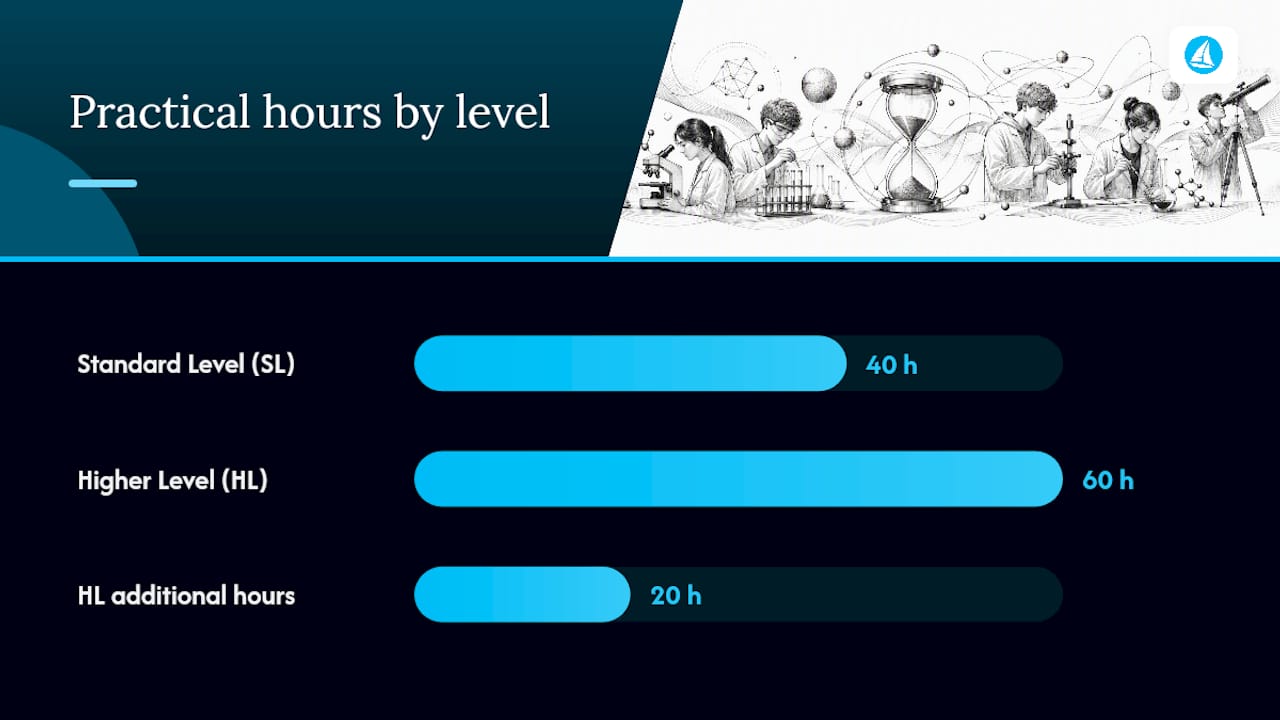
- The hours guideline: SL ≈ 40 hours, HL ≈ 60 hours, inclusive of investigation time.
- The assessed elements: the scientific investigation (IA) and the Group 4 project.
- Who owns compliance: your teacher designs the PSOW and keeps evidence; you generate the practical record through logbooks, data, and write-ups.
Key Takeaways
Meeting the IB science practical requirement means logging roughly 40 hours (SL) or 60 hours (HL) of documented investigative work that feeds directly into the scientific investigation and Group 4 project.
| Point | Details |
|---|---|
| Headline hour figures | SL sciences guide towards approximately 40 practical hours, HL towards approximately 60, including IA and Group 4 project time. |
| Two assessed elements | The scientific investigation (IA) and the collaborative Group 4 project are the compulsory practical outputs every student completes. |
| Documentation is non-negotiable | Log date, activity, objective, evidence type, and teacher sign-off contemporaneously, not retrospectively. |
| Safety is assessed, not optional | A written risk assessment before every experiment supports AO4 and protects your school during moderation. |
| Verify against subject briefs | Confirm exact hour guidance and IA weighting in your own subject’s official IBO brief, since figures can vary slightly by subject. |
| Practise with examiner-built tools | Tibertutor’s examiner-created practical tests, IA exemplars, and syllabus trackers help you build lab technique and IA writing skills that map directly to the marking criteria. |
Table of Contents
- What is the IB science practical requirement exactly?
- How the hours break down by level and subject
- What actually counts as practical work?
- How practical work is actually assessed
- The Group 4 project explained
- Safety, ethics, and the risk assessment requirement
- How schools plan and record practical hours
- What examiners actually want to see
- What separates a genuinely strong practical record
- Get examiner-built practical resources with Tibertutor
- Sources
- FAQ
What is the IB science practical requirement exactly?
The requirement is a combination of a recommended practical-hour total and two compulsory assessed tasks. It isn’t a single rule you can point to in one sentence, which is why so many students get confused searching for a hard number.
Standard Level students are expected to complete approximately 40 hours of practical science across the two-year course, while Higher Level students work towards approximately 60 hours, according to guidance published in subject briefs such as the DP sciences biology subject brief. These totals typically fold in your regular lab lessons, the scientific investigation itself, and time spent on the Group 4 project.
The scientific investigation, the compulsory internal assessment, usually draws a portion of hours from that overall practical allocation. Think IB’s chemistry guidance places the experimental programme and IA allocation at roughly 10 hours of dedicated investigation time, with the IA typically contributing close to 20% of your final subject mark. The Group 4 project draws a further portion of time, leaving the remaining time for standard lab work, technique practice, and data handling across your two years of study.
None of this is examined as a stopwatch tally. No inspector counts your hours line by line. What matters is whether your school’s PSOW demonstrably covers the techniques, skills, and investigative depth the syllabus expects, and whether your IA and Group 4 project show that coverage in practice.
How the hours break down by level and subject
The 40/60 hour figures aren’t identical blocks copied across every Group 4 subject. They’re a shared planning benchmark that each subject brief applies with its own emphasis, and the subjects themselves vary in what counts as core practical work.
Group 4 currently includes biology, chemistry, physics, design technology, computer science, and sports, exercise and health science. Environmental systems and societies (ESS) sits as a crossover option between Group 3 and Group 4, meaning it can satisfy your Group 4 subject requirement while carrying its own blended practical and fieldwork expectations. Every DP student must study at least one Group 4 subject, a rule the IB’s own Group 4 curriculum page sets out clearly.
| Element | Standard Level | Higher Level |
|---|---|---|
| Total practical hours (recommended) | a guidance figure for SL | a guidance figure for HL |
| Scientific investigation (IA) time | a recommended portion | a recommended portion |
| Group 4 project time | a recommended portion | a recommended portion |
| Remaining lab/technique time | the remainder of practical time | the remainder of practical time |
Higher Level students don’t just do more of the same experiments. The extra 20 hours usually go towards more advanced techniques, more independent experimental design, and deeper data processing work, since HL papers test more sophisticated practical reasoning. Some subjects list specific prescribed techniques your teacher must cover somewhere in that programme, a chromatography separation in chemistry, a microscopy technique in biology, so check your subject brief rather than assuming every practical hour is interchangeable.
Design technology and computer science interpret “practical” more loosely than biology or physics. A DT student might log hours through prototyping and material testing, while a computer science student logs hours through programming projects and case study analysis. The school still designs and owns that PSOW, and it can legitimately count fieldwork, simulation-based work, and structured data analysis lessons where they meet the investigative aims, as Think IB’s guidance on the biology practical scheme of work makes clear.
What actually counts as practical work?
This is where students most often sell themselves short, assuming only “wet lab” bench work counts. It doesn’t have to be that narrow.
Accepted practical activities generally include:
- Hands-on laboratory experiments with measurable, recorded outcomes.
- Fieldwork with a clear investigative question, not just a site visit.
- Data collection and processing exercises, including secondary data analysis.
- Computer simulations and modelling software, where the exercise is investigative rather than passive.
- Structured visits (a museum lab, a research facility) tied to a specific inquiry task.
- Standalone data analysis lessons that build uncertainty and evaluation skills.
Acceptable evidence looks similarly broad: written lab reports, practical logbooks, digital records such as photos or short videos of setups, simulation output files, and teacher checklists confirming completion. Some schools keep a moderated sample of student work specifically to demonstrate consistency across the cohort if the IB ever asks questions about how hours were logged.
What doesn’t count, generally, is passive observation. A guided tour of a science museum or a demonstration where students simply watch a teacher run an experiment rarely satisfies the requirement on its own. It can be reworked into something that does.
Pro Tip: If you’re stuck with a passive activity, turn it investigative before you start. Write one specific research question, note the method and any data you can extract, and get your teacher to sign off on what you observed. That single step converts a watch-only session into logged, defensible practical evidence.
How practical work is actually assessed
Practical hours matter because they build towards two compulsory, assessed outputs, not because a hidden tally exists somewhere in Geneva. The scientific investigation is the one every science student completes individually.
The IA typically draws around 10 hours from your overall practical allocation and asks for a focused write-up, often guided at somewhere between 6 and 12 pages depending on the subject, according to Think IB’s biology PSOW notes. It usually contributes close to 20% of your final subject mark, though you should always confirm the exact weighting in your own subject brief since it can shift slightly between subjects and syllabus updates.
Your practical work is judged against four assessment objectives that run across every DP science:
| Assessment objective | What it tests | How practical work demonstrates it |
|---|---|---|
| AO1 | Knowledge and understanding | Correct use of technique and underlying theory |
| AO2 | Application | Applying skills to unfamiliar experimental contexts |
| AO3 | Analysis, evaluation, synthesis | Data processing, uncertainty analysis, evaluation |
| AO4 | Skills, including safety and ethics | Risk assessment, technique execution, collaborative work |
Marking happens internally first. Your teacher assesses your IA against the official criteria, then the IB moderates a sample of marks from the school to check consistency, a process the DP curriculum overview confirms applies across internally assessed components. Practical technique and data-handling questions also turn up in written papers, so hours logged in the lab support your exam performance well beyond the IA itself.
The Group 4 project explained
The Group 4 project is the collaborative half of your practical requirement, and it’s frequently the part students understand least. Unlike the IA, it isn’t a solo effort or a piece of individually graded coursework.
Students from different science subjects, biology, chemistry, physics, and any others offered at your school, work together on a shared theme over a period of roughly a day or a few sessions spread across a week. The aim is interdisciplinary thinking: seeing how a biologist, a chemist, and a physicist approach the same broad question differently, while practising the communication and ethical awareness skills that AO4 rewards.
A few practical points worth knowing:
- Schools typically allocate around 10 hours within the overall practical programme to the Group 4 project.
- The project itself is usually not externally examined, but it counts towards your practical coverage and must be documented like any other practical activity.
- Strong Group 4 projects pick a genuinely investigative theme (something like renewable energy or water quality) rather than a broad topic with no research question attached.
- Documentation still matters here: logbooks, group reflections, and evidence of individual contribution all help if your school is ever asked to demonstrate coverage.
Treat the Group 4 project as a real chance to practise collaborative scientific communication, not a box-ticking day off timetable. Examiners and universities alike value evidence that you can work across disciplines, and a well-documented project gives you material to draw on for university applications and interviews later.
Safety, ethics, and the risk assessment requirement
Every practical activity in the DP sits inside a formal safety and ethics framework, and this isn’t optional paperwork. It’s assessed under AO4 and treated as a genuine part of the scientific method.
The IB’s own experimentation guidance requires that anyone organising, supervising, or delivering a science experiment follows clear ethical and safety principles, including the replacement, refinement, and reduction framework for any work involving animals, as set out in the IB sciences experimentation guidelines. Both teachers and students are expected to complete a written risk assessment before starting a practical activity, not after something goes wrong.
Examiners do report safety breaches through to the IB Assessment Division, and unsafe or undocumented practice can genuinely affect how internally assessed work is treated. This makes a written risk assessment less a formality and more an examinable artefact worth keeping alongside your IA evidence.
Pro Tip: Build a five-line risk assessment template you reuse every practical: hazard identified, who’s at risk, control measure, residual risk, and sign-off. Filling the same five fields each time turns a task students dread into a two-minute habit, and it gives you a consistent paper trail if your school ever needs to demonstrate compliance.
How schools plan and record practical hours
Meeting the requirement isn’t something that happens automatically across two years of lessons. It needs deliberate planning, usually built around a practical scheme of work that your teacher designs at the start of the course.
- Build the PSOW early. Map every required technique and investigative skill across both years so nothing gets left to the final term before exams.
- Log every session as it happens. Record the date, activity, time spent, the investigative objective, the type of evidence produced, and teacher sign-off, ideally the same day rather than reconstructed from memory months later.
- Store evidence centrally. Whether that’s a shared digital folder or physical logbooks, keep it organised by subject and term so a moderator or new teacher can follow the coverage at a glance.
- Check coverage each term. Compare what’s been logged against the subject brief’s technique list and flag gaps before they become a problem in the final year.
- Address shortfalls with verified alternatives. If hours run short, validated simulations, additional documented data analysis tasks, or supervised home-based investigations with teacher verification can plausibly fill the gap, provided the rationale and verification are recorded for moderation purposes.
Real disruptions happen. Remote learning periods, equipment shortages, and staffing gaps have all forced schools to adapt practical delivery in recent years. What the IB and examiners consistently look for in these cases isn’t a perfect hour count. It’s documented reasoning: what was substituted, why, and how a teacher verified the student still engaged with the investigative skill being tested.
What examiners actually want to see
Marking hundreds of IAs and Group 4 projects a year gives examiners a fairly consistent picture of what separates a strong practical record from a weak one, and it usually has nothing to do with expensive equipment.
Examiners consistently reward a clear, specific research question over a broad or vague one, replicated data rather than a single measurement pretending to be a trend, honest uncertainty analysis, and genuine evaluation of what went wrong and why. Personal engagement matters too: an IA that reads like a recipe followed step by step scores lower than one where the student clearly made design choices and can justify them.
Common pitfalls worth avoiding include leaning too heavily on a standard textbook protocol without adapting it to your own research question, weak or missing uncertainty calculations, and evaluations that list generic sources of error (“human error”, “equipment limitations”) instead of specific, quantified problems with the actual method used.
Building that kind of practical fluency takes structured practice, not last-minute cramming before submission deadlines. Exam-style practical questions, worked IA exemplars, and animated technique demonstrations all help students see what a mark-worthy investigation actually looks like before they attempt their own, and Tibertutor’s Biology practical skills guide breaks these expectations down against the actual assessment objectives rather than generic study advice. Pairing that with structured study scheduling keeps practical practice from being squeezed out by content revision in the final months.
What separates a genuinely strong practical record
The gap between a solid IA and a mediocre one rarely comes down to the equipment a school can afford. It comes down to whether the student actually thought like a scientist at each stage, or simply executed a method someone else designed.
A student who can explain why they chose a particular sample size, why they controlled a specific variable the way they did, and what they’d change if they repeated the investigation, demonstrates exactly the kind of authentic engagement the assessment criteria are built to reward. That’s harder to fake than it sounds, and examiners spot the difference quickly between a genuinely independent investigation and one that’s been heavily scaffolded by a teacher or copied from a common template.
Documentation is the other half of the equation. A brilliant experiment with no contemporaneous logbook record is far weaker evidence than a modest one that’s been meticulously tracked from the first risk assessment to the final data table. Schools that treat record keeping as an afterthought put their students at a real disadvantage when moderation comes round.
Teachers walk a genuine tightrope here. Support students enough to keep them safe and on track, but not so much that the investigation stops being theirs. The best practical programmes give students room to make their own mistakes early, when the stakes are low, so that by the time the real IA comes round, they’ve already learned what independent scientific thinking actually feels like.
Get examiner-built practical resources with Tibertutor
Meeting the practical requirement is one challenge; proving you understand the skills behind it under exam conditions is another, and that’s where most generic revision guides fall short. Tibertutor’s practical and topic tests are built by IB examiners who mark real IAs and papers, so every question mirrors the exact language, data-handling style, and mark scheme logic you’ll meet in your actual assessment.
The platform covers Biology, Chemistry, Physics, and IB Maths with interlinked resources: animated technique videos that show correct experimental method, IA exemplars annotated against the real marking criteria, syllabus trackers that flag which practical skills you haven’t covered yet, and mock exams that combine written and practical-style questions in one place. Nothing else on the market pairs that breadth with the depth of performance analytics Tibertutor offers, tracking exactly which assessment objectives you’re strongest and weakest on so revision time goes where it actually matters.
If you’re chemistry-focused, start with the IB Chemistry topic tests to target specific practical techniques, or move straight to a full Chemistry mock exam to see how practical reasoning shows up under timed conditions. A free 7-day trial gives you access to the full library before you commit to a subscription.
Sources
Always confirm current details against official IB sources rather than relying on secondhand summaries, since subject briefs and guides are updated periodically.
The Diploma Programme subject brief for Group 4 sciences sets out which subjects qualify and the general role of practical work in the DP. Subject-specific documents, like the DP biology subject brief, give the precise hour guidance and assessment structure for that course. For safety and ethical requirements before running any experiment, the IB sciences experimentation guidelines remain the clearest reference point for staff and students alike. Schools exploring how the Group 4 project fits alongside broader interdisciplinary teaching may also find context in resources like Linda Mandarin’s IB and IGCSE course overview.
- Diploma Programme subject brief—Group 4: sciences (IBO)
- IBDP biology: practical scheme of work (Think IB)
FAQ
How many practical hours does IB science require?
Standard Level sciences guide towards approximately 40 hours of practical work, while Higher Level sciences guide towards approximately 60 hours, including time for the scientific investigation and Group 4 project.
What counts as practical work in IB science?
Hands-on lab experiments, fieldwork, data analysis, computer simulations, and modelling all count when they’re investigative and properly documented; passive demonstrations generally don’t unless reworked into a genuine inquiry task.
What are the 5 hardest IB subjects?
Difficulty is subjective and varies by student, but HL Physics, HL Chemistry, HL Mathematics: Analysis and Approaches, HL Biology, and Higher Level Economics are commonly cited by students and teachers as among the most demanding due to content depth and exam rigour.
Do universities prefer IB or AP?
Neither is universally preferred; university admissions teams generally view a strong IB Diploma and strong AP results as comparably rigorous, with preference often depending on the specific institution and country.
Is 27 a good IB score?
A score near the global average is generally considered a solid, respectable result rather than a top-tier one for highly competitive university courses.
What is the IB equivalent to in the US?
There’s no exact equivalent, but the IB Diploma is often compared to a strong Advanced Placement (AP) course load, since both are recognised by US universities as evidence of advanced, university-preparatory study. For structured revision that reflects real exam standards across Biology, Chemistry, Physics, and Maths, Tibertutor’s Biology exam tests are built around the same assessment objectives examiners use to mark practical work.