
Biology practical questions: your IB exam guide 2026
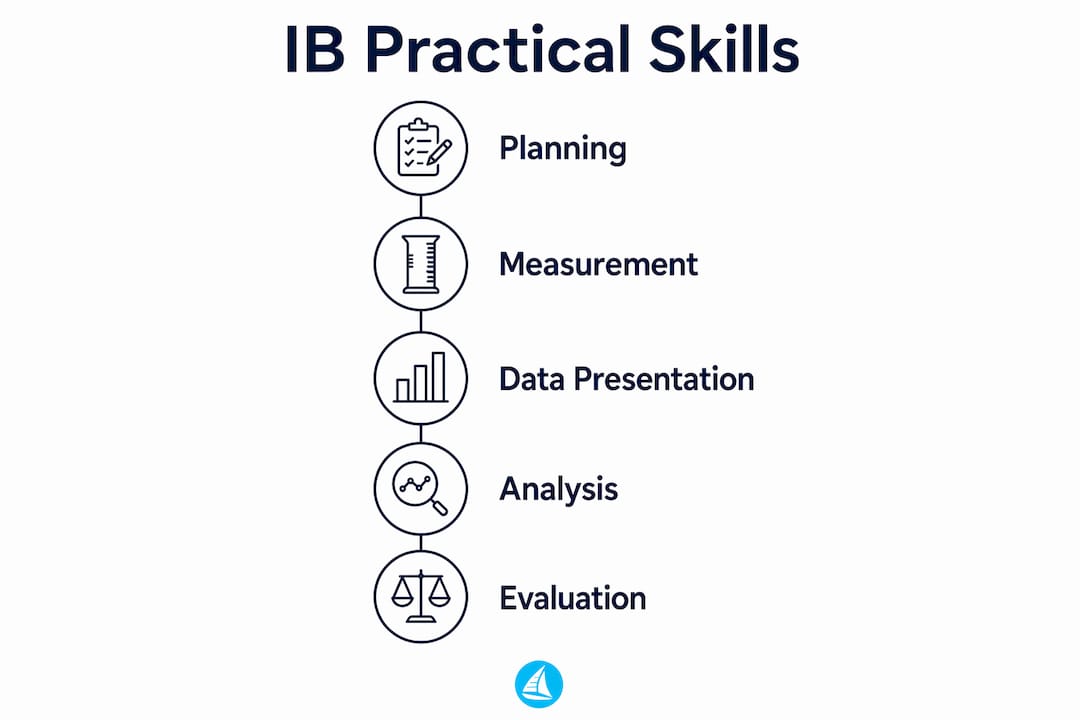
Biology practical questions are structured prompts designed to assess students’ laboratory skills and scientific reasoning across four key skill strands: Planning, Manipulation/Measurement/Observation (MMO), Data Presentation/Organisation (PDO), and Analysis/Conclusions/Evaluation (ACE). For IB Biology students, these questions appear in internal assessments and practical papers, testing everything from microscope technique to enzyme assay interpretation. Mastering each strand builds the confidence you need to perform well under exam conditions. This guide walks you through every strand with concrete examples, common pitfalls, and expert tips drawn from real assessment criteria.
What are biology practical questions and how are they assessed?
Biology practical questions are exam and assessment prompts that test your ability to design, conduct, record, and evaluate biological experiments. Skill strands like Planning and ACE guide both question construction and mark allocation, giving examiners a clear framework and giving you a clear revision target.
Planning accounts for 15% of practical paper marks, with the remaining marks split across MMO, PDO, and ACE. That distribution tells you something important: data collection alone will not secure a top grade. You must also demonstrate reasoning, presentation, and evaluation skills.

Common practical formats include osmosis investigations using potato cylinders, photosynthesis rate experiments using aquatic plants, food tests with iodine and Benedict’s solution, and enzyme assays measuring reaction rates. IB internal assessments, as defined by the IB Organisation, require students to design and carry out their own investigations, making strong practical reasoning non-negotiable.
How to plan a biology experiment that meets IB criteria
Strong planning starts with three clearly defined variables. Your independent variable is what you deliberately change, your dependent variable is what you measure, and your controlled variables are everything you keep constant. Vague definitions such as “temperature will be controlled” fail to satisfy examiners. Write instead: “Water bath maintained at 25°C ± 0.5°C throughout all trials.”
A testable hypothesis follows the format: “If [independent variable] increases, then [dependent variable] will increase/decrease, because [biological reasoning].” Linking your prediction to a named biological mechanism, such as enzyme active site saturation or osmotic potential, shows the examiner you understand the science behind the procedure.
Your method must be feasible within a standard school laboratory. Microscale titration practicals, for example, assess safe technique, endpoint observation with a starch indicator, and the ability to plan follow-up experiments. Outline your steps in numbered order, specify quantities and apparatus, and include at least one safety consideration tied to a specific reagent or piece of equipment.
Common planning pitfalls to avoid:
- Listing controlled variables without stating how you will control them
- Writing a hypothesis with no biological justification
- Omitting a negative control or a blank reference
- Failing to state the number of repeats or the time window for measurements
- Identifying hazards without proposing realistic mitigation steps
Pro Tip: Identify hazards that are specific to your experiment. “Iodine solution is an irritant; wear gloves and safety goggles” scores higher than a generic “be careful with chemicals.”
Techniques for accurate measurement and observation in biology labs
Accurate measurement is the foundation of valid data. For microscopy, always record the magnification used and produce sharp, labelled biological drawings with a scale bar. A drawing of an onion epidermal cell, for instance, should show a clear cell wall, nucleus, and vacuole without shading or artistic interpretation.
Standardised procedures matter for common biology lab questions involving food tests, osmosis, and enzyme assays. Follow these steps for reliable results:
- Prepare all solutions at the same concentration and volume before starting trials.
- Use a water bath rather than a Bunsen burner to maintain consistent temperature.
- Measure time intervals with a stopwatch and record readings immediately.
- Repeat each trial at least three times and calculate a mean.
- Record all raw data in a table during the experiment, not from memory afterwards.
Proxy measurements are accepted in IB assessments when you document your assumptions. Counting oxygen bubbles per minute is a valid proxy for photosynthesis rate, provided you state that bubble size is assumed to be constant and specify the time window. Similarly, percentage mass change is the accepted proxy for water uptake in osmosis experiments.
Pro Tip: Repeat each measurement at least three times and discard obvious anomalies before calculating your mean. This reduces random error and demonstrates methodological awareness to the examiner.
| Measurement type | Proxy used | Key assumption to state |
|---|---|---|
| Photosynthesis rate | Oxygen bubbles per minute | Bubble volume is constant |
| Osmosis | Percentage mass change | Initial mass is accurately recorded |
| Enzyme activity | Colour change time (colorimetry) | Substrate concentration is constant |
How to present and analyse data from biology experiments
Data presentation begins with your table. Every table needs a title, column headers with units in brackets, consistent decimal places, and no units repeated in the data cells. A table recording enzyme activity, for example, should show “Time (s)” and “Absorbance (AU)” as headers, not “time in seconds” scattered across the cells.
Graphs must match your data type. Plot a line graph for continuous data such as rate against substrate concentration, and a bar chart for categoric data such as enzyme activity across different pH values. Draw a line or curve of best fit rather than connecting points dot to dot. Label both axes with units and give the graph a descriptive title.
| Presentation element | Common mistake | Correct approach |
|---|---|---|
| Table headers | No units included | Include units in brackets, e.g., “Volume (cm³)” |
| Graph type | Bar chart for continuous data | Use a line graph for continuous independent variables |
| Line of best fit | Connecting every data point | Draw a smooth curve or straight line through the trend |
| Evaluation | “Human error caused inaccuracy” | Name the specific error and propose a concrete fix |
Analysis requires you to link your data to your hypothesis. State the trend clearly, quote specific values from your graph, and then explain the trend using a named biological concept. “As substrate concentration increased from 0 to 40 mmol/dm³, the rate of reaction increased, consistent with more enzyme-substrate complexes forming before active site saturation.”
High-scoring IB IA evaluations replace vague error claims with specific, plausible improvements. Instead of “human error affected results,” write: “Replacing the plastic syringe with a calibrated micropipette would reduce the volume measurement error from ±0.5 cm³ to ±0.01 cm³.” That level of specificity demonstrates genuine insight into your methodology.
Pro Tip: When proposing improvements, tie each one to a specific source of error you identified in your data. Examiners reward students who show they understand why an error occurred, not just that it did.
Common post-experiment biology practical questions and how to answer them
Post-experiment questions are where many students lose marks. You may have collected excellent data but still struggle to explain reagent roles or interpret unexpected results. Structured post-lab reasoning/14%3A_Oxygen_Requirements-_FTM_and_the_Anaerobe_Jar/14.05%3A_Post-lab_Questions) helps close this gap by targeting the specific biological logic behind your procedure.
Examiners test the reasoning behind results/14%3A_Oxygen_Requirements-_FTM_and_the_Anaerobe_Jar/14.05%3A_Post-lab_Questions), not just data collection. A question such as “Why did the anaerobic bacteria fail to grow on the aerobic plate?” requires you to explain that obligate anaerobes lack the enzymes, such as catalase and superoxide dismutase, needed to neutralise toxic reactive oxygen species. A generic answer about “wrong conditions” will not score.
Typical post-lab questions and effective response strategies:
- Reagent function: “What is the role of resazurin in microbial growth media?” Answer by naming the mechanism: resazurin is a redox indicator that changes from blue to pink to colourless as bacteria reduce it during metabolic activity, confirming viable growth.
- Failed condition: “Why did your enzyme show no activity at pH 2?” Link to protein structure: extreme acidity denatures the enzyme by disrupting ionic bonds and hydrogen bonds in the active site, preventing substrate binding.
- Follow-up experiment: “How would you modify this investigation to test a wider pH range?” Propose a specific change: extend the pH range from 2–12 using a buffer series at 1-unit intervals, keeping all other variables constant.
- Assay-specific requirements: State organism or substrate requirements clearly, such as the need for a cofactor like magnesium ions in certain enzyme assays.
Understanding the IB science mark scheme helps you frame post-lab answers in the language examiners reward.
Key takeaways
Strong biology practical skills require consistent practice across all four assessed strands, from planning through to evaluation.
| Point | Details |
|---|---|
| Know your skill strands | Planning, MMO, PDO, and ACE each carry marks; neglecting any one strand costs you. |
| Define variables precisely | State how each controlled variable is maintained, not just that it will be controlled. |
| Use specific evaluations | Name the error source and propose a concrete improvement with measurable impact. |
| Practise post-lab reasoning | Tie answers to named biological mechanisms, not generic statements about conditions. |
| Match graph type to data | Use line graphs for continuous data and bar charts for categoric data, always with units. |
What I have learned from years of IB biology practical teaching
The students who score highest in practical assessments are rarely the ones with the neatest lab technique. They are the ones who understand why each step exists. I have seen students produce beautiful osmosis data and then write “the results support my hypothesis” with no reference to water potential or osmotic gradient. That single gap costs them marks in ACE that their MMO performance fully deserved.
My honest advice is to treat every experiment as a two-part task. The first part is the practical work itself. The second part is the reasoning audit: can you explain every reagent, every control, and every anomaly in biological terms? If you practise that habit consistently, post-lab questions stop feeling like a surprise and start feeling like an opportunity.
The IB internal assessment types reward students who show curiosity about their own data. Ask yourself what your results actually mean for the organism or process you studied. That curiosity is what separates a grade 5 from a grade 7.
— Oliver
How Tibertutor supports your biology practical preparation
Tibertutor gives IB Biology students access to a structured question bank built around the exact skill strands assessed in practical papers and internal assessments.
Every question on Tibertutor’s IB science platform is written by experienced examiners and paired with detailed mark scheme explanations, so you understand not just the correct answer but the reasoning behind it. The platform’s progress tracking identifies which skill strands need the most attention, letting you focus your revision where it counts. Whether you are preparing for your internal assessment or a practical paper, Tibertutor’s student resources give you the structured, exam-focused practice that builds real confidence.
FAQ
What skill strands do biology practical questions assess?
Biology practical questions assess four strands: Planning, Manipulation/Measurement/Observation, Data Presentation/Organisation, and Analysis/Conclusions/Evaluation. Each strand carries a defined proportion of the available marks.
How should I write a hypothesis for a biology practical?
State the expected relationship between your independent and dependent variables, then justify it with a named biological mechanism. A hypothesis without biological reasoning will not score full marks.
What makes a good evaluation in a biology practical report?
A strong evaluation names a specific source of error, explains how it affected your data, and proposes a concrete improvement with a measurable impact. Vague references to human error reduce your score significantly.
How do I answer post-lab questions about reagent functions?
Name the reagent, describe its chemical behaviour in the assay, and link it to the biological process being measured. For example, resazurin acts as a redox indicator that confirms microbial metabolic activity through colour change.
Where can I find IB biology practical exam questions to practise?
The IB question bank guide on Tibertutor explains how to access curated practical-style questions aligned to current IB Biology syllabi.