IB Physics Topic 3 Notes
This page contains our IB Physics notes for topic 3. By reading each one of these notes, you will fully cover the content for IB Physics 'Wave Behaviour'.
Chapters
Properties of oscillations
A core concept in IB physics is that of oscillations: which are the continual movement of an object around a fixed point, called its equilibrium position. You are expected to know five more properties of oscillations: displacement, amplitude, wavelength, period, and frequency.
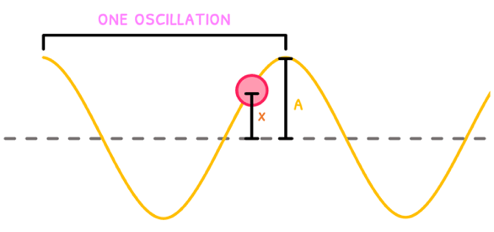
- The displacement of the object (x) is the distance of the particle from its equilibrium position, measured in meters
- The amplitude of the oscillation (a) is the maximum or minimum displacement of the particle, also measured in meters
- The length of one oscillation is visible from crest to crest, or trough to trough, and can be defined by three terms: wavelength, period, frequency, and angular frequency:
- Wavelength (λ) is defined as the length of one oscillation, measured in meters
- Period (T) is defined as the time it takes to complete one oscillation, measured in seconds
- Frequency (f) is defined as the number of oscillations that occur in one second, measured in Hertz (Hz)
- Angular frequency (ω) is defined as the angular displacement of an oscillation in one second, measured in radians per second
Since angulary frequency, frequency, and period both measure oscillations in terms of time, they are related. The formula for this is:
Now that you know the properties of oscillations, we can discuss the two different types:
- Periodic - waves with a constant frequency and period.
- Aperiodic - waves with multiple frequencies or periods.
tibertutor.com
Next Up
You have completed the topic 3 notes for IB Physics - continue with related resources below or explore the full IB Physics course from the IBO.
Other topic 3 resources