IB Physics C4 Notes
This page contains our IB Physics notes for C4. By reading each one of these notes, you will fully cover the content for IB Physics 'Standing waves & resonance'.
Chapters
Standing wave
Now that you understand the properties and phenomena of waves, it is important to learn about a second type of wave: the standing wave.
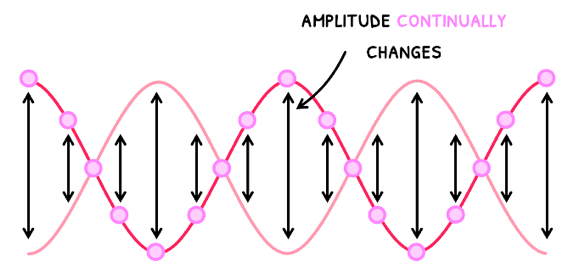
Standing waves are waves whose particles travel in a constant spatial pattern whilst their amplitude continually changes.
The reason it comes at the end of this topic is because you need to know about reflection before covering standing waves.
Standing wave are formed when two waves of the same amplitude and frequency move in opposite directions. This typically happens when an emitted wave reflects and meets itself again.
A common scenario where this occurs is during plucking of strings in an instrument. Because the strings are fixed at both ends, they vibrate as a wave in a cyclical pattern with a particular frequency. This means they exhibit simple harmonic motion.
tibertutor.com
Next Up
You have completed the sub-topic C4 notes, covering "Standing waves & resonance" for IB Physics - continue with related resources below or explore the full IB Physics course from the IBO.
Other Sub-topic C4 resources