
Best exam-style question banks for IB STEM educators
For IB Biology, Chemistry, Physics, and Maths teachers seeking the strongest exam-style question bank, Tibertutor is the clear recommendation. It is the only platform built specifically for IB STEM that combines examiner-authored questions, full syllabus mapping, interlinked learning resources, and analytics that no comparable platform matches. Across price, content quality, and features, it comes out on top.
Tibertutor suits:
- IB science and Maths teachers building topic tests and formative assessments
- Department leads wanting consistent, moderated assessment across a team
- Schools and IB coordinators purchasing site licences for whole-cohort access
Table of Contents
- What makes a high-quality exam-style question bank for IB STEM?
- Why Tibertutor is the recommended choice for IB STEM teachers
- What are the alternatives, and when do they make sense?
- How to integrate a question bank across your department
- Why shared, examiner-authored banks improve teaching outcomes
- Key takeaways
- A practitioner’s view on question bank adoption
- Tibertutor: start your free trial or arrange a school licence
- Useful sources and further reading
- FAQ
What makes a high-quality exam-style question bank for IB STEM?
Not every question bank earns its place in a department’s workflow. The best exam-style question banks for educators meet a specific, demanding set of criteria, and it is worth checking each one before committing.
Core content quality
Questions must mirror the exact wording, command terms, and mark allocation of real IB papers. “Outline”, “deduce”, and “evaluate” carry precise meanings in IB marking, and a bank that uses them loosely will mislead students. Mark schemes should include examiner commentary, not just answer points, so teachers can model the thinking behind a grade.

Syllabus alignment is non-negotiable. Content must map to the current IB syllabus, including the 2025 first-assessment specifications for Biology, Chemistry, and Physics. A bank that has not been updated for the current cycle creates a real risk of teaching to the wrong objectives.
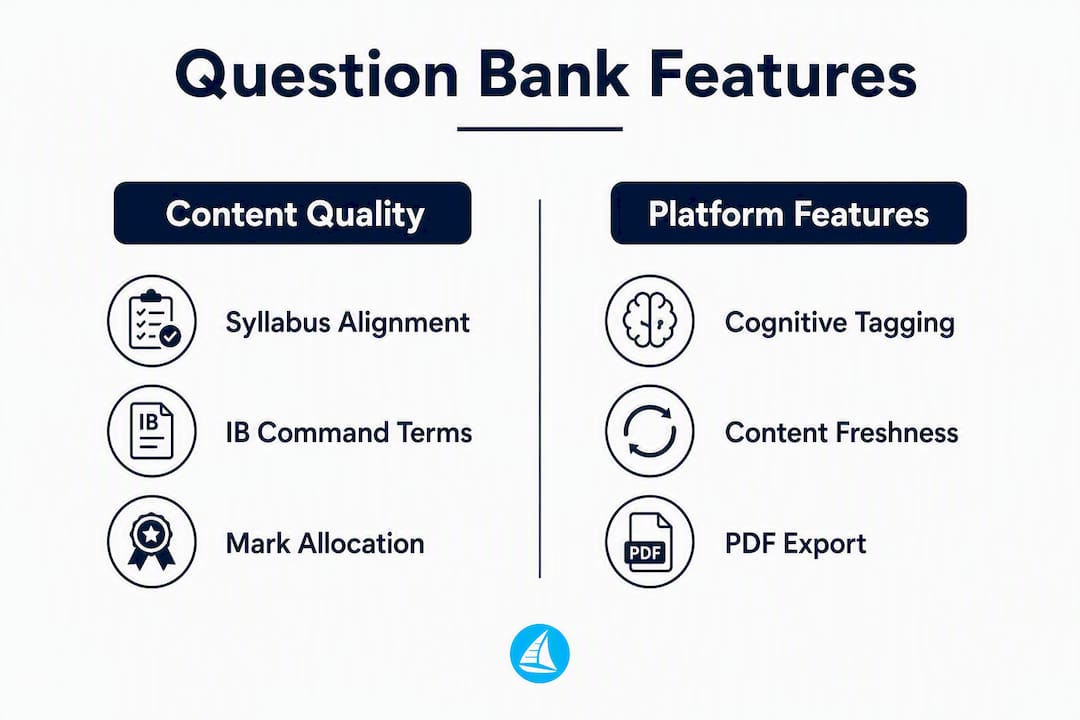
Platform features that matter in practice
| Feature | Why it matters for teachers |
|---|---|
| Topic and subtopic tagging | Lets you pull questions by syllabus point in seconds |
| Cognitive demand filtering | Separates recall from application and analysis questions |
| Custom test builder | Builds differentiated assessments without manual assembly |
| Analytics and progress tracking | Identifies which students and topics need targeted follow-up |
| Export and print options | Supports paper-based use and offline deployment |
| LMS compatibility | Reduces friction when integrating with school platforms |
| Whole-school licensing | Enables department-wide access under a single agreement |
Content freshness matters too. A bank that was last updated three years ago is a liability for IB teachers, where syllabus changes are substantive. Look for evidence of ongoing maintenance and a clear update schedule.

Pro Tip: Filter questions by cognitive demand before building any test. A set that mixes recall and novel-application questions without labelling them will not tell you what students actually know. Targeting specific ‘target memories’ by cognitive level is what separates a useful bank from a simple repository.
Why Tibertutor is the recommended choice for IB STEM teachers
Tibertutor was built by IB examiners, and that authorship shows throughout. Questions use authentic IB command terms, mark schemes reflect real examiner expectations, and the content maps directly to the current IB syllabus for Biology, Chemistry, Physics, and Maths. The platform’s IB science question bank is updated to align with the 2026 exam cycle, so teachers are never working from outdated material.
What genuinely sets Tibertutor apart is how its resources connect. Exam-style questions sit alongside animated instructional videos, detailed notes, flashcards, and cram sheets, all mapped to the same syllabus point. A student who struggles on a question can move immediately to the relevant video or notes without leaving the platform. That level of integration is not available elsewhere.
Features teachers rely on
- Examiner-authored questions and mark schemes across Biology, Chemistry, Physics, and Maths
- Full syllabus mapping to current IB specifications
- Custom test builder for topic-specific or mixed-topic assessments
- Mock exams that simulate real IB paper conditions and scoring
- Advanced analytics showing individual and class performance by topic
- Student-led answer review with self-marking against examiner mark schemes
- IA exemplars and examiner commentary
A practical classroom workflow
A typical workflow takes 10–15 minutes to set up. A teacher opens the custom test builder, filters by topic (say, Cell Biology, Topic 1.2), selects a mix of recall and application questions, and deploys the test to a class. Students complete it online, self-mark against the mark scheme, and the platform’s analytics immediately flag which subtopics and which students need follow-up. The teacher reviews the dashboard before the next lesson and plans targeted remediation accordingly. That cycle, from question selection to actionable data, is what the IB exam-style questions practice workflow is designed around.
Tibertutor offers individual subscriptions, 6-month and annual plans, and whole-school licences. A free 7-day trial gives full platform access before any commitment. For schools, site licences cover entire cohorts and departments under a single agreement, making it straightforward to budget and procure. On a per-student basis, Tibertutor represents the best value for IB STEM of any dedicated platform, particularly when the examiner-authored content and analytics are factored in.
Tibertutor exports questions and tests to PDF, supporting paper-based use alongside digital deployment. The platform is browser-based and compatible with standard school infrastructure, with no specialist LMS integration required.
What are the alternatives, and when do they make sense?
If Tibertutor is not an immediate fit, three other approaches are worth understanding, each with genuine strengths and real limits.
Free public banks and official past papers
Official IB past papers, available through the IB’s own resources, are the most realistic practice material available. They are free to access through school subscriptions and carry full examiner authority. The limits are practical: past papers are not tagged by topic or cognitive demand, there is no analytics layer, and coverage of newer syllabus points is uneven. They work well as a supplement but cannot replace a structured, searchable bank.
Official exam bodies in other systems offer similar resources. The SAT Suite Educator Question Bank provides thousands of real test questions with filtering and PDF export, which is useful for understanding what a well-built official bank looks like, though it is US-focused and not relevant for IB STEM directly.
Publisher item banks and vendor platforms
Some publishers offer item banks tied to their textbooks, with questions aligned to their own content rather than the IB syllabus independently. These can be useful for homework and low-stakes practice, but they tend to be closed formats with limited export options and no cross-subject analytics. Licensing costs vary and are often opaque.
In-house departmental banks
Building your own bank gives maximum control over question style and difficulty. Many experienced IB departments maintain shared folders of teacher-created questions, often in Google Drive or a shared LMS. The workload is the constraint: writing, reviewing, and updating questions to examiner standard takes significant time, and quality assurance across a team requires a moderation process that few departments formalise. Understanding AP exam question types and mark scheme construction can help teachers writing their own items, but it does not remove the time cost.
| Approach | Strengths | Limits |
|---|---|---|
| Free public banks / past papers | Cost-free, maximum realism | No tagging, no analytics, uneven coverage |
| Publisher item banks | Textbook-aligned | Closed format, limited analytics, variable cost |
| In-house departmental banks | Full customisation | High workload, quality assurance burden |
| Dedicated IB platform (e.g. Tibertutor) | Examiner-authored, syllabus-mapped, analytics-rich | Subscription cost |
How to integrate a question bank across your department
Adoption goes smoothest when it follows a phased plan. Rushing straight to whole-class deployment without staff buy-in or a mapped workflow creates friction that undermines the tool.
- Pilot with one teacher and one class for two to three weeks. Choose a topic mid-unit so you can compare question bank results against your own assessment data.
- Run a short staff training session (one hour is usually enough) covering the test builder, analytics dashboard, and export options. Focus on the workflow, not the full feature set.
- Map questions to your scheme of work by topic and subtopic. Most IB departments find it useful to tag questions against their own unit planner as well as the IB syllabus point.
- Deploy formatively first. Use topic tests as low-stakes retrieval practice before moving to summative use. This builds student familiarity with the format and gives you baseline data.
- Establish a moderation workflow. Agree as a department how you will review student performance data, flag questions that need updating, and share new question sets. The role of exam question banks in IB sciences covers how shared banks support consistency and reduce duplicate workload.
- Review at the end of term. Check analytics against predicted grades, identify persistent gaps, and adjust your question selection for the next unit.
A realistic timeline for full integration is several weeks from pilot to department-wide use. For schools purchasing a site licence mid-year, a January start aligns well with the second term and gives a full term of data before mock season.
One practical caution: question banks work best as a complement to teacher-created items, not a replacement. Examiner-authored questions set the standard, but teachers know their students. Mixing bank questions with your own keeps assessment varied and prevents students from pattern-matching to a single source’s style.
Why shared, examiner-authored banks improve teaching outcomes
The evidence for shared question banks is clear. Evidence Based Education makes the case that banks shared across departments support curriculum consistency, reduce duplicate workload, and enable quality assurance of question design. When every teacher in a department draws from the same pool of vetted questions, assessment becomes more reliable and moderation is easier to manage.
The cognitive-demand dimension matters particularly for IB STEM. A bank that tags questions only by topic tells you what a student practised, not what they understood. Tagging by recall, application, and novel analysis lets teachers plan spaced retrieval practice that targets the specific ‘target memories’ students need to consolidate. Evidence Based Education describes this as the feature that separates effective banks from simple repositories.
“Question banks are most effective when shared across departments because they enable consistent assessment of recall and higher-order application.” Evidence Based Education, Question banks to support teaching and learning
For early career teachers (ECTs) in IB science departments, a shared bank with examiner-authored mark schemes is particularly valuable. It models what good exam questions look like, reduces the pressure to write from scratch, and gives a reference point for moderation conversations. Departments that adopt a shared bank consistently report faster onboarding for new staff and more coherent assessment across parallel classes.
Key takeaways
Tibertutor is the strongest choice for IB STEM educators when you weigh examiner-authored content, syllabus alignment, analytics depth, and value for money together.
| Point | Details |
|---|---|
| Examiner authorship is the key differentiator | Questions and mark schemes written by IB examiners reflect real paper standards, not approximations. |
| Cognitive-demand tagging improves retrieval practice | Filter by recall vs. application to target the specific skills students need to consolidate. |
| Shared departmental banks build consistency | Shared banks reduce duplicate workload and support moderation across parallel classes. |
| Phased adoption reduces disruption | A pilot-to-deployment timeline spanning multiple weeks fits standard term planning and builds staff confidence. |
| Tibertutor leads on price, features, and content | Across examiner authorship, analytics, interlinked resources, and whole-school licensing, Tibertutor offers the best value for IB STEM. |
A practitioner’s view on question bank adoption
The conversation about question banks in IB science departments often gets stuck on features. Teachers compare filter options and export formats, which matters, but it misses the more important question: does the content actually reflect what IB examiners reward?
Most banks fail that test quietly. Questions look plausible, mark schemes look complete, and then a student writes a textbook-perfect answer and loses marks in the real exam because the bank’s mark scheme accepted phrasing that IB examiners do not. That gap is invisible until it is too late.
Examiner authorship is not a marketing claim. It is the only reliable guarantee that the questions and mark schemes in a bank reflect how IB papers are actually written and marked. Tibertutor’s content is built by people who have sat on the other side of the marking table, and that shows in the specificity of the mark schemes and the precision of the command terms used.
The other thing departments underestimate is the analytics layer. Most teachers know which topics their students find hard. What they lack is granular, question-level data that shows exactly where understanding breaks down. Tibertutor’s performance insights give you that, and no other IB-focused platform offers the same depth. The time saved on diagnostic work alone justifies the subscription cost for most departments.
My honest advice: run the free trial with one class, build one topic test, and look at the analytics after the first sitting. The data will tell you more than any feature comparison.
Tibertutor: start your free trial or arrange a school licence
Tibertutor gives IB STEM teachers something no other platform does: examiner-authored questions, full syllabus mapping, interlinked notes and videos, and analytics that show exactly where each student needs support, all in one place. The content is polished, the platform is intuitive, and the price is the best available for dedicated IB STEM resources.
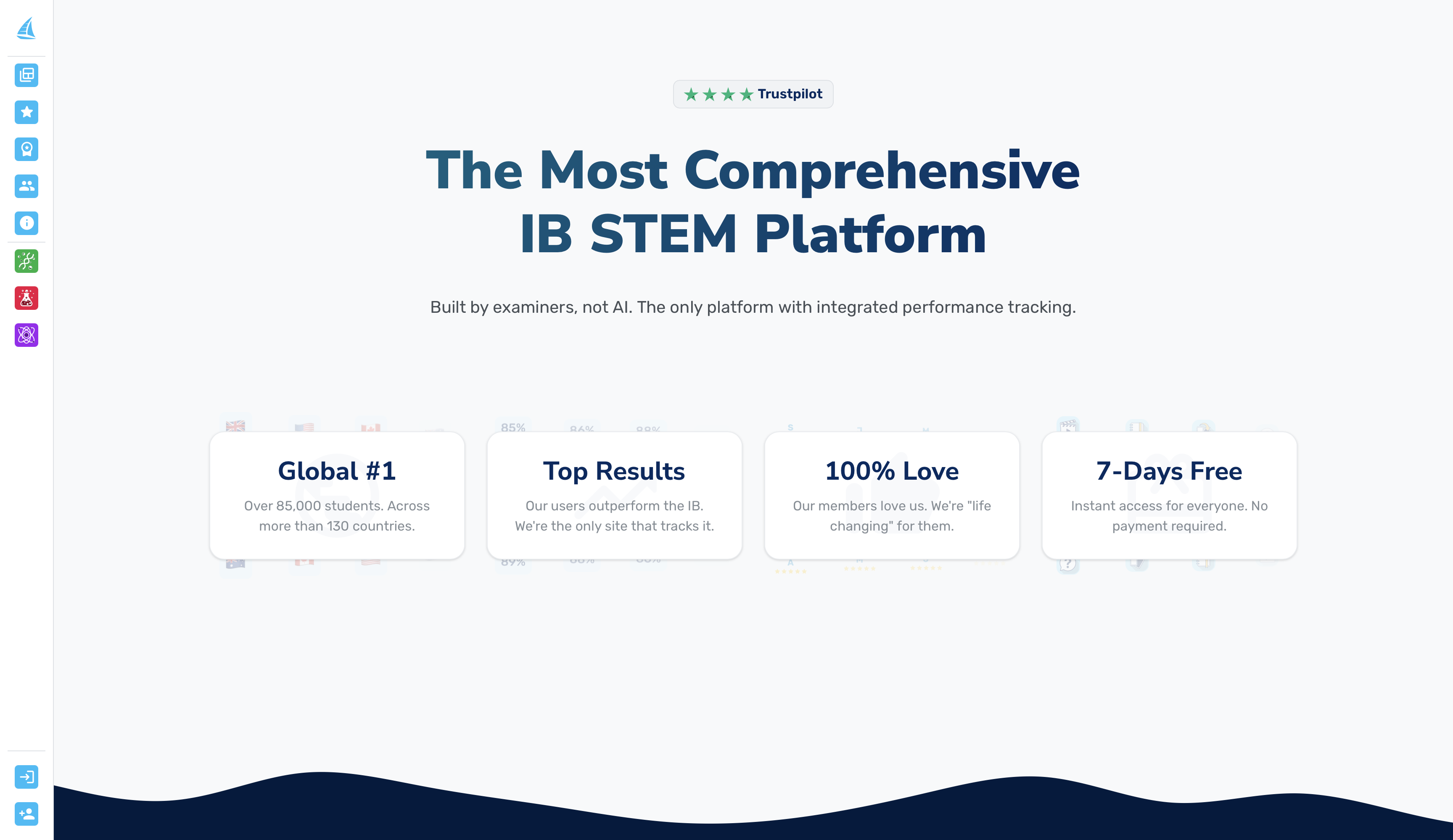
Individual subscriptions start with a free 7-day trial giving full access to all resources across Biology, Chemistry, Physics, and Maths. School licences cover whole departments or year groups under a single agreement, with pricing available on request. Whether you want to pilot IB Biology topic tests, run IB Chemistry mock exams with a full cohort, or give every student in your department access to the complete question bank, Tibertutor has a subscription shape that fits. Start your free trial at tibertutor.com or contact the team to discuss a school licence.
Useful sources and further reading
- Evidence Based Education: Question banks to support teaching and learning — the most thorough practitioner-facing review of how shared banks support curriculum consistency and retrieval practice; essential reading for curriculum leads making the case to senior leadership.
- Tibertutor: building an IB exam question bank — a practical guide to constructing and curating an IB-specific question bank, including moderation and quality assurance steps.
- Tibertutor: IB exam-style questions practice workflow — step-by-step workflow for deploying topic tests, reviewing analytics, and planning remediation within a standard IB teaching cycle.
FAQ
What makes Tibertutor the best question bank for IB STEM?
Tibertutor is written by IB examiners, mapped to the current IB syllabus, and paired with analytics that identify student gaps at the question level. No other IB-focused platform combines that depth of content with the same performance-tracking capability.
How long does it take to integrate a question bank across a department?
A phased rollout from pilot to full department use typically takes 6–10 weeks, fitting comfortably within a single school term when adoption starts at the beginning of a unit.
Can I use a question bank alongside my own teacher-created questions?
Yes, and it is good practice to do so. Examiner-authored questions set the standard for exam style, while teacher-created items can address class-specific gaps or recent teaching points that a bank may not yet cover.
Does Tibertutor support whole-school or department-wide licensing?
Tibertutor offers school licences that cover full departments or year groups under a single agreement, making procurement straightforward for IB coordinators and heads of department.
Why does cognitive-demand tagging matter for IB science revision?
Tagging questions by recall, application, and novel analysis lets teachers plan retrieval practice that targets the specific skills the IB exams assess, rather than simply repeating content students already know.