
Building an IB exam question bank: your complete guide
An IB exam question bank is an organised collection of syllabus-aligned questions tagged by topic, difficulty, and command term, designed to support targeted retrieval practice throughout the IB Diploma Programme. Done well, it becomes one of the most powerful revision tools you have. Done poorly, it becomes an unmanageable pile of questions that wastes time and builds false confidence. This guide covers everything you need to know about creating an exam question bank that actually works, from the tools you need at the start to the habits that keep it useful right through to exam season.
What do you need before building an IB exam question bank?
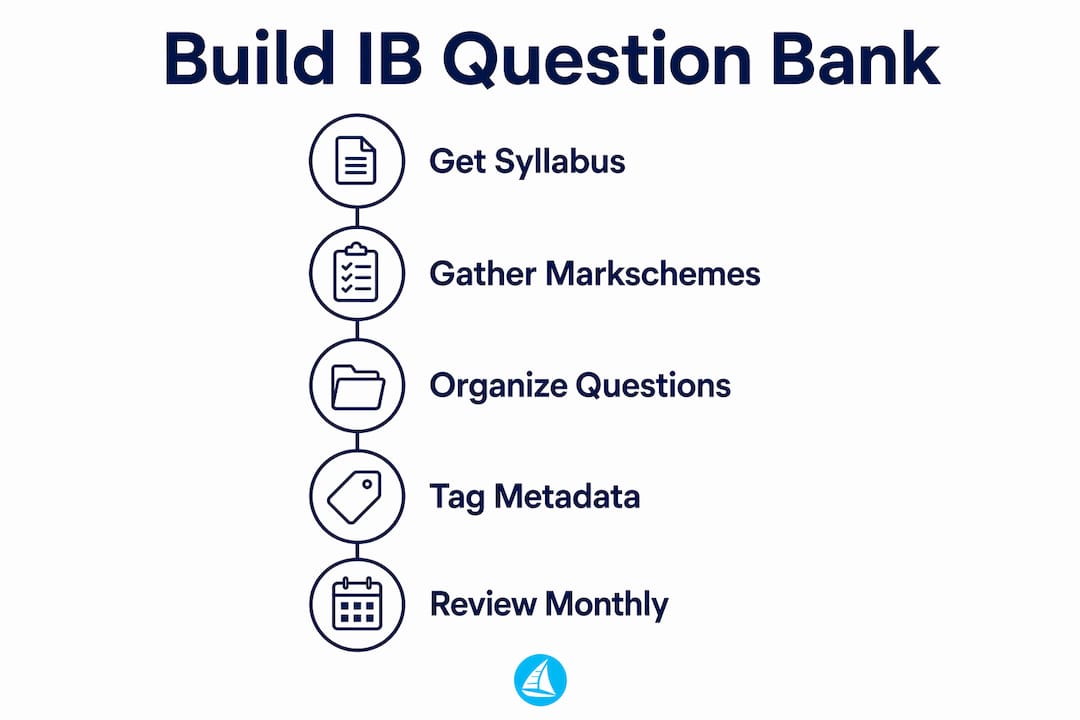
The foundation of any effective question bank is the IB syllabus document for your subject. Before you add a single question, download the official syllabus and identify every topic, subtopic, and learning outcome. This gives you the skeleton your bank will hang on. Without it, you risk collecting questions that feel relevant but do not map to what the examiner actually tests.
You also need access to official IB markschemes. Markscheme pairing with every question is not optional. The markscheme tells you exactly what the examiner expects, and that information is more valuable than the question itself. Store both together from day one.

For organising your bank, you have several options. A well-structured spreadsheet works for many students. Learning management system (LMS) platforms offer more advanced filtering. Most LMS platforms support bulk import via CSV or QTI format, which saves time if you are migrating existing questions. Note-taking apps that allow tagging, such as Notion or Obsidian, also work well for linking questions to your study notes.
| Resource | Function | Benefit |
|---|---|---|
| IB syllabus document | Maps all topics and learning outcomes | Ensures every question is syllabus-relevant |
| Official markschemes | Defines examiner expectations per question | Builds accurate exam technique |
| Spreadsheet or LMS | Organises and filters questions by metadata | Enables fast retrieval and mock exam creation |
| Note-taking app | Links questions to study notes | Deepens understanding of each topic |
| Past exam papers | Source of authentic exam-style questions | Reflects real assessment conditions |
How do you structure and populate your question bank?
Categorisation by topic, difficulty, and learning outcome is mandatory from the moment you add your first question. A bank without structure becomes unusable within weeks. Follow these steps to build yours correctly from the start.
-
Break the syllabus into topics and subtopics. Use the official IB syllabus document as your guide. Create a separate category for each topic, such as Cell Biology or Organic Chemistry, and list the subtopics beneath each one.
-
Tag every question with metadata. Each question needs four tags: topic, difficulty level (beginner, intermediate, or advanced), command term, and typical mark value. Metadata tags for these four fields let you filter questions quickly and build targeted mock exams later.
-
Pair each question with its markscheme. Add the official markscheme answer directly below or alongside the question. Write a brief note in plain language explaining what the examiner is looking for. This “markscheme translation” step is where real exam technique improvement happens.
-
Add a model answer or annotated response. A concise model answer written in your own words confirms you understand the question, not just the marks. It also gives you a reference point when you return to the question weeks later.
-
Add questions progressively, not all at once. Resist the urge to bulk-collect questions before you have studied the topic. Questions added just-in-time as syllabus gaps emerge during revision keep the bank lean and purposeful.
-
Keep question wording consistent. Uniform language and format across all questions reduces confusion and makes the bank feel professional. Decide on a format and stick to it.
Pro Tip: Only add questions that trace directly to a named learning outcome in the IB syllabus. If you cannot link a question to a specific outcome, leave it out. This single rule keeps your bank focused and prevents it from growing into something unmanageable.
How should you use your question bank for IB exam preparation?
A question bank is a retrieval practice tool, not a learning resource. Question banks work best when you use them after building your notes on a topic, not before. The correct sequence is: study the content, build your notes, then test yourself with the bank. Using questions to learn new material for the first time is an inefficient approach that most students regret.
The right workflow looks like this. Attempt a question under timed, exam-style conditions. Then compare your answer to the markscheme. Write a feedback note identifying exactly where you lost marks and why. This feedback loop is what separates students who improve from those who simply practise without progress. Pair your practice sessions with an IB exam-style workflow to get the most from each attempt.
Common mistakes to avoid:
- Attempting questions without first studying the topic thoroughly
- Skipping the markscheme comparison after each attempt
- Ignoring command terms when reading questions
- Practising only topics you already find easy
- Adding questions to the bank without tagging them immediately
Mastering IB command terms like “evaluate,” “deduce,” and “outline” is one of the highest-return revision activities available to you. Students who misread command terms lose marks not because they lack knowledge, but because they answer the wrong question. Tag every question in your bank by command term so you can practise the ones you find most challenging. You can also explore IB Biology exam strategies for subject-specific guidance on targeting your weakest areas.
Pro Tip: Filter your bank by assessment objective and command term before each revision session. If you consistently struggle with “evaluate” questions in Cell Biology, target that combination specifically rather than working through the bank at random.
How do you maintain your question bank over the Diploma Programme?
A question bank that is not maintained becomes a liability. The most common problem is collection fatigue, where the bank grows so large that students stop using it. Building incrementally by adding questions only when a specific syllabus gap appears is the most reliable way to prevent this.
Set a monthly review. Check that every question still maps to the current syllabus. The IB updates subject guides periodically, and questions written for an older syllabus can mislead you. Remove or update any question that no longer reflects current assessment guidance. This is especially relevant for IB sciences, where syllabus updates can shift the emphasis of entire topics. For a broader view of how question banks fit into teaching IB sciences, the role of exam question banks is worth reading.
| Common pitfall | Solution |
|---|---|
| Bank grows too large to use | Add questions just-in-time, not in bulk |
| Missing or inconsistent tags | Tag every question immediately on entry |
| Outdated questions from old syllabi | Review and cull monthly against current syllabus |
| Markschemes stored separately | Keep markscheme and question in the same entry |
| No link to study notes | Cross-reference each question to the relevant notes section |
Key takeaways
A well-structured IB question bank, built with consistent metadata tagging and markscheme pairing, is the most reliable revision tool for targeted IB exam preparation.
| Point | Details |
|---|---|
| Structure from day one | Tag every question by topic, difficulty, command term, and mark value immediately. |
| Pair questions with markschemes | Store the official markscheme and a plain-language translation alongside every question. |
| Use for retrieval, not learning | Attempt questions only after studying the topic through notes and other resources. |
| Add questions progressively | Build the bank just-in-time as syllabus gaps emerge to avoid collection fatigue. |
| Review and maintain regularly | Cull outdated questions monthly and check alignment with the current IB syllabus. |
What I have learned from building and using IB question banks
The single biggest mistake I see students make is treating their question bank as a collection project rather than a revision tool. They spend hours sourcing questions and almost no time actually attempting them under exam conditions. The bank becomes something to admire rather than something to use.
Tagging questions by command term changed how I thought about exam preparation entirely. Once you can filter for every “evaluate” question in Genetics, you realise very quickly which command terms you avoid and which ones you genuinely understand. That clarity is uncomfortable, but it is exactly what drives improvement.
On bank size: smaller is almost always better. A bank of 80 well-tagged, markscheme-paired questions beats a bank of 400 untagged ones every time. Quality and usability matter far more than volume.
Start early, add steadily, and use the bank every week. The students who build this habit in their first year of the Diploma Programme arrive at exam season with genuine confidence, not just familiarity with the material.
— Oliver
Tibertutor’s ready-made IB science question bank
Building your own question bank takes time and discipline. Tibertutor gives you a head start with a fully syllabus-aligned IB Science question bank, built by examiners and experienced educators.

Every question on Tibertutor comes tagged by topic and difficulty, paired with markscheme solutions, and organised for instant filtering. You can practise with IB Biology topic tests or work through IB Chemistry mock exams that replicate real exam conditions. Progress tracking shows you exactly where your gaps are, so you can target your revision with confidence. Tibertutor is used by students across dozens of countries aiming for top IB scores in Biology, Chemistry, and Physics.
FAQ
What is an IB exam question bank?
An IB exam question bank is a curated, organised collection of syllabus-aligned questions tagged by topic, difficulty, and command term, used to support targeted retrieval practice during IB Diploma Programme revision.
How many questions should an IB question bank contain?
Quality matters more than quantity. A focused bank of well-tagged, markscheme-paired questions is more useful than a large, unstructured collection. Add questions progressively as syllabus gaps emerge rather than in bulk.
What metadata should I tag each question with?
Tag each question with topic, subtopic, difficulty level, command term, and mark value. These four fields let you filter efficiently and build targeted mock exams.
When should I use my question bank during revision?
Use your question bank after studying a topic through notes and other resources. Question banks are retrieval tools, not a way to learn new content for the first time.
How do I stop my question bank from becoming unmanageable?
Add questions just-in-time as specific syllabus gaps appear, review the bank monthly against the current IB syllabus, and remove any question that no longer maps to a named learning outcome.