Eight exam-style classroom activities that actually prepare IB students
The most useful examples of IB exam-style classroom activities share one feature: they force students to work under the same conditions, command terms, and mark-scheme logic they’ll meet in the real Biology, Chemistry, Physics, or Mathematics paper. Timed past-paper drills, mini data-response stations, command-term flash rounds, structured peer marking, synoptic quizzes, and full simulated exam days all belong in a well-run IB science or maths course, not just in the final revision fortnight.
Here’s a shortlist to run this term:
- Timed past-paper extract (20 minutes) — use mid-topic to test recall under light pressure.
- Mini data-response station rotation (30 minutes) — run after a data-heavy topic like enzyme kinetics or projectile motion.
- Command-term drill (10 minutes) — weekly, to build fluency with “evaluate,” “deduce,” “outline.”
- Structured peer marking with mark schemes (25 minutes) — after any timed paper, to build examiner literacy.
- Synoptic quiz spanning two topics (15 minutes) — before end-of-unit tests.
- Full simulated exam day (2–4.5 hours) — once per term, ahead of mocks.
- Calculator familiarisation task (15 minutes) — before Maths or Physics papers with a GDC component.
- Error-log review session (10 minutes) — the lesson after any marked paper is returned.
Subject-specific templates for Biology, Chemistry, Physics, and Mathematics follow below.
Key Takeaways
Effective IB exam preparation combines timed past-paper practice, examiner-report analysis, and structured peer marking, run consistently rather than only in the weeks before mocks.
| Point | Details |
|---|---|
| Start with the shortlist | Run timed extracts, data-response stations, and command-term drills weekly, not just pre-mock. |
| Use recent papers first | Prioritise the last two to three years of papers to match current syllabus emphasis. |
| Standardise conditions | Fix room layout, permitted resources, and timing protocol every time you simulate exam pressure. |
| Follow the four-step protocol | Untimed deconstruction, targeted teaching, timed redraft, then mark-scheme comparison. |
| Use examiner-authored tools | Tiber Tutor’s topic tests, mock exams, and analytics let teachers target drills at each class’s actual error patterns. |
Table of Contents
- Examples of IB exam-style classroom activities by subject
- How do you simulate IB exam conditions in class?
- How should teachers use past papers and examiner reports?
- Which quick formative activities build exam skills fastest?
- Why recent past papers and examiner reports matter most
- What I’ve seen work in IB science classrooms
- Run these activities with examiner-authored resources
- Where to go for further guidance
- Sources
- FAQ
Examples of IB exam-style classroom activities by subject
Generic advice about “practising past papers” doesn’t help a teacher planning Tuesday’s lesson. What helps is a template with timing, materials, and a marking checklist already built in. The four templates below are designed to be lifted straight into a lesson plan, with subject labels so you can go straight to the one you need.
1. Biology: data-response station rotation
Objective: Interpret experimental data and apply command terms at the level expected in Paper 2 and Paper 3 (assessment objectives 2 and 3).
Materials: Four to five short data-response extracts (graphs, tables, or experimental descriptions), stopwatch, mark schemes for each station.
Flow: Students rotate through stations in groups of three to four, spending eight minutes per station answering two or three questions modelled on IB Biology’s data-based question style. A bell or timer signals rotation.

Sample question snippet: “Using the data in Figure 1, evaluate the claim that increasing temperature always increases enzyme activity” (4 marks).
Marking checklist: Award marks for correct data citation, comparative language, and a linked conclusion, mirroring how IB examiners weight evidence-based reasoning over vague description.
Differentiation: Give weaker groups a partially annotated graph; extend stronger groups with a “justify your confidence in this conclusion” follow-up.
2. Chemistry: practical-to-paper mini
Objective: Bridge practical work with Paper 1 and Paper 2 exam demands, reflecting how well-designed lesson resources fold IB-style exam questions and mark schemes directly into content delivery rather than treating them as an afterthought.
Materials: A short practical demonstration or simulation, followed by ten IB-style questions with mark schemes, similar in structure to the format used in a particle-nature-of-matter lesson pack.
Flow: Fifteen minutes of practical or demonstration, then a 20-minute timed written response using exam-style questions on the same content.

Sample question snippet: “Deduce the electron configuration of the ion formed and explain the trend in first ionisation energy across Period 3” (6 marks).
Marking checklist: Peer-mark against the scheme, flagging where students lost marks for missing units, incomplete explanations, or skipped working.
Differentiation: Provide a formula and command-term glossary sheet for students who need scaffolding; remove it for higher-band students.
3. Physics: modelling question clinic
Objective: Build fluency in mathematical modelling and multi-step problem-solving, core to Physics Paper 2.
Materials: Three multi-part problems of increasing difficulty, whiteboards, GDC calculators.
Flow: Students attempt Part (a) individually, compare in pairs, then attempt Part (b) and © with teacher circulating to give command-term hints rather than answers.
Sample question snippet: “A ball is launched at 30° to the horizontal. Determine the maximum height reached, stating any assumptions” (5 marks).
Marking checklist: Check working is shown at every step, units are consistent, and assumptions are explicitly stated, since examiners frequently penalise silent assumptions.
Differentiation: Extension students tackle a variant with air resistance included; others stick to the idealised model.
4. Mathematics: short-paper timed circuit
Objective: Sharpen speed and accuracy across a mixed topic set, replicating Paper 1 pacing demands.
Materials: Six short questions (five minutes each), timer, answer keys.
Flow: Students work individually against the clock, swap papers, then self-correct using a projected mark scheme.
Sample question snippet: “Solve for x: log₂(x+3) − log₂(x−1) = 2” (4 marks).
Marking checklist: Award method marks separately from accuracy marks, exactly as IB mark schemes do, so students see where technique broke down versus where arithmetic slipped.
Pro Tip: Keep a running “mark loss” tally on the board across several timed circuits. Students start correcting their own recurring errors before you even flag them.
How do you simulate IB exam conditions in class?
Simulating exam conditions well means controlling four things: the room, the resources, the clock, and the record-keeping. Push desks apart, remove revision posters from sightlines, and ban phones exactly as you would in a real session. Only allow the resources a genuine paper permits, meaning IB-approved GDC calculators for Maths and Physics, a clean periodic table for Chemistry, and no formula booklet unless the paper provides one.
Room and rules checklist:
- Desks spaced as per your school’s exam layout, not classroom groupings.
- Only permitted calculators and paper on desks; check calculator memory is cleared where required.
- Start and stop times displayed and enforced to the minute.
- Attendance and any access arrangements (extra time, reader, scribe) logged the same way as a real exam session.
Accommodating SEN needs without breaking standardisation means applying the same access arrangement every time that student sits a timed task, not improvising per lesson.
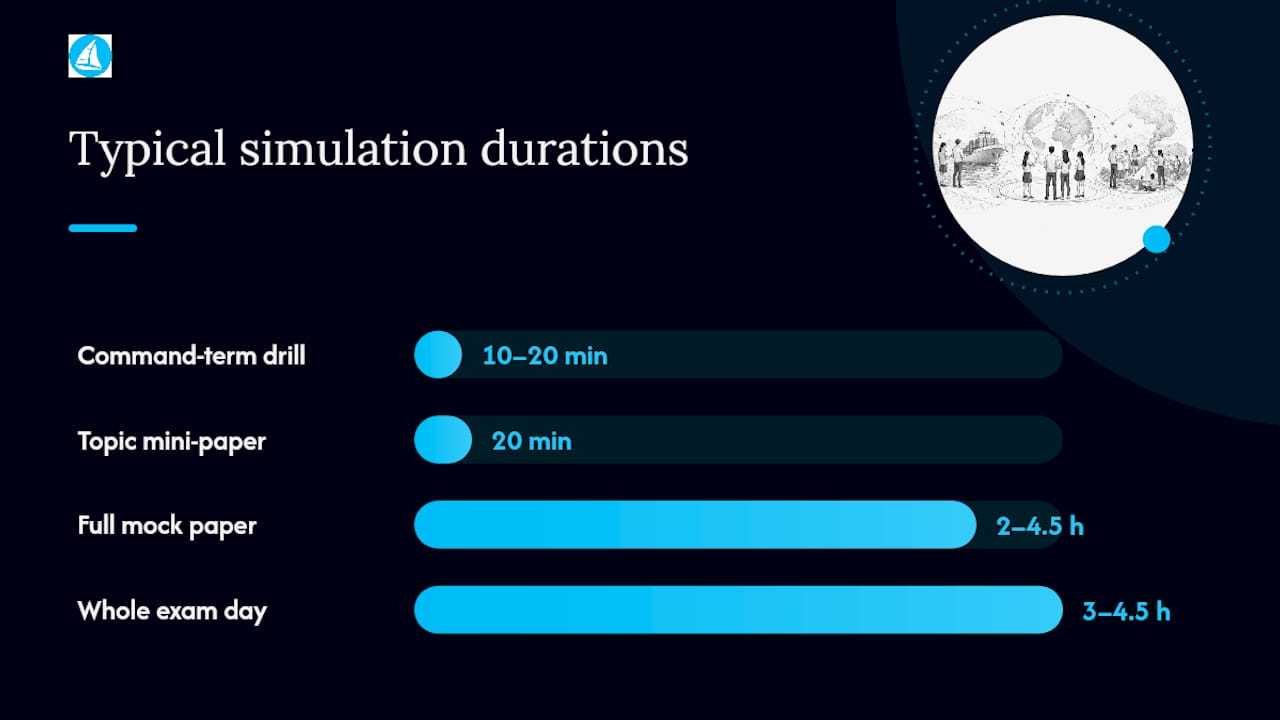
| Simulation type | Typical duration | Best use |
|---|---|---|
| Command-term drill | 10–20 minutes | Weekly skill building |
| Topic mini-paper | 20 minutes | End of topic |
| Full mock paper | 2–4.5 hours | Pre-mock or mock week |
| Whole exam day | 3–4.5 hours | Once per term |
Pro Tip: Rotate which class sits the “hard” version of a mock task first. It stops one group informally briefing another before their turn, which quietly undermines standardisation.
For fairness, use anonymised peer marking where students swap scripts with a class they don’t know, and moderate a sample of teacher-marked scripts across parallel classes each term so grading stays consistent.
How should teachers use past papers and examiner reports?
The most reliable source of exam intelligence isn’t a revision guide. It’s the official examiner reports and mark schemes published alongside past papers, which record exactly where cohorts lost marks and why. Recent papers matter more than older ones, since syllabus changes shift emphasis year on year, and a report from a superseded syllabus can send students practising the wrong skills entirely.
A simple four-step protocol converts a past paper into a genuinely useful lesson:
- Untimed deconstruction — students annotate command terms and mark allocations before attempting any answer.
- Targeted teaching — address the specific command terms or content gaps the deconstruction exposed.
- Timed redraft — students answer the same or a similar paper under full time pressure.
- Mark scheme and examiner report comparison — students self-mark, then read the examiner report’s “common errors” section against their own script.
This untimed-then-timed sequence is what a subject-level study guide recommends as the highest-leverage revision workflow, and it works just as well as a classroom routine as it does for solo revision.
Pro Tip: Keep a running class error log by topic and command term. When three or more students repeat the same mistake, that’s your next five-minute drill, not a note in your marking margin.
Which quick formative activities build exam skills fastest?
Short, repeatable activities between mocks do more for exam readiness than another full past paper crammed into a lesson. Aim for five to twenty minutes, run weekly, with immediate feedback built in.
- Command-term flash drill (5 minutes): show a command term, students write what an examiner expects in response.
- Micro data-response (10 minutes): one graph, two questions, self-marked against a projected scheme.
- Two-minute justification sprint: students defend an answer choice aloud to a partner, mimicking the “justify” and “explain” demand.
- Calculator familiarisation task (10–15 minutes): timed practice with GDC functions specific to the paper ahead.
- Error-log review (5 minutes): revisit last week’s mistakes before starting new content.
- Vocabulary matching game: pair command terms with sample examiner-approved answer starters.
Run these at the start of a lesson, tied to whichever assessment objective the week’s content targets, and success criteria should be visible before students start, not explained afterwards.
Pro Tip: A five-minute drill only works if feedback lands within the same lesson. Save whole-class feedback for the full papers; correct these on the spot.
Why recent past papers and examiner reports matter most
Prioritise the most recent papers matching your current syllabus over a large stack of older ones. Syllabus changes shift which skills examiners weight most heavily, and an examiner report from three syllabi ago can point students towards content that no longer appears.
Lesson resources that fold ten original IB-style questions and mark schemes directly into a two-hour teaching block shows what this looks like in practice: exam-style questions aren’t bolted on at the end of a topic, they’re part of how the content gets taught in the first place. A 12-month pacing plan built around starting serious past-paper work well ahead of exams, then increasing volume steadily, reflects the same principle applied across a school year rather than a single lesson.
Implementation tip: pair untimed deconstruction with a scheduled timed re-test roughly a week later. Question banks with built-in analytics, such as Tiber Tutor’s, cut the manual work of tracking which topics a class keeps missing, so the re-test targets the actual gap rather than a guess.
- Use the most recent two to three years of papers where your syllabus allows.
- Log examiner-flagged “common errors” against your own class error log.
- Schedule the timed re-test, don’t leave it optional.
What I’ve seen work in IB science classrooms
Sequencing matters more than most teachers expect. Mini-papers dropped mid-topic, straight after new content, catch misunderstandings while they’re still cheap to fix. Save full mock days for once a term, ideally three to four weeks before the real mocks, so there’s time to act on what the data shows.
The most common error I see is inconsistent marking across parallel classes, usually fixed by a ten-minute moderation huddle comparing three borderline scripts. A well-run simulated day, with proper timing and anonymised peer marking, tends to produce a visible jump in student pacing within a single term.
Run these activities with examiner-authored resources
Every template above works better with a question bank built by people who’ve actually written IB mark schemes, not adapted from someone else’s revision notes. Tiber Tutor’s topic tests, mock exams, and custom test builder are all authored or reviewed by practising IB examiners, which means the sample questions in your station rotations and timed circuits already reflect real assessment objectives and command-term weighting, not a guess at what the syllabus might ask.

For the Biology data-response rotation, load a ready-made topic test as one of your stations instead of writing extracts from scratch. For the whole-paper simulation day, Tiber Tutor’s mock exams give you a full paper with mark scheme and analytics attached, so after the sitting you can see exactly which command terms or topics tripped up a class, then aim next week’s five-minute drill directly at that gap. No other IB platform pairs examiner-authored content this closely with per-student analytics, which is what makes the marking-to-intervention loop faster than building it by hand. Start with a free trial and explore the Chemistry test bank to see how a topic test slots into your next lesson plan.
Where to go for further guidance
- International Baccalaureate (IBO) — the primary source for syllabi, examiner reports, and official guidance.
- IB Demystified’s study guide — practical pacing advice for the untimed-to-timed protocol.
- Notesmakr’s 12-month plan — subject-specific pacing across a school year.
- Tiber Tutor’s exam-technique workflow guide — how to structure classroom exam training.
- Math Vault — cross-subject reference for maths practice structure and calculator conventions.
Sources
- International Baccalaureate (IBO)
- Particles in motion | Introduction to the particle nature of matter | Complete lesson, activities & assessment | Teaching resources
- How to study for IB exams: complete 2026 guide | IB Demystified
- How to study for IB exams: a 12‑month plan (HL + SL 2026) | Notesmakr
FAQ
How can teachers incorporate IB traits into their classrooms?
Build activities around IB’s assessment objectives and command terms directly, using timed past-paper drills, structured peer marking, and reflective discussion after each simulated task rather than treating exam skills as separate from content teaching.
What are some examples of IB exam-style classroom activities?
Timed past-paper extracts, data-response station rotations, command-term drills, structured peer marking against mark schemes, synoptic quizzes, and full simulated exam days all count, with subject-specific templates for Biology, Chemistry, Physics, and Mathematics detailed above.
What is the IB approach to teaching and learning?
IB teaching emphasises inquiry, conceptual understanding, and transferable skills over rote recall, which is why the strongest exam-style activities embed practice questions into content delivery rather than saving them for a revision week.
How do I know which past papers to prioritise?
Use the most recent two to three years matching your current syllabus, since content and command-term emphasis shift between syllabus versions, and older examiner reports can point students towards material no longer assessed.
How can Tiber Tutor support these activities?
Tiber Tutor’s examiner-authored topic tests, mock exams, and analytics let teachers slot ready-made exam-style content straight into station rotations or mock days, then use per-student data to target the exact command terms or topics a class is missing.