How to deliver IB exam technique training effectively
A focused programme of four to eight sessions, delivered across a two to four week span, that teaches command-term responses, timed practice, and examiner-marked feedback gives the quickest, reproducible gains for IB science and maths students. The precise session count and timeline may be adapted to fit different teaching schedules or student needs. The core actions to take this term are:
- Run a diagnostic micro-mock in session one to map each student’s baseline weaknesses.
- Teach command-term templates explicitly: define, describe, analyse, and evaluate each need a distinct opening move.
- Schedule two timed micro-mocks within the programme, marked against IBO markschemes.
- Use IBO examiner reports to show students exactly what earns and loses marks.
- Assign Tibertutor for between-session practice, where examiner-authored questions and analytics track every gap automatically.
Pro Tip: Start with examiner reports before you plan a single lesson. They tell you, in the examiner’s own words, which mistakes recur every session — saving you hours of guesswork.
Key takeaways
Delivering effective IB exam technique training requires a structured programme of four to eight sessions built on command-term drills, timed practice, and examiner-aligned feedback cycles, delivered over two to four weeks for intensive formats or up to six to eight weeks for extended programmes.
| Point | Details |
|---|---|
| Start with a diagnostic | Run a 20-minute micro-mock in session one to set a baseline and identify priority targets. |
| Teach command terms explicitly | Each term needs a distinct opening formula; model live against the official markscheme. |
| Use examiner-authored materials | IBO examiner reports and markschemes align practice directly with how marks are awarded. |
| Track the right KPIs | Monitor command-term accuracy, repeat-error frequency, and band shifts across two practice cycles. |
| Tibertutor accelerates the cycle | Examiner-built questions, mock exams, and analytics replace manual tracking and cut session prep time. |
Table of Contents
- What does a ready-to-use IB exam technique programme look like?
- Which exam techniques should you teach first?
- Low-prep classroom activities that build exam technique
- How do you measure gaps and track progress efficiently?
- How should you run mock exams and feed back effectively?
- Adapting the programme for different attainment levels and access needs
- What KPIs and timeline should you expect?
- Practical resources and teacher checklist
- Why examiner-authored content changes outcomes
- Tibertutor supports every stage of this programme
- Sources
- FAQ
What does a ready-to-use IB exam technique programme look like?
Structured preparation begun 3–6 months before the exam session produces the most reliable gains. The plan below compresses the highest-impact elements into 4–8 sessions you can drop into your timetable across two to four weeks.
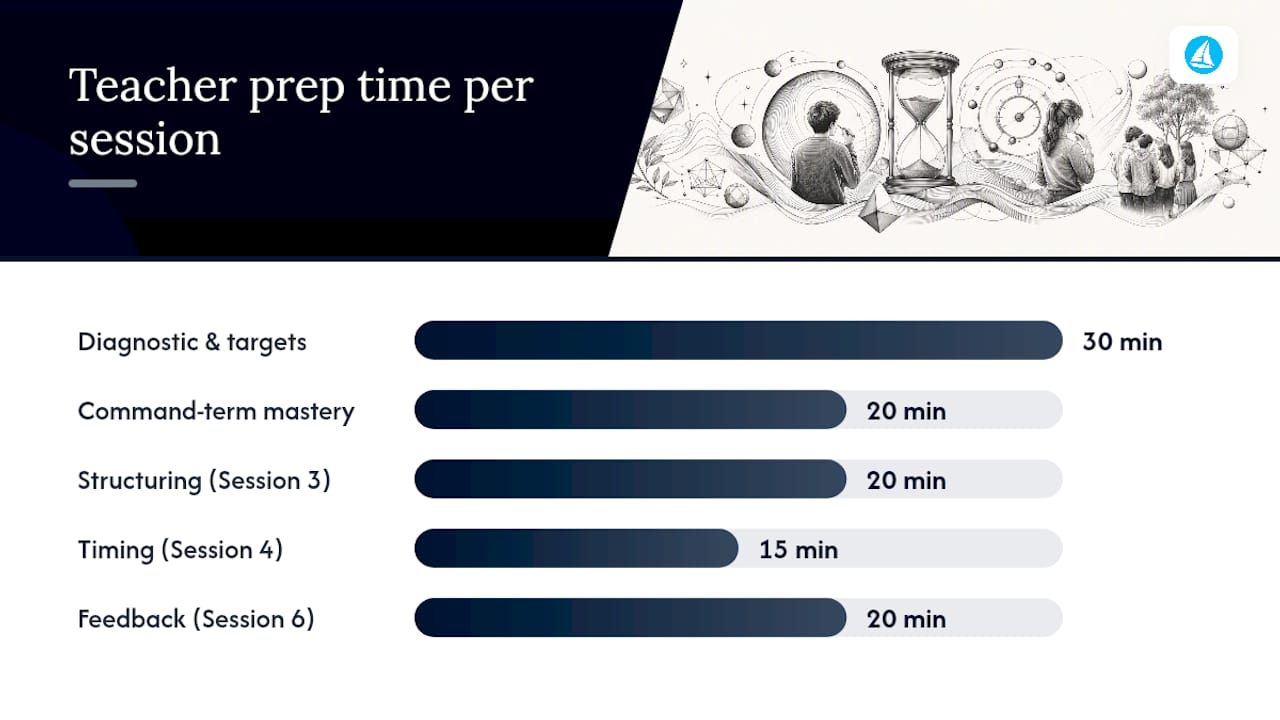
| Session | Objective | Key Activity | Teacher Prep | Student Homework |
|---|---|---|---|---|
| — | Diagnostic and target-setting | 20-min micro-mock + error log | 30 min: select past-paper questions | Review own errors; note two recurring command-term mistakes |
| — | Command-term mastery | Drill define/describe/explain/analyse/evaluate templates | 20 min: prepare worked exemplars | Write three practice openings per command term |
| 3 | Structuring extended responses | Map a 6-mark answer to mark-scheme levels live | 20 min: annotate a model answer | Rewrite one weak answer using the structure taught |
| 4 | Timing and mark allocation | Timed question rotation (marks-to-minutes practice) | 15 min: prepare question set | Complete one timed section; log time per question |
| 5 | Timed micro-mock with examiner marking | 40-min mock, peer-marked against markscheme | Short time: prepare rubric and peer-marking guide | Error log: three targets for next session |
| 6 | Feedback and targeted redrafting | Return scripts; students redraft one answer | 20 min: moderate peer marking | Redraft and self-assess against markscheme |
| 7 | Skills consolidation | Command-term relay and flash drills | 15 min: prepare drill cards | Active recall set on weakest skill area |
| 8 | Final micro-mock and reflection | Full timed mock; compare to session-one baseline | 30 min: prepare mock and marking guide | Write a personal action plan for the next four weeks |
Which exam techniques should you teach first?
IB examiners recommend reading all questions before allocating time, answering command terms directly in the opening paragraph, structuring extended responses to match mark-scheme levels, and budgeting a final review period. That advice maps onto four discrete techniques worth teaching explicitly.
Command-term templates. Each command term signals a specific cognitive task. “Define” needs one precise sentence with units or criteria. “Describe” needs observable features in sequence. “Analyse” needs identification of components and their relationships. “Evaluate” needs a judgement supported by evidence and a counter-consideration. Teaching students a one-line opening formula for each term removes hesitation and earns the first mark reliably.
Answer structure mapped to mark-scheme levels. For extended responses in IB Biology, Chemistry, Physics, and Maths, the pattern is: opening claim or thesis, evidence or working, a linking or evaluative sentence. Show students a real mark scheme and annotate which sentence earns which level descriptor. That single exercise is more persuasive than any amount of general advice.
- Read the full paper before writing anything; allocate minutes by mark value.
- Leave 5–10 minutes at the end for review and corrections.
- In calculation questions, show every step; a correct method with an arithmetic error still earns method marks.
- Use subject-specific terminology precisely; vague phrasing rarely reaches the top band.
Pro Tip: Project a student answer (anonymised) and mark it live against the official markscheme. Students learn more from watching a mark get awarded or withheld in real time than from reading a model answer alone.
Low-prep classroom activities that build exam technique
Active recall and spaced repetition reliably outperform passive revision; timed past-paper practice under exam conditions is associated with stronger performance. These activity formats embed that principle without heavy preparation.
Micro-mocks (20–40 minutes). Select two or three questions from past papers, set a strict time limit, and mark against the official scheme. A 20-minute micro-mock fits inside a standard lesson and generates immediate data. Use a simple checklist: command term addressed in opening sentence? Evidence present? Correct terminology used? Review period taken?

Command-term relay. Give each pair a command term and a topic. They write the opening sentence only, pass it to the next pair for a second sentence, and so on. The class then marks the composite answer together. It is fast, low-stakes, and exposes gaps in structure without the pressure of a full paper.
Peer-marking protocol. Distribute a short rubric (three criteria, each worth one mark) and a comment script: “This answer earns [mark] because… To improve, the student should…” Two-stage marking, where students mark first and you moderate a sample, builds consistency and saves teacher time. Return scripts within one lesson wherever possible; delayed feedback loses most of its effect.
Homework error logs. After any timed task, students record their two most common errors and write a one-sentence correction. These feed directly into the next session’s drill focus and take under five minutes to review.
How do you measure gaps and track progress efficiently?
A skills-first approach — identifying 6–10 high-value skills, practising them deliberately with feedback, and increasing difficulty — builds exam resilience more reliably than knowledge-first revision. Measuring the right metrics makes that cycle work.
Practical metrics to track each cycle:
- Accuracy on past-paper items by command term and topic area.
- Time per mark: students who consistently over-run on short questions lose marks on longer ones.
- Command-term success rate: the proportion of answers that address the command term in the opening sentence.
- Repeat-error frequency: how often the same error appears across two consecutive tasks.
- Mock-paper band shifts: movement between grade boundaries across successive mocks.
The workflow is: diagnostic → targeted practice → reassessment → personalised homework. Tibertutor’s progress-tracking dashboard and examiner-authored item tagging compress this loop considerably. Every question on the platform is tagged by topic, command term, and difficulty, so you can see at a glance which skills need the next drill cycle rather than spending time cross-referencing spreadsheets.
How should you run mock exams and feed back effectively?
Mocks should develop assessment-capable learners by sharing assessment criteria in advance, using markschemes consistently, returning scripts promptly, and converting mock data into feedforward interventions, according to educational best practices. The schedule and workflow below make that practical at scale.
| Mock type | Timing | Duration | Marking approach | Feedback format |
|---|---|---|---|---|
| Mini-mock | Every —–3 weeks during the programme | 20–40 min | Peer-marked, teacher-moderated | 3 written action points per student |
| Full mock | 6–8 weeks before school mocks or final exams | Full paper | Teacher-marked against official markscheme | Individual feedforward sheet + class error summary |
| Diagnostic mock | Session — (programme start) | 20 min | Teacher-marked | Baseline band and two priority targets |
After each full mock, use a three-point feedforward template: one thing done well (with the mark-scheme reference), one structural error to fix, and one command-term habit to change. Students who receive specific, mark-scheme-referenced feedback improve more consistently than those who receive general comments. Moderate a sample of peer-marked scripts to keep grade boundaries consistent across the cohort.
Adapting the programme for different attainment levels and access needs
Scaffolding and stretch tasks do not require separate lesson plans. Small adjustments to the same activity serve the full attainment range.
Scaffolds for lower-attaining students:
- Sentence frames for each command term (“This process involves… because… which means…”).
- Partially completed outlines for extended responses, with the claim sentence provided.
- Visual organisers for multi-step calculations showing where each value goes.
- Simplified question stems that retain the command term but reduce the cognitive load of the context.
Stretch tasks for higher attainers:
- Extension prompts that ask students to evaluate a counter-argument or compare two mechanisms.
- Synthesis questions that combine two topic areas within one answer.
- Transfer tasks: apply a concept from one topic to an unfamiliar context, then mark against a student-constructed markscheme.
SEN and access arrangements. Students with extra time allowances should practise with their adjusted time from the first micro-mock, not just in formal assessments. Modified question stems, larger font versions, and assistive technology (text-to-speech for reading questions) can be integrated into micro-mocks with minimal disruption. Confirm each student’s formal access arrangements with your IB coordinator and replicate those conditions consistently across all timed practice.
What KPIs and timeline should you expect?
Reliable, measurable improvement typically emerges across a 6–8 week cycle: diagnostic in week one, two focused practice cycles, a mid-point micro-mock, and a reassessment at week six or eight.
Sample KPIs to track:
- A band shift of one grade boundary on a timed paper after two full practice cycles.
- A reduction in repeat errors of at least 50% between session one and session five error logs.
- An increase in command-term accuracy (proportion of answers addressing the command term in the opening sentence) from baseline to reassessment.
- Time-per-mark compliance: students finishing within the allocated time on at least 80% of questions by session eight.
Repeated, rubric-based measurement matters here. A single improved score can reflect question difficulty rather than genuine skill gain. Two or three consistent data points across different question types give you a valid signal. Top-performing IB students often complete 10–15 full past papers per subject in the final eight weeks; your programme builds the habits that make that volume productive rather than just repetitive.
Practical resources and teacher checklist
A well-resourced programme does not need to be expensive. The essentials are:
- Diagnostic micro-mock (two or three past-paper questions, printed or on-screen).
- Command-term poster or reference card for each student (one A4 sheet, free to produce).
- Sample markschemes from the IBO subject resource centre.
- Student error-log template (a simple two-column sheet: error / correction).
- A timetable of four to eight practice sessions with dates confirmed in advance.
- Short peer-marking rubric (three criteria, one mark each).
- 30-minute micro-mock script with timing prompts for the teacher.
- Homework error-log sheet for between-session consolidation.
For IB science independent study resources, Tibertutor provides examiner-authored questions, cram sheets, and mock exams across Biology, Chemistry, Physics, and Maths. Printed sheets work well for in-class micro-mocks; platform-based tests add the analytics layer that printed resources cannot replicate.
Why examiner-authored content changes outcomes
Most exam-technique programmes fail not because teachers lack effort but because the materials they use do not reflect how examiners actually award marks. A past-paper question from a textbook publisher and the same question from an IBO examiner can look identical on the surface, yet the markscheme logic differs in ways that matter at the top band.
Examiner-authored exemplars show students the exact phrasing that earns a level-three descriptor, not a plausible approximation of it. When you use materials written by the people who set and mark the papers, the alignment between practice and performance is direct. That is not a marginal gain; for students sitting on a grade boundary, it is often the difference between a 5 and a 6.
The workload concern is real. Running a full programme on top of normal teaching is demanding. Starting small, with a single diagnostic micro-mock and one command-term lesson, is enough to generate the data you need to target the next step. The programme in this article is designed to be modular: run four sessions if that is all the timetable allows, then add the remaining four next term.
Tibertutor supports every stage of this programme
Every session in the plan above has a direct counterpart in Tibertutor’s platform. Examiner-authored IB Biology practice tests and IB Chemistry practice tests map directly to the micro-mock and timed practice sessions. The custom test builder lets you select questions by topic, command term, and difficulty in under two minutes, so session preparation takes a fraction of the time it would with printed past papers.
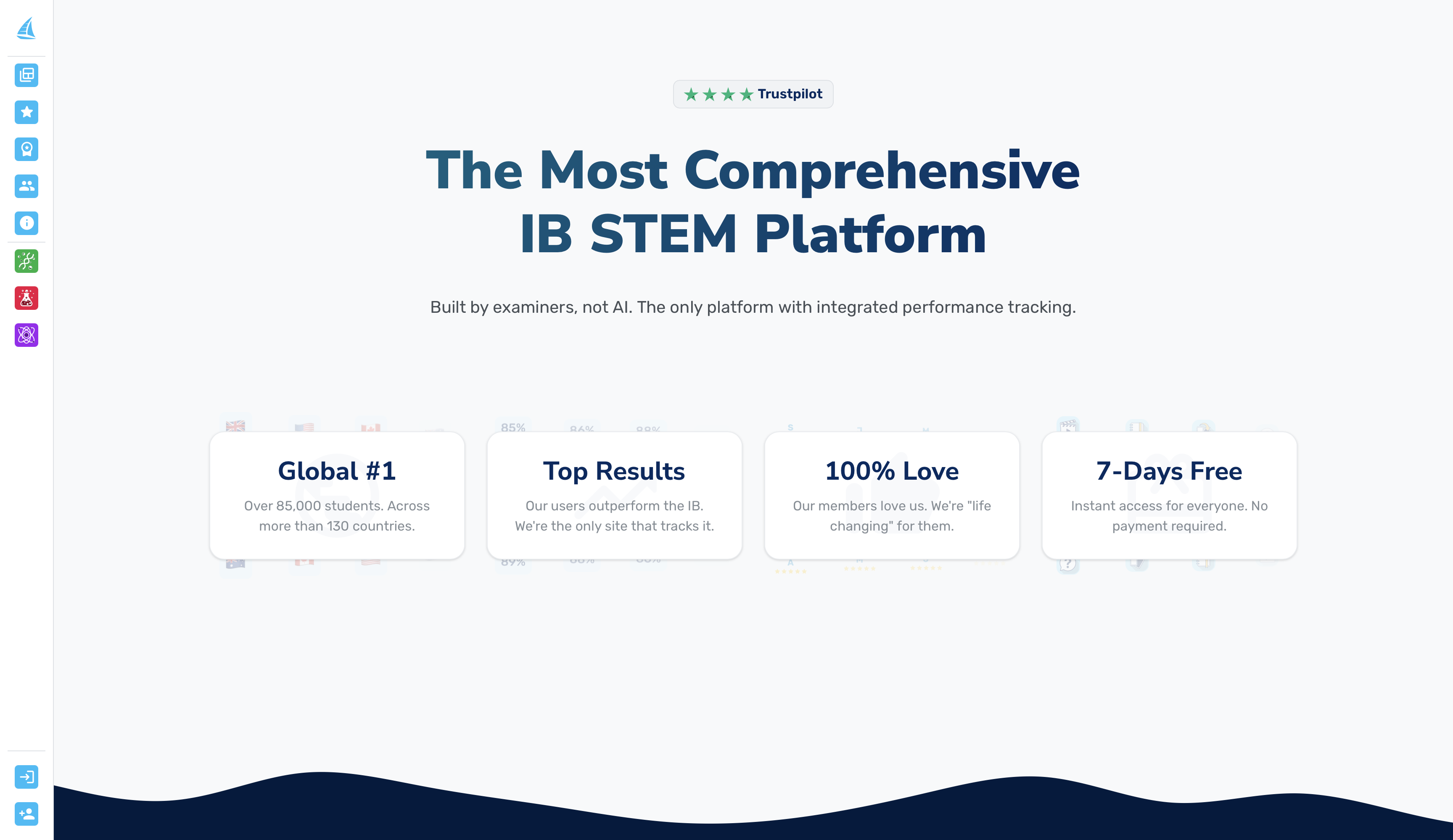
The analytics dashboard shows you, at student and cohort level, which command terms are underperforming and which topics need the next drill cycle — the kind of insight that would otherwise require a spreadsheet and an hour of cross-referencing. Content is built by actual IB examiners, making Tibertutor the strongest value-for-money option for IB STEM preparation available online. A free 7-day trial gives you full access to test the platform with one cohort before committing to a monthly, 6-month, yearly, or full-course subscription. School licensing is available for departments wanting to run the programme across multiple classes simultaneously.
Sources
- How to Study for IB Exams: Complete 2026 Guide | IB Demystified
- IB DP Subject Mastery: The “Skills First” Revision Plan for IB DP (All Subjects) - Sparkl
- 10 Considerations When Running Mock Examinations | Subject Support - ManageBac+
FAQ
How many sessions does an IB exam technique programme need?
Four to eight sessions, delivered across two to four weeks for an intensive approach or extended over six to eight weeks, is sufficient for measurable gains, provided each session includes timed practice and examiner-aligned feedback. A diagnostic in session one and a reassessment in the final session give you a clear before-and-after comparison.
How often should students sit mock exams during the programme?
Mini-mocks every two to three weeks and one full mock six to eight weeks before formal assessments strikes the right balance. Returning scripts within one lesson and providing three specific feedforward points maximises the benefit of each mock.
How do you adapt exam technique training for students with SEN?
Replicate each student’s formal access arrangements (extra time, modified stems, assistive technology) in every timed practice session from the start, not only in formal assessments. Sentence frames and partially completed outlines also reduce barriers without lowering the cognitive demand of the task.
Which metrics show that exam technique training is working?
A band shift of one grade boundary after two practice cycles, a reduction in repeat errors, and improved command-term accuracy in the opening sentence are the three most reliable indicators. Time-per-mark compliance is a useful secondary check.
Can Tibertutor support this programme for IB science and maths?
Yes. Tibertutor provides examiner-authored exam-style questions, IB Chemistry mock exams, and a progress-tracking dashboard that tags performance by topic and command term, making it straightforward to identify and target weak skills between sessions.