IB science independent study resource types: 2026 guide
IB science independent study resource types consist primarily of past papers, conceptual guides, interactive simulations, and structured question banks designed to build active recall and exam readiness. The 2026 IB science curriculum shifts firmly towards concept-based learning, which means passive reading no longer cuts it. Students in Biology, Chemistry, and Physics need resources that mirror what examiners actually reward. This guide breaks down each resource type, explains why it works, and helps you choose the right combination for your level and subject.
1. Why past papers are the cornerstone of IB science study resources
Past papers are the single most effective independent study material for IB sciences. Experts recommend dedicating 60–70% of study time to exam-style practice. That figure reflects a clear truth: the IB exam rewards students who know how to answer, not just what to know.
The real value of past papers comes from pairing them with mark schemes. Effective past paper use involves timing yourself, then self-marking critically to understand where your answer fell short. This process teaches you examiner intent, not just content.

Pro Tip: Do not just check whether your answer is right or wrong. Read the mark scheme language carefully. Examiners often accept only specific phrasing, and recognising that pattern is what separates a 5 from a 7.
2. Conceptual guides and structured notes for active recall
Structured notes are not the same as passive reading. A conceptual guide forces you to organise knowledge into a form you can test yourself on. Active recall produces more durable learning than rereading, because your brain works harder to retrieve information.
The best conceptual guides for IB sciences share three qualities:
- They map directly to the 2026 syllabus, covering only what is assessed
- They use diagrams, mind maps, and summary tables to aid retention
- They are concise enough to review quickly before timed practice
For Biology, a well-structured guide covers topics like cell biology and genetics with clear diagrams. For Chemistry, it prioritises stoichiometry, bonding, and energetics. For Physics, it focuses on mechanics, waves, and electricity with worked examples. Tibertutor’s detailed notes and cram sheets are built precisely around this structure.
Pro Tip: After reading a section of your conceptual guide, close it and write down everything you remember. Then check. This single habit accelerates retention faster than any highlighter.
3. Flashcards and spaced repetition tools
Flashcards are one of the most underused independent study materials in IB sciences. Digital and physical flashcards with spaced repetition are highly effective for locking in key vocabulary, formulae, and definitions. Spaced repetition means you review cards at increasing intervals, which forces long-term storage rather than short-term cramming.
For Chemistry, flashcards work brilliantly for organic reaction types and functional groups. For Biology, they cement terminology like osmoregulation, mitosis stages, and enzyme specificity. For Physics, they reinforce unit conversions, equations, and definitions of quantities. The key is keeping each card focused on one fact, not a paragraph of information.
4. Interactive simulations and digital visualisation tools
Simulations help students visualise complex scientific phenomena far better than textbooks alone. Experienced IB science teachers and examiners strongly recommend simulations, particularly for topics that are difficult to observe directly. Concepts like enzyme kinetics, electromagnetic induction, and molecular geometry become far clearer when you can manipulate variables and watch outcomes change.
Free tools such as PhET Interactive Simulations from the University of Colorado Boulder cover Physics and Chemistry topics directly relevant to the IB syllabus. For Biology, virtual lab platforms help students understand experimental design and data analysis without needing a physical lab. These tools align well with the 2026 curriculum’s emphasis on applying concepts rather than recalling facts.
The risk with digital tools is overuse. Simulations work best as a supplement to past paper practice, not a replacement. Spend no more than 20% of your study time on visualisation tools. Use them to resolve a specific conceptual gap, then return to exam-style questions.
5. Question banks and targeted practice materials
A question bank is a curated collection of exam-style questions organised by topic, command term, or difficulty. IB examinations reward precision in command term usage and scientific language, and a good question bank trains exactly that. Working through topic-specific questions builds the habit of structuring answers the way examiners expect.
The table below compares the main types of practice materials available to IB science students:
| Resource type | Best use | Limitation |
|---|---|---|
| Official past papers | Full exam simulation and timing | Limited to past syllabi; 2026 changes may not be reflected |
| Topic question banks | Targeted practice by concept | Quality varies widely across providers |
| Mock exams | Assessing readiness under timed conditions | Less useful for identifying specific gaps |
| Worked example sets | Understanding method and structure | Risk of passive reading without active application |
Tibertutor’s IB science question bank is built by examiners and aligned to the 2026 syllabus, covering Biology, Chemistry, and Physics with topic-specific tests and full mock exams.
6. The over-resource trap: why less is more
The over-resource trap causes passive consumption and reduces effective study time. Collecting five textbooks, three apps, and multiple note sets feels productive. It is not. Each new resource you add dilutes the time you spend on exam-aligned practice.
The fix is simple. Choose one primary resource that is fully aligned to the IB syllabus and use it consistently. Add a second resource only when you need clarification on a specific topic. Exam readiness comes from trusted, updated materials used deeply, not from a wide collection used superficially.
7. How to choose and combine resources for SL and HL
SL and HL students have different demands, and their resource combinations should reflect that. SL students benefit most from a tight loop of conceptual guides, past papers, and flashcards. The syllabus is narrower, so depth within each topic matters more than breadth.
HL students need the same core loop but must add more rigorous question bank practice. HL papers test application at a higher level, and frequent low-stakes testing is a proven strategy for building that depth. Breaking revision into individual topics and self-testing after each one is the most reliable method for both levels.
Pro Tip: Map your weakest topics from your most recent past paper attempt. Spend the next study session on those topics only, using your conceptual guide and question bank together. Then retest with a new past paper question on the same topic.
For a structured approach to IB science exam preparation, combining these resource types in a planned weekly schedule produces the most consistent results.
8. Mastering command terms with subject-specific resources
Command terms are the language of IB exams. Students often fail to differentiate between general scientific knowledge and the IB exam’s specific demand for command term mastery. “Describe” requires a different answer structure from “explain,” and “evaluate” requires a different structure again.
Subject-specific guides to command terms are an underused but highly effective resource type. Tibertutor’s IB Chemistry command terms guide is one example of a resource that directly addresses this gap. The same principle applies to Biology and Physics: knowing the command term tells you exactly how to structure your answer before you write a single word.
Pairing a command term guide with past paper practice is one of the highest-value combinations available to IB science students. It is also one of the most overlooked.
Key takeaways
The most effective IB science independent study resources combine past papers, conceptual guides, and targeted question banks, with active recall at the centre of every session.
| Point | Details |
|---|---|
| Past papers first | Spend 60–70% of study time on exam-style practice with mark scheme review. |
| Active recall over passive reading | Use conceptual guides and flashcards to generate answers, not just absorb information. |
| Simulations as supplements | Use interactive tools to resolve specific conceptual gaps, not as a primary resource. |
| Avoid the over-resource trap | One strong, syllabus-aligned resource used deeply beats five resources used lightly. |
| Match resources to your level | SL students need depth within topics; HL students need rigorous question bank practice alongside core resources. |
What I have learned from watching students study IB sciences
The students who improve fastest are not the ones with the most resources. They are the ones who sit down with a past paper, mark their own work honestly, and go back to their conceptual guide only to fix what they got wrong. That loop, repeated consistently, is what builds a 7.
The most common mistake I see is treating resource collection as revision. A student who has annotated three textbooks but never timed themselves under exam conditions is not prepared. The exam does not reward familiarity with content. It rewards the ability to apply knowledge precisely, under pressure, using the right command term language.
My honest advice: pick one strong resource per category, build a weekly schedule around past paper practice, and use simulations and flashcards to fill specific gaps. Adapt the mix to how you learn, but never let adaptation become an excuse to avoid the hard work of exam-style questions. That is where the marks are.
— Oliver
Tibertutor: exam-focused science resources for IB students
IB science revision works best when your resources are built by people who understand exactly what examiners look for.
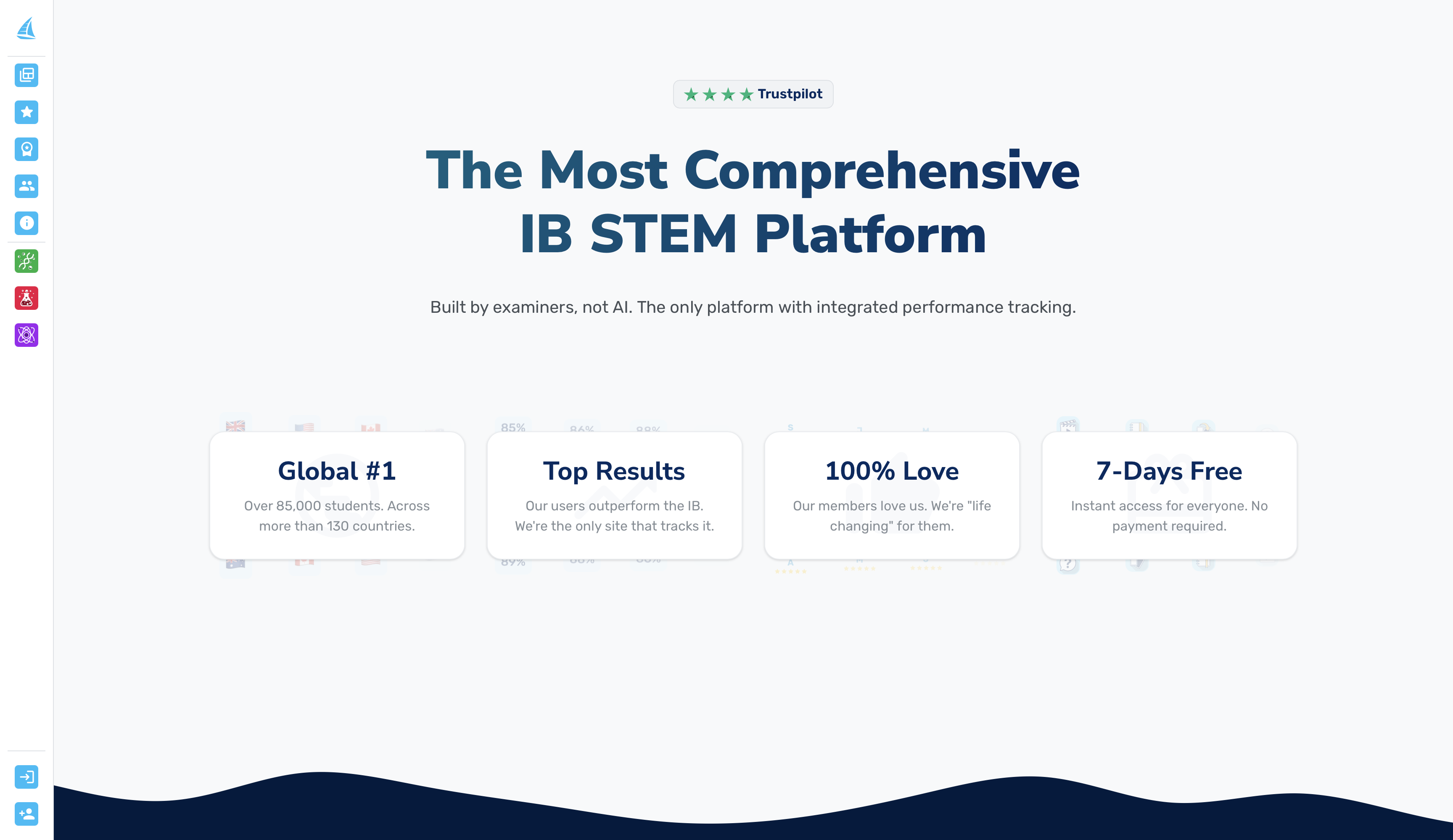
Tibertutor is designed specifically for IB Biology, Chemistry, and Physics students aiming for top marks. The platform gives you access to a curated question bank, animated instructional videos, detailed notes, flashcards, and full mock exams, all aligned to the 2026 syllabus. Progress tracking and analytics show you precisely where to focus next. Whether you are an SL student consolidating core topics or an HL student pushing for a 7, Tibertutor’s student resources are built to match your goals. Start with the question bank and let your results guide the rest.
FAQ
What are the most effective IB science independent study resource types?
Past papers, conceptual guides, flashcards, interactive simulations, and topic-specific question banks are the most effective resource types. Experts recommend spending 60–70% of study time on exam-style practice.
How do I avoid the over-resource trap in IB science revision?
Choose one primary resource fully aligned to the IB syllabus and use it consistently. Add a second resource only when you need clarification on a specific topic.
Are simulations useful for IB Biology, Chemistry, and Physics?
Simulations are highly effective for visualising complex concepts, but work best as a supplement. Use them to resolve a specific gap, then return to past paper practice.
What is the difference between SL and HL resource strategies?
SL students benefit from a tight loop of conceptual guides, past papers, and flashcards within a narrower syllabus. HL students need the same core loop plus more rigorous question bank practice to meet higher application demands.
Why do command terms matter so much in IB science exams?
IB exams reward precision in command term usage. Knowing whether a question asks you to “describe,” “explain,” or “evaluate” determines the structure of your answer and directly affects your mark.