IB curriculum compliance monitoring: a practical guide
IB curriculum compliance monitoring is the continuous process of gathering evidence that your school’s science programmes meet IB standards and practices, culminating in an external evaluation visit. Your immediate next step is to assemble an evidence pack and assign a monitoring lead before your next staff meeting.
Start by checking these highest-priority items first:
- Internal assessments (IAs): task suitability, marking records, and moderation samples for Biology, Chemistry, and Physics
- Academic honesty records: signed declarations, investigation logs, and policy documentation
- Programme documentation: current curriculum maps, unit plans, and staffing records aligned to IB requirements
Table of Contents
- What does IB curriculum compliance monitoring actually cover?
- Who is responsible for monitoring in a UK IB school?
- What must every monitoring system include?
- How do you build a practical monitoring cycle?
- What should you check for Biology, Chemistry, and Physics IAs?
- How do you fix gaps when monitoring finds non-compliance?
- How do you prepare for an IB external evaluation visit?
- Which tools help you manage monitoring and documentation?
- What timelines and impacts should UK schools plan for?
- Your one-page compliance checklist
- Key takeaways
- A practitioner’s perspective on what actually works
- How Tibertutor supports your monitoring workflow
- Authoritative sources to include in your evidence pack
- FAQ
What does IB curriculum compliance monitoring actually cover?
Monitoring covers five domains: the written curriculum, assessment practices, staffing and professional development, physical resources, and school policies. The IB’s Programme standards and practices and its assessment principles guide form the two reference documents every school must work against.
Monitoring is continuous and evidence-based. It is not a single annual audit. The process builds towards an external evaluation visit, at which the IB verifies that what your self-study claims is actually happening in classrooms and labs.
Pro Tip: Treat the self-study as a living document updated termly, not a report written the month before the visit. Schools that maintain rolling evidence files consistently find the visit far less stressful.
Who is responsible for monitoring in a UK IB school?
The head of school holds ultimate accountability. The IB coordinator owns the day-to-day monitoring cycle. Subject leaders own subject-level evidence. The safeguarding lead and SEN coordinator hold their respective policy records.

| Role | Core responsibilities | Evidence they must hold |
|---|---|---|
| Head of school | Overall compliance; notifies IB of major changes | Governance documents, signed notification letters |
| IB coordinator | Runs self-study; manages evidence index | Self-study questionnaire, action plan, moderation logs |
| Science subject leaders | Curriculum maps, IA sampling, marking consistency | Unit plans, IA samples, internal moderation records |
| Safeguarding lead | Safeguarding policy current and reviewed | Signed policy, review dates, training records |
| SEN coordinator | Inclusion policy meets IB guidelines | Inclusion policy with review date, access arrangement records |
The IB coordinator or head of school must notify the IB of any major change in governance, location, or organisational structure. Failure to do so risks withdrawal of authorisation.
What must every monitoring system include?
These components are non-negotiable. Auditors will expect to see all of them.
- Written curriculum maps: versioned, dated, signed by subject leaders, aligned to current IB subject guides
- Assessment calendars: scheduled IA deadlines, moderation dates, and submission windows
- IA samples: a representative sample from each science subject, anonymised, with supervisor comments attached
- Internal moderation records: dated notes showing marks were checked against IB markschemes before submission
- Academic honesty logs: signed student declarations, any investigation records, and policy review dates
- Lab health and safety records: risk assessments for practical work, equipment inspection logs, and CLEAPSS guidance references for UK schools
Risk priorities: IA integrity and academic honesty carry the highest risk of sanctions. Failure to notify the IB of governance changes is the most commonly overlooked obligation and can trigger authorisation review.
How do you build a practical monitoring cycle?
Your policy baseline: run an annual self-study with quarterly evidence checks. Assign each check to a named owner and log outcomes in a shared evidence index.
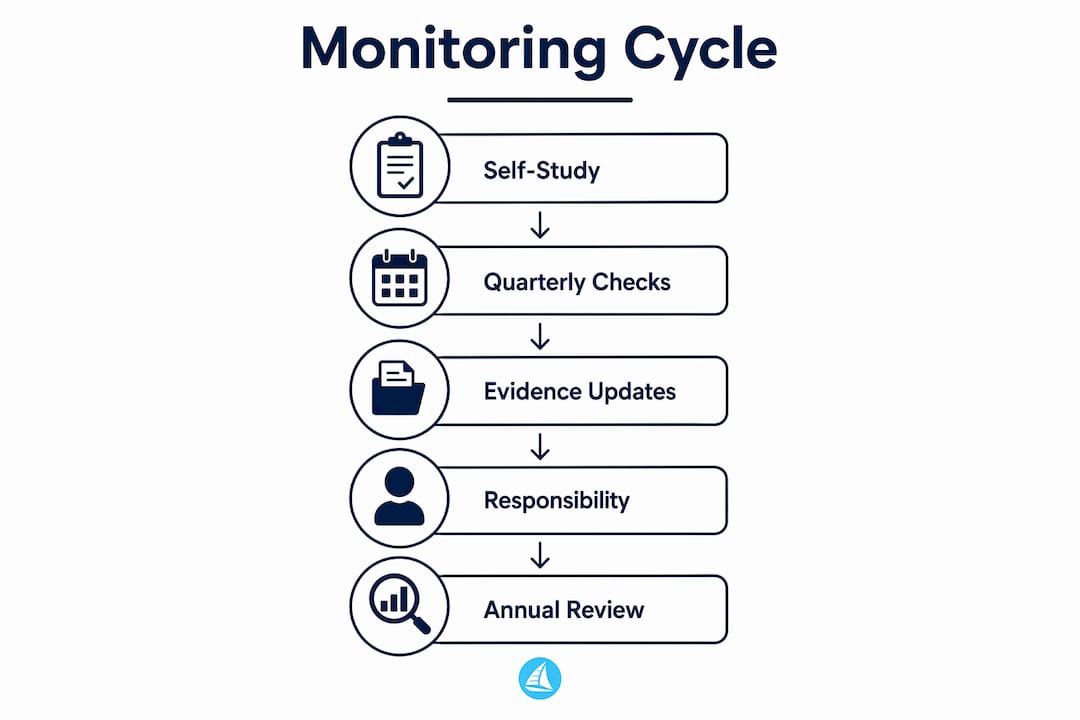
| Period | Activity | Owner | Evidence produced |
|---|---|---|---|
| September | Update curriculum maps and IA task briefs | Subject leaders | Versioned unit plans |
| November | Internal moderation of draft IA work | IB coordinator + subject leaders | Moderation notes, mark adjustments |
| February | Quarterly compliance check: policies, staffing, lab safety | IB coordinator | Completed checklist, signed off |
| May | Post-exam review: use analytics and IA feedback | Subject leaders | Feedback log, action points |
| July | Annual self-study update; action plan revised | IB coordinator | Updated self-study, evidence index |
Data sources to draw on: IA submission records, internal moderation logs, exam analytics from your assessment platform, and attendance and submission metadata. Compliance monitoring best practice consistently points to risk-based prioritisation and continuous monitoring rather than periodic checklists as the more effective approach.
Pro Tip: Keep a lightweight one-page monitoring checklist in your shared drive. Update it after every meeting with file paths, dates, and the name of the person who verified each item.
What should you check for Biology, Chemistry, and Physics IAs?
Science IAs are high-impact. A single moderation adjustment can shift a cohort’s grades significantly, so internal marking must closely follow IB markschemes. The IB assessment guide confirms that moderation may raise or lower school marks, making internal consistency the first line of defence.
Check these items for each science subject:
- Task suitability: does the investigation meet the current subject guide criteria?
- Raw data files and lab journals: are they saved and accessible for moderation?
- Photographs of practical setups: archived with the IA file
- Supervisor comments: completed, specific, and not coaching the student
- Anonymisation: student names removed from moderation samples
- Marking consistency: at least two teachers have applied the markscheme independently
External moderation uses a seeding model. The IB embeds definitive seed responses to monitor examiner accuracy. Any drift in your internal marking is likely to be detected and corrected, sometimes with significant mark adjustments. After results, use IA feedback forms and subject reports released by the IB to improve task design and marking standards for the next cycle.
Pro Tip: Build a shared repository where each science unit plan and IA brief is versioned and linked to the corresponding moderation notes. Documentation drift, where unit plans slowly diverge from IB requirements, is the most common compliance failure in science departments.
How do you fix gaps when monitoring finds non-compliance?
The remediation principle is simple: document the issue, assign an owner, agree a deadline, and log the outcome. Effective remediation addresses root causes rather than symptoms, reducing the chance of the same issue appearing in the next cycle.
Follow this workflow:
- Log the finding: record the standard or practice not met, the date identified, and the evidence gap.
- Assign an owner: one named person is responsible for the fix.
- Agree a timeline: set a realistic deadline, typically two to six weeks for documentation gaps.
- Implement and verify: the owner completes the action; the IB coordinator independently checks the evidence.
- Close and archive: sign off the remediation record and file it in the evidence index.
When matters to be addressed arise during an evaluation, the IB sets specific deadlines for submitting evidence. Missing those deadlines can lead to withdrawal of authorisation, so log them immediately and treat them as fixed commitments.
Pro Tip: Convert recurring remediation items into staff training objectives. If the same IA marking gap appears two cycles running, the fix is a CPD session, not another email reminder. See the IB educator professional development guide for structured approaches.
How do you prepare for an IB external evaluation visit?
Compile an evidence pack aligned to the Programme standards and practices and your self-study questionnaire. The self-study and evaluation guide is clear: evidence must reflect actual practice over the review period, not aspirational statements.
| Evidence pack item | Purpose | Notes |
|---|---|---|
| Self-study summary | Shows the school’s self-assessment against each standard | Must be evidence-based, not descriptive |
| Action plan | Documents how identified gaps are being addressed | Include deadlines and owners |
| IA samples (all three sciences) | Demonstrates assessment quality and marking consistency | Anonymised; include supervisor comments |
| Internal moderation records | Proves marks were checked before submission | Dated and signed |
| Staff CVs and PD records | Confirms teachers meet IB qualification requirements | Include IB workshop attendance |
| Lab safety records | Demonstrates safe and compliant practical provision | Risk assessments, inspection logs |
Staff preparation matters as much as the documents. Run briefing sessions where every teacher understands which evidence they own. Practice presenting evidence clearly to reduce anxiety and improve coherence on the day.
Which tools help you manage monitoring and documentation?
Four tool categories make monitoring more manageable: syllabus coverage trackers, evidence repositories, assessment analytics platforms, and staff training logs. Technology can automate continuous controls and flag syllabus drift early, though it must always be backed by saved IB documentation.
Tibertutor supports monitoring in several practical ways:
- Syllabus coverage logs: track which topics have been taught and assessed, providing a timestamped record for curriculum map audits. Explore how to audit syllabus coverage using the platform’s tools.
- IA-style question banks and mock exams: demonstrate curriculum delivery and provide data for internal moderation sampling. The IB science question bank gives teachers exam-aligned evidence of student progress.
- Performance analytics: identify which topics students are underperforming on, flagging potential syllabus drift before it becomes a compliance issue.
Tools support evidence collection. They do not replace signed unit plans, moderation notes, or official IB records. Every data point from a platform needs a corresponding paper or digital document in your evidence index.
What timelines and impacts should UK schools plan for?
The standard cadence is periodic evidence checks, an annual self-study update, and a full programme evaluation on a multi-year cycle.
| Milestone | Typical timing | Responsible party |
|---|---|---|
| Monitoring cycle launch | September (start of academic year) | IB coordinator |
| Quarterly compliance check | November, February, May | IB coordinator + subject leaders |
| Annual self-study update | July | IB coordinator |
| Pre-visit evidence pack complete | Six months before evaluation visit | Head of school + IB coordinator |
| External evaluation visit | Every five years | IB evaluators |
Organisational impacts are real. Subject leaders typically spend time each term on documentation and moderation records. The benefit is fewer urgent fixes before the visit and more reliable IA outcomes for students.
Your one-page compliance checklist
Use this checklist in your next monitoring meeting. Attach file paths, dates, and the name of the person who verified each item.
Curriculum and documentation
- [ ] Curriculum maps versioned and dated for all three sciences
- [ ] Unit plans aligned to current IB subject guides
- [ ] Academic honesty policy reviewed within the last 12 months
- [ ] Inclusion policy current and compliant with IB guidelines
Internal assessment
- [ ] IA tasks checked for suitability against subject guide criteria
- [ ] Raw data files and lab journals archived
- [ ] Internal moderation completed and recorded before submission
- [ ] Supervisor comments completed and specific
Lab safety (UK)
- [ ] Risk assessments in place for all practical activities
- [ ] Equipment inspection logs up to date
- [ ] CLEAPSS guidance referenced where applicable
Governance and notifications
- [ ] IB notified of any changes in governance, location, or structure
- [ ] Staff CVs and IB workshop records current
Sign-off block
Key takeaways
Effective IB curriculum compliance monitoring requires a continuous evidence cycle, clear role ownership, and subject-specific IA checks, not a one-off audit before the evaluation visit.
| Point | Details |
|---|---|
| Start with high-risk items | Prioritise IA integrity, academic honesty records, and governance notifications first. |
| Assign clear owners | Every evidence item needs one named person responsible for keeping it current. |
| Version your documents | Date and version all curriculum maps and unit plans so the self-study reflects actual practice. |
| Notify the IB promptly | Major changes in governance or location must be reported; failure risks authorisation withdrawal. |
| Use Tibertutor for analytics | Tibertutor’s syllabus coverage logs and performance analytics support evidence gathering across Biology, Chemistry, and Physics. |
A practitioner’s perspective on what actually works
The most common mistake I see in IB science departments is treating compliance as a once-a-year scramble. The schools that sail through evaluation visits are the ones where subject leaders have a shared folder that is genuinely alive: unit plans updated after each teaching cycle, moderation notes filed the week they happen, and IA briefs versioned every time the task changes.
Three classroom-level habits make the biggest difference. First, use a standardised supervisor comment template so every teacher records the same information in the same format. Second, archive raw data and photographs at the point of collection, not retrospectively. Third, read the IA feedback forms the IB releases after results and treat examiner comments as a direct brief for next year’s task design. These are not bureaucratic extras. They are the difference between a moderation adjustment that surprises you and one you predicted and already addressed.
How Tibertutor supports your monitoring workflow
Gathering evidence for an IB evaluation visit takes time. Tibertutor gives science teachers a faster route to two of the most time-consuming parts: demonstrating syllabus coverage and building internal moderation data.
The platform’s analytics show exactly which Biology, Chemistry, and Physics topics students have practised and where performance is weakest, giving coordinators a ready-made coverage log. IB Biology tests and IB Chemistry mock exams generate standardised assessment data that feeds directly into internal moderation sampling. Built by examiners, every question is aligned to current IB markschemes, so the data is audit-ready from the start. Tibertutor does not replace your signed unit plans or official moderation records, but it gives you the analytics layer that makes those documents easier to justify. Start your free trial at tibertutor.com and connect your science department’s monitoring cycle to real student performance data today.
Authoritative sources to include in your evidence pack
Always cite official IB documents in your self-study. Keep file paths and version dates for every source you reference.
| Source | Why it matters | Where to cite it |
|---|---|---|
| IB Programme standards and practices | The primary compliance reference for all IB schools | Self-study questionnaire; governance section |
| Assessment principles and practices guide | Explains moderation, seeding, and assessment integrity | IA and moderation sections of evidence pack |
| Programme evaluation and self-study guide | Sets out the self-study process and evidence requirements | Action plan; pre-visit preparation |
| IB assessment and exams overview | Covers DP assessment procedures and digital transition | Assessment calendar; staff briefing notes |
Prioritise official IB documents over third-party summaries. When assembling your evidence pack, record the document title, version date, and the file path or URL so evaluators can verify each reference quickly.
FAQ
What is IB curriculum compliance monitoring?
It is the continuous process of gathering evidence that a school’s programmes meet IB standards and practices, verified through an external evaluation visit approximately every five years.
Which IB science IA issues most often cause compliance problems?
Marking drift from IB markschemes and incomplete supervisor comments are the most frequent issues; both are corrected during external moderation and can result in significant mark adjustments.
How often must a UK IB school update its self-study?
The self-study should be updated annually, with quarterly evidence checks throughout the year, feeding into a full programme evaluation on a five-year cycle.
Does Tibertutor replace official IB documentation?
No. Tibertutor’s analytics and question banks support evidence gathering and syllabus coverage tracking, but signed unit plans, moderation records, and official IB forms remain the required documentation.
What happens if a school fails to notify the IB of major changes?
Failure to notify the IB of changes in governance, location, or organisational structure can lead to withdrawal of authorisation to offer the programme.