
Convert Timed Practice into IB Paper 1 Score Gains in 4 Weeks
The best IB Paper 1 strategy is a fast, disciplined first pass through the multiple-choice questions that banks every easy mark within seconds, a slower and more deliberate method for the data-based questions, and syllabus-tagged practice afterwards that tells you exactly which sub-topics are costing you marks. Paper 1A rewards speed and elimination. Paper 1B rewards patience with figures. Tools like Tiber Tutor exist to help you run that whole cycle without guessing where your weaknesses actually are.
TL;DR:
- Rapid first passes on multiple-choice questions should aim for 60 to 90 seconds per item to maximize easy marks and prevent stalling.
- Data-based questions require careful reading of stimuli, annotation, and about 10 to 15 minutes per question, depending on mark value, with practice improving speed over time.
- Tracking performance by sub-topic and question family identifies weaknesses, and frequent review against examiner mark schemes accelerates targeted improvement.
- Avoid common mistakes like misreading question stems and axes, answer grid misalignment, or overreliance on exact calculations, with specific fixes for each issue.
- Using examiner-authored mocks with automated tagging and analytics significantly boosts exam readiness, with recommended full mock practice every seven to ten days.
Table of Contents
- Quick strategy checklist for Paper 1A and 1B
- A four-week timed practice plan for Paper 1
- How to track practice and turn it into real improvement
- Common Paper 1 mistakes and how to fix them
- Exam-day checklist: what to pack and how to run the room
- An examiner’s view on why these tactics work
- What actually moves the needle on Paper 1
- Try Tiber Tutor for timed Paper 1 practice and analytics
- Where to find official past papers and examiner guidance
- Sources
- FAQ
Quick strategy checklist for Paper 1A and 1B
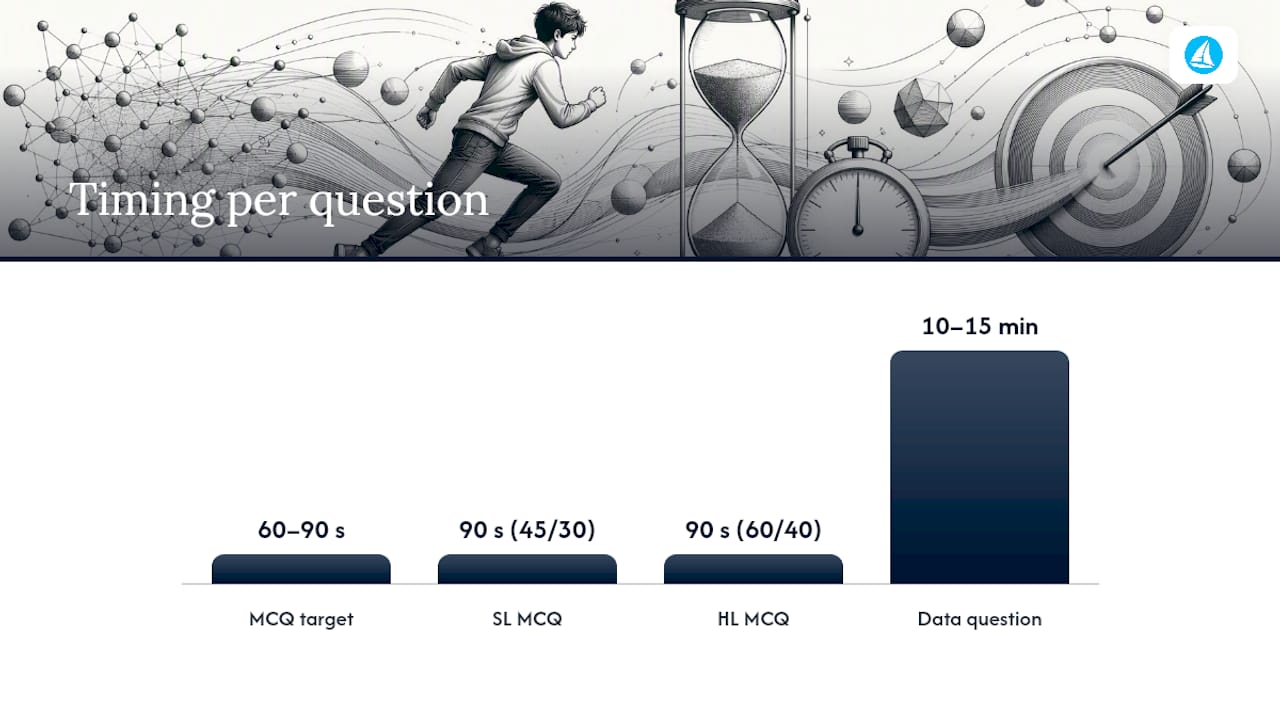
Paper 1A is the multiple-choice section: SL sits 30 questions in 45 minutes, HL sits 40 in 60 minutes. That works out to roughly 60 to 90 seconds per question, which is tight enough that you cannot afford to freeze on a single item. Paper 1B follows with three or four data-based questions, and SL and HL carry different mark totals and timings, so check your subject’s exact breakdown before exam day.
Here is the tactical checklist worth memorising before you sit any timed practice:
- Paper 1A: aim for 60 to 90 seconds per MCQ on your first pass; flag anything uncertain and move on rather than stalling.
- Paper 1A: eliminate obviously wrong options first. Removing two of four choices doubles your odds even on a guess.
- Paper 1A: answer every single question. There is no negative marking, so a blank answer is a guaranteed zero when a guess might score.
- Paper 1B: read the stimulus, then the question, then the figure, in that order, so you know what you are actually looking for before you scan the graph.
- Paper 1B: annotate axes and units immediately, and mark out variables and controls before writing anything.
- Paper 1B: budget roughly 10 to 15 minutes per data question depending on mark allocation.
Pro Tip: Rewrite double-negative question stems in your own words before answering. “Which of the following is not an incorrect statement” trips up more capable students than it should, purely because nobody pauses to translate it.
Recognising question families matters as much as timing. MCQ writers reuse a small set of structures — definition recall, application to a novel scenario, data-response embedded in the stem, and “select the exception” — and once you can name the family, you know which tactic to reach for.
A four-week timed practice plan for Paper 1
Speed on Paper 1 is a trained skill, not a fixed trait, and a short microcycle builds it faster than scattered revision ever will. Structure four weeks like this:
- Week 1: short MCQ drills of 15 to 20 questions, strictly timed, focused on one or two syllabus topics at a time.
- Week 2: add targeted data-question workouts, isolating graph reading, table interpretation, and calculation from unfamiliar practicals.
- Week 3: run a full mixed timed mock covering both Paper 1A and 1B, then spend at least as long reviewing it as you did sitting it.
- Week 4: repeat a full timed mock, but with less familiar stimulus material, to simulate the unpredictability of the real paper.
A regular cadence of timed mocks every seven to ten days, each followed by careful mark-scheme review, builds stamina faster than untimed revision spread thin across weeks.
Each session should follow a simple template: a five-minute warm-up on easy recall questions, a focused timed block on the week’s target skill, immediate marking against the scheme, and a short reflection noting exactly which question types cost you time or marks. That reflection step is the one students skip most often, and it is the one that actually drives improvement.
Progression should move in one direction only: shorter time allowances, less familiar stimulus material, and a gradual shift from single-topic drills to full-paper conditions. By week four you want conditions that feel harder than the real exam, not easier.
Pro Tip: Never sit two full mocks back to back without a review day between them. Marking is where the learning happens; sitting more papers without marking them just repeats the same mistakes at speed.
How to track practice and turn it into real improvement
Practice without a record is just repetition. The loop that actually raises scores runs: attempt, mark, tag, drill, retest.
Every past-paper question you attempt should get tagged against the alphanumeric syllabus sub-topic code it belongs to, not just filed under a broad topic name.
Two metrics matter more than raw scores:
- Time-per-mark, tracked by question family, shows you where you are slow rather than just where you are wrong.
- Accuracy by sub-topic, tracked over multiple attempts, shows whether a weakness is improving or stuck.
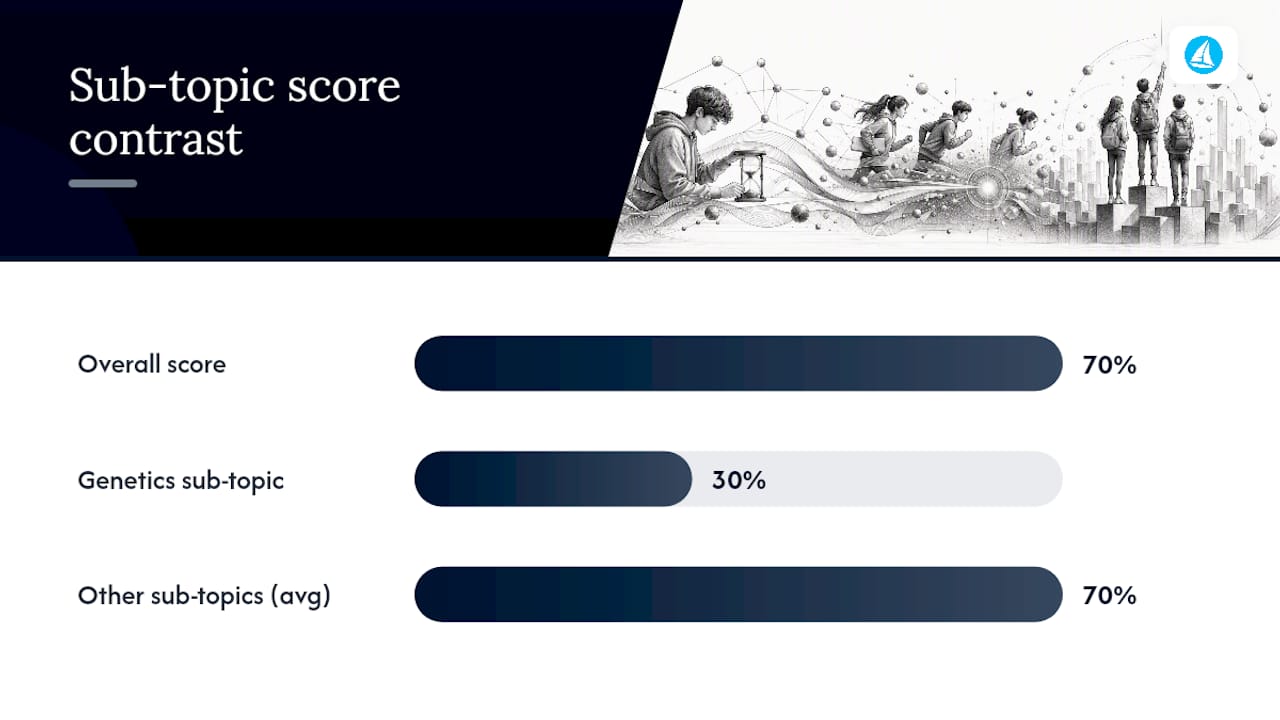
A student who scores 70% overall but 30% on genetics questions has a completely different revision priority to a student scoring 70% evenly across every sub-topic, even though their raw marks look identical.
Analytics only help if they trigger action. Once a sub-topic shows a persistent pattern of weak or slow answers, it should get scheduled back into your practice within a few days, not left until the next mock. This is where examiner-authored mark schemes earn their place: they show you the specific wording examiners reward, which is often narrower than students assume, and student-led answer review against those schemes forces you to spot the gap between what you wrote and what actually scored the mark, rather than just checking whether your final number matched.
Platforms built specifically for IB science, Tiber Tutor among them, automate the tagging and re-testing side of this loop so the analytics update after every attempt rather than after you manually total a spreadsheet.
Common Paper 1 mistakes and how to fix them
Four error patterns show up again and again across Paper 1 scripts, and each has a specific, practisable fix rather than a vague “be more careful.”
- Misreading question stems, especially double negatives or “except” clauses. Fix: pause and rephrase the stem in plain words before reading the options.
- Misreading figures on Paper 1B, particularly axis units or which variable is independent. Fix: annotate the axes and label the controls before attempting the question.
- Answer grid misalignment, where a skipped question shifts every later answer one row out. Fix: build in a final check pass matching question numbers against the grid before time runs out.
- Overreliance on exact calculation when an estimate would catch an error faster. Fix: sanity-check calculator outputs against a rough mental estimate before writing the final figure.
Grid misalignment in particular is a silent score killer. It rarely shows up in self-marking because the working is usually correct. It only surfaces when a teacher or examiner-style review checks the paper against the actual question numbers, which is exactly why timed mocks marked properly matter more than casual revision.
Exam-day checklist: what to pack and how to run the room
Preparation the night before matters less than the routine you run in the exam hall itself, but both need to be right.
Pack list: your approved calculator with spare or fresh batteries, photo ID, standard stationery, and any permitted data booklet or reference sheet your subject allows.
Before the exam: a short MCQ warm-up of five to ten questions to settle nerves, proper rest the night before, and water on hand. Avoid dense last-minute cramming; it rarely adds marks and often adds panic.
During the exam:
- Scan the whole paper first so nothing surprises you halfway through.
- Bank the easy MCQs immediately, flagging anything uncertain.
- Annotate every Paper 1B figure before answering.
- Run a final grid alignment check with the last few minutes remaining.
An examiner’s view on why these tactics work
Mark schemes are more specific than most students expect. As an examiner-contributor, Oliver has seen the same pattern repeat across scripts: strong students lose marks not from ignorance but from answering the question they assumed was asked rather than the one actually written.
Examiner mark schemes reveal exactly which phrases and data points earn credit, and that detail rarely survives in a generic study guide. Classroom cases show the pattern clearly: a student stuck at the same Paper 1B score for weeks improves sharply once analytics isolate that their errors cluster in one specific skill, such as identifying independent variables, rather than being spread randomly across the paper.
What actually moves the needle on Paper 1
Most Paper 1 advice online repeats the same three tips: read carefully, manage your time, practise past papers. None of that is wrong, but it is also not specific enough to change a score. The advice that actually works is narrower: track where time and marks are lost, by sub-topic and by question family, and let that data decide what you practise next.
The conventional approach treats revision as volume. Do more papers, it says, and improvement follows. It does not, reliably. A student who sits ten mocks without tagging errors by sub-topic often repeats the same mistakes ten times. A student who sits four mocks, tags every error, and drills the two weakest sub-topics before the next attempt improves faster with less total practice.
Prioritise the tagging and review step over sheer paper volume. That single change, more than any timing trick or elimination method, is what separates steady improvement from a plateau. Examiner-authored mark schemes make the review meaningful; analytics make the prioritisation obvious.
— Oliver
Try Tiber Tutor for timed Paper 1 practice and analytics
Running the workflow above by hand, spreadsheets, timers, and manually sorted past papers, is possible but slow. Tiber Tutor is built specifically to run it for you: examiner-authored questions and mock exams tagged by syllabus sub-topic, student-led answer review against real examiner mark schemes, and performance analytics that update automatically after every attempt so you see exactly where marks are being lost.

Every mock exam and test bank on the platform is written by practising IB examiners rather than generic tutors, which is what makes the mark-scheme review genuinely reflect how your paper will actually be graded. No comparable IB STEM platform pairs that examiner-authored content with the same depth of interlinked progress tracking across Biology, Chemistry, Physics, and Maths.
Start with a timed Biology or Chemistry Paper 1 mock, review the analytics it generates, and schedule your next drill session against whichever sub-topic shows the weakest accuracy. Subscriptions run from a Per-Subject Plan at $9 per month up to the All-Access Plan at $19 per month, both following a free 7-day trial, and you can browse the Biology mock exams or the Chemistry test bank to see the format before you commit.
Where to find official past papers and examiner guidance
Authentic practice material matters as much as the strategy you apply to it. Start with primary sources before turning to any secondary guide.
- The International Baccalaureate Organisation publishes specimen papers and subject guides directly, and examiner reports there explain the common errors seen in real cohorts.
- Subject-specific breakdowns of Paper 1 timing and technique, such as the IB Biology Paper 1 top tips from experienced IB teachers, are worth reading alongside your own timed practice.
- Tiber Tutor’s own Biology Paper 1 structure and timing guide and Chemistry Paper 1 preparation notes go deeper into subject-specific format differences than general revision sites tend to.
Sources
- IB Biology Paper 1 -Top Tips -Advice from IB Teachers & Examiners
- IB Biology Paper 1 Guide 2025 | MCQ + Data Strategy | Cerebrum | Cerebrum Biology Academy
- IB Biology: The Complete Guide for 2026 | MyRevisionAgent
FAQ
How Long Should I Spend on Each Paper 1A Question?
Aim for roughly 60 to 90 seconds per multiple-choice question on your first pass, flagging anything uncertain rather than stalling on it. That pace leaves reserve time to return to flagged questions before the paper ends.
Should I Guess on Multiple-Choice Questions I Do Not Know?
Yes. Paper 1 MCQs carry no negative marking, so an educated guess after eliminating obviously wrong options always beats leaving a blank answer.
What Is the Best Way to Practise Paper 1B Data Questions?
Read the stimulus, then the question, then the figure, annotating axes, units, and variables before you write anything. Regular timed data-question drills followed by mark-scheme review build this skill faster than untimed practice.
How Does Tiber Tutor Help With Paper 1 Preparation?
Tiber Tutor pairs examiner-authored mock exams and question banks with performance analytics that tag every attempt by syllabus sub-topic, showing exactly where time and marks are being lost. Plans start at $9 per month for a single subject, following a free 7-day trial.
How Often Should I Sit a Full Timed Mock?
A timed mock every seven to ten days, paired with thorough mark-scheme review afterwards, builds exam stamina more reliably than frequent untimed practice. Reviewing errors by sub-topic matters more than the number of mocks sat.