How to identify weak IB topics in one session
A 30–45 minute mixed timed diagnostic, combined with a structured error log, is the fastest evidence-based method to find your real IB topic weaknesses. Not the ones you think you have. The ones the marks reveal.
Here is what to do in the next hour:
- Pull your syllabus sheet for one STEM subject (Biology, Chemistry, Physics, or Maths).
- Select 8–12 questions spanning at least four distinct topics, mixing short-recall and extended questions.
- Set a timer and work under exam conditions. No corrections mid-test.
- After the test, record marks lost and error type for every question.
- Map priority by multiplying marks lost × frequency across topics.
That single session gives you a weakness map — a living record of where your marks are actually going.
Key takeaways
Identifying weak IB topics requires a structured 45-minute diagnostic, honest error classification, and a prioritised repair cycle — not more general revision.
| Point | Details |
|---|---|
| Run a timed diagnostic | Use a 45-minute mixed test with 10 questions across at least four syllabus topics. |
| Measure marks lost, not percentage | Record error type and time per question to find root causes, not just low scores. |
| Classify before you revise | Map every lost mark to one of six error types before choosing a repair method. |
| Prioritise by impact × effort | Fix high-marks-lost, low-effort weaknesses first; batch minor careless errors together. |
| Use Tibertutor for the full loop | Examiner-crafted tests, analytics, and interlinked resources run the diagnostic-to-repair cycle faster than any manual approach. |
Table of Contents
- How do you run a mixed diagnostic test that actually reveals weaknesses?
- What should you measure beyond the raw percentage score?
- How do you classify every lost mark and find the real root cause?
- How do you rank weaknesses so you fix the highest-return items first?
- What does a repair loop actually look like over two weeks?
- Which resources are best for diagnosing and practising IB STEM weaknesses?
- A printable 45-minute diagnostic template you can use today
- When should you ask a teacher or hire extra help?
- How Tibertutor accelerates diagnosis and tracks your improvement
- How I would diagnose my own IB weaknesses this week
- Tibertutor gives you the fastest path from diagnosis to improvement
- Sources
- FAQ
How do you run a mixed diagnostic test that actually reveals weaknesses?
The diagnostic only works if the conditions are honest. A 30–45 minute window is long enough to surface topic-level patterns but short enough to stay focused. Going longer tends to introduce fatigue noise; going shorter gives too few data points per topic.
Before you start, prepare these five things:
- The official IB syllabus sheet for your subject — align every question to a numbered learning objective, not just a vague topic name. The IB mathematics syllabus is a good model for how assessment objectives and command terms are structured.
- A set of 8–12 past-paper questions drawn from at least four different topics. Use the IB subject brief to confirm which topics carry the most marks in your subject’s assessment.
- The corresponding mark schemes, kept face-down until after the test.
- A timer and a quiet space that mirrors exam conditions, including any calculator rules from the IB exam calculator policy.
- A blank scoring sheet with columns for question ID, topic, marks available, and marks lost.
For STEM subjects, aim for this question mix:
- 30% short-recall questions (1–3 marks each): tests factual knowledge and definitions.
- 40% procedural questions (4–6 marks): tests method application and calculation steps.
- 30% extended or problem-solving questions (6–10 marks): tests transfer and command-term response.
Two common mistakes to avoid: using only one past paper (a single paper may over-represent certain topics by chance), and self-correcting mid-test. Both distort the data. Topic-specific testing strategies, like those outlined in IB Biology topic-specific test approaches, reinforce why short, focused diagnostics beat full-paper attempts at the identification stage.
What should you measure beyond the raw percentage score?
A percentage score tells you almost nothing useful on its own. Sixty-three percent could mean you have one catastrophic gap or six small ones. The scorecard below captures what actually matters.
Record these seven columns for every question:
| Column | What to record |
|---|---|
| Question ID | Paper, question number, year |
| Syllabus topic | Numbered learning objective |
| Marks available | Total marks for that question |
| Marks lost | Actual marks dropped |
| Error type | See rubric in the next section |
| Time taken | Minutes spent on that question |
| Confidence rating | 1 (guessed) to 5 (certain) |
Marks lost and time taken are the two most diagnostic columns. A question where you lost 4 marks and spent 8 minutes points to a different root cause than one where you lost 4 marks in 90 seconds. The first suggests a knowledge or method gap; the second suggests a careless or reading error.
Save every script. Teacher comments, IA feedback, and past test annotations are evidence you can reuse across multiple diagnostic cycles. A weakness map built from recurring evidence with severity and frequency ratings focuses revision far more precisely than a general topic list.
How do you classify every lost mark and find the real root cause?
Lost marks have causes. Treating them all as “I need to revise this topic” is the single biggest inefficiency in IB revision. The rubric below gives you six error types and a specific fix for each.
Error-type rubric:
- Knowledge gap: You could not recall the fact, definition, or concept. Fix: spaced flashcard recall, then apply the fact in a past-paper question within 24 hours.
- Procedural or skill gap: You knew the concept but made errors in the method (wrong formula step, incorrect graph construction). Fix: worked-example study with the mark scheme open, then three micro-drills on that exact procedure.
- Interpretation or misread: You answered a different question than the one asked. Fix: practise underlining command terms before writing; check the Analysis and Approaches subject guide for precise command-term definitions.
- Exam technique or command-term misuse: You understood the topic but did not structure the answer to match the mark scheme. Fix: self-mark using the mark scheme as a checklist; study IB Biology extended response examples to see how marks are allocated per point.
- Careless arithmetic: Correct method, wrong number. Fix: add a 30-second check step at the end of every calculation question.
- Time management: Left blank or rushed. Fix: timed micro-drills on that question type until you can complete it comfortably within the allocated time.
Example in practice: A student answers a Chemistry equilibrium question, loses 5 out of 6 marks, and spent 10 minutes on it. The error type is procedural: they applied Le Chatelier’s principle correctly but set up the ICE table wrong. Root cause: a skill gap in equilibrium calculation, not a knowledge gap in the concept. The fix is three worked-example ICE table drills, not re-reading the equilibrium chapter.
Pro Tip: When you classify errors, be brutally honest about the difference between a knowledge gap and a technique gap. Students routinely mislabel technique errors as knowledge gaps and then re-read notes instead of practising — which wastes revision time without improving marks.
How do you rank weaknesses so you fix the highest-return items first?
Not all weaknesses are worth equal attention. The impact × effort matrix gives you a simple way to prioritise.
Estimating impact (expected mark return):
- High-impact: topics where you lost 4+ marks across two or more diagnostic questions, topics that appear in multiple paper sections, and topics that underpin other topics (e.g., stoichiometry in Chemistry underpins almost every quantitative question).
- Medium-impact: topics where you lost 2–3 marks, appearing in one paper section.
- Low-impact: single careless errors unlikely to recur.
Estimating effort (time cost to fix):
- Low effort: careless arithmetic errors, minor command-term misreads — fixable with a single focused session.
- Medium effort: procedural gaps — require 3–5 practice repetitions with feedback.
- High effort: conceptual knowledge gaps — require re-learning, worked examples, and spaced retrieval over 1–2 weeks.
Priority matrix:
| Priority | Impact | Effort | Action |
|---|---|---|---|
| Fix first | High | Low or Medium | Immediate targeted practice |
| Schedule next | High | High | Block dedicated revision days |
| Batch together | Low | Low | Quick-win session, 20 minutes |
| Deprioritise | Low | High | Maintain only; do not over-invest |
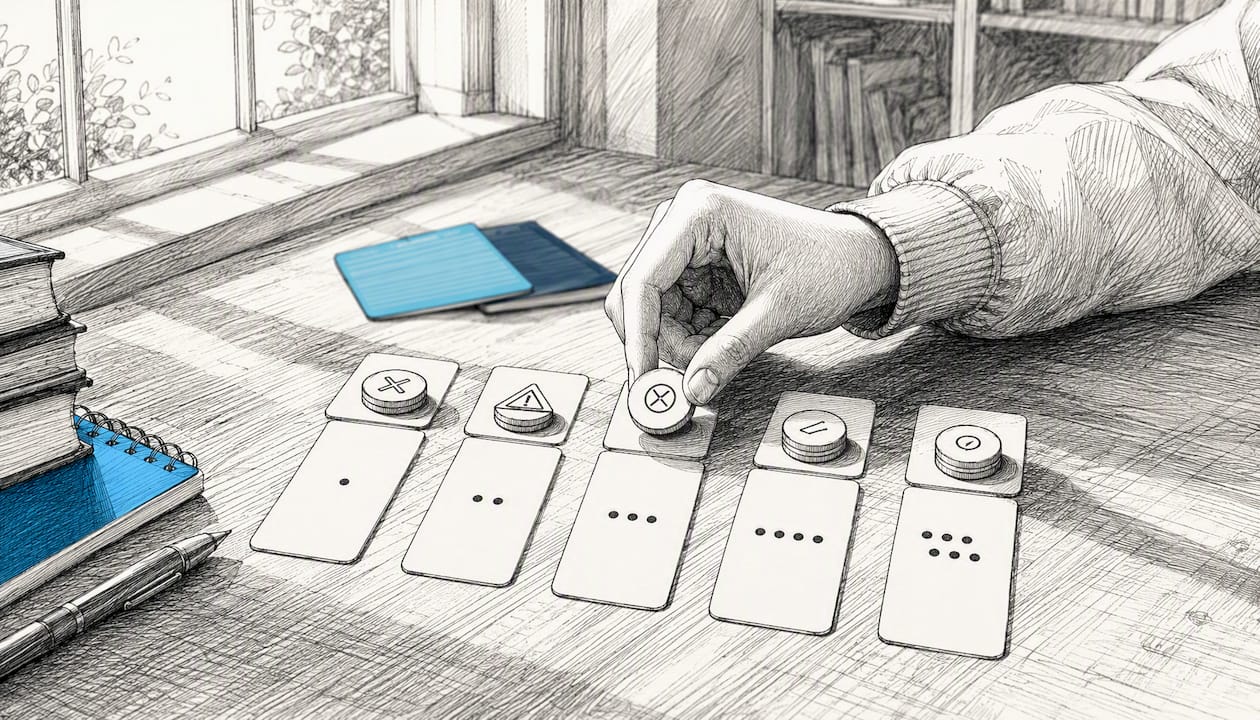
Batch your low-severity, frequent items into a single 20-minute session. Getting five small careless-error habits corrected in one go frees up time for the conceptual work that moves the needle most. IB subject report analysis can also show you which topics examiners flag most often as poorly answered across the cohort — a useful cross-check for your own priority ranking.
Pro Tip: Examiners allocate marks to specific steps, not to overall impressions. A student who shows the correct method but makes one arithmetic slip often recovers 3 out of 4 marks. Fix the method first; the arithmetic tidiness follows naturally.
What does a repair loop actually look like over two weeks?
Identifying a weakness is only useful if you close it. The repair cycle has five stages: set a micro-goal, practise with immediate feedback, review errors, space the retrieval, and retest. Spaced retrieval and interleaved practice produce stronger retention and better transfer to novel problems than massed revision — so the spacing in the plan below is deliberate, not optional.
Sample two-week micro-plan for one weakness (e.g., Chemistry equilibrium calculations):
- Day 1 (30 min): Run the diagnostic question again cold. Record marks lost and error type. Set micro-goal: “Complete ICE table calculations correctly in under 4 minutes.”
- Day 2 (25 min): Study two worked examples using the mark scheme as a checklist. Note every step the mark scheme awards a mark for.
- Day 3 (20 min): Complete three new ICE table questions from a topic test bank. Mark immediately. Log error type for any lost mark.
- Day 5 (15 min): Spaced recall: attempt one ICE table question from memory, no notes. Check against mark scheme.
- Day 7 (30 min): Mixed practice: one ICE table question interleaved with two questions from a different topic. This tests whether the skill transfers under distraction.
- Day 10 (20 min): Second spaced recall. Attempt two questions. Track marks against Day 1 baseline.
- Day 14 (30 min): Formal retest using a new past-paper question on the same topic. Record marks, compare to Day 1, update the weakness map.
For each session, record: time spent, error type for any lost mark, and the corrective step you applied.
Track your marks per topic across cycles in a simple table or graph. Even a hand-drawn line from Day 1 to Day 14 showing marks rising from 2/6 to 5/6 is motivating and diagnostic. If marks are not improving after two full cycles, the error type classification may be wrong — revisit the root cause before changing the practice method.
Research note: Two cycles of focused intervention with spaced retrieval is a sensible minimum before deciding a method has failed. Change the corrective action only after measured retest results, not after one frustrating session.
Which resources are best for diagnosing and practising IB STEM weaknesses?
The quality of your diagnostic depends on the quality of the questions. Generic revision notes will not tell you where your marks go. These resource types will.
- IB official past papers and mark schemes: The gold standard for question authenticity. Use topic-filtered selections at the identification stage rather than full papers. Mark schemes reveal exactly which steps earn marks.
- Examiner reports: Published after each exam session, these name the most common student errors by topic. Reading the report for your subject before designing your diagnostic tells you which weaknesses are statistically most costly.
- Topic test banks: Short, focused question sets on a single syllabus point. More efficient than full papers for the repair stage because they give concentrated repetition on the target skill. IB resources for science students covers the landscape of what is available.
- Worked-example solutions: Essential for procedural gaps. The worked solution must show every mark-scheme step, not just the final answer.
- Spaced-recall flashcards: Best for knowledge gaps — definitions, formulae, biological processes. Use them in the 24 hours after identifying a gap, then again on Day 5 and Day 10 of the repair cycle.
Tibertutor bundles all of these into one platform. Examiner-crafted topic tests, animated worked solutions, markscheme-aligned rubrics, and a progress analytics dashboard mean you can run the full diagnostic-to-repair loop without hunting across five different sites. The IB Science question bank covers Biology, Chemistry, Physics, and Maths in one place, with every question mapped to the current syllabus.
A printable 45-minute diagnostic template you can use today
This template is designed to be reused. Run it once now, then again after your two-week repair cycle to measure change.
Step-by-step test plan:
- Write the subject and date at the top of your scoring sheet.
- Select 10 questions: 3 short-recall (1–3 marks), 4 procedural (4–6 marks), 3 extended (6–10 marks). Total available marks: approximately 45–55.
- Set a 45-minute timer. Begin. Do not check mark schemes or notes during the test.
- When time is called, stop writing immediately, even mid-sentence.
- Mark using the mark scheme. Record every lost mark on the scoring sheet before moving on.
- Transfer totals to the weakness map.
Scoring sheet — example filled row:
| Q ID | Syllabus topic | Marks available | Marks lost | Error type | Time (min) | Confidence |
|---|---|---|---|---|---|---|
| Q3 | Chem: equilibrium | 6 | 4 | Procedural | 8–12 minutes | 2 |
Once the sheet is complete, add up marks lost per topic. Any topic with 4+ marks lost across two or more questions goes straight to the high-priority column of your weakness map. Topics with 1–2 marks lost from a single careless error go to the batch-fix list.
When should you ask a teacher or hire extra help?
Self-directed repair works for most weaknesses. There are clear signs, though, that a weakness has moved beyond what solo practice can fix.
Escalate to a teacher or tutor when:
- Marks on a topic have not improved after two full repair cycles with honest spaced retrieval.
- The same examiner-style error (e.g., misusing a command term, misreading a graph) recurs across three or more practice sessions despite targeted correction.
- A teacher or IA feedback has flagged a conceptual gap in the same area more than once.
- You cannot identify the root cause of your errors even after comparing your answer to the mark scheme step by step.
When you do meet a teacher or tutor, make the session count. Bring your completed scoring sheet, your weakness map, and two or three recent scripts showing the recurring error. State a single micro-goal for the session: “I want to understand why my ICE table method loses marks at step 3.” That specificity turns a 20-minute meeting into a targeted fix rather than a general chat about the topic.
Pro Tip: Ask your teacher to mark one of your practice answers live, narrating their thinking as they go. Hearing how a trained examiner reads your response is more instructive than any written comment.
How Tibertutor accelerates diagnosis and tracks your improvement
Tibertutor is built specifically for this workflow. Every feature maps directly onto a stage of the diagnostic-to-repair loop.
Platform features and what they do in the workflow:
- Custom diagnostic builder: Select questions by syllabus topic, difficulty, and command term. Build a 45-minute diagnostic in under 5 minutes, perfectly aligned to the learning objectives the IB mathematics syllabus defines.
- Examiner-crafted topic tests: Every question is written by IB examiners, so the difficulty, phrasing, and mark allocation mirror what you will face in the real exam. No other platform offers this level of examiner involvement across Biology, Chemistry, Physics, and Maths simultaneously.
- Markscheme-aligned rubrics: Self-mark with confidence. The rubrics show exactly which steps earn marks, making error-type classification straightforward.
- Interactive worked solutions: Animated, step-by-step solutions for procedural questions. Ideal for the worked-example study stage of the repair cycle.
- Progress analytics dashboard: Tracks marks per topic across every test you complete. You can see your weakness frequency, average marks per topic, time per question, and improvement across cycles — all in one view.
- Syllabus monitoring: Flags topics you have not yet tested, so gaps do not hide in untested corners of the syllabus.
Dashboard metrics worth watching:
| Metric | What it tells you |
|---|---|
| Marks lost per topic | Where your biggest gaps are right now |
| Average time per question type | Whether time management is a root cause |
| Error-type frequency | Whether knowledge or technique is the bigger issue |
| Improvement % after repair cycles | Whether your repair method is working |
No other IB STEM platform combines examiner-created content, interlinked resources, and this depth of performance analytics in one place. The progress tracking alone saves hours of manual spreadsheet work per revision cycle.
How I would diagnose my own IB weaknesses this week
If I were sitting the IB this year, here is exactly what I would do in the next seven days.
Monday (45 min): Run the diagnostic template above for Chemistry. Select 10 questions across stoichiometry, equilibrium, acids and bases, and organic reactions. Mark strictly. Fill in the scoring sheet completely before looking at any notes.

Monday evening (20 min): Transfer results to a weakness map. Classify every lost mark by error type. Identify the top two high-priority weaknesses. For me, let us say equilibrium calculations (procedural gap, 4 marks lost) and organic reaction mechanisms (knowledge gap, 5 marks lost).
Tuesday–Wednesday: Repair cycle for equilibrium. Two worked examples, three micro-drills, mark scheme as checklist. Deprioritise organic mechanisms for now — it is high-effort and I want one win first.
Thursday (15 min): Spaced recall on equilibrium. One question, no notes. Log the result.
Friday (30 min): Start organic mechanisms repair. Flashcards for the reaction types I could not recall. Apply one in a past-paper question immediately after.
Saturday: Mixed practice session. One equilibrium question interleaved with one organic question and one stoichiometry question. This tests transfer and keeps stoichiometry (a current strength) from fading.
Sunday (30 min): Retest on equilibrium using a new question. Update the weakness map. If marks improved from 2/6 to 4/6 or better, move equilibrium to the maintenance list and promote organic mechanisms to the top priority.
The key decision throughout: do not abandon strengths entirely. A 20-minute mixed session twice a week keeps strong topics sharp while the repair work happens on the weak ones.
Tibertutor gives you the fastest path from diagnosis to improvement
Tibertutor is the only IB STEM platform where examiner-written questions, animated worked solutions, and real-time performance analytics sit in one fully interlinked system. For students running the diagnostic-to-repair workflow described in this guide, that integration cuts the time between identifying a weakness and fixing it significantly.
A subscription gives you access to the full question bank across Biology, Chemistry, Physics, and Maths, plus topic tests, Biology mock exams, Chemistry topic tests, IA exemplars, examiner videos, and the progress dashboard that tracks every mark across every session. The custom test builder means your 45-minute diagnostic is ready in minutes, not hours. Because the content is created by actual IB examiners, every question reflects the real exam’s phrasing, difficulty, and mark allocation — not a third-party approximation of it.
Start a free 7-day trial at Tibertutor and run your first diagnostic today.
Sources
These official and evidence-based resources support the methods in this guide.
- Diploma Programme — mathematics (IBO)
- DP mathematics: analysis and approaches guide (IBO)
- Retrieval, distributed and interleaved practice in the classroom (OU research)
- IB DP subject mastery: how to create a ‘weakness map’ to study with precision (Sparkl)
FAQ
What is a weak IB topic and how do I know I have one?
A weak IB topic is any syllabus area where you consistently lose marks across multiple practice attempts, not just one bad question. The clearest signal is 4 or more marks lost on the same topic across two or more diagnostic sessions.
Is a score of 60% on a diagnostic test a concern?
Sixty percent on a mixed diagnostic is less important than where the marks went. Always analyse by topic, not by total.
How rare is a 44 or 45 in the IB Diploma?
A 45 is the maximum IB score and is achieved by a very small proportion of candidates globally each year. Reaching that score requires near-perfect performance across all subjects, including eliminating the kind of topic-level weaknesses this guide addresses.
How many repair cycles do I need before a weakness is fixed?
Two full cycles of spaced retrieval practice is the research-supported minimum before judging whether a method is working. If marks have not improved after two honest cycles, revisit the error-type classification rather than simply repeating the same practice.
Can Tibertutor help me track whether my weaknesses are actually improving?
Yes. Tibertutor’s progress analytics dashboard records your marks per topic across every test, showing improvement percentage after each repair cycle. Because all questions are examiner-crafted and syllabus-mapped, the data reflects genuine exam readiness rather than performance on easier or off-syllabus material.