IB World School status: a guide for parents and educators
An IB World School is a school formally authorised by the International Baccalaureate Organisation (IBO) to deliver one or more IB programmes. That authorisation is not a marketing label. It is a checkable licence, granted only after a rigorous review process, that gives a school the legal right to register students for official IB assessments.
Three things follow directly from that definition:
- Authorised schools can enter students for official IB examinations and assessments. Schools without authorisation cannot.
- Authorised schools must follow IB standards and practices, covering curriculum design, teacher development, and assessment.
- The designation is trademark protected. Only authorised schools may use the names “International Baccalaureate”, “IB”, or “IB World School” and the associated logos.
If a school claims to offer the IB but cannot be found in the official IB school directory, treat that claim with caution.
Key takeaways
IB World School status is a formal, checkable authorisation granted by the IBO that gives schools the right to deliver IB programmes and enter students for official assessments.
| Point | Details |
|---|---|
| Verify authorisation officially | Search the IB school directory to confirm a school is authorised, not just a candidate. |
| Know which programmes are authorised | A school may hold authorisation for one programme but not another; always confirm the specific programme. |
| Authorisation is a baseline, not a guarantee | Quality of science and maths teaching still varies; probe teacher training and lab provision. |
| Targeted exam practice remains essential | Examiner-authored resources aligned to IB mark schemes are the most effective supplement to authorised-school teaching. |
| Status requires ongoing maintenance | Schools undergo periodic reviews; ask when the last evaluation took place and what the outcomes were. |
Table of Contents
- What does IB World School status mean for your child?
- How authorisation shapes teaching and professional development
- Why schools pursue and maintain IB World School status
- How does a school become an IB World School?
- How is IB World School status maintained over time?
- How to verify a school’s IB World School claim
- Common misconceptions about IB World School status
- How IB World School status affects STEM exam preparation
- A perspective on what parents and educators actually need to know
- Sources
- FAQ
What does IB World School status mean for your child?
Authorisation gives students something concrete: access to globally standardised IB assessments. A student at an authorised school can sit official examinations and receive credentials recognised by universities worldwide. That access simply does not exist at a school that has not been through the authorisation process.
The IB offers four programmes, each covering a different stage of schooling. Understanding which one your child’s school is authorised for matters, because the academic expectations differ considerably.
| Programme | Age range | Purpose | Typical academic focus |
|---|---|---|---|
| Primary Years Programme (PYP) | 3–12 | Inquiry-based primary education | Cross-curricular concepts |
| Middle Years Programme (MYP) | 11–16 | Structured secondary framework | Disciplinary and interdisciplinary study |
| Diploma Programme (DP) | 16–19 | Pre-university qualification | Six subject groups including sciences and maths |
| Career-related Programme (CP) | 16–19 | Vocational and academic blend | Applied learning with IB core elements |
For most families focused on university preparation, the Diploma Programme carries the greatest weight. DP students follow a balanced two-year curriculum across six subject groups, which typically includes a science and a mathematics course. The workload is demanding by design, and the assessments are marked against common global standards. That consistency is one of the most tangible benefits of studying at an authorised school.
Authorised schools must also follow inclusive practices under IB standards, including access arrangements for students with additional needs in programmes such as the MYP, which can affect how science and maths teaching is delivered in the classroom.
- Students receive consistent, externally moderated assessment criteria rather than school-designed marking.
- Teachers at authorised schools are expected to engage in ongoing IB professional development.
- The predictable exam structure helps students prepare more efficiently, particularly in sciences and maths.
Pro Tip: Ask the school which specific programmes it is authorised for, not just whether it is “an IB school”. A school authorised for the PYP only cannot enter your child for DP examinations.
How authorisation shapes teaching and professional development
Authorisation changes what teachers are expected to do, not just what they teach. Schools carrying IB World School status must align their staff development with IB standards and practices, which means teachers cannot simply adapt their existing methods and call it IB teaching.
In practice, this means:
- Teachers attend IB-approved training for their specific programme and subject area.
- Schools receive curricular resources and moderated assessment guidance directly from the IBO.
- Internal assessment in sciences and maths is subject to external moderation, which keeps marking standards consistent across schools globally.
- A programme relationship manager supports schools during candidacy and beyond, helping staff prepare for authorisation and subsequent reviews.
For parents assessing a school’s quality, the depth of teacher training is one of the most telling indicators. A school that has held authorisation for several years and can point to a structured programme of IB professional development is likely to deliver more consistent science and maths teaching than one that has only recently been authorised.
Pro Tip: When visiting a prospective school, ask specifically: “How many of your science and maths teachers have completed IB category 1 and category 2 training?” A confident, specific answer is a good sign. Vagueness is not.
Questions worth asking any school about teacher training:
- What IB training have science and maths teachers completed in the past two years?
- How does the school support teachers who are new to IB assessment?
- Has the school’s internal assessment been externally moderated, and what were the outcomes?
Why schools pursue and maintain IB World School status
Schools apply for IB authorisation for reasons that go well beyond prestige. The IB’s standards and practices framework functions as an external quality assurance mechanism, requiring schools to demonstrate that their curriculum, assessment, and governance meet defined benchmarks. That external audit is something a school cannot replicate internally, however good its leadership.
Membership of the IB community, which spans several thousand authorised schools globally, gives schools access to shared professional development, benchmarking data, and a network of educators working within the same framework. For schools with a strong STEM focus, that network is particularly useful: it connects science and maths departments with colleagues who are navigating the same assessment challenges.

There are operational obligations too. Authorised schools pay ongoing fees to the IBO, submit to periodic reviews, and must demonstrate continuous programme development. These are not trivial commitments, which is precisely why the status carries weight. A school that has maintained authorisation over multiple review cycles has shown it can meet those obligations consistently.
For families focused on STEM outcomes, IB World School status also signals that a school is likely to attract and retain specialist science and maths teachers who want to work within a structured, internationally recognised framework.
How does a school become an IB World School?
The path to authorisation is a school-driven, developmental process with no fixed timeline. The IBO is explicit that the authorisation process is rigorous and that readiness, not speed, determines progress.
- Feasibility study. The school assesses whether it has the resources, governance, and staff capacity to deliver an IB programme. This includes reviewing laboratory provision for sciences, staffing, and budget for ongoing IB fees and training.
- Application and candidacy. The school submits a formal application to the IBO. If accepted, it becomes a candidate school. During candidacy, the IBO assigns a programme relationship manager to support curriculum planning and staff development. Candidacy is not authorisation and does not allow the school to award IB qualifications.
- Verification visit. IB educators visit the school to assess evidence of alignment with IB standards and practices. The school must demonstrate curriculum implementation, teacher training records, and assessment processes across all subject areas.
- Authorisation decision. If the verification visit confirms readiness, the IBO grants authorisation. The school may then use the IB name and logos under licence and register students for official IB assessments.
Fees apply at each stage, and timelines vary because they depend entirely on how quickly a school can gather and demonstrate the required evidence. A school that rushes candidacy without adequate preparation is unlikely to pass the verification visit.
| IB community metric | Figure |
|---|---|
| Authorised IB World Schools globally | Thousands |
| Countries with authorised IB schools | Many countries worldwide |
| IB programmes available | Multiple programmes including PYP, MYP, DP, and CP |
Pro Tip: If a school tells you it is “in the process of becoming IB”, ask which stage it is at and when the verification visit is scheduled. A school still in candidacy cannot yet enter your child for IB assessments.
How is IB World School status maintained over time?
Authorisation is not a one-time award. Schools are subject to periodic programme evaluation, during which the IBO reviews whether standards and practices are still being met. Schools that fall short face remediation requirements, and in serious cases, authorisation can be withdrawn.
The licence to use the IB name and logos is legally protected. Only authorised schools may use the terms “International Baccalaureate”, “IB”, or “IB World School” and the associated branding. A school using this language without current authorisation is in breach of IB trademark rules.
Common reasons schools struggle to maintain status include:
- Insufficient evidence of ongoing teacher professional development.
- Gaps in laboratory or resource provision that affect practical science delivery.
- Governance or leadership changes that disrupt programme continuity.
- Failure to complete required reporting or submit to scheduled reviews.
Where gaps are identified, schools typically follow a remediation plan agreed with the IBO. Outright withdrawal of status is less common but does occur.
Pro Tip: Ask a school when its most recent programme evaluation took place and what the outcomes were. An authorised school should be able to share this without hesitation.
How to verify a school’s IB World School claim
This is the most practical section for parents making a school choice. Marketing language can be misleading, and the difference between an authorised school and an “IB-inspired” one has real consequences for your child’s qualifications.
- Search the official IB school directory and confirm the school appears as authorised, not as a candidate.
- Check which specific programmes the school is authorised for. A school may be authorised for the MYP but not the DP.
- Ask the school for its authorisation certificate and the date of its most recent programme evaluation.
- Confirm the date of authorisation. A recently authorised school has less of a track record than one that has maintained status through multiple review cycles.
- For sciences and maths specifically, request sample schemes of work, teacher training records, and evidence of internal assessment moderation outcomes.
Watch for these phrases in school marketing, which do not indicate IB authorisation:
- “IB-inspired curriculum”
- “Follows the IB approach”
- “IB-aligned teaching”
- “Preparing students for the IB”
None of these phrases indicate that a school is authorised. A candidate school cannot award IB qualifications, and a school using IB-adjacent language without appearing in the official directory is not an IB World School.
Common misconceptions about IB World School status
“IB-inspired means IB-authorised.” It does not. Any school can describe its teaching as inquiry-based or IB-influenced. Only authorised schools have been through the verification process and can enter students for official assessments.
“Authorisation guarantees excellent teaching.” Authorisation sets a baseline. It confirms that a school has met defined standards at the point of review, but it does not guarantee that science or maths teaching is uniformly strong. Laboratory provision, specialist staffing, and internal assessment quality still vary between authorised schools.
“Being an IB World School automatically gets students into top universities.” The IB Diploma is widely recognised and respected by selective universities, including those in the US and UK. Understanding what Ivy League admissions teams look for makes clear that the IB credential is one strong factor among many, not a guaranteed entry ticket. Grades, extended essays, and personal statements all matter alongside the qualification itself.
“Candidate schools are almost authorised.” Candidacy is a developmental phase, not a waiting room. It carries no guarantee of future authorisation, and the timeline to authorisation is not fixed.
How IB World School status affects STEM exam preparation
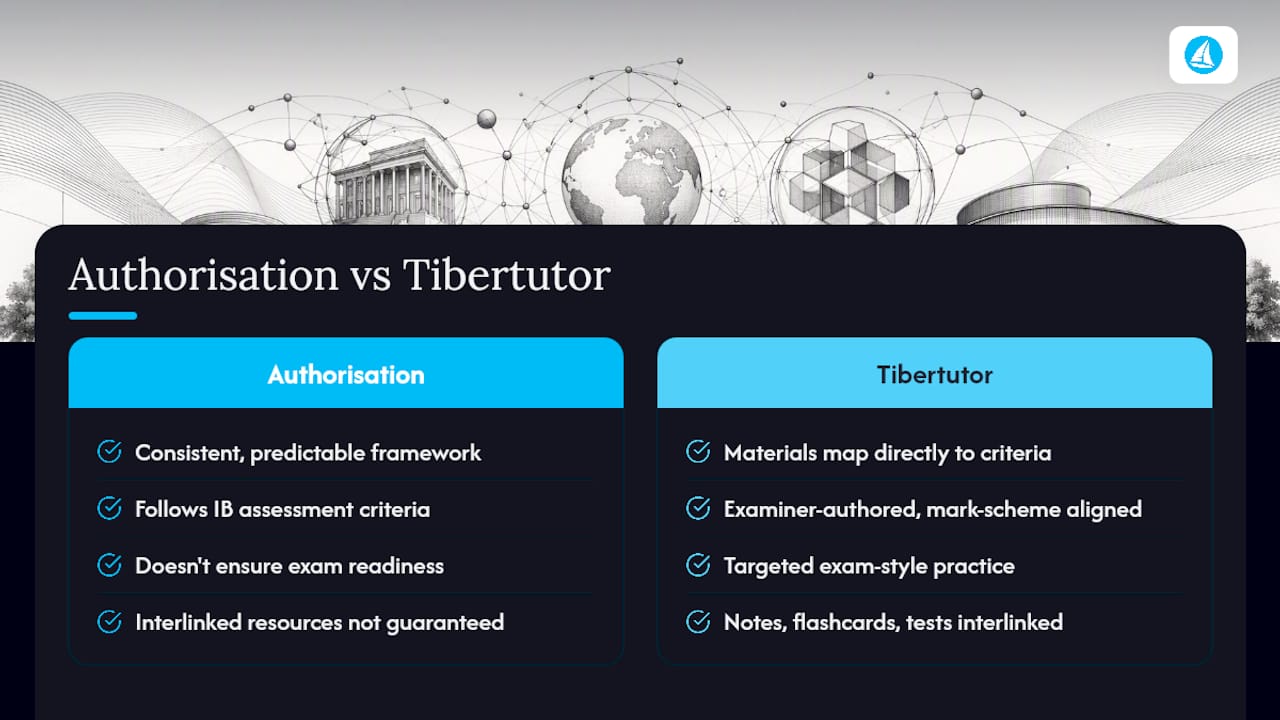
Authorisation means students follow IB assessment criteria in their science and maths courses. That is genuinely useful: it creates a consistent, predictable framework for exam preparation. But authorisation alone does not produce exam-ready students. The gap between following IB criteria and performing confidently under exam conditions is where targeted practice matters most.
Because IB assessments use common global standards, examiner-authored practice aligned to IB mark schemes delivers disproportionate value to students preparing for Biology, Chemistry, Physics, and IB Maths. A student who has worked through questions written by the people who set and mark the real papers is practising in the closest possible approximation to the actual exam.
Tibertutor is built specifically for this. Every piece of content on the platform, from exam-style questions and animated videos to mock exams and AI-powered flashcards, is authored by real IB examiners. The platform covers IB Biology, Chemistry, and Physics in full, alongside IB Maths, with resources that map directly to current IB assessment criteria. What sets Tibertutor apart is how tightly everything connects: notes, flashcards, topic tests, and mock exams are all interlinked, so a student moving from revision to practice to self-assessment never loses the thread of what they are working on.
The progress tracking and performance analytics on Tibertutor are genuinely unlike anything else available online. Students and teachers can see exactly where understanding is strong and where it is not, at the topic and subtopic level, with insights that update in real time. For parents trying to support a child at an authorised school, that visibility is invaluable. For teachers, it means targeted intervention rather than guesswork.
Tibertutor offers a free 7-day trial, with subscription options for individual students and school-wide access. Content is written by actual IB examiners, making it the strongest value-for-money STEM resource in the IB space. Explore IB Biology mock exams, IB Chemistry tests, and IB Maths AI flashcards to see how the platform complements authorised-school teaching.
A perspective on what parents and educators actually need to know
Parents asking about IB World School status are usually asking a deeper question: “Is this school genuinely good for my child, or is it trading on a label?” That is the right question, and the honest answer is that authorisation is necessary but not sufficient.
The IB framework is rigorous. The assessment criteria for sciences and maths are demanding, and the internal assessment process, when properly moderated, produces students who understand how to construct scientific arguments and apply mathematical reasoning. That is worth something. But the quality of delivery inside an authorised school depends heavily on teacher expertise, laboratory resources, and how seriously the school engages with IB professional development between review cycles.
What I would tell any parent: use the official directory to confirm authorisation, then go one level deeper. Ask about teacher training records. Ask to see internal assessment moderation outcomes. Ask whether the school’s science and maths results are above or below the global IB average. These are questions a well-run authorised school will answer confidently.
For students at authorised schools who want to close the gap between classroom learning and exam performance, the most effective step is practising with examiner-authored material that mirrors the real assessment. That is not a generic recommendation. It reflects how IB marking actually works: examiners reward specific language, specific structures, and specific levels of detail. Practising with content written by those same examiners builds exactly those habits.
Pro Tip: Ask the school for its most recent DP results compared to the global IB average. Authorised schools have access to this data and should share it willingly. If they cannot or will not, that tells you something important.
Sources
- International Baccalaureate®
Always cross-check a school’s IB claim against the official directory before accepting marketing language at face value.
FAQ
What does it mean for a school to be an IB World School?
It means the school has been formally authorised by the International Baccalaureate Organisation to deliver one or more IB programmes. Only authorised schools can register students for official IB assessments and use the IB name and logos under licence.
Is an IB school better than a regular school?
Authorisation signals that a school meets defined international standards for curriculum, assessment, and teacher development, which is a meaningful quality marker. Whether it is the right fit depends on your child’s learning style, the school’s specific STEM provision, and how well it has maintained those standards between review cycles.
What is the IB Diploma equivalent to in the US?
The IB Diploma is widely recognised by US universities as a rigorous pre-university qualification, broadly comparable to Advanced Placement (AP) courses in terms of academic demand. Many US universities grant college credit for strong DP scores, particularly in sciences and maths.
Is IB accepted at Harvard?
Harvard and other highly selective US universities recognise the IB Diploma and consider it strong preparation for university-level study. Acceptance depends on the full application, including grades, extended work, and personal profile, not the IB credential alone.
How do I check if a school is genuinely IB-authorised?
Search the official IB school directory at ibo.org/programmes, confirm the school appears as authorised (not as a candidate), and check which specific programmes it holds authorisation for. A genuine IB World School can also provide its authorisation certificate on request.