IB programme evaluation: a guide for school leaders
IB programme evaluation is a mandatory review process conducted by the International Baccalaureate Organization to ensure every authorised IB World School maintains and develops the standards of its programme. It is not an inspection in the traditional sense. Think of it as a structured conversation between your school and the IBO, one that is designed to support growth rather than catch you out.
What is IB programme evaluation and why does it matter?
At its core, IB programme evaluation is both a requirement and a service. The IBO uses it to verify that programme standards and practices are being upheld across all authorised schools worldwide. For UK school leaders and IB coordinators, understanding this process is the first step towards using it well.
The evaluation is grounded in the Programme Standards and Practices document, which organises its criteria into four overarching categories:
- Purpose: the school’s commitment to IB philosophy and mission
- Environment: the physical, human, and financial resources supporting the programme
- Culture: the collaborative and reflective ethos across the school community
- Learning: the quality and fidelity of teaching and learning in IB classrooms
These four categories frame every aspect of the review. For IB science departments in particular, the “learning” category carries direct implications for how Biology, Chemistry, and Physics are taught, assessed, and resourced. The process involves both a school-led self-study and external verification by the IBO, making it genuinely collaborative rather than top-down.
A common misconception is that evaluation targets individual teachers. It does not. The IBO is explicit that the process focuses on institutional capacity and programme implementation, not on appraising any single member of staff.
How the IB programme evaluation process works in practice
The evaluation cycle runs every five years after a school’s initial authorisation. The relevant IB regional office schedules the process and provides timelines well in advance, giving schools sufficient time to prepare documentation and organise internal reflection.
Here is how the process unfolds:
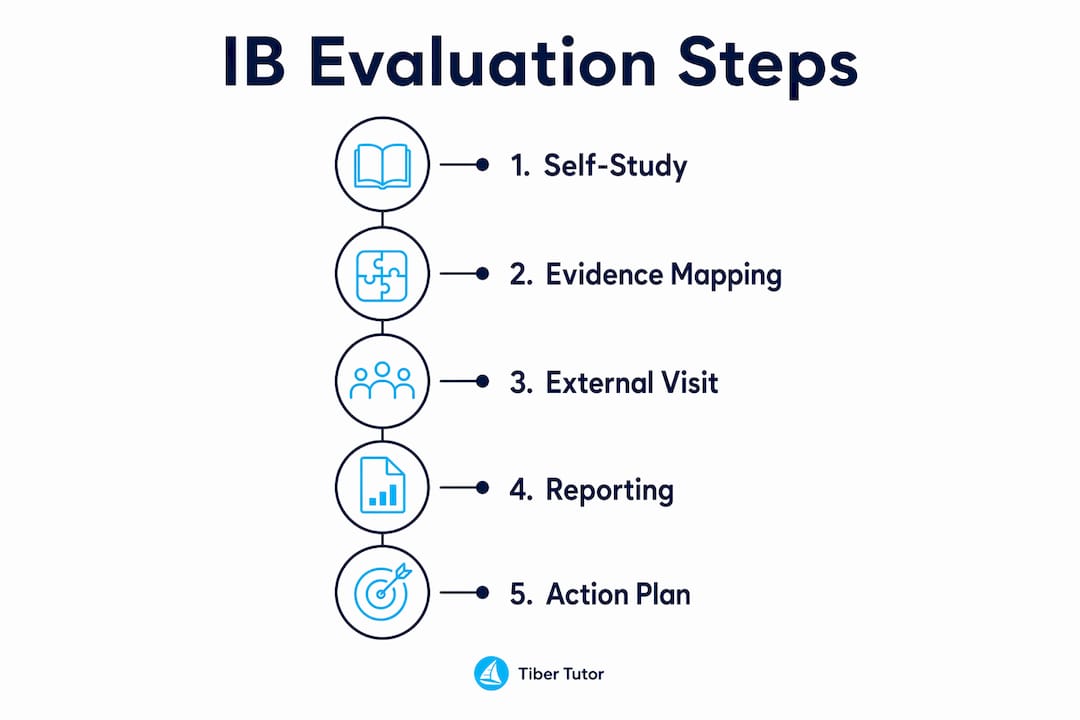
- Notification and planning: The IB regional office contacts the school with timelines, submission deadlines, and procedural guidance.
- Self-study questionnaire: The school completes a detailed questionnaire assessing its own implementation of the programme against the Programme Standards and Practices. This is the most important stage of the entire process.
- Evidence gathering: The self-study must be evidence-based, drawing on existing school documentation that reflects actual practice over the five-year review period.
- Levels of implementation: For each practice, the school indicates its level of implementation, from low to high, using agreed descriptors to maintain consistency across departments.
- Action plan integration: The outcomes of the self-study feed directly into the school’s ongoing five-year action plan, which is submitted as part of the supporting documentation.
- Submission: The completed questionnaire and supporting documents are submitted electronically to the IB regional office.
- Evaluation visit: An IB visiting team may conduct an on-site visit to verify the school’s self-assessment. The visit gathers evidence on programme implementation since the last evaluation or authorisation.
- Final report: After analysing the self-study, supporting documents, and visit findings, the IBO sends a final evaluation report to the head of school.
Several challenges arise at different stages. Schools that leave the self-study to the final months often find the evidence-gathering phase overwhelming. Coordinators who carry the process alone, without drawing in science heads and classroom teachers, tend to produce thinner self-studies that miss departmental nuance. Early planning and broad staff involvement are the two factors that most reliably produce a well-evidenced submission.
Pro Tip: Start mapping your evidence against the four standards categories at least twelve months before your submission deadline. A shared document where science teachers log relevant practices as they happen makes the evidence-gathering stage far less burdensome.

Understanding the IB evaluation report and its components
The evaluation report is sent directly to the head of school, who is responsible for sharing its findings with the wider school community. The report is structured around three distinct sections, each carrying different implications for your school’s planning.
- Commendations recognise practices that address the Programme Standards and Practices in ways that solve real challenges or demonstrate outstanding implementation. These are worth celebrating, but also worth analysing: they tell you what is working and why.
- Recommendations provide guidance for further developing the programme. They are not urgent requirements, but they should feed directly into your next five-year action plan.
- Matters to be addressed are the most serious category. These are areas where, if left unresolved, the integrity of the programme is at risk and the school’s authorisation as an IB World School could be jeopardised. The relevant IB office sets a specific deadline for the school to submit a response, including evidence that the matter has been resolved or that a credible plan is in place.
The report focuses on systemic programme issues, not on individual classroom performance. A matter to be addressed in an IB science department might relate to how the school resources laboratory work, or whether the internal assessment process is consistently applied, rather than to any one teacher’s practice. Understanding this distinction helps school leaders communicate the report’s findings constructively to staff.
Once the evaluation is complete, the school incorporates the IBO’s recommendations into a refreshed action plan for the new five-year cycle. Responses to matters to be addressed are handled separately, within the timelines set by the regional office. You can read more about how evaluation reports guide programme development in IB schools.
How evaluation drives continuous improvement in IB sciences
Evaluation works best when it is treated as an ongoing process rather than a five-yearly event. The IBO frames it explicitly as a catalyst for school improvement, linking findings to action plans and professional development rather than simply producing a report that sits in a drawer.
For IB science departments, this means the evaluation cycle should connect directly to how Biology, Chemistry, and Physics are taught and assessed day to day. Schools that integrate their IB programme standards into their regular departmental review processes find that evaluation feels like a natural checkpoint rather than an external imposition.
A few practical ways to embed evaluation thinking into ongoing school improvement:
- Review your action plan termly, not just at evaluation time, so that progress is documented continuously.
- Use the self-study questionnaire as a reflective tool with science department heads at the start of each academic year.
- Align professional development planning with the gaps identified in your most recent evaluation report.
- Encourage science teachers to document how their practice reflects IB philosophy, particularly around inquiry-based learning and internal assessment.
The self-study process has the greatest impact when it reaches beyond the IB coordinator. When science teachers, heads of department, and senior leaders all engage with the questionnaire, the resulting self-study reflects a richer, more honest picture of the school’s practice. Schools that treat the self-study as the coordinator’s job alone tend to miss the departmental detail that evaluators look for.
Evaluation also builds a culture of reflective practice. When staff understand that the process is about programme quality rather than personal performance, they engage more openly. That openness produces better evidence, more honest self-assessment, and ultimately a stronger report.
What evaluation outcomes look like in practice
Because the IBO does not publish individual school evaluation reports, specific named case studies are not publicly available. What the evaluation framework does make clear, however, is the range of outcomes schools typically experience and the patterns that distinguish strong results from weaker ones.
Schools that receive commendations in IB sciences often share common characteristics. Their laboratory programmes are well-documented and consistently aligned with IB internal assessment requirements. Science teachers can articulate how their practice connects to IB philosophy, and the school has a clear record of how it has developed its programme since the last evaluation. The action plan is live and updated, not a document produced solely for submission.
Schools that receive matters to be addressed in science departments frequently face one of three issues. First, inconsistent application of internal assessment procedures across Biology, Chemistry, or Physics. Second, insufficient evidence that the school has acted on recommendations from the previous evaluation cycle. Third, a gap between what the self-study claims and what the visiting team observes during the on-site review.
The visiting team’s role is specifically to verify the self-assessment, not to conduct an independent audit. Where the self-study is honest and evidence-based, the visit tends to confirm rather than challenge the school’s own conclusions. Where the self-study overstates implementation, the gap becomes visible quickly. Coordinators who audit IB syllabus coverage regularly are far better placed to produce an accurate self-study.
The five-year cycle also means that schools have a genuine opportunity to show growth. A recommendation from one cycle that becomes a commendation in the next is a concrete demonstration of programme development. That trajectory is exactly what the IBO is looking for.
When your students are preparing for IB science assessments, Tibertutor gives them the exam-style practice they need to build real confidence. Explore IB Biology tests and IB Chemistry tests built by experienced IB examiners, with detailed analytics to track progress and target weaknesses.
Key takeaways
IB programme evaluation is a five-year cycle of self-study and external verification that drives continuous improvement in IB World Schools, with outcomes directly shaping each school’s action plan.
| Point | Details |
|---|---|
| Mandatory five-year cycle | Evaluation occurs every five years after authorisation, scheduled by the IB regional office. |
| Four standards categories | Purpose, environment, culture, and learning frame all evaluation criteria and self-study responses. |
| Three report sections | Commendations, recommendations, and matters to be addressed each require different responses from school leaders. |
| Not a teacher appraisal | Evaluation targets institutional programme implementation, not individual teacher or student performance. |
| Self-study is the foundation | The self-study questionnaire is the most important stage; broad staff involvement produces the strongest outcomes. |
FAQ
What is an IB evaluation?
IB programme evaluation is a mandatory review conducted by the International Baccalaureate Organization every five years to verify that a school is implementing its IB programme in line with the Programme Standards and Practices. It combines a school-led self-study with an external verification visit and results in a formal report with commendations, recommendations, and any matters to be addressed.
How is the IB programme assessed during evaluation?
The IBO assesses programme implementation against four categories of standards: purpose, environment, culture, and learning. Schools complete a self-study questionnaire, submit supporting documentation, and may receive an on-site visit from an IB visiting team to verify their self-assessment.
Does IB evaluation assess individual teachers?
No. The evaluation process focuses on institutional capacity and programme implementation, not on appraising individual teachers or students. Its aim is to assess how effectively the school as a whole is delivering the IB programme.
What happens if a school receives a matter to be addressed?
The relevant IB regional office sets a deadline by which the school must submit evidence that the matter has been resolved, or a credible plan for its resolution. Failure to respond appropriately puts the school’s authorisation as an IB World School at risk.
How often does IB programme evaluation take place?
The evaluation process occurs every five years after a school’s initial authorisation. The IB regional office provides timelines and submission instructions well in advance to allow schools adequate preparation time.