IB programme standards explained: what students and parents need to know
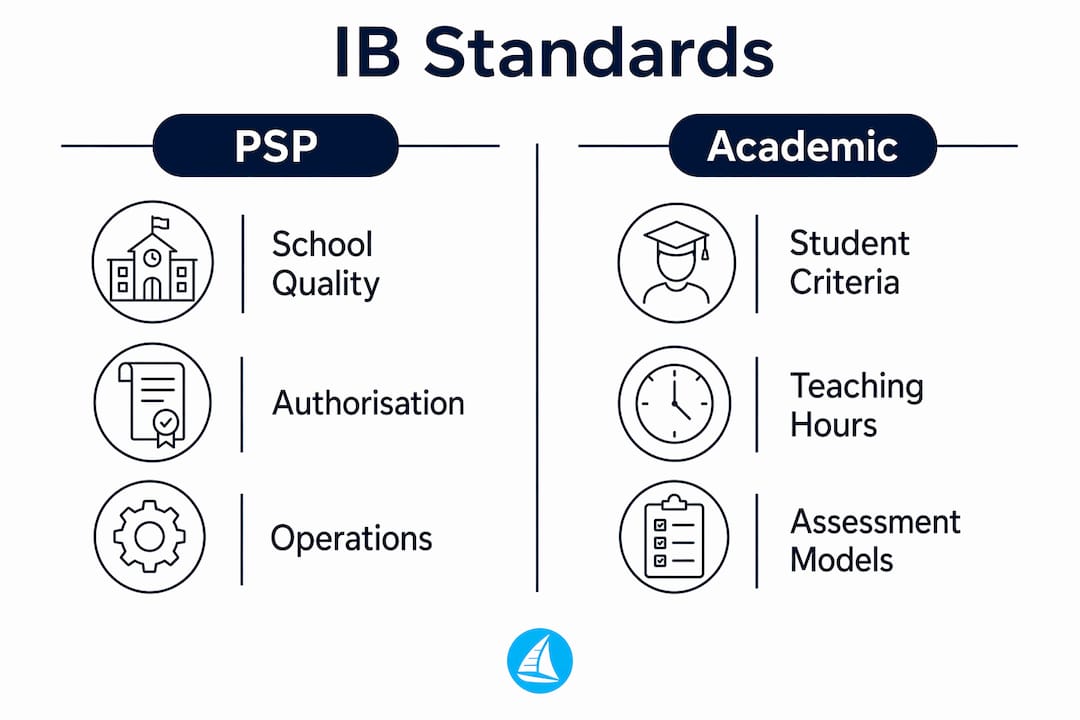
IB Programme Standards are the foundational criteria that govern how IB World Schools deliver quality education and how student achievement is assessed within the International Baccalaureate framework. Two distinct sets of standards exist: the Programme Standards and Practices (PSP), which govern school operations and authorisation, and the curriculum standards, which set academic requirements for students within the Diploma Programme (DP). Understanding what is IB programme standards means recognising that these two frameworks serve different purposes. Conflating them leads to confusion for students, parents, and educators alike.
What are IB Programme Standards and Practices (PSP)?
The Programme Standards and Practices (PSP) is the institutional framework that IB World Schools must follow to gain and maintain authorisation. PSP governs how a school plans, develops, and operationally implements its IB programme. It does not set what students must score or study. It sets what the school must do.
PSP covers several key areas:
- Authorisation and evaluation: Schools must demonstrate alignment with IB philosophy before and after authorisation.
- Policy enforcement: Schools implement policies on academic integrity and international-mindedness as part of their PSP obligations.
- Self-assessment: Schools regularly evaluate their own practice against IB criteria and submit evidence through official IB platforms.
- Programme development: Schools must show ongoing improvement, not just initial compliance.
The 2020 revision of IB Standards and Practices introduced interactive action plans and self-assessment processes focused on programme development and case studies. Schools now submit evaluation documents through the IB Concierge platform and must demonstrate clear alignment with IB approaches. This shift places greater emphasis on evidence of policy communication and genuine school accountability.
IB assessment practices increasingly focus on conceptual understanding and personalised learning rather than rote memorisation. Schools must reflect this philosophy in their teaching policies and support structures.
Pro Tip: If your school undergoes a PSP evaluation, this is an institutional review of how the school delivers the IB programme. It is not a judgement of individual student performance.
What are the IB Diploma academic standards students must meet?
The academic standards within the Diploma Programme are the criteria students must satisfy to receive the IB Diploma. These are fixed, non-negotiable thresholds set by the International Baccalaureate Organisation.
The DP is structured around six subject groups plus three core components: Theory of Knowledge (TOK), the Extended Essay (EE), and Creativity, Activity, Service (CAS). Each subject is scored on a scale of 1 to 7 points.
To be awarded the IB Diploma, students must meet all of the following:
- Minimum total score: 24 points out of a possible 45.
- Higher Level minimum: At least 12 points across three HL subjects.
- Standard Level minimum: At least 9 points across three SL subjects.
- Core requirements: Pass CAS (pass/fail), and achieve a grade of D or above in both TOK and the Extended Essay.
- No failing conditions: A grade of 1 in any subject, or more than two grades of 2, results in diploma failure.
The TOK and Extended Essay together contribute up to 3 bonus points to the total score. CAS carries no points but is mandatory. Missing CAS means no diploma, regardless of academic scores.
The DP passing criteria are strict and inflexible. Students must meet subject-level minimums, core requirement completions, and total points simultaneously. Falling short on any single condition results in diploma failure, even with a high overall score.
Pro Tip: Track your TOK and EE grades carefully. Many students focus entirely on subject scores and overlook that a failing grade in either core component can cost them the diploma.
How do IB curriculum standards structure teaching and assessment?
IB curriculum standards define the content, teaching time, and assessment models for every subject in the Diploma Programme. These standards apply globally, ensuring consistency across all IB World Schools.
The IB curriculum requires the following teaching hours:
| Subject level | Required teaching hours | Typical subjects |
|---|---|---|
| Higher Level (HL) | 240 hours | Biology HL, Chemistry HL, Physics HL |
| Standard Level (SL) | 150 hours | Biology SL, Chemistry SL, Physics SL |
Subject guides run approximately 80–150 pages each and are updated roughly every seven years. These guides define learning outcomes, assessment criteria, and internal assessment requirements for every subject. For IB science students, this means the content of Biology, Chemistry, and Physics exams is tightly prescribed and globally standardised.
Assessment models within the IB curriculum align with conceptual learning rather than simple recall. Internal assessments, practical work, and written examinations all follow criteria set out in the subject guide. Understanding these criteria is the foundation of effective exam preparation.
What do IB standards mean for students, parents, and educators?
Understanding IB standards has direct practical consequences for everyone involved in the IB Diploma. The distinction between PSP and academic standards is the most important starting point.
Key implications include:
- For students: Academic thresholds are fixed. Knowing the minimum scores for HL, SL, TOK, and EE allows you to plan your study priorities clearly.
- For parents: A school’s PSP evaluation reflects institutional quality, not your child’s academic standing. Do not interpret a school review as a signal about your child’s performance.
- For educators: Communicating the difference between PSP and academic standards to families reduces anxiety and builds trust.
Confusion between PSP and academic standards is common. Parents sometimes interpret a school’s authorisation review as a reflection of their child’s academic risk. This misreading can cause unnecessary concern.
The DP’s structured curriculum is highly regarded by universities worldwide precisely because its standards are consistent and demanding. Students who understand the framework perform with greater confidence and purpose.
Pro Tip: Ask your school’s IB coordinator to explain which standards apply to the school and which apply to you as a student. The answer will clarify your responsibilities and your school’s responsibilities separately.
Key takeaways
IB Programme Standards operate on two levels: the PSP governs school quality and authorisation, while the DP academic standards set the fixed thresholds every student must meet to earn the diploma.
| Point | Details |
|---|---|
| PSP is institutional, not academic | PSP governs school operations and authorisation, not individual student scores or content. |
| Diploma requires 24 points minimum | Students must also meet HL, SL, TOK, EE, and CAS thresholds simultaneously to be awarded the diploma. |
| Teaching hours are standardised | HL subjects require 240 hours; SL subjects require 150 hours, as defined in IB subject guides. |
| Core components carry real weight | TOK and EE contribute up to 3 bonus points; CAS is mandatory and pass/fail. |
| Clarity prevents planning errors | Understanding the PSP versus academic standards distinction helps students and parents plan effectively. |
Why the distinction between PSP and academic standards matters more than people realise
Most families entering the IB world hear the phrase “IB standards” and assume it refers to what their child must achieve. That assumption is understandable. It is also frequently wrong, and the consequences of that confusion are real.
I have seen parents grow anxious during school evaluation cycles, believing their child’s diploma is at risk because the school is under review. The school’s PSP evaluation and the student’s academic standing are entirely separate processes. One does not affect the other. Knowing this removes a significant source of unnecessary stress.
What I find genuinely underappreciated is how clearly the academic standards are actually written. The DP passing criteria leave no room for ambiguity. A student who reads them carefully knows exactly what is required. The problem is that most students and parents never read them directly. They rely on secondhand summaries, which often omit the failing conditions or the CAS requirement entirely.
The rigid structure of the Diploma Programme is intentional. It produces graduates who can think broadly and deeply, which is why universities worldwide value the qualification. Understanding the standards is not just useful for compliance. It builds the kind of purposeful preparation that leads to real academic confidence.
— Oliver
Tibertutor: built to help you meet IB science standards
Knowing the standards is the first step. Meeting them in Biology, Chemistry, and Physics requires consistent, targeted practice aligned with what the IB actually assesses.
Tibertutor is built by IB examiners and experienced educators to match the exact demands of the Diploma Programme. The platform offers IB Biology topic tests, IB Chemistry exam tests, and IB Physics topic tests that reflect the content and assessment criteria in the official subject guides. Progress tracking and analytics show students and parents exactly where preparation is strong and where attention is needed. For students aiming to clear the 24-point threshold and beyond, Tibertutor provides the structured, exam-focused practice that makes the difference between knowing the standards and actually meeting them.
FAQ
What is the difference between PSP and IB academic standards?
PSP (Programme Standards and Practices) governs how schools operate and maintain IB authorisation. Academic standards set the scores and requirements individual students must meet to earn the IB Diploma.
How many points do you need to pass the IB Diploma?
Students need a minimum of 24 points in total, with at least 12 points at Higher Level and 9 points at Standard Level, plus passing grades in TOK, EE, and CAS.
How many teaching hours does an IB Higher Level subject require?
IB Higher Level subjects require 240 teaching hours. Standard Level subjects require 150 hours, as defined in the IB subject guides.
Can a student fail the IB Diploma despite a high total score?
Yes. A grade of 1 in any subject, more than two grades of 2, or a failing grade in TOK or the Extended Essay results in diploma failure regardless of the total points scored.
How often are IB subject guides updated?
IB subject guides are updated approximately every seven years, ensuring that curriculum standards remain consistent and current across all IB World Schools globally.