International school curriculum explained: a guide for parents
An international school curriculum is a structured educational programme adopted by schools worldwide to provide globally recognised qualifications for diverse student populations. The four main pathways are the English National Curriculum, the International Baccalaureate (IB), the American Curriculum, and specialised national systems. Accreditation bodies such as the Council of International Schools (CIS) and Cambridge International Education set the quality standards that separate genuinely rigorous programmes from schools that simply use the word “international” as a marketing label. Understanding these distinctions gives parents, educators, and students the confidence to make well-informed choices.
What is international school curriculum and its main types?
International school curricula are mainly divided into four pathways: the English National Curriculum, the IB, the American Curriculum, and specialised national systems such as French or German programmes. Each pathway has a distinct structure, assessment timeline, and philosophy. Choosing between them requires understanding what each actually delivers in the classroom, not just what a school’s prospectus promises.
The English National Curriculum leads to terminal GCSE exams at ages 14–16 and A-level exams at ages 16–18. The American Curriculum uses continuous assessment throughout secondary school, with Advanced Placement (AP) courses offering university-level study in the final years. The IB Diploma Programme combines internal assessments with final exams taken at ages 16–18, and its inquiry-based approach places particular emphasis on critical thinking and international-mindedness.

Specialised national curricula, such as the French Baccalauréat or the German Abitur, follow their home country’s academic pathway. These are well-regarded within their own national contexts but carry less recognition abroad compared to the IB or British systems when families relocate frequently.
| Curriculum | Assessment style | Key qualification | Age range |
|---|---|---|---|
| English National Curriculum | Terminal exams | GCSE and A-levels | 14–18 |
| International Baccalaureate | Internal assessments and final exams | IB Diploma | 16–18 |
| American Curriculum | Continuous assessment and AP courses | High School Diploma | 14–18 |
| French Baccalauréat | Terminal national exams | Baccalauréat | 15–18 |
Pro Tip: When comparing schools, ask specifically which external body accredits the curriculum, not just which curriculum the school claims to follow. Accreditation is the proof; the label is just the name.
How do international curricula differ from local education systems?
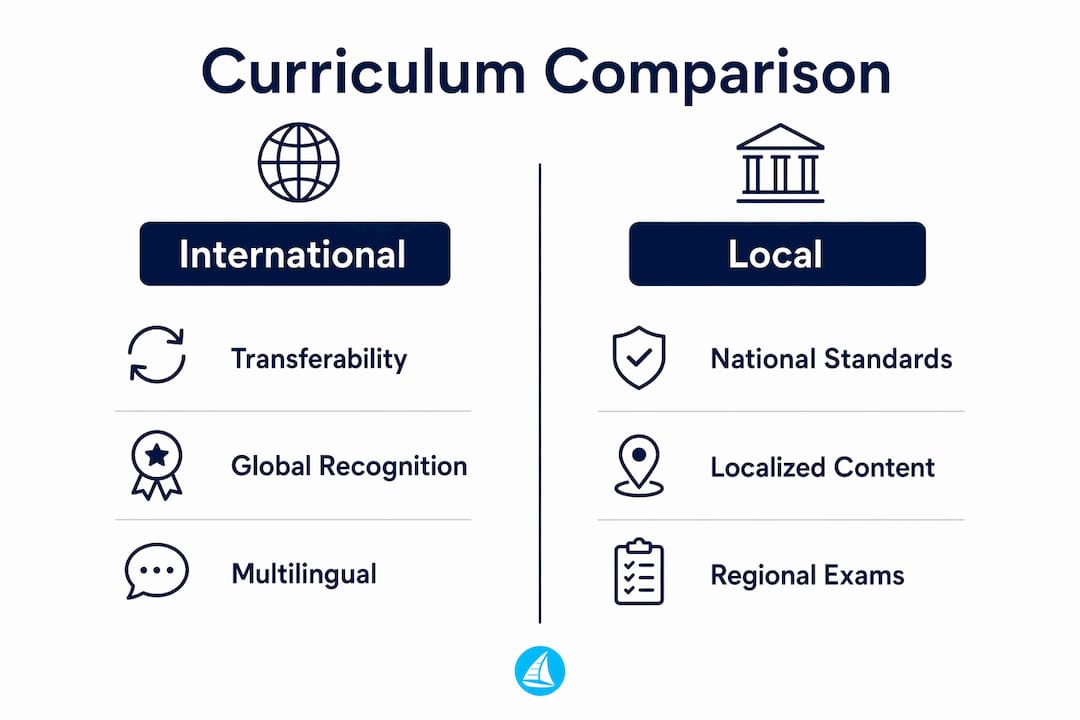
The clearest difference lies in transferability. A student completing Year 10 of the English National Curriculum in Singapore can move to a school in Dubai following the same framework with minimal disruption. A student mid-way through a country-specific national programme faces a far harder transition because that curriculum may not be recognised or structured equivalently elsewhere.
Pedagogy is a second major distinction. The CIS Council of International Schools defines curriculum as distinct from pedagogy, noting that effective schools align their curriculum with suitable teaching and assessment strategies to support both personal and academic development. Many local national systems prioritise content delivery and rote learning, while internationally recognised programmes tend to reward analysis, extended writing, and independent research.
Assessment style also separates the two. Local systems often rely on a single high-stakes national exam. International programmes, particularly the IB, spread assessment across coursework, practical work, and final exams, reducing the risk of one bad day defining a student’s results.
International schools increasingly integrate sustainability as an educational framework alongside traditional subjects to meet global demand. This reflects a broader shift in international education programmes towards preparing students for real-world challenges, not just university entrance requirements.
- Transferability. IB and British curricula allow smoother school transitions for mobile families than country-specific systems.
- Pedagogy. International programmes typically combine content knowledge with critical thinking and independent enquiry.
- Assessment breadth. Spreading assessment across coursework and exams reduces over-reliance on a single terminal test.
- Global issues. Sustainability, intercultural understanding, and global citizenship feature prominently in international curricula.
What are the benefits of an international school curriculum?
The most practical benefit is global university recognition. Universities in the United Kingdom, the United States, Canada, and Australia accept IB and A-level qualifications without conversion or equivalency checks. That removes a significant administrative barrier for families who are unsure where their child will eventually apply.
Beyond university access, international education programmes develop skills that local systems often undervalue. The IB’s Theory of Knowledge component, for example, teaches students to question how they know what they know. That kind of reflective thinking is genuinely useful in higher education and professional life, not just on an exam paper.
- University acceptance. IB and A-level qualifications are recognised by leading universities across multiple continents.
- Critical thinking. Inquiry-based programmes build analytical skills that transfer beyond the classroom.
- Intercultural understanding. Exposure to diverse student populations and global issues builds genuine international-mindedness.
- Sustainability literacy. International curricula embed environmental and social awareness into core subjects.
- Credential portability. Qualifications travel with the student, regardless of where the family relocates next.
Accreditation status is a stronger indicator of quality than marketing or facility investment. A school with a swimming pool and a glossy brochure is not automatically delivering a rigorous curriculum. Verified external recognition from bodies like CIS or NEASC is the reliable measure.
Pro Tip: Before enrolling, check whether the school holds current accreditation from CIS, Cambridge International Education, or an equivalent body. Accreditation is reviewed periodically, so confirm it is active, not historical.
How should parents and students choose the right curriculum?
The starting point is your family’s mobility plan. Families expecting to relocate every two to four years benefit most from globally portable qualifications. IB and British curricula offer easier transfer than country-specific systems, which may lack recognition in a new country. Choosing a curriculum that travels well avoids the disruption of a student having to repeat a year or sit equivalency exams after a move.
Some schools offer hybrid curriculum models that combine a national curriculum in early years with the IB Diploma Programme in the final two years. This approach can maximise university eligibility while giving younger students a structured, familiar learning environment. It is worth asking schools directly whether they offer this pathway and how the transition between stages is managed.
- Match curriculum to mobility. Frequent movers should prioritise IB or British pathways for smoother transitions.
- Check accreditation first. Not all schools named “international” meet quality standards; CIS and NEASC accreditation confirms genuine rigour.
- Evaluate pedagogy alongside curriculum. Ask how teachers deliver the curriculum, not just which framework the school follows.
- Consider university destinations. Research which qualifications your target universities accept before committing to a curriculum.
- Ask about hybrid models. A school combining national early-years teaching with the IB Diploma may offer the best of both structures.
For students pursuing the IB, understanding the IB core syllabus in detail helps families assess whether the programme suits their child’s learning style before enrolment. Language choices also matter: complementary language study, such as IB and IGCSE language courses, can strengthen a student’s overall profile for competitive university applications.
Key takeaways
The international school curriculum is defined by its accreditation, not its name: IB, British, and American pathways offer the strongest global portability, while accreditation from bodies like CIS confirms genuine quality.
| Point | Details |
|---|---|
| Four main curriculum types | English National Curriculum, IB, American Curriculum, and specialised national systems cover most international schools. |
| Accreditation over marketing | CIS and NEASC accreditation is a more reliable quality indicator than school facilities or branding. |
| Transferability matters most | IB and British curricula travel best for mobile families; country-specific systems may not be recognised abroad. |
| Pedagogy is separate from curriculum | A good curriculum delivered poorly still underserves students; assess teaching approach alongside the framework. |
| Hybrid models exist | Some schools combine national early-years programmes with the IB Diploma to maximise university options. |
Why the “international” label is the most misleading thing in education
I have spoken with enough expat families to know that the word “international” on a school gate creates an almost automatic assumption of quality. It does not. A school can call itself international, charge premium fees, and still deliver a curriculum that is neither accredited nor globally recognised. That gap between perception and reality is where families get hurt most.
The families who navigate this well share one habit: they ask for the accreditation certificate before they ask for the school tour. Accreditation from CIS or an equivalent body means an external team has reviewed the school’s curriculum, teaching, and governance against published standards. That is a fundamentally different level of assurance than a school’s own claims about its programme.
The other mistake I see regularly is treating curriculum choice as permanent. It is not. Hybrid models exist precisely because schools and families have learnt that flexibility serves students better than rigidity. A student who starts on a national curriculum and transitions to the IB Diploma at 16 can get the structure of early years and the global recognition of the Diploma. That combination is underused and underappreciated.
— Oliver
Tibertutor’s support for IB science students
Students who choose the IB pathway face some of the most demanding science assessments in international education. Tibertutor is built specifically for that challenge, offering exam-style questions, animated videos, detailed notes, and mock exams for IB Biology, Chemistry, and Physics, all created by experienced examiners.
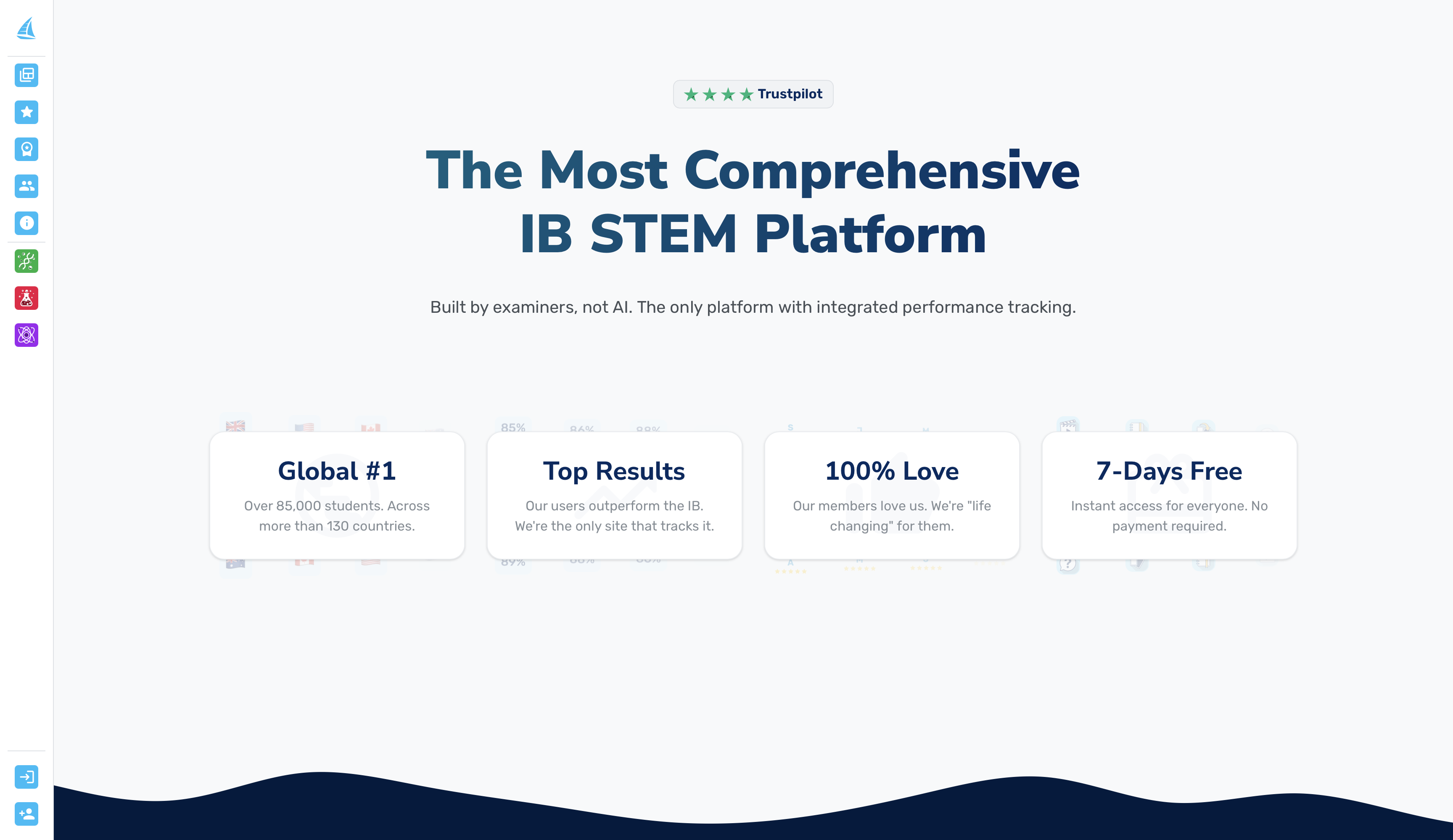
Whether your child is preparing for internal assessments or final exams, Tibertutor’s IB Biology topic tests and IB Chemistry exam tests give them structured, targeted practice that builds both knowledge and confidence. The platform’s progress tracking shows exactly where gaps exist, so revision time is spent where it counts most. For parents and students ready to take IB science preparation seriously, Tibertutor provides the depth and rigour the Diploma demands.
FAQ
What is the most widely used international school curriculum?
The English National Curriculum is followed by the largest share of international schools globally, with the IB Diploma Programme recognised as the most portable and widely accepted qualification for university entry across multiple countries.
Is the IB harder than A-levels?
The IB Diploma requires students to study six subjects simultaneously alongside core components, making it broader than A-levels. A-levels allow deeper specialisation in three or four subjects, so the difficulty depends on the student’s strengths and preferred learning style.
How do I know if an international school’s curriculum is genuinely accredited?
Check whether the school holds current accreditation from a recognised body such as CIS or NEASC. Accreditation is reviewed periodically, so confirm it is active and ask the school for documentation rather than relying on its website alone.
What is a hybrid curriculum model?
A hybrid model combines a national curriculum in early school years with the IB Diploma Programme in the final two years. This approach gives students a structured foundation and a globally recognised qualification for university applications.
Does the IB curriculum prepare students for science degrees?
The IB’s science subjects, particularly at Higher Level, include substantial internal assessments and final exams that develop both practical and theoretical skills. Students who use structured resources such as IB science internal assessments alongside their school programme are well prepared for university-level science.