IB Biology A1.2 Notes
This page contains our IB Biology notes for A1.2. By reading each one of these notes, you will fully cover the content for IB Biology 'Nucleic acids'.
Nucleotides
Organic molecules are typically divided into four types. The first of these you need to know about is nucleic acids, whose function is to code for proteins. Nucleic acids all have base units (monomers), called nucleotides. These have three main components:
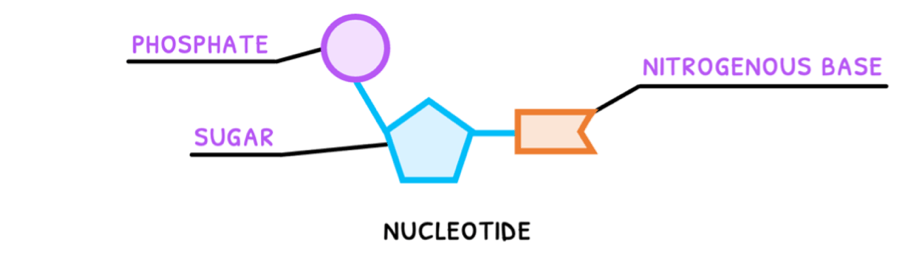
- Phosphate group - a PO43- group connected to the 5' carbon of the pentose sugar.
- Sugar ring - deoxy-D-ribose or D-ribose pentose ring connected to a nitrogenous base at the 1' carbon and a phosphate group at the 5' carbon.
- Nitrogenous base - one of adenine, thymine, cytosine, guanine, or uracil, connected to the 1' carbon of the pentose sugar.
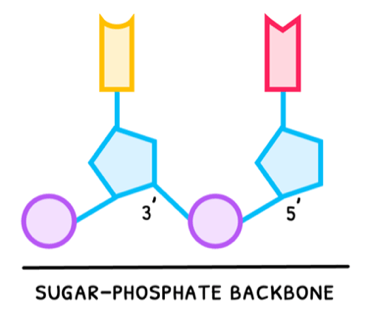
Nucleotides are subsequently connected together via condensation reactions, forming a connection between the 3' carbon of one nucleotide and the phosphate group of another nucleotide. Altogether this forms an alternating pattern of phosphates and sugars, called the sugar-phosphate backbone.
tibertutor.com
Next Up
You have completed the sub-topic A1.2 notes, covering "Nucleic acids" for IB Biology - continue with related resources below or explore the full IB Biology course from the IBO.
Other Sub-topic A1.2 resources